- 352 pages
- English
- ePUB (mobile friendly)
- Available on iOS & Android
eBook - ePub
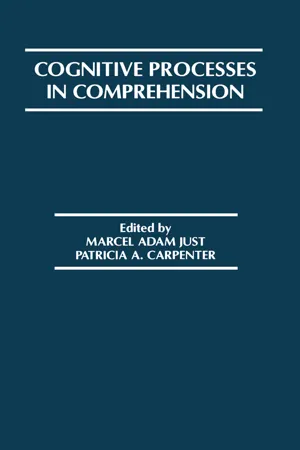
Cognitive Processes in Comprehension
About this book
First published in 1978. Cognitive Processes in Comprehension is a look at what goes on in the mind of the listener or reader when he hears a sentence during a conversation or reads a passage in a book. For most adults, comprehension is rapid, automatic, and effortless. But, despite its apparent simplicity, comprehension includes a myriad of subprocesses, each of which by itself constitutes a formidable computational task.
Trusted by 375,005 students
Access to over 1 million titles for a fair monthly price.
Study more efficiently using our study tools.
Information
Topic
PsicologíaSubtopic
Psicología cognitiva y cogniciónPart I
Knowledge Sources in Comprehension
1
Semantic Macro-Structures and Knowledge Frames in Discourse Comprehension
University of Amsterdam
Introduction
This paper outlines a theory of macro-structures within a larger framework of a model of cognitive information processing. We will focus on semantic structures and processes of discourse comprehension; in particular, we will formulate the macro-rules underlying the global interpretation of discourse. Although the focus is on discourse comprehension, the basic principles of macro-processing also are valid for other cognitive domains, such as vision, action, thinking, and problem solving.
The notion of macro-structure is introduced as a partial explication of such notions as ‘schema’ or ‘plan’ as they are currently used in cognitive psychology and artificial intelligence. Semantic macro-structures will be distinguished from other kinds of ‘schematic’ structures of discourse, such as narrative super-structures. Finally, we will elucidate the relationship between macro-structures and frames.
In linguistics, macro-structures have been postulated in order to account for the ‘global meaning’ of discourse such as it is intuitively assigned in terms of the ‘topic’ or ‘theme’ of a discourse or conversation. The assumption is that these notions cannot be accounted for in terms of current logical, linguistic, and cognitive semantics for isolated sentences or sequences of sentences. In disciplines such as rhetorics and narrative theory, macro-structures may constitute the semantic basis for specific categories and rules. For instance, the setting of a narrative should be defined at a macro-level of analysis and cannot be defined in terms of individual sentences (or their underlying propositions). Similarly, well-known categories such as ‘premise’ and ‘conclusion’ in an argument also operate on global structures of discourse. Besides defining the global coherence of discourse, macro-structures also contribute to ‘local’ coherence at the micro-level of connections between propositions in composite sentences and successive sentences.
In this paper, we will show that some fundamental problems of cognitive psychology can be accounted for in terms of macro-processing of complex semantic information. If a discourse is at all long, subjects are unable to process it at a micro-level alone: not only are they unable to store and retrieve such discourse verbatim, but they are also unable to retrieve the constituent propositions. At the same time, if the sequences of sentences can be assigned a macro-structure, they will be recalled much better than scrambled sequences. Thus, comprehension (as well as production) probably takes place at several levels, such that lower-level information is organized, reduced, and represented at higher levels. These processes involve the use of macro-rules; the input to the macro-rules is the micro-structure, and the output is the macro-structure. Macrostructures help to explain the ability to summarize discourse, and in general to use information from discourse for other cognitive tasks, even if the individual propositions of the discourse are no longer accessible. Similarly, macro-structures may provide further insight into the structure and use of frame-like representations of conventional knowledge in discourse comprehension and other cognitive tasks.
Semantic Structures of Discourse
We will deal primarily with semantic macro-structures, although other kinds of global structures (e.g., narrative and pragmatic ones) may also play a role in the global organization and comprehension of discourse. One possible way to make semantic structures explicit is to use a formal language, such that expressions of this language can be given a suitable interpretation in the formal semantics of that logical language.1 This formal semantics may be of the usual model-theoretical sort, (e.g., involving notions such as possible worlds). One of the difficulties with other kinds of representations (e.g., graphs) is that they do not yet have an associated formal semantics (cf. Woods, 1975).
Micro-structures and Coherence
Micro-structures, the sequence of propositions underlying the sequence of sentences of the discourse, constitute the input to the macro-rules. The micro-structures themselves require some preliminary semantic description. We will introduce the abstract concept of a text to refer to the abstract structure of a discourse. We can characterize the structures of texts at different levels of description.2 At one level of description, a text is simply an ordered sequence of propositions, which under various pragmatic, stylistic, and other constraints is mapped onto a sequence of sentences.
Propositions are construed in the usual way, namely, as n-place predicates followed by n arguments which may be bound by quantifiers. Propositions may be modalized by various kinds of operators (tense, knowledge, belief, obligation, etc.), and connectives may be used to make compound propositions. The semantics of the formal language representing propositions provides recursive truth (or satisfaction) conditions in a constructive way. That is, interpretations of larger units depend on the interpretation of smaller units. Predicates are interpreted as properties or relations and arguments as individuals. Modal operators are interpreted in terms of possible worlds; for example, It is necessary that p is true in a world wi iff p is true in all possible worlds which are accessible from wi. Sentences have as their referents the facts in possible worlds. Thus, the sentence Peter is ill refers to the fact that Peter is ill now, i.e., in the actual possible world at the moment of the utterance. However, unlike classical formal languages, natural language is intensional. That is, we want to assign not only extensional referents, but also meanings. In particular, the extensions of an expression are assigned on the basis of its intensional meaning. Such intensions are functions, taking possible worlds as arguments and extensions as values. Thus, the phrase the book has an intensional meaning, namely the individual concept of a book, which may take various extensions, i.e., actual books referred to, in particular situations. Both intensional and extensional interpretations are necessary in an account of the semantic structures of discourse.
A semantics of discourse is characterized by relative interpretations: sentences in a discourse sequence are not interpreted in an ‘absolute’ way, but relative to the interpretation of other, mostly previous, sentences of the discourse. Sequences satisfying the constraints of relative interpretation are called linearly coherent One major coherence constraint is connection. Two propositions are considered to be pairwise connected if the facts they denote are related. This relation can be made explicit in terms of possible, probable, or necessary conditions, components, or consequences. Connections between propositions are typically expressed by natural connectives such as and, because, yet, so, etc. (cf. van Dijk, 1977).
Sequences of propositions exhibit other coherence properties besides pairwise connections. For example, two expressions may both refer to the same facts, properties, or individuals. It should be noted, however, that in general these conditions are neither necessary nor sufficient for coherence. Discourse coherence is not primarily a matter of meaning, but of reference. Roughly speaking, the coherence of the discourse depends on the coherence of the possible-world fragment or course of events it represents. One of the conditions that makes a text uninterpretable is the impossibility of imagining situations where it could be satisfied. Of course, numerous formal and empirical details are omitted in this presentation. A further note of caution is that our theoretical abstractions and generalizations apply to an idealized discourse. Actual discourses that are produced, understood, and accepted do not always have a fully correct textual structure. Additional rules of pragmatics, cognitive strategies, and social conventions must account for the relevant conditions of acceptability of non-ideal discourses.
There is another constraint on linear coherence that is not referential, but rather intensional or conceptual; not only must denoted facts be related, but this relation must be relative to a topic of discourse. That is, the facts must originate in the same range of semantic space. Thus, John’s playing the piano may, as such, be independent from Mary’s knitting, but both actions lie in the same range, namely, human leisure activities. Thus, connection conditions can be established relative to other propositions, which may or may not be explicitly stated in the text. For example, a sequence may be coherent because each fact relates to the general theme. The notion of a theme or topic of a discourse or a conversation will be reconsidered in terms of macro-structures. This means that conditions for linear coherence may depend on conditions for global coherence.
Coherence is not only semantic, but may also be determined by pragmatic conditions. Clearly, connections between facts should be satisfied not only ‘objectively’, but also relative to language users and communicative contexts. Similarly, the connections must relate not only facts but also speech acts. Thus, one speech act may constitute a condition, component, or consequence of another speech act. The details of these various pragmatic conditions on coherence will be ignored here, as well as other principles of cooperative communication and interaction (cf. van Dijk, 1977).
A major pragmatic constraint on discourse is that it be informative; consequently, information that the hearer already knows need not be expressed and asserted. This knowledge may be contextual or general. Contextual knowledge pertains to properties of the communicative situation, such as the presence of certain objects. This allows for coherence based on the context, such as the use of indexical pronouns (I, you, this, that, yesterday, now, etc.). General knowledge includes lexical/semantic information pertaining to the meaning postulates of the language – for example, knowing that the word “bachelor” entails unmarriedness. Alternatively, the general knowledge may be conventional, involving shared knowledge about the ‘world’ (e.g., knowing that Mexico is warm). Conventional knowledge contains not only actual facts, but also ‘possible facts’ compatible with the actual world. The latter kind of conventional knowledge can be thought of as frames, which will be discussed in more detail later.
The propositions implied by the discourse need not be expressed. Some propositions may remain implicit, even though they are essential in the establishment of linear coherence in texts. For example, they may be ‘presuppositions’ of other propositions, or they may be necessary to allow the listener to draw certain inferences. If we call the sequence of propositions of a discourse the text base,3 we can distinguish between an implicit and an explicit text base. The explicit text base is the theoretical construct containing all the propositions necessary to give relative interpretations of each proposition of the sequence. The explicit text base may be mapped onto the implicit text base by deletion of known or inferrable propositions. It is the implicit text base which constitutes the input to the surface grammar. The distinction is not only important for cognitive reasons but also for grammatical reasons: the surface structure may contain ‘traces’ of the explicit propositions. One example of such a trace of the explicit text base is the use of pronouns without antecedents. Another is the use of definite articles without indefinitely introduced noun phrases. This is also the reason why an explicit text base may not be too rich and contain all implications of each proposition. Only those propositions are interpolated which are immediate conditions for the full interpretation of each expressed proposition.
Macro-structures
Beyond the linear semantic structure of discourse, we also postulate global levels of descriptions, namely macro...
Table of contents
- Cover
- Half Title
- Title Page
- Copyright Page
- Dedication
- Table of Contents
- Preface
- Part I: Knowledge Sources in Comprehension
- Part II: Psychological Mechanisms in Comprehension
- Part III: Modeling Language Comprehension
- Author Index
- Subject Index
Frequently asked questions
Yes, you can cancel anytime from the Subscription tab in your account settings on the Perlego website. Your subscription will stay active until the end of your current billing period. Learn how to cancel your subscription
No, books cannot be downloaded as external files, such as PDFs, for use outside of Perlego. However, you can download books within the Perlego app for offline reading on mobile or tablet. Learn how to download books offline
Perlego offers two plans: Essential and Complete
- Essential is ideal for learners and professionals who enjoy exploring a wide range of subjects. Access the Essential Library with 800,000+ trusted titles and best-sellers across business, personal growth, and the humanities. Includes unlimited reading time and Standard Read Aloud voice.
- Complete: Perfect for advanced learners and researchers needing full, unrestricted access. Unlock 1.4M+ books across hundreds of subjects, including academic and specialized titles. The Complete Plan also includes advanced features like Premium Read Aloud and Research Assistant.
We are an online textbook subscription service, where you can get access to an entire online library for less than the price of a single book per month. With over 1 million books across 990+ topics, we’ve got you covered! Learn about our mission
Look out for the read-aloud symbol on your next book to see if you can listen to it. The read-aloud tool reads text aloud for you, highlighting the text as it is being read. You can pause it, speed it up and slow it down. Learn more about Read Aloud
Yes! You can use the Perlego app on both iOS and Android devices to read anytime, anywhere — even offline. Perfect for commutes or when you’re on the go.
Please note we cannot support devices running on iOS 13 and Android 7 or earlier. Learn more about using the app
Please note we cannot support devices running on iOS 13 and Android 7 or earlier. Learn more about using the app
Yes, you can access Cognitive Processes in Comprehension by Marcel A. Just,Patricia A. Carpenter in PDF and/or ePUB format, as well as other popular books in Psicología & Psicología cognitiva y cognición. We have over one million books available in our catalogue for you to explore.