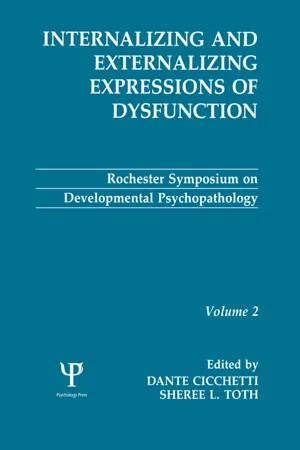
The contributors to this volume apply a developmental focus to their examination of one of the most widely agreed upon classifications of behavior disorders in child psychopathology -- internalizing and externalizing expressions of dysfunction. The research reported spans a wide range from infancy through young adulthood and from normalcy through severe psychopathology. These current investigations demonstrate that the implications of utilizing the developmental approach for the evolution of theory, research, and intervention are vast.
eBook - ePub
Internalizing and Externalizing Expressions of Dysfunction
Volume 2
- 320 pages
- English
- ePUB (mobile friendly)
- Available on iOS & Android
eBook - ePub
Internalizing and Externalizing Expressions of Dysfunction
Volume 2
About this book
Information
Publisher
Psychology PressYear
2014Print ISBN
9781138992603
9780805809336
Edition
1eBook ISBN
9781317782988
1 | A Developmental Perspective on Internalizing and Externalizing Disorders |
Mt. Hope Family Center University of Rochester
This volume, the second in the Rochester Symposium on Developmental Psychopathology series, applies an innovative and long overdue approach to a much studied area of psychopathology. The current authors impart a developmental focus to their examination of one of the most widely agreed upon classifications of behavior disorders in child psychopathology, internalizing and externalizing expressions of dysfunction. Although current classification systems have evolved greatly since E. James Anthony’s (1970) description of behavior disorders of childhood, the greatest consensus continues to emerge when exploring psychopathology on these two broad dimensions of dysfunction (Achenbach, 1982; Achenbach & Edelbrock, 1981; Hinshaw, 1987). In order to provide a context within which to conceptualize the contributions to the current volume, a brief historical review of the literature relevant to internalizing and externalizing expressions of dysfunction is presented.
It is generally agreed that externalizing disorders include hyperactivity and aggressive symptomatology, whereas internalizing disorders are marked by anxiety, depression, and somatic concerns (Achenbach & Edelbrock, 1978, 1981; Zigler & Glick, 1986). Although early classifications of behavior disorders were based primarily on clinical case reports, even these practitioner-based systems revealed an early agreement that behavior dysfunction may be evidenced in somatic concerns, in inhibited reactions, and in aggressive, active conduct disorders (Anthony, 1970). Similarly, classification systems developed for research purposes revealed two main constructs involving the contrast of anxious, inhibited, neurotic individuals with those exhibiting antisocial, aggressive, acting out symptomatology (Fish & Shapiro, 1964).
Perhaps the strongest historical support for two broad dimensions of behavior disorders was generated by empirical classification studies. Ackerson (1942), a pioneer in this area, undertook a study of the clinical records of 2,113 boys and 1,181 girls. He extracted a “personality” score, correlated with mental conflict, changeable moods, depression, an unhappy appearance, and odd behavior, and a “conduct” score, correlated with truancy, disobedience, destructiveness, cruelty, lying, swearing, stealing, and curfew violations (Ackerson, 1942). In a study of 500 child guidance clinic records, Hewitt and Jenkins (1946) established the presence of three clusters of traits, which they interpreted as representing over-inhibition, undersocialized aggression, and socialized delinquent behavior. Again, the presence of internalizing versus externalizing dysfunction is clear. In a review and integration of factor analytic classification studies, Achenbach (1966) also identified two broad dimensions relating to internalizing and externalizing disorders. Although this conceptualization has not been accepted without question (Wolff, 1971), the separation and validation of internalizing and externalizing problems with regard to issues such as age, gender, course, prognosis, and family interaction patterns has been well established (Achenbach & Edelbrock, 1978, 1981; Hetherington & Martin, 1979; Robins, 1979).
In order to comprehend the magnitude of internalizing and externalizing disorders, epidemiological estimates of these categories are necessary. Estimates of prevalence rates for behavior problems in children from 5–18 years of age vary between 7% and 20%, with the majority of studies revealing rates in the 15%-18% range (see, for example, Earls, 1981 and Gould, Wunsch-Hitzig, & Dohrenwend, 1981). Prevalence rates of behavior problems in preschool children typically mirror the findings with older children (Earls, 1980; Richman & Graham, 1971; Stevenson & Richman, 1978), with estimates in the 15%-20% range (see, for example, Costello & Benjamin, 1989, and Institute of Medicine, 1989). Thus, the scope and magnitude of these problems necessitate that developmental psychopathologists must begin to devote more research attention to these internalizing and externalizing expressions of dysfunction.
In turning from the classification and prevalence of internalizing and externalizing disorders to examining the effects of each on adaptation, it becomes apparent that these diagnostic conceptualizations have generated a great deal of research. Externalizing disorders have, however, yielded the largest body of research to date (Achenbach, 1985; Achenbach & Edelbrock, 1981; Robins, 1966; Sroufe & Rutter, 1984). This may stem, at least in part, from the controversy over the reliable identification and the long-term clinical significance of internalizing disorders in childhood. In fact, when assessing children the differential measurability of internalizing versus externalizing disorders becomes significant. Because the self-reports of children, especially as they relate to behavior problems, are often suspect, investigators have felt the need to incorporate parent and teacher report data into their diagnostic conceptualizations (Achenbach, McConaughy, & Howell, 1987; Edelbrock, Costello, Dulcan, Kalas, & Con-over, 1985; Loeber, Green, Lahey, & Stouthamer-Loeber, 1989). Not surprisingly, the assessment of an internal state such as depression through externally based reports is much more problematic than is the reliance on these sources for information on observable behavior problems (Links, Boyle, & Offord, 1988). Thus, until recently research on internalizing disorders has lagged behind that of investigations on externalizing disorders (Strauss, 1988).
With regard to externalizing disorders, Coie, Belding, and Underwood (1988) summarize their significance in a review of research on aggression and peer rejection. Research compellingly demonstrates that aggression is the major reason for peer rejection (Coie, Belding, & Underwood, 1988). In view of the significant relationships that have been found between peer rejection and the emergence of future psychiatric disorders (Cowen, Pederson, Babigian, Izzo, & Trost, 1973; Kohlberg, LaCrosse, & Ricks, 1972; Parker & Asher, 1987), the implications of the role of aggression in peer rejection are far ranging (cf. Robins, 1966). Of note to the developmental perspective are findings that reveal that the magnitude of this correlation varies with age, with more moderate relations occurring in preschool-aged children (for a review, see Coie et al., 1988).
In exploring the sequelae of internalizing disorders, similar clinical significance has emerged. To date, research has confirmed that withdrawn children also evidence peer deficits (Rubin, 1985; Rubin & Lollis, 1988; Rubin & Mills, 1988; Strauss, 1988), which may well adversely affect future adaptation (Cicchetti, Lynch, Shonk, & Todd Manly, in press). In fact, Cicchetti and Schneider-Rosen (1986) discuss the possible linkages among deficient social skills, heightened anxiety, and subsequent major depressive and anxiety disorders. Though this progression has not yet been as clearly verified empirically as has the aftermath of externalizing disorders, confirmatory evidence is emerging (Rubin & Hymel, 1986; Sacco & Graves, 1984).
Clearly, then, the investigation of the developmental course and sequelae of internalizing and externalizing disorders merits our continued attention. In culling out those areas that have generated research interest, several issues emerge. Specifically, researchers have directed their primary energies toward assessing the continuity of these problems, broad versus narrow band classifications, co-morbidity, and biological processes. Each of these are addressed in turn.
Although childhood difficulties are often viewed as transient and thus of minimal concern, mounting evidence has called this into question (Institute of Medicine, 1989). In fact, externalizing behaviors in particular have been demonstrated to be quite stable over time (Loeber, 1982; Robins, 1966, 1978; Rutter & Giller, 1983). This is especially true with respect to children age 6 and above (Links, 1983; Robins, 1979). Huesmann, Lefkowitz, Eron, and Walder (1984) provided a compelling example of this continuity. These investigators followed a sample of 8-year-old boys and found that, 22 years later, childhood aggression was positively correlated with adult aggression. These findings are consistent with other longitudinal studies that have supported the relationship between childhood conduct problems and future emotional instability and delinquency (Olweus, 1979; Robins, 1966).
Because early onset disorders may, in fact, be indicative of a more serious course of illness (Kovacs, Feinberg, Crouse-Novak, Paulauskas, & Finkelstein, 1984), ascertaining the continuity of dysfunction in young children also has become an especially important issue to researchers in this field. Campbell and her colleagues (Campbell, this volume; Campbell, Breaux, Ewing, & Szumowski, 1984, 1986) have explored the persistence of problems in children as young as age 3 and found evidence of continuity over a 3-year period. Similar patterns of stability in preschoolers have been identified across settings and with teacher as well as parent report measures (Coleman, Wolkind, & Ashley, 1977; Kohn, 1977; Kohn & Rossman, 1972; Minde & Minde, 1977, Rose, Rose, & Feldman, 1989). Age of onset also is significant in view of studies that have attempted to identify factors that contribute to stability. In examining the stability of antisocial and delinquent behavior, Loeber (1982) concluded that the greatest stability was evidenced in children who exhibited very high rates of antisocial behavior early in life, who did so across environmental settings, who engaged in a range of antisocial behaviors, and who began their involvement in delinquent activities at an early age.
Of note when assessing stability of dysfunction is the caution that developmentalists have added regarding the importance of assessing continuity in the developmental process, and not simply looking for phenotypic continuity (Loeber, 1982; Sroufe & Rutter, 1984). Whereas a developmental perspective posits a coherence in development that is followed by normal as well as atypical populations (Cicchetti, 1984, 1990a,b; Cicchetti & Sroufe, 1978), this viewpoint must not be taken to reflect a dictum of symptomatic stability over time (Sroufe & Rutter, 1984). Rather, it proposes that continuity is manifest in lawful relations, and not in isomorphic behavior. This distinction is critical in investigations of the continuity of behavior disorders, as an assessment of only symptomatic isomorphism is antithetical to a developmental approach and also may greatly underestimate the actual rates of continuity of dysfunction.
With the exception of the work of Loeber (1982), studies addressing the continuity of externalizing disorders have largely failed to identify specific factors that account for the observed stability or instability. In an exploration of this issue, Pianta and Caldwell (1990) assessed a normative sample of 325 kindergarten entry children and followed them through first grade. At baseline, approximately 20% of the normative sample exhibited moderate externalizing problems. The study revealed considerable stability in externalizing behaviors for both boys and girls over a 2-year period. Concurrent learning problems were found to be associated with higher than expected continuity of dysfunction. Conversely, factors such as cognitive ability, maternal education, child frustration tolerance, task orientation, and social skills were found to be associated with lower than predicted continuity of externalizing disorders.
In a similar exploration of the stability of internalizing disorders from kindergarten through first grade, Pianta and Castaldi (1989) found that approximately 17% of their sample evidenced internalizing symptomatology. Over a 2-year period, low to moderate continuity of dysfunction was revealed. Whereas Edelbrock and Achenbach (1985) found persistence of internalizing symptomatology over a short period of time in a clinic-referred sample of children, Pianta’s normative sample was most likely less dysfunctional due to its nonclinic status. Thus, this may have contributed to the lower rates of stability of dysfunction. Pianta and Castaldi (1989) found that the stability/instability of internalizing disorders were related to markers of previous adaptation. For example, higher IQ scores and positive affect between mother and child were related to decreases in internalizing symptomatology, whereas child dependency, levels of conduct and attentional problems, and peer difficulties were related to increases in internalizing symptomatology. These findings are consistent with factors typically discussed in the literature on the role of risk and protective factors in the development of psychopathology (Garmezy, 1984; Rolf, Masten, Cicchetti, Nuechterlein, & Weintraub, 1990). Although Pianta’s work has revealed lower levels of stability of internalizing than of externalizing disorders, the work of Rubin and his colleagues (Rubin et al., this volume) is generating support for continuity in maladaptation of internalizing disorders as well.
In assessing the stability of these dimensions of behavior, one naturally begins to question exactly what aspects of adaptation are being addressed; that is, is continuity of maladaptation only apparent when exploring a broad-band syndrome (e.g., internalizing) or are more finite diagnostic categorizations (e.g., depression) also continuous over time? Currently, considerable controversy exists over whether various symptom constellations constitute a single global internalizing or externalizing disorder, or whether more specific delineation within these broad categories is possible (Boyle & Jones, 1985; Hinshaw, 1987; Quay & LaGreca, 1986; Rutter, 1983). Although this concern affects subcategorizations within the dimension of internalizing disorders such as depression (Cantwell, 1982; Puig-Antich, 1982), it is perhaps most clearly evident in the attempt to distinguish conduct disorders from attention deficit disorders. As a diagnosis, conduct disorder has fulfilled several significant requirements of a classification system (Taylor, 1988). However, due to the heterogeneity of this category it continues to cause misgivings and leads many authorities to reject the specificity of the diagnosis (Jacobvitz, Sroufe, Stewart, & Leffert, 1990; Sroufe & Stewart, 1973; Taylor, 1988). In fact, in a comprehensive review of this literature, Hinshaw (1987) concluded that in applying strict, medical criteria, the domains of hyperactivity/attention deficit disorder and aggression/conduct disorders do not constitute valid syndromes, as studies do not reveal a clearly differentiated pattern of biological and/or etiological precursors (cf. Sroufe & Stewart, 1973, for a similar conclusion). However, Hinshaw (1987) does state that sufficient evidence exists to consider these categorizations as partially independent and as potentially useful.
An issue that is related to the separateness of narrow-band syndromes within the broader internalizing/externalizing conceptualization pertains to the comorbidity of disorders. Because these broad-band dimensions are sometimes correlated, children may present with a symptom picture comprised of both features (Rutter, Tizard, & Whitmore, 1970). It is this co-occurrence of disorders that has generated increased research in recent years. Rather than assuming that correlations between disorders reflect two distinct disturbances (e.g., attention deficit and conduct disorder), it may be that the comorbidity of disorders reflects a separate diagnostic entity that warrants further consideration. To date, studies have generally revealed moderate to high levels of comorbidity between internalizing and externalizing disorders (Achenbach & Edelbrock, 1983; Rose et al., 1989). According to Achenbach and Edelbrock (1983), the positive correlations between internalizing and externalizing disorders may be reflective of a general problem factor similar to the “g” posited to underlie general intelligence. The fact that not all studies are confirming the comorbidity between internalizing and externalizing disorders (see, for example, Pianta & Caldwell, 1990) emphasizes the importance of continuing research efforts in this area. According to Pianta and Caldwell, discrepancies between their data and prior studies may be attributed to the low-versus high-risk status of the samples. However, because comorbidity also may be related to factors such as age of onset and severity of dysfunction (Garber et al., this volume), an indepth understanding of the cooccurrence of these disorders also will possess important implications for the provision of effective intervention for these children. Additionally, depending on other risk factors that may be present, preventive interventions also could be...
Table of contents
- Cover
- Title Page
- Copyright Page
- Dedication
- Table of Contents
- 1. A Developmental Perspective on Internalizing and Externalizing Disorders
- 2. Emotional Regulation, Self-Control, and Psychopathology: The Role of Relationships in Early Childhood
- 3. Longitudinal Studies of Active and Aggressive Preschoolers: Individual Differences in Early Behavior and in Outcome
- 4. Conceptualizing Different Developmental Pathways To and From Social Isolation in Childhood
- 5. Cerebral Asymmetry and Affective Disorders: A Developmental Perspective
- 6. Quantitative Genetics and Developmental Psychopathology
- 7. Emotional Socialization: Its Role in Personality and Developmental Psychopathology
- 8. Aggression and Depression in Children: Comorbidity, Specificity, and Social Cognitive Processing
- 9. What Can Primate Models of Human Developmental Psychopathology Model?
- Author Index
- Subject Index
Trusted by 375,005 students
Access to over 1.5 million titles for a fair monthly price.
Study more efficiently using our study tools.
Frequently asked questions
Yes, you can cancel anytime from the Subscription tab in your account settings on the Perlego website. Your subscription will stay active until the end of your current billing period. Learn how to cancel your subscription
No, books cannot be downloaded as external files, such as PDFs, for use outside of Perlego. However, you can download books within the Perlego app for offline reading on mobile or tablet. Learn how to download books offline
Perlego offers two plans: Essential and Complete
- Essential is ideal for learners and professionals who enjoy exploring a wide range of subjects. Access the Essential Library with 800,000+ trusted titles and best-sellers across business, personal growth, and the humanities. Includes unlimited reading time and Standard Read Aloud voice.
- Complete: Perfect for advanced learners and researchers needing full, unrestricted access. Unlock 1.5M+ books across hundreds of subjects, including academic and specialized titles. The Complete Plan also includes advanced features like Premium Read Aloud and Research Assistant.
We are an online textbook subscription service, where you can get access to an entire online library for less than the price of a single book per month. With over 1.5 million books across 990+ topics, we’ve got you covered! Learn about our mission
Look out for the read-aloud symbol on your next book to see if you can listen to it. The read-aloud tool reads text aloud for you, highlighting the text as it is being read. You can pause it, speed it up and slow it down. Learn more about Read Aloud
Yes! You can use the Perlego app on both iOS and Android devices to read anytime, anywhere — even offline. Perfect for commutes or when you’re on the go.
Please note we cannot support devices running on iOS 13 and Android 7 or earlier. Learn more about using the app
Please note we cannot support devices running on iOS 13 and Android 7 or earlier. Learn more about using the app
Yes, you can access Internalizing and Externalizing Expressions of Dysfunction by Dante Cicchetti, Sheree L. Toth, Dante Cicchetti,Sheree L. Toth in PDF and/or ePUB format, as well as other popular books in Psychology & Developmental Psychology. We have over 1.5 million books available in our catalogue for you to explore.