- 229 pages
- English
- ePUB (mobile friendly)
- Available on iOS & Android
eBook - ePub
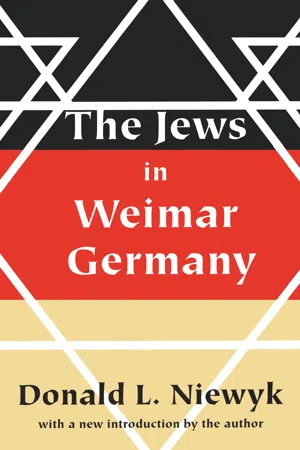
Jews in Weimar Germany
About this book
The first comprehensive history of the German Jews on the eve of Hitler's seizure of power, this book examines both their internal debates and their relations with larger German society. It shows that, far from being united, German Jewry was deeply divided along religious, political, and ideological fault lines. Above all, the liberal majority of patriotic and assimilationist Jews was forced to sharpen its self-definition by the onslaught of Zionist zealots who denied the "Germanness" of the Jews. This struggle for the heart and soul of German Jewry was fought at every level, affecting families, synagogues, and community institutions.Although the Jewish role in Germany's economy and culture was exaggerated, they were certainly prominent in many fields, giving rise to charges of privilege and domination. This volume probes the texture of German anti-Semitism, distinguishing between traditional and radical Judeophobia and reaching conclusions that will give no comfort to those who assume that Germans were predisposed to become "willing executioners" under Hitler. It also assesses the quality of Jewish responses to racist attacks. The self-defense campaigns of the Central Association of German Citizens of the Jewish Faith included publishing counter-propaganda, supporting sympathetic political parties, and taking anti-Semitic demagogues to court. Although these measures could only slow the rise of Nazism after 1930, they demonstrate that German Jewry was anything but passive in its responses to the fascist challenge.The German Jews' faith in liberalism is sometimes attributed to self-delusion and wishful thinking. This volume argues that, in fact, German Jewry pursued a clear-sighted perception of Jewish self-interest, apprehended the dangers confronting it, and found allies in socialist and democratic elements that constituted the "other Germany." Sadly, this profound and genuine commitment to liberalism left the German Jews increasingly isolated as the majority of Germans turned to political radicalism in the last years of the Republic. This full-scale history of Weimar Jewry will be of interest to professors, students, and general readers interested in the Holocaust and Jewish History.
Information
IX Conclusion
It was inevitable that the Nazi catastrophe would cast a lasting pall over efforts to make sense out of the Jewish experience in Weimar Germany. The sheer enormity of what followed the collapse of Weimar institutions challenges the credibility of Jewish faith in assimilationism. Did the Jews not see disaster coming? Why did they not save themselves while there was still time?
At the outset of this survey it was noted that the persistent liberalism of German Jews might be interpreted in one of three ways: as self-deception, as compulsion born of a lack of alternatives, or as a clear-eyed choice. The first of these has been popular among those who approach the problem from the standpoint of the historian of mass psychology. For them (but by no means exclusively for them) it is frequently compelling to regard nazism as the logical culmination of German history, and Hitlerite anti-Semitism as a natural product of all previous anti-Jewish agitation. From that premise it is but a small step to the conclusion that realism on the part of the Jews would have led them to Zionism, or else to some other alternative to hopeful-minded assimilationism.
This is the approach adopted by Sydney Bolkosky in his recent study of the Jew’s perceptions of their fellow Germans in the Weimar years. Although he abjures condemnatory judgments, Bolkosky nonetheless depicts German Jewish liberal assimilationism as a monumental case of self-delusion. A neurotic passion for acceptance caused the Jews to believe “that Germany and most Germans were characterized by the values of the Enlightenment: tolerance, reason, cosmopolitanism combined with nationalism, understanding, and liberal humanism.” Their willingness to see only Herders and Lessings among their fellow Germans blinded them to the presence in far greater numbers of Stöckers and Hitlers. It also prompted them to assume that the Weimar Republic was deeply rooted in pre-World War I German tradition rather than that it represented a break with historical continuity. By projecting their own liberal image on the rest of German society, “German Jews ignored the dangerous growth of antisemitism among more than just uneducated Germans and the existence of a large part of Germany that was anti-Enlightenment, racist, and irrational.”1
No one will deny the allegiance of most German Jews to the liberal values of the Enlightenment. It has been the central thesis of this study that historical, economic, and political circumstances had cemented the most intimate union between liberalism and the Jews. However, the contention that this union existed at the expense of repressing consciousness of the antiliberalism and anti-Semitism that existed among Germans as a whole cannot be squared with the facts. Jewish awareness of the need to counteract Judeophobia was authenticated by the self-defense and anti-Nazi activities of the Centralverein. These by far exceeded the bootless apologetics described by Bolkosky, who, on this point, echoes Hannah Arendt.2 The energies of the Centralverein were not restricted...
Table of contents
- Cover Page
- Half title
- Title Page
- Copyright Page
- Dedication
- Introduction to the New Edition
- preface
- I Introduction
- II The Role of the Jews in the Economic, Potitical, and Cultural Life of Weimar Germany
- III Anti-Semitism
- IV The Jewish Response to Anti-Semitism
- V The Jew as German Liberal
- VI The Jew as Jewish Nationalist
- VII The Jew as German Chauvinist
- VIII The Divisive Landscape of German Jewry
- IX Conclusion
Trusted by 375,005 students
Access to over 1.5 million titles for a fair monthly price.
Study more efficiently using our study tools.
Frequently asked questions
Yes, you can cancel anytime from the Subscription tab in your account settings on the Perlego website. Your subscription will stay active until the end of your current billing period. Learn how to cancel your subscription
No, books cannot be downloaded as external files, such as PDFs, for use outside of Perlego. However, you can download books within the Perlego app for offline reading on mobile or tablet. Learn how to download books offline
We are an online textbook subscription service, where you can get access to an entire online library for less than the price of a single book per month. With over 1.5 million books across 990+ topics, we’ve got you covered! Learn about our mission
Look out for the read-aloud symbol on your next book to see if you can listen to it. The read-aloud tool reads text aloud for you, highlighting the text as it is being read. You can pause it, speed it up and slow it down. Learn more about Read Aloud
Yes! You can use the Perlego app on both iOS and Android devices to read anytime, anywhere — even offline. Perfect for commutes or when you’re on the go.
Please note we cannot support devices running on iOS 13 and Android 7 or earlier. Learn more about using the app
Please note we cannot support devices running on iOS 13 and Android 7 or earlier. Learn more about using the app
Yes, you can access Jews in Weimar Germany by Donald L. Niewyk in PDF and/or ePUB format, as well as other popular books in Storia & Storia del XX secolo. We have over 1.5 million books available in our catalogue for you to explore.