![]()
——— Chapter One ———
On Being an Adventure Photographer
The Why
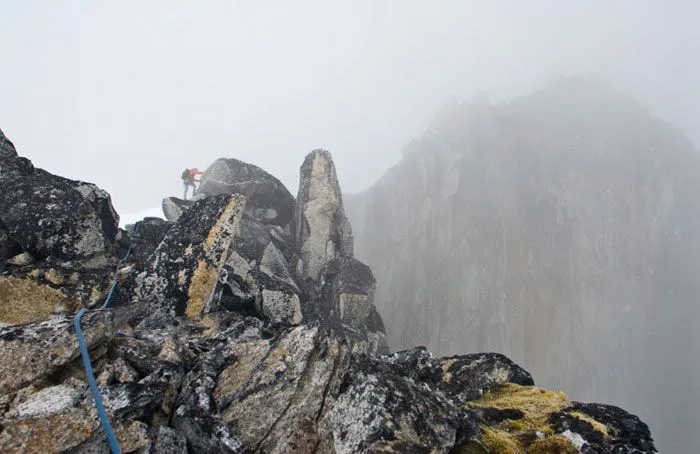
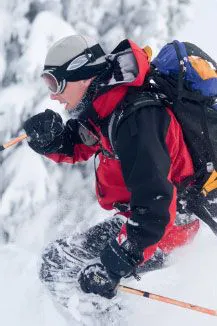
Imagine yourself pulling over a tiny lip in the middle of a thousand vertical feet of granite, or skirting along a knife-edge ridge as you look down upon a remote valley full of broad, broken glaciers and majestic high peaks. Riding your boards through waist-deep powder, pedaling your bike through a stand of yellow aspens on a crisp fall day, or waiting for your friends just downstream of the Class V rapids. It doesn’t matter, as long as you’re outside.
Your backpack isn’t as light as it could be; it rarely is. Your ultramodern outdoor gear doesn’t weigh very much, but all that metal and glass definitely pulls on the shoulder straps. You’re OK with it though, because you simply cannot imagine heading off on an adventure without your camera.
Just then a band of pink clouds forms at the horizon, causing your adrenaline to rise. Spotting an ideal vantage point, you break off from your companions and head for a tiny ledge that offers the best view. Your heart beats faster as you survey the scene in front of you. Your creative mind goes into overdrive and you’re already thinking about how cool these shots are going to look on the screen when you get home.
After swapping out lenses with well-practiced efficiency, you verify your camera settings. You check them again, because you know that once the action starts to unfold, you won’t have time to fiddle with dials and menus. You won’t even have time to think. At that point, you’ll have to be on autopilot, because you may only have one chance to capture a fleeting moment that will likely go by in the blink of an eye.
You’ve been waiting all day for this moment. Maybe all week. Perhaps even all year. This could be a once-in-a-lifetime commercial assignment on the other side of the world that required you to research remote locations, travel thousands of miles, hump loads of heavy gear, and work around coordinating schedules with professional athletes. Or maybe you’re just hiking or riding through the wilderness in your own backyard with a friend and creating memorable experiences, not just as a photographer, but also as a participant in the adventure as well. Even if you didn’t have your camera with you, this is exactly where you’d want to be.
A few seconds later, the sky opens up and delivers golden rays of afternoon sunlight that splash onto the scene with intense color and drama. You look towards your models and yell “GO!” Then you take a deep breath and you bring the camera up to your eye …
Are you ready for the action that’s about to explode in front of your lens? I mean REALLY ready? You’d better be, because there is no second chance in this game. When the light fades and your model drops that line, your moment is gone. You’ll either nail it or you won’t. Simple as that.
True love, fierce challenges, and endless rewards
Adventure and action photography is not just a job, it’s a way of life, where the lines are blurred between vocation and vacation; where trips can potentially become tax write-offs; and where nearly every aspect of your life revolves around your photography. It can take you to the most magnificent places in the world, and it can become a vehicle that lets you do things that others only dream about.
This is true even if you’re not a full-time pro. Adventure bloggers and camera-toting outdoor enthusiasts take note: even if you have a day job, I’ll wager that you possess the same passion for your craft. When you’re not out shooting, you live a life that revolves around your love of photography. You’re constantly working to improve your skills. Your main expenditures in life usually break down into gear and trips, trips and gear; and you work hard to stay in shape, because keeping up with pro athletes and your hardcore friends while lugging a pack full of heavy camera gear is no easy task.
Cameras were practically made for adventure. Ever since Frank Hurley first dragged a full-sized 8 x10 view camera all the way to Antarctica in 1911, cameras have accompanied explorers to nearly every corner of the globe. Of course, Frank shot his photos on glass plates, and it took years for anyone to see his imagery from the trip. Today, we document our adventures and send images around the world in almost real time.
Few styles of shooting bust your photography chops like adventure and action photography. Consequently, this kind of shooting makes you a better photographer. Imagine trying to grab a shot while trying not to be plowed over by a mountain biker who’s blasting down a rocky hillside at 30 miles per hour. You have to be on top of your game, because you might only have one chance to get it right. This kind of shooting requires skill, focus, and confidence, because in a span of split seconds you can do one of three things: miss the shot, get the shot, or actually nail the shot. Which one would you rather do?
Outdoor adventure photography requires you to effectively gauge your scene and pull together all of the elements that will make for a breathtaking shot, oftentimes in the harshest light you can imagine, all while being immersed within the scene yourself. It requires you to think quickly and see geometrically, because the world doesn’t stop and wait for you. It doesn’t even slow down. In fact sometimes it feels like it’s speeding up!
For the pro, shooting adventure sports and high-action subjects brings both income and recognition. The potential client base for adventure imagery goes well beyond just magazines and outdoor companies; nearly every type of client uses this kind of imagery in their projects at some point. To step up into this realm, your imagery has to be top notch, because competition is fierce in this industry.
This type of photography can also open up many doors in today’s media-driven world, especially for the emerging or aspiring pro. Create jaw-dropping imagery and you’re more likely to get more followers, which can contribute to revenue by way of workshops, blogging, writing, and self-publishing. High visibility can also lead to opportunities for taking your career to the next level, as well as the chance to work with camera manufacturers and other companies in the photography industry.
However, not everyone aspires to make money with their camera, so let’s explore the other side of The Why. Professional shooting aside, we all share a similar passion for photography, whether we do it for a living or not. We’re all driven by the image and immersing ourselves in the scene; wrangling with bold light and experimenting with new techniques and equipment is what pushes our creativity.
As artists, we strive to say something, to communicate our vision, to share the experiences that move us, shape us, and bring us to the edges of our world. And, of course, we hope to come out the other side with imagery that whacks our viewers on the side of the head and transports them to a whole new place. That’s why we do this.
How to
This practical reference manual is written especially for aspiring and emerging photographers, as well as pro and semi-pro shooters who want to master their craft and take their game to the next level. The techniques and insight I present in this book were pulled directly from nearly 18 years working as a full-time pro and teaching other photographers. From selecting the right equipment to refining your eye and technique, I’ll show you how to capture motion, emotion, and moments that convey the true sense of adventure for whatever sport you like to shoot.
I’ve included a wide variety of subject matter and equipment, partly because it reflects the diversity of what I shoot, but also because I recognize that everyone has a unique style of dealing with their gear, working within their scene, directing their models, and yes, living the outdoor life. What works for one person may be totally impractical for another. As far as you’re concerned, so long as you possess the technical skills and creative methods that allow you to get the shots you want, there is no right way; there is only your way. Ultimately, it doesn’t matter if you’re a top pro on assignment in a remote location or an enthusiast shooting on your local trails, once you put that camera up to your eye, it feels the same for everyone.
In addition to the technical and creative chapters, I’ve included a section on going pro. In it, I detail approaches and ideas that can help you turn your passion into a business, and I profile a handful of other adventure photographers who have each found their own success in this fiercely competitive field. It’s true that this is a tough industry. The very same thing could have been said when I first started, but I got my foot in the door. There is always room for new talent, and if you work hard and shoot great imagery there’s no reason that you can’t get yours in as well.
Let’s get started!
![]()
——— Chapter Two ———
The Gear
Adventure photography equipment
Let’s consider the early adventure photographers. In 1924, mountain photographer Captain John Noel hauled 14 cameras to the base of Mt. Everest to document a British climbing expedition. His kit included a 40 lb. cinematograph, a glass-plate camera, a number of small Kodak Vest Pocket cameras, and all the necessary equipment to set up a darkroom at basecamp. His “film” would have been emulsion-coated glass plates that were probably packed into wooden crates for the long journey, and he would, no doubt, have required numerous Sherpas to carry all of his gear.
Fast forward to the late sixties, when a young rock climber named Galen Rowell, who many consider to be the father of modern-day adventure photography, started documenting the vertical world of Yosemite with manual Nikon cameras. He had no idea how his pictures would turn out until he returned from his outings and sent his film off to the nearest Kodachrome lab. Although Galen’s 35 mm film canisters were certainly less cumbersome than Captain Noel’s glass plates, he had his own challenges, like making sure not to drop any off the sides of 3,000-foot-high granite walls like El Capitan and Half Dome.
What about all those nineties ski photographers like the late Carl Skoog who changed countless rolls of film without gloves in the cold on deep powder slopes? Forget about frozen hands; drop a roll in the snow and it’s gone forever.
Having started shooting back in the days of film myself, I can’t ever imagine going back. Early photographers aside, compared to the gear that was available even just a decade ago, we’ve got it pretty darn easy.
Today, photographers can choose from a wide selection of highly advanced and easily portable camera systems that allow us to go lighter and faster through the world than ever before. And instead of waiting until after a long trip is over to see what we shot, we can view and share our images in real time, which gives us the opportunity to learn, correct, and compensate right there on the spot.
Each year, camera manufacturers give us quicker autofocus, faster frame rates, and smaller cameras that produce even higher resolution than the generation before. It almost seems as if all of the advances in modern photography gear are designed with sports and action photographers in mind. Lucky us!
Given all the tools that we have at our disposal these days, there’s almost no excuse for you not to be a great adventure photographer. Keep in mind, though, that gear isn’t everything. Without comprehensive technical know-how and a strong creative style, a kit full of expensive, high-tech gizmos won’t get the job done. However, it makes our job much easier, and for that we can be thankful, even if it does make us a little bit softer than the legends who came before us.
Pro gear vs. amateur gear
In a large sense, photography is a money game. The more you spend, the better your images can be. Please take note, I said “can,” and not “will,” because gear alone doesn’t make the image. More on that later.
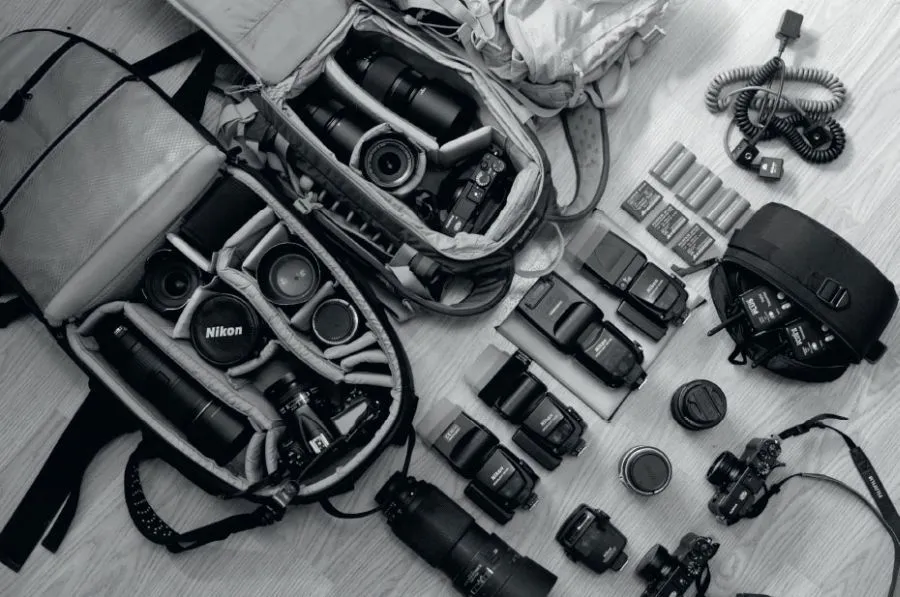
High-end camera gear offers superior optics, unmatched image resolution, tonal range and color rendition, better low-light sensitivity, and increased frame rates. Pro gear takes much more of a beating than amateur-class gear. Like anything else in life, you get what you pay for. If you want to create the best imagery, and if you want your cameras to withstand the rigors of being dragged through the outdoors year after year, then you’ll probably want to shell out decent money for high-quality gear.
That said, nearly every single piece of modern photo equipment you’ll find on shelves today will produce acceptable quality imagery. Especially when you consider that most images in today’s marketplace are viewed on the web at 1/4 screen or smaller. Even if it’s destined for full-screen on a high-resolution display, an image shot on a 3-megapixel camera is more than adequate.
In theory, unless you’re printing larger than 8 × 10, you really don’t need image file sizes larger than 6 megapixels. However, most digital cameras today (even point and shoots) fall somewhere in the 16–24MP range, which is what you should aim for.
From an image-quality standpoint, most amateur gear is often good enough for pro work. I’ve sold a number of photos from my $600 compact camera, and many of today’s modern journalists and bloggers rely on gear that wouldn’t be considered “pro quality” by any stretch of the imagination. These days, high-end clients are even starting to use iPhone photos in their projects. Bottom line, if an...