This special issue of Military Psychology reports behavioral, pharmacological, and toxicological science research on military performance as it is affected by chemical warfare agents (CWAs) and their pharmacological countermeasures. The papers in this issue are a diverse assembly; some very pharmacological in orientation, others driven by behavioral neuroscience. The unifying theme is the psychological consequences or organic syndromes that may be confused with consequences resulting from exposure to CWAs or use of their medical countermeasures.
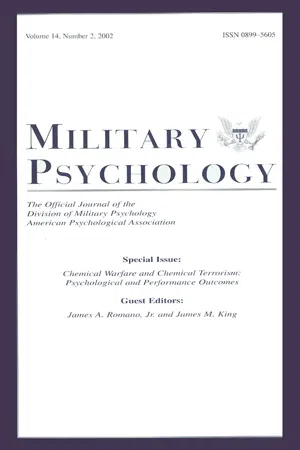
eBook - ePub
Chemical Warfare and Chemical Terrorism
Psychological and Performance Outcomes:a Special Issue of military Psychology
- 98 pages
- English
- ePUB (mobile friendly)
- Available on iOS & Android
eBook - ePub
Chemical Warfare and Chemical Terrorism
Psychological and Performance Outcomes:a Special Issue of military Psychology
About this book
Information
Performance Impacts of Nerve Agents and Their Pharmacological Countermeasures
Applied Pharmacology Branch
U.S. Army Medical Research Institute of Chemical Defense
Aberdeen Proving Ground, Maryland
Nerve agents are some of the most toxic compounds known to man and, as suggested by their name, have pronounced effects on central and peripheral nervous system function. In addition, several of the drugs used as pharmacological countermeasures to reverse the potentially life-threatening physiological effects of nerve agents themselves have potent effects on a variety of neurobehavioral functions. This article reviews the toxicological and neurobehavioral effects of exposure to nerve agents and their medical treatment compounds, giving particular emphasis to their impacts on performance and behavior, both immediate and long-term. As such, this review touches on a number of major related topics, primarily pharmacological and toxicological. Where possible, more in-depth discussions of these topics have been cited for the interested reader. The toxicology and pharmacology of the nerve agents and the respective medical treatment drugs are addressed separately, representing distinctly different pharmacological classes of compounds and producing distinctly different effects on the central nervous system and performance. Both animal and human data have been evaluated for this review. Although animal data provide a valuable adjunct to the human reports, the majority of studies cited here describe the effects of these compounds in humans. Where it was thought necessary for clarification or elaboration, animal studies have been cited, but these represent only a small subset of this vast literature.
Nerve Agents: An Overview
The nerve agents are highly toxic organophosphorous (OP) compounds that are chemically related to some insecticides (parathion, malathion). The four most common nerve agents are tabun (o-ethy I N, N-dimethyl phosphoramidocyanidate; GA), sarin (isopropyl methyl phosphonofluoridate; GB), soman (pinacolyl methyl phosphonofluoridate; GD), and VX (o-ethyl S-2-N, N-diisopropylaminoethyl methyl phosphonofluoridate). These compounds exist as colorless and relatively odorless liquids and are meant for use in weapons systems (shells, rockets, bombs) that are designed to deliver them as aerosols or fine sprays. They exert their toxic effects by inhibiting the cholinesterase (ChE) family of enzymes that includes acetylcholinesterase (AChE), the enzyme that hydrolyzes the neurotransmitter acetylcholine (ACh). Nerve agents bind to the active site of the AChE enzyme, thus preventing it from hydrolyzing ACh. The enzyme is inhibited irreversibly, and the return of esterase activity depends on the synthesis of new enzyme (approximately 1 % per day in humans). All agents are highly lipophy lie and readily penetrate the central nervous system (CNS). Acetylcholine is the neurotransmitter at the neuromuscular junction of skeletal muscle, the preganglionic nerves of the autonomic nervous system, the postganglionic parasympathetic nerves, as well as muscarinic and nicotinic cholinergic synapses within the CNS. Following exposure and the inhibition of the AChE enzyme, levels of ACh rapidly increase at the various effector sites, resulting in continuous overstimulation. It is this hyperstimulation of the cholinergic system at central and peripherial sites that leads to the toxic signs of poisoning with these compounds. These signs include miosis (constriction of the pupils), increased tracheobronchial secretions, bronchial constriction, laryngospasm, increased sweating, urinary and fecal incontinence, muscle fasciculations, tremor, convulsions or seizures of CNS origin, and loss of respiratory drive from the CNS. The relative prominence and severity of a given toxic sign depend highly on the route and degree of exposure. Ocular and respiratory effects occur rapidly and are most prominent following vapor exposure, whereas localized sweating, muscle fasciculations, and gastrointestinal disturbances are the predominant signs following percutaneous exposures and usually develop in a more protracted fashion. The acute lethal effects of the nerve agents are due to respiratory failure caused by a combination of effects at both central and peripheral levels and are further complicated by copious secretions, muscle fasciculations, and convulsions. Several excellent reference sources provide more detailed discussions of the history, chemistry, physiochemical properties, pharmacology, and toxicology of the nerve agents (Koelle, 1963; Sidell, 1992, 1997; Somani, Solana, & Dube, 1992; Taylor, 1985).
Treatment of Nerve Agent Exposure
Physical protective measures (e. g., gas masks, gloves, and overgarments; see especially Krueger & Banderet, 1997) and strict decontamination procedures are the most effective means of protection against the toxic action of these agents. If intoxication does occur, treatment of nerve agent poisoning is focused along several lines. Prevention or reduction of the toxic signs is accomplished primarily via the (a) administration of anticholinergic drugs, atropine sulfate being almost universally used for this purpose; (b) reactivation of agent-inhibited enzyme with oxime reactivators such as pralidoxime chloride (2-PAM Cl); and when indicated in cases of severe poisoning (c) treatment of convulsions or seizures with benzodiazepine drugs (Medical Management of Chemical Casualties Handbook, 1999; Sidell, 1974, 1992, 1997).
Anticholinergic drugs such as atropine block the action of ACh overstimulation at central and peripheral muscarinic sites. As such, it provides symptomatic relief of the excessive secretory responses, laryngospasm, and to a lesser extent, the loss of central respiratory drive, but it is unable to counteract the nicotinic signs of intoxication. Reversal of the nicotinic signs of intoxication is performed primarily via oxime reactivation of inhibited enzyme. Like other OP anti-ChE compounds, the nerve agents react with AChE by phosphylating the active site of the enzyme. Oximes are nucleophilic compounds that are capable of splitting off the phosphorus atom from the active site, thereby restoring enzyme activity. However, oxime treatment of a nerve agent casualty is complicated by several factors.
First, the ability of a given oxime to reactivate nerve agent-inhibited enzyme is highly dependent on the specific nerve agent, owing to individual differences in the structures of the enzyme-inhibitor complex. Second, the phosphylated enzyme can undergo a dealkylation reaction, termed aging, that makes the resultant enzyme-inhibitor complex totally resistant to oxime reactivation. The different agents vary considerably in their rates of aging, with soman (GD) being the fastest (minutes) and the others considerably slower (hours). Third, oximes are quaternary drugs, do not penetrate the blood brain barrier, and thus provide minimal reactivation of CNS-inhibited enzyme. For these reasons, no single oxime has been developed that provides equivalent therapeutic efficacy against all nerve agents (Dawson, 1994).
Treatment of nerve agent-induced convulsions is essential for overall casualty management and reducing the potential for subsequent brain damage that could result from the prolonged seizure activity (McDonough & Shih, 1997). Benzodiazepine drugs such as diazepam are most commonly used to antagonize nerve agent-induced seizures.
Because nerve agents can produce rapid lethal effects, U.S. military personnel are issued several different automatic injector devices to deliver drugs intramuscularly (IM) for immediate emergency treatment in the event of nerve agent exposure. Individuals are issued three MARK 1 treatment drug kits; each kit contains two autoinjectors, one with 2 mg of atropine and the other with 600 mg of the oxime 2-PAM Cl. Individuals are also issued an autoinjector containing 10 mg of diazepam, providing each soldier with a total of up to 6 mg of atropine, 1, 800 mg of 2-PAM Cl, and 10 mg of diazepam. The rationale and guidelines for the use of these treatment drugs are based on the route and severity of poisoning and have been discussed in detail elsewhere (Medical Management of Chemical Casualties Handbook, 1999; Sidell, 1992, 1997). It should be noted that other countries have a different complement of drugs for treating nerve agent casualties, but the differences are more in the specific drug used rather than in the general treatment approach itself (Moore, Clifford, Crawford, Cole, & Baggett, 1995). Virtually all countries use atropine as the anticholinergic treatment compound and diazepam, or a water-soluble prodrug form (Avizafone), as the benzodiazepine. The greatest difference involves the choice of oxime treatment. The United States and France use the chloride salt (2-PAM Cl) of the mono-oxime, praldoxime, whereas the United Kingdom uses the sulfonate salt (referred to as P2S). Other countries favor a more potent bisquaternary oxime, such as obidoxime (Toxogonin) or TMB-4 (Trimedoxime).
In addition to the drugs used to treat the signs and symptoms of acute intoxication, U.S. military personnel also have a pretreatment drug, pyridostigmine bromide (PB), that is to be taken prophylactically when the threat of use of certain nerve agents is considered high (Dunn, Hackley, & Sidell, 1997). PB is a carbamate drug that is a spontaneously reactivating inhibitor of ChE, which attaches to the same site on the enzyme as the nerve agent, but this attachment is only temporary. This binding by PB prevents the binding of nerve agents and thus temporarily shields the enzyme from irreversible inhibition by the nerve agent. In practice, doses of PB are given that are targeted to inhibit approximately 20% to 30% of the total pool of ChE in the body. This reversible carbamylation protects a fraction of the enzyme pool, and spontaneous decarbamylation of this enzyme fraction following exposure, along with rapid removal of excess OP from the body, will provide sufficient enzyme to then degrade the excess ACh. PB pretreatment is especially beneficial when (a) the agents are resistant to reactivation with the treatment oxime (2-PAM Cl is the only oxime approved for clinical use in the United States, and it has poor reactivating properties against tabun [GA] or soman [GD] inhibited enzyme), or (b) the agent used ages so rapidly (e. g., soman) that there is minimal time for oxime treatment. It should be noted that PB pretreatment does not obviate the need for standard therapy treatment after exposure. Prompt postexposure administration of atropine is still needed to antagonize ACh excess, and an oxime reactivator must also be given if an excess of nerve agent remains to attack the newly uncovered AChE active sites that were protected by pyridostigmine. PB is provided to military personnel in the form of 30 mg tablets, in a 21-tablet blister pack (the nerve agent pyridostigmine pretreatment set; NAPPS), with only one tablet to be taken every 8 hr. Doses are not to be doubled up in the case of a missed dose because this may lead to excessive AChE inhibition. The use of PB pretreatment is to be a command decision made at division level or above, based on assessment of the chemical agent threat by chemical, intelligence, and medical staff officers. Current U.S. military doctrine calls for a maximum pretreatment period of 21 days, with frequent reassessments of the need for continued pretreatment.
It should be noted that the treatment of nerve agent exposure in a military setting poses a unique medical problem: Individuals who are medically naive must accurately diagnose the signs and symptoms of a potentially lethal exposure and then administer to themselves or their fellow soldier the necessary treatment drugs in the proper order and the proper dosage. This is of special concern due to the need for prompt antidote administration by the individual soldier who is given a complement of drugs that by themselves have potent effects on behavior and performance.
A major issue in this regard is dose-response. There are low doses of nerve agent, and likewise of the various pretreatment and antidote compounds, that produce minimal to mild signs or symptoms of the agent or compound’s effect. For example, the ocular effects of nerve agents, which will be discussed in more detail, occur at very low exposure levels and may be the only physical sign of exposure. At higher doses, these effects may be magnified in degree and duration and become part of a constellation of the effect of the agent or drug on other organ systems. Thus, the magnitude and duration of a particular physiological effect is highly dependent on the level of agent exposure or dose of drug.
Nerve Agent Effects
The signs and symptoms of nerve agent exposure involve the following organs or organ systems: eye, nose, mouth, pulmonary tract, gastrointestinal tract, sweat glands, muscular system, and CNS. Details of the physiological effects of nerve agents on these organs or organ systems, as well as on performance, have been extensively reviewed by Sidell (1992, 1996, 1997), and the following account draws heavily on these sources. Some of the signs and symptoms of nerve agent exposure have features similar to other psychological clinical conditions that may be manifested in military situations. For example, anxiety states such as panic disorder have several clinical symptoms (e. g., dyspena, chest pain or discomfort, choking or smothering sensations, sweating, and trembling) that are similar to some symptoms of mild to moderate nerve agent exposure. Indeed, such signs of acute panic disorder may have contributed to the many individuals in the Tokyo subway terrorist attack that had self-reported physical complaints, yet displayed no clinical sign of nerve agent exposure. Likewise, some of the symptoms indicative of posttraumatic stress disorder (PTSD; e. g., sleep disturbance, memory impairment, or trouble concentrating) are among the neurobehavioral effects also reported to occur following moderate to severe exposure to a nerve agent. Following are ways that a differential diagnosis can be made between immediate or long-term effects arising from true nerve agent exposures and these other psychological conditions.
Eye
The effects of nerve agents on the eye include miosis, conjunctival injection, pain in or around the eye, and dim or blurred vision. These effects are most prominent following vapor, aerosol, or direct liquid exposure, but can also occur following systemic (percutaneous, oral) exposure usually as a delayed effect (Nozaki et al., 1995). Miosis (contraction of the pupil) can occur rapidly following vapor exposure but may not be maximal for an hour or so if the concentration is low. Miosis was the most common medical effect of the exposure to sarin in the 1994 Matsumoto and 1995 Tokyo subway terrorist attacks in Japan, and in the majority of cases, it was the only physical sign of exposure (Kato & Hamanaka, 1996; Masuda, Takatsu, Morinari, & Ozawa, 1995; Morita et al., 1995; Ohbu et al., 1997; Okumura et al., 1996). Because miosis is a result of a local effect on pupillary muscles, unilateral miosis can occur in cases in which exposure is restricted to one eye, which, in turn, can cause difficulty with depth perception (the Pulfrich stereo effect; Hayes, 1982). The duration of miosis varies depending on the degree of exposure; the pupils may react normally outdoors or in bright light within several days of exposure, but the ability to fully dilate in darkness may not return for 6 to 9 weeks (Rengstorff, 1985; Sidell, 1974).
Dim vision following nerve agent exposure is generally thought to be a result of the reduced amount of light reaching the retina due to miosis. In keeping with this, Stewart, Madill, and Dyer (1968) reported that the reduction in pupil size correlated with the reduction in visual sensitivity following instillation of sarin on the eyeball. However, other evidence suggests that dim vision is a central (at the retina or other level of CNS) effect of exposure. For example, Craig and Freeman (1953) reported that, in workers accidentally exposed to “G” agents, the degree of dim vision began to recover before objective changes in miosis (pupil diameter) occurred, and Rubin, Krop, and Goldberg (1957) showed that dim vision was not present when miosis was produced by direct application of a nerve agent to the eye. Conversely, Rubin and Goldberg (1958) then showed that dim vision could be produced in the absence of miosis following systemic administration of sarin. Furthermore, the reduction in visual threshold could be reversed by atropine sulfate, which enters the CNS, but not by atropine methyl nitrate, which acts only peripherally; neither drug altered pupil size (Rubin & Goldberg, 1958).
Miosis and reduction in visual sensitivity will therefore significantly impact the performance of individuals who depend on accurate vision in a dim light. Human exposure studies, detailed by Sidell (1996), in general note that night operations would be severely compromi...
Table of contents
- Cover
- Table of Contents
- Preface to the Special Issue
- Chemical Warfare and Chemical Terrorism: Psychological and Performance Outcomes
- Performance Impacts of Nerve Agents and Their Pharmacological Countermeasures
- Nerve Agent Bioscavengers: Protection With Reduced Behavioral Effects
- Vesicant Agents and Antivesicant Medical Countermeasures: Clinical Toxicology and Psychological Implications
- Neurotoxicological and Behavioral Effects of Cyanide and Its Potential Therapies
Trusted by 375,005 students
Access to over 1.5 million titles for a fair monthly price.
Study more efficiently using our study tools.
Frequently asked questions
Yes, you can cancel anytime from the Subscription tab in your account settings on the Perlego website. Your subscription will stay active until the end of your current billing period. Learn how to cancel your subscription
No, books cannot be downloaded as external files, such as PDFs, for use outside of Perlego. However, you can download books within the Perlego app for offline reading on mobile or tablet. Learn how to download books offline
Perlego offers two plans: Essential and Complete
- Essential is ideal for learners and professionals who enjoy exploring a wide range of subjects. Access the Essential Library with 800,000+ trusted titles and best-sellers across business, personal growth, and the humanities. Includes unlimited reading time and Standard Read Aloud voice.
- Complete: Perfect for advanced learners and researchers needing full, unrestricted access. Unlock 1.5M+ books across hundreds of subjects, including academic and specialized titles. The Complete Plan also includes advanced features like Premium Read Aloud and Research Assistant.
We are an online textbook subscription service, where you can get access to an entire online library for less than the price of a single book per month. With over 1.5 million books across 990+ topics, we’ve got you covered! Learn about our mission
Look out for the read-aloud symbol on your next book to see if you can listen to it. The read-aloud tool reads text aloud for you, highlighting the text as it is being read. You can pause it, speed it up and slow it down. Learn more about Read Aloud
Yes! You can use the Perlego app on both iOS and Android devices to read anytime, anywhere — even offline. Perfect for commutes or when you’re on the go.
Please note we cannot support devices running on iOS 13 and Android 7 or earlier. Learn more about using the app
Please note we cannot support devices running on iOS 13 and Android 7 or earlier. Learn more about using the app
Yes, you can access Chemical Warfare and Chemical Terrorism by James M. King,James A. Romano Jr.,James A. Romano, Jr. in PDF and/or ePUB format, as well as other popular books in Psychology & History & Theory in Psychology. We have over 1.5 million books available in our catalogue for you to explore.