Sexuality and Human Rights
eBook - ePub

Sexuality and Human Rights

A Global Overview

  1. 268 pages
  2. English
  3. ePUB (mobile friendly)
  4. Available on iOS & Android
eBook - ePub

Sexuality and Human Rights

A Global Overview

About this book

Finallya comparative overview of sexuality and human rights issues and law!

Human rights issues exist globally, particularly when they have to do with sexuality. Sexuality and Human Rights: A Global Overview focuses on the controversial issues of human sexuality and the legal challenges that LGBT individuals face. Internationally recognized legal experts thoroughly discuss the status of important human rights laws pertaining to sexuality from around the world. Reviewing the progression from historical foundations and shifting public opinions through the most recent landmark legal cases, this is an essential resource on the present state of human rights laws and sexuality.

This unique, up-to-date examination of the legal issues involving LGBT individuals' rights around the world reviews the latest rulings, such as the adoption of minors by homosexual or bisexual parents, the legal acceptance of marriage between same-sex couples, whether the gender-reassigned can be legally considered their true gender identity, and much, much more. Sexuality and Human Rights: A Global Overview illustrates the journey our worldwide legal systems have traveled, and the path stretching before them, until the destination of equality and acceptance in sexuality may finally be reached. Well-referenced, comprehensive, and yet accessible to the general reader, this book provides a crucial, provocative look at just what basic sexual human rights means in today's laws.

Some of the topics of Sexuality and Human Rights: A Global Overview include:

  • perspectives and objectives to challenge discrimination
  • sexuality and international human rights law
  • sexuality and human rights in Australian law
  • transsexuals issues in European human rights law
  • sexual orientation and gender identity legal issues in North America
  • the present state of sexuality and human rights in European law
  • the Asian legal perspective on sexuality and human rights
  • laws pertaining to sexual identity issues

Sexuality and Human Rights: A Global Overview is a vital reference source for law educators, law students, gay rights activists, and law reformers.

Frequently asked questions

Yes, you can cancel anytime from the Subscription tab in your account settings on the Perlego website. Your subscription will stay active until the end of your current billing period. Learn how to cancel your subscription.
No, books cannot be downloaded as external files, such as PDFs, for use outside of Perlego. However, you can download books within the Perlego app for offline reading on mobile or tablet. Learn more here.
Perlego offers two plans: Essential and Complete
  • Essential is ideal for learners and professionals who enjoy exploring a wide range of subjects. Access the Essential Library with 800,000+ trusted titles and best-sellers across business, personal growth, and the humanities. Includes unlimited reading time and Standard Read Aloud voice.
  • Complete: Perfect for advanced learners and researchers needing full, unrestricted access. Unlock 1.4M+ books across hundreds of subjects, including academic and specialized titles. The Complete Plan also includes advanced features like Premium Read Aloud and Research Assistant.
Both plans are available with monthly, semester, or annual billing cycles.
We are an online textbook subscription service, where you can get access to an entire online library for less than the price of a single book per month. With over 1 million books across 1000+ topics, we’ve got you covered! Learn more here.
Look out for the read-aloud symbol on your next book to see if you can listen to it. The read-aloud tool reads text aloud for you, highlighting the text as it is being read. You can pause it, speed it up and slow it down. Learn more here.
Yes! You can use the Perlego app on both iOS or Android devices to read anytime, anywhere — even offline. Perfect for commutes or when you’re on the go.
Please note we cannot support devices running on iOS 13 and Android 7 or earlier. Learn more about using the app.
Yes, you can access Sexuality and Human Rights by Phillip Tahmindjis in PDF and/or ePUB format, as well as other popular books in Education & Education General. We have over one million books available in our catalogue for you to explore.

Information

Publisher
Routledge
Year
2014
Print ISBN
9781560235545

Sexuality and Human Rights: An Asian Perspective

Erick Laurent, PhD
Gifu Keizai University, Japan
Erick Laurent has a doctorate in Anthropology (Ecole des Hautes Etudes en Sciences Sociales, Paris) and in Zoology (University of Kyoto), specialized in Japanese culture and society, and is Professor of Cultural Anthropology, with a seminar in Gay and Lesbian Studies, at Gifu Keizai University in Ogaki, Japan. His present themes of research include “male homosexuality in contemporary Japan, ” “gay ways of life in rural Japan” in an anthropological perspective, and based on fieldwork in different places in the country. Correspondence may be addressed: 8-73 Inuzuka-cho, Shugakuin, Sakyo-ku, Kyoto 606-8083, Japan (E-mail: [email protected]).
SUMMARY. In Asia, the lesbian and gay rights movements are clearly dominated by activists, who tend to think in terms of a binary opposition (homo- vs hetero-) and clear-cut categories. Based on “Western patterns, ” the approach is practical, the arguments based on minority rights. “Coming out” is often perceived as a “white model” bringing more problems than real freedom. On the contrary, “Asian values” put the emphasis on family and social harmony, often in contradiction to what is pictured as “lesbian and gay rights.” Homophobia follows very subtle ways in Asian countries. Asian gays have to negotiate their freedom, lifestyle and identities in an atmosphere of heterosexism, and not the endemic violent homophobia prevalent in many western countries. In Asia, one’s identity relates to one’s position in the group and sexuality plays a relatively insignificant role in its cultural construction. That Asian gays often marry and have children shows the elasticity their sexual identity encompasses. Fluidity of sexuality does not really match the Western approach in terms of essentialist categories that have a right to exist. Most Asian societies can be thought of as “tolerant” as long as homosexuality remains invisible. Procreative sexuality can be seen as a social duty, and heterosexual marriage is often not considered incompatible with a “homosexual life.” The development of the Internet has even facilitated the encounters while allowing secrecy. Unfortunately, the traditional figures of transgender and transvestites have often been separated from the gay liberation movement. [Article copies available for a fee from The Haworth Document Delivery Service: 1 -800-HAWORTH. E-mail address: <[email protected]> Website: <http://www.HaworthPress.com> © 2005 by The Haworth Press, Inc. All rights reserved.]
KEYWORDS. Human rights, sexual rights, homosexuality, Asia, Asia-Western relations, marriage, sex-education, homophobia, religion, transgender, shamanism

Introduction

In order to be fully understood, the complex relation between homosexuality and human rights in Asia must be integrated into a broader reflection about the universality of human rights on the one hand, and into cultural and social aspects specific to the Asian cultures considered, on the other hand. In this sense, traditional ideas, and their evolution, about sexuality in general and same-sex relationships and practices in particular, must be considered. As a matter of fact, these conceptions affect, at different levels, lesbian-gay-bisexual-transgender1 issues, their human rights not being the least of them.
In order to do so, and before giving a panorama of LGBT rights in different Asian countries, generalities related to human rights and Asia will be considered. First, it seems important to discuss the universality of human rights in general, as well as to try to evaluate Western historical influences in Asia, Western impact on Asian modernities.2 Indeed, homosexuality bears a cultural “coloration”: its definition, broadness, social integration and acceptance depend on cultural factors. Secondly, while emphasizing the diversity of Asian cultures and societies, another important question that has to be considered is the existence-or not-of “Asian identities” or of an “Asian model” as far as LGBT issues are concerned, and which could be thought of as in opposition-or not-to “Western identities” or a “Western model.” Referring to the much debated question in anthropological spheres of the globalization of culture, one could ask: is there any (pan-)Asian “queer subculture, ” or else an Asian type/model of a “queer subculture”? At the same time, the relationship between traditional Asian practices of same-sex relations and the present movement of gay liberation, has to be investigated.

Human Rights: A “Western Model” in Asia?

Are Human Rights Universal?

There is a large body of literature, mainly from “Third World” scholars, that tends to put into question the universality of human rights, as defined through “Western criteria.”3 Lesbian and gay rights cannot be excluded from such a debate.
The definition and the conception of human rights bear a western bias, whether one likes it or not, having been written under American influence, via mainly western concepts. It can be pictured as the outcome of political debates and bargaining, and was thus necessarily based on specific cultural assumptions that still influence discourses about human rights today. Many rights listed in the Universal Declaration of Human Rights are specific rather than general, emerging from modern (Western) ideas: for example, freedom of marriage, right to social security benefits, right to elect political representatives (which means as a prerequisite the existence of political parties, free mass media, general literacy and so on). Not all rights are trans-historical nor trans-cultural. In this sense, human rights do bear a historicity and a topicality: they have a cultural background. In other words, human rights are culture-dependent. This may be one of the reasons why human rights (and lesbian and gay rights) found no real popular acceptance in Asia. As Chang puts it: “While western liberalism does have its followers in Asia, fewer Asians would defend (
) the rights of homosexuals (
).”4
This does not mean, of course, that Asian countries deny the universality or the ethical importance of human rights, but they stress the idea of diversity as much as the concept of universality. Stress on diversity can certainly not justify gross violation of human rights, but their universality can be harmful if used to mask the diversity of the Asian realities. One could rather consider that Asian countries and cultures are mostly just emerging from centuries of colonization and/or cultural influences. Truly “Asian” thinking concerning these issues has not yet had the opportunity to fully develop.
In 1993, the “Bangkok Declaration” stated that “while human rights are universal by nature, they must be considered in the context of a dynamic and evolving process of international norm-setting, bearing in mind the significance of national and regional particularities and various historical, cultural and religious backgrounds.”
This bears, naturally, important consequences as far as the rights of homosexuals are concerned. Without following the anti-homosexual critics in Asia (voiced among others by Mahathir Mohammed in Malaysia and Lee Kuan Yew in Singapore), one cannot help being concerned with the ways “the West” influenced, nay shaped, social, legal, and cultural aspects of the LGBT liberation movements in different parts of Asia from the 1980s on. This is a very tricky way to put it, for nobody could deny the numerous positive concrete aspects that such (“western-like”) campaigns and movements have brought to Asian homosexual communities, but at the same time nobody could deny the negative points either.
The relation to society in non-Western cultures is made of obligations and responsibilities. The language of “right” is a cultural construct imported from “the West.” There is always a gap between the right and a set of beliefs, values and social relations that constitute a framework to negotiate one’s position in society and culture. Such a set is nonreducible to mere “rights.” Nevertheless, for LGBT issues, one needs to speak a sort of “language of power” to be accepted in the age of globalization. It seems nearly impossible, but could this not be done while trying to respect the constellation of beliefs? This is to me the important challenge that the locals have to take up in order to find “Asian ways.”

Western Influences in Asia

Since the end of the 1990s, voices have emerged, mainly from anthropologists, to denounce the “imposition” of Western ideas and categories concerning LGBT matters on the peoples and cultures of non-Occidental societies.5 Western influence can be directly witnessed in the “pride parades, ” festivals, and mainly in the structure, activities and symbols of LGBT organizations with agendas similar to those found in the West.6 However, such an influence may not have reached individuals’ lives. Asian specificities play a major role in drawing a line, and establishing differences with (and perhaps dissociation from) Western modes.
Besides, the very existence of a “Western model” is contested.7 Ways of life, political opinions, socioeconomic situations of homosexuals in Europe and the United States show a broad diversity.
The so-called western influences do not necessarily always come directly from “the West.” Most gay activists in Asia have been influenced by Western thinking very concretely, through overseas studies. It seems that it is often during these stays that they came out of the closet. For example: Dede Oetomo8 (Indonesia), Chung To (Hong Kong), Shamshasha (Hong Kong). Likewise, Asian activist organizations themselves did not used to speak negatively about western ideas, influence, or a Western model. Times are changing though. For example, the Indonesian activist Dede Oetomo seems to me rather suspicious about “the West, ” in the sense that he considers it very important to keep the indigenous traditions concerning “homosexuality, ” as he said in July 1996 at the Vancouver International Aids Conference. Khan,9 while recognizing the progress made, is sceptical about the ways an “English speaking urban elite” lead LGBT activities in India and sees the imposition of Western categories on Asia as partly neo-colonialist: “What we, as diasporic Indian ‘lesbian’ and ‘gay’ men, often do is to try to fit Indian sexual and cultural histories as well as contemporary behaviour and identities into a Western sexual discourse.”1...
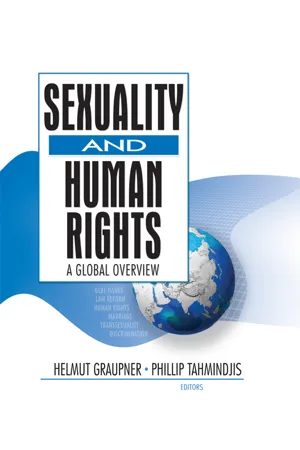
Table of contents

  1. Cover
  2. Half Title
  3. Title
  4. Copyright
  5. CONTENTS
  6. Foreword
  7. International Lesbian and Gay Law Association
  8. CERSGOSIG: Perspectives and Objectives to Challenge Discrimination. A Network on Global Scale
  9. Sexuality and International Human Rights Law
  10. Sexuality and Australian Law
  11. Transsexuals and European Human Rights Law
  12. Sexual Orientation and Gender Identity in North America: Legal Trends, Legal Contrasts
  13. Sexuality and Human Rights in Europe
  14. Advancing Human Rights Through Constitutional Protection for Gays and Lesbians in South Africa
  15. Sexuality and Human Rights: An Asian Perspective
  16. Laws and Sexual Identities: Closing or Opening the Circle?
  17. Index