This translation of this classic text contains a balance of cultural and biological considerations. While arguing for the strong influence of exposure and of formal training on the way that music is perceived, Frances draws on the literature concerning the amusias to illustrate his points about the types of cognitive abstraction that are performed by the listener.
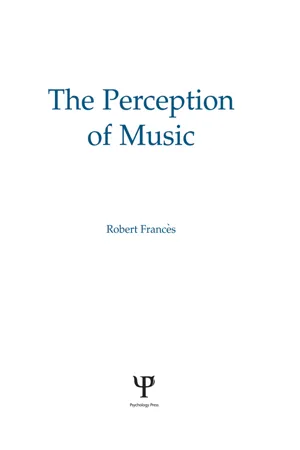
- 384 pages
- English
- ePUB (mobile friendly)
- Available on iOS & Android
eBook - ePub
The Perception of Music
About this book
Information
Part I
SYNTAX
SYNTAX
Chapter 1
SOUND AND MUSIC
SOUND AND MUSIC
PRESENT THEORIES OF AUDITION
The periphery of the auditory system has received special attention from physiologists since 1870, when Helmholtz (with Hensen) proposed that the transverse fibers along the basilar membrane resonate selectively to different frequencies. There at last, it seemed, was a clear theoretical picture, in keeping with what was already known about the physical properties of resonators. However, this view had to be abandoned for various reasons. For one thing, the fibers are neither freely vibrating nor anatomically separate and because of that cannot mediate distinct perceptions of different frequencies. Second, the fibers vary greatly in length, but not in mass or tension; and although there are many of them (about 2800 over the seven octaves where discrimination is good), there are not enough to explain the subtlety attained by the musical ear.1 In fact, the idea of specific places of stimulation for different pitches has now been abandoned, without giving up the general idea of a place model of pitch perception altogether. The general notion has theoretical support (Blondel, 1934; Causse, 1944; Gribensky, 1951) and is approximately correct on a practical level: fibers in a specific region respond to a particular tone, with the region situated toward the basal end of the membrane for high tones and toward the apex for low tones (cf. van Esbroeck & Montfort, 1946; Wever, 1949). All the same, this approximation is not without difficulties, because it increases still more the number of fibers required to explain known discrimination abilities. Moreover, if an increase in intensity enlarges the region of stimulation, it ought to produce a decline in discrimination, but that is not the case. And the simultaneous perception of several neighboring tones at high intensity would be impossible because of the interference of the neighboring regions of stimulation.
Such difficulties gave rise to the theories mentioned earlier and shifted the locus of auditory discrimination from peripheral to central processes. These theories held that the message transmitted to the brain via the auditory nerve is not yet identified by means of peripheral resonators, but rather consists of a pattern of excitation—a frequency of nerve firings determined by the frequency of vibration received. The discovery of electrical currents corresponding to auditory activity in the cortex by Beck in 1890, and in the auditory nerve by Beaurcgard and Dupuy in 1896, was refined by Wcver and Bray using more highly developed techniques in 1930. We now distinguish the cochlear response recorded from the basilar membrane from the neural response. The former reproduces the waveform of the stimulus; the latter has its own distinctive pattern. The neural response has a higher intensity threshold than the cochlear response. And, most important, the cochlear response is capable of following a wide range of frequencies, whereas the upper limit of neural synchronization is around 4000 or 5000 Hz. At higher frequencies, the place mechanism comes into play.
But synchrony at such high frequencies is not consistent with a neuron’s refractory period. A single fiber could not transmit such rapid excitation. The cooperation of several fibers relieving each other in tandem is required to convey a volley—a cluster of responses for each peak of stimulation; hence the name volley principle. Wever supposed that the volley principle would operate in the range of 400 to 5000 Hz, whereas a modified place mechanism would handle frequencies beyond that. “Pitch therefore has a twofold representation, in terms of place on the basilar membrane and hence of particularity of nerve fibers, and in terms of composite input frequency “(Wever, 1949, p. 189) The process of audition is different depending on the frequency range considered: from 15 to 400 Hz, the auditory nerve transmits the frequency just as it receives it; from 400 to 5000 Hz, it encodes it in volleys; and from 5000 to 24000 Hz the response is tied to place of excitation on the basilar membrane. For midrangc frequencies, the volley principle operates jointly with a more or less precise place mechanism, which nevertheless plays a minimal role in pitch analysis.
For the origin of the cochlear microphonic potentials, we must look in the organ of Corti supported by the basilar membrane, rather than in the membrane directly. The disturbances it receives are transmitted to the hair cells, which rub intermittently on the tectorial membrane, initiating electrical potentials that are transmitted to the auditory nerve (Wever, 1949; Gribensky, 1951).
Thus, beginning with an explanation of pitch perception based on a single mechanical principle, we progress to an explanation positing several principles according to the frequency range in question, implicating cortical activity to decode each message in accordance with its specific pattern. Certain recent considerations regarding this central processing theory involve difficulties, however. Although certain authors admit the dual-process model of Wever (e.g., Caussé, 1944; Gribensky, 1951; Stevens & Davis, 1948), others proffer two sorts of objections. First, pure tone auditory stimulation evokes an electrical response at the cortex over the entire area of reception, but without point-for-point resolution of frequencies. Cortical projections of single-frequency stimuli only show a tendency toward localization, in which specific regions of the cortex respond (cf. Piéron, 1945). Second, the duality of Wever’s model creates difficulties for its use as an explanation of a function that exhibits such a manifest continuity across the entire scale of frequencies (cf. Piéron, 1945).
THE GENERALITY OF AUDITION AND THE SPECIFICITY OF MUSICAL PERCEPTION
It seems reasonable to start, therefore, by piecing together a coherent explanation of the auditory mechanism. Yet we are still speaking only of simple tones without harmonics and of isolated tones without rhythmic, harmonic, or melodic relationships with other tones. For even if these simple phenomena were thoroughly explained, the study of the three psychological attributes of sound—pitch, loudness, and timbre—would still not provide us with specific contributions to the psychology of musical perception. Of course, analysis is the time-honored procedure of all the sciences, and it is not clear how one could inaugurate a new one by starting with the complex. Even so, the simple phenomena with which one does start must belong to the domain being researched or at the very least should be linked by successive approximations to the complex phenomena they support.
Concerning the object of our study, the audition of simple and complex tones provides a basic point of departure only if those tones can be related to the combinations into which they are always integrated. The history of music has seen just one genre based on a monotone,2 and even that coexisted for the same listeners with genres involving a variety of tones. One wonders what the effect on such a listener’s musical ear would be if Klangfarbenmelodie had been the only influence on its formation. It seems to us a simple matter, then, for the range of study to be exhausted by the study of the three aforementioned attributes, along with some related additions concerning noise and attack transients. Therefore, the approach to music cannot be made from the direction of the nonmusical; though it is easy to suppose that the nonmusical sets conditions for music, it clearly does not constitute it. There is no doubt that music is embedded in a complex social reality that envelops it. In its aims, as well as in its causes, music is social; and it is no less certain that its material, whatever the sound object, is determined by the laws of physics, is perceived, and is subjected to physiology and psychology. But what music consists of, is precisely relations among sensory qualia—among sensations of sound. To grasp what that object is, as a specific mode of human activity, is the fundamental task out of which arises the study of reactions evoked in the subject through the action of that object. We shall not seek, therefore, to reduce music to such nonspecific elements as pitch, duration, and loudness; nor aptitude at musical perception to the sense of pitch, of duration, and the like.3 Such a reduction would seem to destroy or ignore what belongs most closely to the object, which is reducible neither to concept nor experience, but which presupposes a technical approach to the discipline in which it has been fashioned. The psychology of music (like the philosophy of music) has often strayed into bordering regions, which involve certain relevant physical and physiological considerations but are too vast for one to expect to encounter in them a well-defined structure for the object. Often the psychology of music has also oriented itself toward a metapsychology in which one seems to get at the truth and where, in a curious paradox, one connects again with the nonmusical under the guise of religious sentiments or metaphysics. In each of these cases, a human fact that has its own laws and scope is reduced to laws that are otherwise foreign to it, or at least only indirectly linked.
I shall cite only one example of this abstract and general approach—an instructive example in that it is revealed by its own consequences. Starting with the self-evident principle that “all musical expression of emotion is communicated in terms of pitch, intensity, duration, and extens-ity,” Seashore, after making careful measurements on recorded fragments, elevates the principle of “the deviation from the exact” to the status of a universal necessity of beauty in music (Seashore, 1928; Seashore & Metfessel, 1925). Among the deviations reported, those of pitch and duration will occupy our attention. It is certain that those in themselves could not be the actual elements of artistic expression. Accidental deviations in mediocre performances sometimes result from insufficient psychological or physiological mastery and are destructive of melodic and rhythmic form. Intentional deviations, in an artist of bad taste, result in equally serious disorders, producing interpretative caricatures incapable of serving as vehicles of aesthetic emotion. The principle Seashore posits seems, therefore, insufficiently precise with respect to the domain under consideration. Deviations in an interpretation in written values can only be specified when done according to the way the work is articulated in its cultural context or in conformity with more or less rigid norms (performance practices) associated with those articulations. Thus, concerning rhythmic fluctuations, especially those of tempo, Brelet (1953) has aptly emphasized the need for a certain amount of rubato, that is, a certain amount of liberty in the synchronization of a song and its accompaniment at specific moments in specific works, under equally specific conditions. Otherwise, rubato is nothing but a clumsy and exaggerated affectation. Liberties in performance are to some extent necessary, in the sense of deviations from constraints other than natural ones. Without doubt, the internal necessities of artistic production, insofar as it is conventional, achieves its ends by means of natural processes—through a slowing of arm and hand, through contraction of a vocal interval. Such events can only be measured with the aid of recording techniques already in use in sciences such as psychology and physiology (although there is nothing to prevent experimental aesthetics from developing new techniques). But the study of these processes furnishes us with knowledge of art only if we gather them from central instances among art works and aesthetic structures. They are instructive only when illuminated by that internal necessity that we need to describe in order to distinguish between the perception of music and mere audition.
That this is so in no way implies that we must return to mystical conceptions involving art in transcendental principles and nonrational ways of knowing. The additus naturae appropriate to art is a human thing and as such falls within the range of scientific investigation. It must be considered as a highly differentiated region of behavior, involving the development of certain natural functions through prolonged interaction with socially defined art works and techniques. It is more interesting to study this development itself, tracing its roots in general human capabilities, than simply to reduce it to functions already understood. This approach arises not from a conception of a hierarchy of facts of humanity (which would be much more in the province of philosophy than of psychology), but rather from a concern for scientific exactitude. Thus it is for the sake of precision that we need to affirm a radical distinction of musical perception versus audition taken as a general physiological process. To be precise, we need to maintain the distinction between a conception of expressive performance as “deviations from the exact” and a cultural conception according to which those deviations differ in their occurrence in keeping with different structural locations in the work. We have seen that this is true of temporal deviations...
Table of contents
- Cover
- Title Page
- Copyright Page
- Table of Contents
- Preface
- Foreword
- Introduction
- Part I Syntax
- Part II Rhetoric
- Part III Expression and Meaning
- References
- Supplementary Bibliography
- Author Index
- Subject Index
Trusted by 375,005 students
Access to over 1.5 million titles for a fair monthly price.
Study more efficiently using our study tools.
Frequently asked questions
Yes, you can cancel anytime from the Subscription tab in your account settings on the Perlego website. Your subscription will stay active until the end of your current billing period. Learn how to cancel your subscription
No, books cannot be downloaded as external files, such as PDFs, for use outside of Perlego. However, you can download books within the Perlego app for offline reading on mobile or tablet. Learn how to download books offline
Perlego offers two plans: Essential and Complete
- Essential is ideal for learners and professionals who enjoy exploring a wide range of subjects. Access the Essential Library with 800,000+ trusted titles and best-sellers across business, personal growth, and the humanities. Includes unlimited reading time and Standard Read Aloud voice.
- Complete: Perfect for advanced learners and researchers needing full, unrestricted access. Unlock 1.5M+ books across hundreds of subjects, including academic and specialized titles. The Complete Plan also includes advanced features like Premium Read Aloud and Research Assistant.
We are an online textbook subscription service, where you can get access to an entire online library for less than the price of a single book per month. With over 1.5 million books across 990+ topics, we’ve got you covered! Learn about our mission
Look out for the read-aloud symbol on your next book to see if you can listen to it. The read-aloud tool reads text aloud for you, highlighting the text as it is being read. You can pause it, speed it up and slow it down. Learn more about Read Aloud
Yes! You can use the Perlego app on both iOS and Android devices to read anytime, anywhere — even offline. Perfect for commutes or when you’re on the go.
Please note we cannot support devices running on iOS 13 and Android 7 or earlier. Learn more about using the app
Please note we cannot support devices running on iOS 13 and Android 7 or earlier. Learn more about using the app
Yes, you can access The Perception of Music by Robert Frances,W. Jay Dowling in PDF and/or ePUB format, as well as other popular books in Psychology & Cognitive Psychology & Cognition. We have over 1.5 million books available in our catalogue for you to explore.