- 252 pages
- English
- ePUB (mobile friendly)
- Available on iOS & Android
eBook - ePub
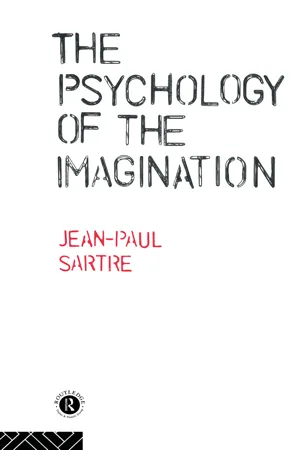
The Psychology of the Imagination
About this book
The Psychology of the Imagination was originally published in France in 1940 under the title of L'Imaginaire. It was specifically designed as an essay in phenomenology and it constitutes the first attempts to introduce Husserl's work into French culture,and from there to the English speaking world. Published three years before Being and Nothingness , it reveals Sartre's first extended examination of such concepts as nothingness and freedom, both here derived from the consciousness's ability to imagine objects not only as they are but as they are not, and to imagine objects not in existence. According to Sartre, an object can be given to us in three ways: by perceiving it, by having an idea of it, and by imagining it (having an image of it). Although we may try to respond to the image in the same way as we would to the object itself, the fact remains that an image, however vivid, presents its object as not being. It was in The Psychology of Imagination that Sartre first brought together his new enthusiasm for phenomenology with the analysis of the preconditions for human freedom which was to figure so prominently in his later philosophical works.
Information
CHAPTER ONE
The Certain

DESCRIPTION
1. The Method
Despite several preconceptions, to which we shall return shortly, it is certain that when I produce the image of Peter, it is Peter who is the object of my actual consciousness. As long as that consciousness remains unaltered, I could give a description of the object as it appears to me in the form of an image but not of the image as such. To determine the properties of the image as image I must turn to a new act of consciousness: I must reflect. Thus the image as image is describable only by an act of the second degree in which attention is turned away from the object and directed to the manner in which the object is given. It is this reflective act which permits the judgment ‘I have an image’.
It is necessary to repeat at this point what has been known since Descartes: that a reflective consciousness gives us knowledge of absolute certainty; that he who becomes aware ‘of having an image’ by an act of reflection cannot deceive himself. There have been psychologists, no doubt, who maintained that a vivid image could not be distinguished from a faint perception. Titchener even cites some experiments in support of this view. But we shall see further on that such claims rest on an error. In fact, the confusion is impossible; what has come to be known as an ‘image’ occurs immediately as such to reflection. But it is not a metaphysical and ineffable revelation that concerns us here. If this consciousness is immediately distinguishable from all others, it is because it presents itself to reflection with certain traits, certain characteristics, which at once determine the judgment ‘I have an image’. The act of reflection thus has a content of immediate certainty which we shall call the essence of the image. This essence is the same for everyone; and the first task of psychology is to explain this essence, to describe it, to fix it.
Why, then, should there be so many different theories concerning this immediate knowledge on which all psychologists should certainly be of one mind? Our answer is that the majority of psychologists ignore this primary knowledge and prefer to build explanatory hypotheses concerning the nature of the image. (1) These, like all other scientific hypotheses, never possess more than a certain probability: the data of reflection are certain.
All new studies of the image should therefore begin with a basic distinction: that it is one thing to describe the image and quite another to draw conclusions regarding its nature. In going from one to the other we pass from certainty to probability. The first duty of the psychologist is obviously to formulate into concepts the knowledge that is immediate and certain.
So we shall ignore theories. We want to know nothing about the image but what reflection can teach us. Later on we shall attempt, as do other psychologists, to classify the consciousness of the image among the other types of consciousness, to find a ‘family’ for it, and we shall form hypotheses concerning its inherent nature. For the present we only wish to attempt a ‘phenomenology’ of the image. The method is simple: we shall produce images, reflect upon them, describe them; that is, attempt to determine and to classify their distinctive characteristics.
2. First characteristic: The image is a consciousness
The very first reflective glimpse shows us that up to now we have been guilty of a double error. We believed, without giving the matter any thought, that the image was in consciousness and that the object of the image was in the image. We pictured consciousness as a place peopled with small likenesses and these likenesses were the images. No doubt this misconception arises from our habit of thinking in space and in terms of space. This we shall call the illusion of immanence. The clearest expression of this illusion is found in Hume, where he draws a distinction between impressions and ideas:
Those perceptions, which enter with most force and violence, we may name impressions. . . . By ideas I mean the faint images of these in thinking and reasoning. . . . (2)
These ideas are none other than what we called images. Now Hume adds several pages further on:
But to form the idea of an object, and to form an idea simply is the same thing; the reference of the idea to an object being an extraneous denomination, of which in itself it bears no mark or character. Now as ’tis impossible to form an idea of an object, that is possest of quantity and quality, and yet is possest of no precise degree of either; it follows, that there is an equal impossibility of forming an idea, that is not limited and confined in both these particulars. (3)
According to this view my actual idea of chair has but an extraneous relation to an existing chair. It is not the chair of the external world, the chair I just perceived; it is not the chair of straw and wood by which I am able to distinguish my idea from the idea of a table or an inkwell. But, my actual idea is nevertheless an idea of chair. What can this mean but that, for Hume, the idea of chair and the chair as an idea are one and the same thing. To have an idea of chair is to have a chair in consciousness. That this is so is shown by the fact that what is true of the object is also true of the idea. If the object must have a determined quantity and quality, so must the idea.
Psychologists and philosophers have in the main adopted this point of view. It is also the point of view of common sense. When I say that ‘I have an image’ of Peter, it is believed that I now have a certain picture of Peter in my consciousness. The object of my actual consciousness is just this picture, while Peter, the man of flesh and bone, is reached but very indirectly, in an ‘extrinsic’ manner, because of the fact that it is he whom the picture represents. Likewise, in an exhibition, I can look at a portrait for its own sake for a long time without noticing the inscription at the bottom of the picture ‘Portrait of Peter Z. . . .’ In other words, an image is inherently like the material object it represents.
What is surprising is that the radical incongruity between consciousness and this conception of the image has never been felt. It is doubtless due to the fact that the illusion of immanence has always been taken for granted. Otherwise it would have been noticed that it was impossible to slip these material portraits into a conscious synthetic structure without destroying the structure, without breaking the contacts, arresting the flow, breaking the continuity. Consciousness would cease being transparent to itself; its unity would be broken in every direction by unassimilable, opaque screens. The works of men like Spaier, Bühler and Flach, in which the image is shown to be supple by being full of life, suffused with feeling and knowledge, are useless; for by turning the image into an organism they did not make it any the less unassimilable by consciousness. It is for this reason that certain logical minds, like F. Moutier, (4) have felt that the existence of mental images must be denied if the integrity of the mental synthesis is to be saved. Such a radical solution is contradicted by the data of introspection. I can, at will, think of an image of a horse, tree or house. But if we accept the illusion of immanence, we are necessarily led to construct the world of the mind out of objects entirely like those of the external world, but which simply obey different laws.
Let us ignore these theories and see what reflection teaches us, so that we may rid ourselves of the illusion of immanence.
When I perceive a chair it would be absurd to say that the chair is in my perception. According to the terminology we have adopted, my perception is a certain consciousness and the chair is the object of that consciousness. Now I shut my eyes and I produce an image of the chair I have just perceived. The chair, now occurring as an image, can no more enter into consciousness than it could do so as an object. An image of a chair is not, and cannot be a chair. In fact, whether I perceive or imagine that chair of straw on which I am seated, it always remains outside of consciousness. In both cases it is there, in space, in that room, in front of the desk. Now – and this is what reflection teaches us above all – whether I see or imagine that chair, the object of my perception and that of my image are identical: it is that chair of straw on which I am seated. Only consciousness is related in two different ways to the same chair. The chair is directed towards its concrete individuality, its corporeality, in both cases. Only, in one of the cases, the chair is ‘encountered’ by consciousness; in the other, it is not. But the chair is not in consciousness; not even as an image. What we find here is not a semblance of the chair which suddenly worked its way into consciousness and which has but an ‘extrinsic’ relation to the existing chair, but a certain type of consciousness, a synthetic organization, which has a direct relation to the existing chair and whose very essence consists precisely of being related in this or that manner to the existing chair.
And what exactly is the image? Evidently it is not the chair: in general, the object of the image is not itself an image. Shall we say then that the image is the total synthetic organization, consciousness? But this consciousness is an actual and concrete nature, which exists in and for itself and which can always occur to reflection without any intermediary. The word image can therefore indicate only the relation of consciousness to the object; in other words, it means a certain manner in which the object makes its appearance to consciousness, or, if one prefers, a certain way in which consciousness presents an object to itself. The fact of the matter is that the expression ‘mental image’ is confusing. It would be better to say ‘the consciousness of Peter as an image’ or ‘the imaginative consciousness of Peter’. But since the word image is of long standing we cannot reject it completely. However, in order to avoid all ambiguity, we must repeat at this point that an image is nothing else than a relationship. The imaginative consciousness I have of Peter is not a consciousness of the image of Peter: Peter is directly reached; my attention is not directed on an image, but on an object.1
Thus, in the woof of the synthetic acts of consciousness there appear at times certain structures which we shall call imaginative consciousness. They are born, develop and disappear in accordance with laws proper to them and which we shall try to ascertain. And it would be a grave error to confuse this life of the imaginative consciousness, which lasts, becomes organized, and disintegrates, with the object of this consciousness which in the meantime can well remain immutable.
3. Second characteristic: the phenomenon of quasi-observation
When we began this study we thought our concern was with images, that is, with some elements of consciousness. Now we see that we are dealing with complete consciousnesses, that is, with complex structures which ‘intend’ certain objects. Let us now see whether reflection can teach us more about these consciousnesses. The simplest procedure will be to examine the image in its relationship to the concept and the percept. To perceive, conceive, imagine: these are the three types of consciousness by which the same object can be given to us.
In perception I observe objects. By this we must understand that although the object enters into my perception in its completeness, I nevertheless see it only from one side at a time. Consider the example of the cube: I know it is a cube provided I have seen its six sides; but of these I can see only three at a time, never more. I must therefore apprehend them successively. And when I pass, for example, from sides ABC to sides BCD, there always remains a possibility that side A has disappeared during my change of position. The existence of the cube therefore remains doubtful. But let us note that when I see three sides of the cube at the same time, these three sides never present themselves to me as squares: their lines become flat, their angles become obtuse, and I must reconstruct their squareness at the very beginning of my perception. All this has been said hundreds of times: the characteristic of a perception is that the object appears only in a series of profiles, of projections. The cube is certainly present to me, I can touch it, see it; but I always see it only in a certain fashion which includes and excludes at one and the same time an infinity of other points of view. We must learn objects, that is to say, multiply upon them the possible points of view. The object itself is the synthesis of all these appearances. The perception of an object is thus a phenomenon of an infinity of aspects. What does this mean for us? It means that we must make a tour of objects; wait until the ‘sugar melts’, as Bergson said.
When, on the other hand, I think of a cube by means of a concrete concept,2 I think of its six sides and its eight angles all at once; I think that its angles are right angles, its sides squared. I am at the centre of my idea, I seize it in its entirety at one glance. This does not mean, of course, that my idea does not need to complete itself by an infinite progression. But I can think of the concrete essences in a single act of consciousness; I do not have to re-establish the appearance, I have no apprenticeship to serve. Such is, no doubt, the clearest difference between a thought and a perception. This is the reason why we can never perceive a thought nor think a perception. The two phenomena are radically distinct: the one is knowledge which is conscious of itself and which places itself at once at the centre of the object; the other is a synthetic unity of a multiplicity of appearances, which slowly serves its apprenticeship.
What shall we say of the image? Is it apprenticeship or knowledge? Let us note first that it seems to belong to perception. In the one, as in the other, the object presents itself in profiles, in projections, in what the Germans designate by the apt term Abschattungen. Only we no longer have to make a tour of it: the cube as an image is presented immediately for what it is. When I say, ‘the object I perceive is a cube’, I make an hypothesis that I may have to reject at the close of my perceptions. When I say,’the object of which I have an image at this moment is a cube’, my judgment is final: it is absolutely certain that the object of my image is a cube. What does this mean? In perception, a knowledge forms itself slowly; in the image the knowledge is immediate. We see now that the image is a synthetic act which unites a concrete, non-imagined, knowledge to elements which are more actually representative. The image teaches nothing: it is organized exactly like the objects which do produce knowledge, but it is complete at the very moment of its appearance. If I amuse myself by turning over in my mind the image of a cube, if I pretend that I see its different sides, I shall be no further ahead at the close of the process than I was at the beginning: I have learned nothing.
And this is not all. Let us consider this piece of paper on the table. The longer I look at it the more of its features are revealed to me. Each new orientation of my attention, of my analysis, shows me a new detail: the upper edge of the sheet is slightly warped; the end of the third line is dotted . . . etc. No matter how long I may look at an image, I shall never find anything in it but what I put there. It is in this fact that we find the distinction between an image and a perception. In the world of perception every ‘thing’ has an infinite number of relationships to other things. And what is more, it is this infinity of relationships – as well as the infinite number of relationships between the elements of the thing – which constitute the very essence of a thing. From this there arises something of the overflowing in the world of ‘things’: there is always, at each and every moment, infinitely more than we see; to exhaust the wealth of my actual perception would require infinite time. Let us not deceive ourselves: this manner of ‘brimming over’ is of the very nature of objects. When we say that no object can exist without having a definite individuality we mean ‘without maintaining an infinity of determined relationships with the infinity of other objects’.
Now, the image, on the other hand, suffers from a sort of essential poverty. The different elements of an image have no relationship with the rest of the world, while among themselves they have but two or three relationships, those, for instance, which I have been able to ascertain; or those which it is now essential for me to hold on to. We must not say that the other relationships exist in secret, that they wait for a bright searchlight to be directed upon them. No: they do not exist at all. Two colours, for instance, which in reality possess a certain discordant relationship, can exist together in imagery without any sort of relationship between them. Objects exist only in so far as they are thought of. This is what all those who consider the image to be a reborn perception fail to understand. The difference is not that of vividness but rather that the objects of the world of images can in no way exist in the world of perception; they do not meet the necessary conditions.3
In a word, the object of the perception overflows consciousness constantly; the object of the image is never more than the consciousness one has of it; it is limited by that consciousness: nothing can be learned from an image that is not already known. It can, of course, happen that a memory image presents itself unexpectedly, and presents some new aspects. But even in such a case it presents itself in one piece to intuition, it reveals immediately what it is. If I perceive a bit of turf, I must study it for a considerable period to determine where it comes from. In the case of an image I know it immediately; it is the grass of this meadow, in such a place. And this origin cannot be determined from the image: the very act that gives me the object as an image includes the knowledge of what it is. It is true that occasionally a memory-image does remain unidentified: all of a sudden I see again a dreary garden under a grey sky and I cannot recall when or where I saw that garden. But this is simply a matter of determinacy lacking to the image, and no observation, no matter how prolonged, will yield the knowledge I lack. If I ...
Table of contents
- Cover
- Title page
- Copyright page
- Contents
- THE INTENTIONAL STRUCTURE OF THE IMAGE
- INTRODUCTION by Mary Warnock
- 1 THE CERTAIN
- DESCRIPTION
- 1 The method
- 2 First characteristic: the image is a consciousness
- 3 Second characteristic: the phenomenon of quasi-observation
- 4 Third characteristic: the imaginative consciousness posits its object as nothingness
- 5 Fourth characteristic: spontaneity
- 6 Conclusion
- THE IMAGE FAMILY
- 1 Image, portrait, caricature
- 2 The sign and the portrait
- 3 From sign to image: the consciousness of imitations
- 4 From sign to image: schematic drawings
- 5 Faces in the fire, spots on walls, rocks in human form
- 6 Hypnagogic images, scenes and persons seen in coffee-grounds, in a crystal ball
- 7 From the portrait to the mental image
- 8 The mental image
- 2 THE PROBABLE
- 1 Knowledge
- 2 Affectivity
- 3 Movements
- 4 The role of the word in the mental image
- 5 How the thing appears in the mental image
- 3 THE ROLE OF THE IMAGE IN MENTAL LIFE
- 1 The symbol
- 2 Symbolic schemata and illustrations of thought
- 3 Image and thought
- 4 Image and perception
- 4 THE IMAGINARY LIFE
- 1 The unreal object
- 2 The unreal and behaviour
- 3 Pathology of the imagination
- 4 The dream
- 5 CONCLUSION
- 1 Consciousness and imagination
- 2 The work of art
- REFERENCES
- INDEX
Trusted by 375,005 students
Access to over 1.5 million titles for a fair monthly price.
Study more efficiently using our study tools.
Frequently asked questions
Yes, you can cancel anytime from the Subscription tab in your account settings on the Perlego website. Your subscription will stay active until the end of your current billing period. Learn how to cancel your subscription
No, books cannot be downloaded as external files, such as PDFs, for use outside of Perlego. However, you can download books within the Perlego app for offline reading on mobile or tablet. Learn how to download books offline
Perlego offers two plans: Essential and Complete
- Essential is ideal for learners and professionals who enjoy exploring a wide range of subjects. Access the Essential Library with 800,000+ trusted titles and best-sellers across business, personal growth, and the humanities. Includes unlimited reading time and Standard Read Aloud voice.
- Complete: Perfect for advanced learners and researchers needing full, unrestricted access. Unlock 1.5M+ books across hundreds of subjects, including academic and specialized titles. The Complete Plan also includes advanced features like Premium Read Aloud and Research Assistant.
We are an online textbook subscription service, where you can get access to an entire online library for less than the price of a single book per month. With over 1.5 million books across 990+ topics, we’ve got you covered! Learn about our mission
Look out for the read-aloud symbol on your next book to see if you can listen to it. The read-aloud tool reads text aloud for you, highlighting the text as it is being read. You can pause it, speed it up and slow it down. Learn more about Read Aloud
Yes! You can use the Perlego app on both iOS and Android devices to read anytime, anywhere — even offline. Perfect for commutes or when you’re on the go.
Please note we cannot support devices running on iOS 13 and Android 7 or earlier. Learn more about using the app
Please note we cannot support devices running on iOS 13 and Android 7 or earlier. Learn more about using the app
Yes, you can access The Psychology of the Imagination by Jean-Paul Sartre in PDF and/or ePUB format, as well as other popular books in Filosofía & Existencialismo en filosofía. We have over 1.5 million books available in our catalogue for you to explore.