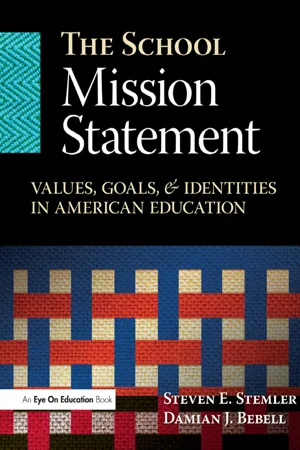
eBook - ePub
The School Mission Statement
Values, Goals, and Identities in American Education
- 256 pages
- English
- ePUB (mobile friendly)
- Available on iOS & Android
eBook - ePub
The School Mission Statement
Values, Goals, and Identities in American Education
About this book
This is a must-have resource for busy educators involved in creating, improving, or reevaluating their school mission statements. The authors provide numerous examples of mission statements from a diverse range of preK-12 schools, offering readers an extremely valuable resource for developing an understanding of various themes and ideas in American education today - all to be better prepared to formulate their own schools' mission statements. Whether you are preparing for accreditation reviews, seeking a broader knowledge base, or are engaged in policy discussions, this practical, readable guide is packed with valuable information to help you reach your professional goals.
Trusted by 375,005 students
Access to over 1.5 million titles for a fair monthly price.
Study more efficiently using our study tools.
Information
Topic
EducationSubtopic
Education GeneralPART I
Background on the Purpose of School and School Mission Statements
1
Diverse Perspectives on the Purpose of School
At present, opinion is divided about the subjects of education. People do not take the same view about what should be learned by the young, either with a view to human excellence or a view to the best possible life, nor is it clear whether education should be directed mainly to the intellect or to moral character… [,] whether the proper studies to be pursued are those that are useful in life, or those that make for excellence, or those that advance the bounds of knowledge…. Men do not all honor the same distinctive human excellence and so naturally they differ about the proper training for it.
—Aristotle as quoted in Knight, 1989
A wide variety of educational stakeholders have questioned and considered the purposes of schooling for hundreds, even thousands, of years. Thus, before proceeding with our examination of modern American school mission statements, we believe it is useful to consider the perspectives on school purpose found in different arenas, including the academic, legislative, legal, and business communities.
Academic Perspectives
Educational philosophers were among the first group of individuals to write about and formally debate the different purposes of schools. Ancient philosophers as diverse as Aristotle, Plato, Mo Tzu, and Confucius wrote extensively on the purpose and role of education and schooling in their respective cultures (Noddings, 1995; Reed & Johnson, 1996). These great thinkers shared some common ideas about what schools should exist to do, but each of them also had their own unique perspectives on the role of schooling within a given culture and civilization.
In more modern times, American educational philosophers such as John Dewey, George Counts, and Mortimore Adler have each proposed systematic and detailed arguments regarding the purpose of schooling in American society. For example, Dewey (1938) argued that the primary purpose of education and schooling is not so much to prepare students to live a useful life, but to teach them how to live pragmatically and immediately in their current environment. By contrast, Counts, a leading progressive educator in the 1930s, critiqued Dewey’s philosophy, stating, “the weakness of progressive education thus lies in the fact that it has elaborated no theory of social welfare, unless it be that of anarchy or extreme individualism” (1978, p. 5). To Counts, the purpose of school was less about preparing individuals to live independently and more about preparing individuals to live as members of a society. Indeed, the role of schooling, according to Counts, was to equip individuals with the skills necessary to participate in the social life of their community and to change the nature of the social order as needed or desired. In 1982, the notable educator and philosopher Mortimer Adler wrote The Paideia Proposal, which integrated the ideas of Dewey and Counts, as well as his own. Specifically, Adler suggested that there are three objectives of children’s schooling: (1) the development of citizenship, (2) personal growth or self-improvement, and (3) occupational preparation.
The great historian of education David Tyack (1988) has argued that from a historical perspective, the purpose of schooling has been tied to social and economic needs. More recently, some sociologists have argued that schools exist primarily to serve a practical credentialing function in society (Labaree, 1997). Expanding on the pragmatic purpose of school, deMarrais and LeCompte (1995) outlined four major purposes of schooling, which include (1) intellectual purposes such as the development of mathematical and reading skills, (2) political purposes such as the assimilation of immigrants, (3) economic purposes such as job preparation, and (4) social purposes such as the development of social and moral responsibility.
Legislative Perspectives
While the perspective of educational philosophers provides us with an important backdrop against which to consider the question of school purpose, a more pragmatic perspective can be ascertained from local, state, and federal governments. Because the United States Constitution makes no mention of the purpose or function of schools, the responsibility for schooling and formal education is a matter delegated to each state. State constitutions vary in the degree to which they explicate the purposes of schooling, but perhaps the most comprehensive view is put forth by the Massachusetts constitution. Massachusetts provides a particularly interesting example because it was the first state constitution written in the US, and it was authored by John Adams, the second president of the United States. Adams wrote pointedly and directly to the purpose and role of schooling in post-colonial Massachusetts:
Wisdom, and knowledge, as well as virtue, diffused generally among the body of the people, being necessary for the preservation of their rights and liberties; and as these depend on spreading the opportunities and advantages of education in the various parts of the country, and among the different orders of the people, it shall be the duty of legislatures and magistrates, in all future periods of this commonwealth, to cherish the interests of literature and the sciences, and all seminaries of them; especially the university at Cambridge, public schools and grammar schools in the towns; to encourage private societies and public institutions, rewards and immunities, for the promotion of agriculture, arts, sciences, commerce, trades, manufactures, and a natural history of the country; to countenance and inculcate the principles of humanity and general benevolence, public and private charity, industry and frugality, honesty and punctuality in their dealings; sincerity, good humor, and all social affections, and generous sentiments among the people. (187th General Court of the Commonwealth of Massachusetts, 2010)
Thus, as early as 1780, the Massachusetts constitution formally established a broad, multifaceted scope for education. Since that time, individual states have developed educational aspirations that reflect the needs of their residents. For example, the state constitution of Florida articulates both common and unique elements related to the purpose of school compared to Massachusetts. Specifically, the Florida constitution, rewritten in 2006, clearly illustrates Florida’s concern with providing a safe environment for its children. In addition, the constitution emphasizes early childhood development and the importance of cognitive, social, and emotional development:
The education of children is a fundamental value of the people of the State of Florida. It is, therefore, a paramount duty of the state to make adequate provision for the education of all children residing within its borders. Adequate provision shall be made by law for a uniform, efficient, safe, secure, and high quality system of free public schools that allows students to obtain a high quality education and for the establishment, maintenance, and operation of institutions of higher learning and other public education programs that the needs of the people may require…. (b) Every four-year old child in Florida shall be provided by the State a high quality pre-kindergarten learning opportunity in the form of an early childhood development and education program which shall be voluntary, high quality, free, and delivered according to professionally accepted standards. An early childhood development and education program means an organized program designed to address and enhance each child’s ability to make age appropriate progress in an appropriate range of settings in the development of language and cognitive capabilities and emotional, social, regulatory and moral capacities through education in basic skills and such other skills as the Legislature may determine to be appropriate. (Florida Legislature, 2010)
Legal Perspectives
An additional source of opinion on the purposes of American schooling has come from the judicial branch. Specifically, in the late 1980s, a series of landmark legal cases helped redefine the purposes and responsibilities of US schools. In 1989, the Kentucky State Supreme Court ordered the general assembly to provide funding “sufficient to provide each child in Kentucky an adequate education” and to reform the property tax system (Rose v. Council for Better Education, 1989). In defining what constitutes an adequate public education, the court enumerated seven learning goals that have been widely cited as precedent and since adopted by numerous other states, including Massachusetts (e.g., McDuffy v. Secretary, 1993). The seven distinct components of education include the development of the following:
| (i) | sufficient oral and written communication skills to enable a student to function in a complex and readily changing civilization; |
| (ii) | sufficient knowledge of economic, social, and political systems to enable students to make informed choices; |
| (iii) | sufficient understanding of government processes to enable the student to understand the issues that affect his or her community, state, and nation; |
| (iv) | sufficient self-knowledge and knowledge of his or her mental and physical wellness; |
| (v) | sufficient grounding in the arts to enable each student to appreciate his or her cultural and historical heritage; |
| (vi) | sufficient training or preparation for advanced training in either academic or vocational fields so as to enable each child to choose and pursue life work intelligently; and |
| (vii) | sufficient level of academic or vocational skills to enable public school students to compete favorably with their counterparts in surrounding states, in academics or in the job market. (McDuffy v. Secretary, 1993) |
In recognizing the many goals of American public education, the supreme courts of Kentucky and many other states have echoed the sentiment that public schooling is not intended to be an exclusively academic or cognitive experience for students. Indeed, the Kentucky and Massachusetts decisions make it clear that cognitive outcomes are only one among many aims of schooling. There is no language in these decisions that implies cognitive skills should receive the primary emphasis over and above civic, emotional, and vocational purposes.
Business Perspectives
Another research-based approach to understanding the purpose of school has come from researchers using survey and interview methodologies. Specifically, survey methods have been used to illustrate different stakeholders’ perspectives concerning the purpose of American schools. For example, a survey of California residents (Immerwahl, 2000) showed that the majority of the respondents believed that the California higher education system indeed served a wide range of educational objectives. The poll showed that the majority of California tax payers felt the purpose of post-secondary education was to develop a sense of maturity and an ability to manage independently (71 percent), develop skills to get along with people different from oneself (68 percent), develop problem-solving and thinking abilities (63 percent), develop specific expertise and knowledge in a chosen career (60 percent), develop writing and speaking ability (57 percent), and develop a sense of responsible citizenship (44 percent).
Similarly, a 2005 survey study examined the purpose of post-secondary school from the perspective of employers and business leaders. The John J. Heldrich Center for Workforce Development (2005) asked more than 400 New Jersey employers to express their views on the purpose of higher education and to evaluate how well the state’s colleges and universities were preparing students across sixteen skill areas. The results revealed that employers cited teamwork (46 percent of respondents), social skills and critical thinking (32 percent, respectively), and integrity and honesty (30 percent) as the most important qualities they expected educated students to possess.
An evaluation of past issues of Recruiting Trends (Gardner, 2007), a publication based on information supplied by hundreds of companies and organizations concerning the recruitment of recent college graduates, revealed what skills employers were specifically seeking in their recruits. An analysis of the publication indicates the most recent trends of recruitment that are taking hold in the workforce. In 2002 to 2003, ethics and integrity were considered the most important competencies. The following year, employers expressed their preference for college students to have better developed skills in communication, personal attributes (work ethic, flexibility, initiative, and motivation), teamwork, interpersonal skills, and learning (willing to learn continuously new skills and ideas). Finally, the 2005 to 2006 issue observes that an emerging skill is geographic awareness and a global understanding of events as they pertain to the company and industrial sector.
Summary
As this brief summary of philosophical and political perspectives illustrates, there has been substantial thought and debate about the purposes of schooling in American culture. From our review, it is clear that both theorists and policy makers recognize that there are multiple purposes for schooling in American society today. However, despite generations of advances in social science research, the amount of systematic empirical research examining broader questions of school purpose remains strikingly limited. In addition, despite the current educational emphasis on reflection and measurement, remarkably little attention paid has been paid to the school’s perspective on its actual role and purpose. Who is asking the big questions?
Recognizing the utility of empirical methodologies and the lack of data and resources representing the schools’ own perspectives, we have conducted a series of empirical studies to categorize and quantify the purpose of school from the perspective of today’s schools themselves. Our research in this area is described in the next chapter.
2
The Value of School Mission Statements
The early years of the 21st century have seen an increased em...
Table of contents
- Cover
- Title Page
- Copyright Page
- Table of Contents
- About the Authors
- Acknowledgements
- Introduction: What Is the Purpose of School?
- Part I: Background on the Purpose of School and School Mission Statements
- Part II: School Mission Statements
- Part III: Analysis and Conclusions
- Index of Schools by Grade Level
- Index of Schools by Urbanicity
- Index of Schools by Percent Free Lunch
- References
Frequently asked questions
Yes, you can cancel anytime from the Subscription tab in your account settings on the Perlego website. Your subscription will stay active until the end of your current billing period. Learn how to cancel your subscription
No, books cannot be downloaded as external files, such as PDFs, for use outside of Perlego. However, you can download books within the Perlego app for offline reading on mobile or tablet. Learn how to download books offline
Perlego offers two plans: Essential and Complete
- Essential is ideal for learners and professionals who enjoy exploring a wide range of subjects. Access the Essential Library with 800,000+ trusted titles and best-sellers across business, personal growth, and the humanities. Includes unlimited reading time and Standard Read Aloud voice.
- Complete: Perfect for advanced learners and researchers needing full, unrestricted access. Unlock 1.5M+ books across hundreds of subjects, including academic and specialized titles. The Complete Plan also includes advanced features like Premium Read Aloud and Research Assistant.
We are an online textbook subscription service, where you can get access to an entire online library for less than the price of a single book per month. With over 1.5 million books across 990+ topics, we’ve got you covered! Learn about our mission
Look out for the read-aloud symbol on your next book to see if you can listen to it. The read-aloud tool reads text aloud for you, highlighting the text as it is being read. You can pause it, speed it up and slow it down. Learn more about Read Aloud
Yes! You can use the Perlego app on both iOS and Android devices to read anytime, anywhere — even offline. Perfect for commutes or when you’re on the go.
Please note we cannot support devices running on iOS 13 and Android 7 or earlier. Learn more about using the app
Please note we cannot support devices running on iOS 13 and Android 7 or earlier. Learn more about using the app
Yes, you can access The School Mission Statement by Damian Bebell,Steven Stemler in PDF and/or ePUB format, as well as other popular books in Education & Education General. We have over 1.5 million books available in our catalogue for you to explore.