- 368 pages
- English
- ePUB (mobile friendly)
- Available on iOS & Android
eBook - ePub
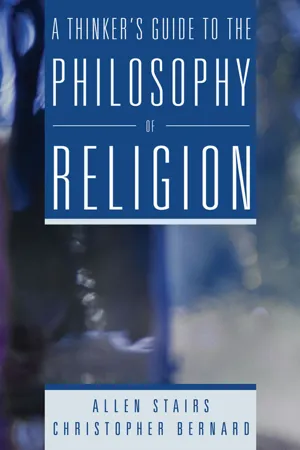
A Thinker's Guide to the Philosophy of Religion
About this book
With an approachable, reader-friendly style, A Thinker's Guide to the Philosophy of Religion provides up-to-date themes in contemporary, analytic philosophy of religion. This provocative collection of readings stimulates clear thinking and careful attention to the reasons for taking up views on religious questions.
Information
Chapter 1
Concepts of God
God and gods are often claimed to have various attributes, such as being supernatural, or being present everywhere, or being perfect. In this chapter, we explore several ways of thinking about God and a few apparent paradoxes, with special emphasis on the God of classical theism: a being who is all-powerful, all-knowing and perfectly good.
Decades from now, scholars may wonder why people in the early years of the twenty-first century were writing Ph.D. dissertations and academic essays on Buffy the Vampire Slayer. Whatever the answer to that question, the show did raise the occasional philosophical conundrum. In the fifth season, Buffy spends most of her time battling Glory, a high-heeled fashionista with great hair, uncanny strength, a band of remarkably unattractive minions, and a serious mean streak. Oh, and one other thing: Glory is a god, trapped in our dimension and trying to get herself back home.
All this is just a story, but does it even make sense? This isn’t just a way of asking whether anything remotely like this ever happened. Does calling a being like Glory a god mean anything? What would count as a god, anyway? And what’s the difference between a god and God?
In this chapter, we’ll explore the concepts of gods and, most importantly, of God. Although we’ll pay most attention to the idea of God in classical theism, we will look at a number of variations on the theme of divinity. We’ll also consider some puzzles about the idea of God.
1 God, God, and Gods
Start with a point of grammar. The word god with a lower-case “g” isn’t a name; it’s a descriptive term. Although saying exactly what would count as a god is difficult, one thing that’s clear is that there could be more than one of them. The ancient Greeks for example, worshipped a whole pantheon with enough gods to populate a good-sized mountaintop. On the other hand, God is a name, or better yet, a title, and it’s a title that’s generally understood to refer to a single being if it refers to anything at all. If there are two or more equally viable candidates for the title “God” then God does not exist, though some gods do. God, if God there be, is unique.
Monotheism is the belief in a single god. Polytheism is the belief that there’s more than one god. Judaism, Islam, and Christianity are perhaps the most well-known monotheistic religions, though not the only ones (Sikhs, for example, are monotheists, as are Zoroastrians and Baha’is). There are many polytheistic religions, including Taoism, Shinto, and Hinduism. (Hinduism recognizes a large number of gods, although many Hindus see all these gods as manifestations of a single divine reality.)
Interestingly enough, some of the best-known arguments from the monotheistic tradition don’t do much to support monotheism. In Chapter 3, we’ll consider the Cosmological Argument, which tries to explain why the physical universe exists at all. In one of its forms, this argument points out that there are chains of causes in the world and argues that any such chain has to have a first member. However, leaving aside whether the first member would have to be a god at all, this wouldn’t show that there needs to be a unique first cause. For example, there might be four separate deities, one for each of the four fundamental forces of nature.
One classic argument implies that only one being is worthy of the name God. It’s called the Ontological Argument, and we’ll discuss it in Chapter 4. It tries to prove the existence of a being so great that no greater being can be conceived. There couldn’t be two such beings. If there were, neither of them could have unlimited power, because neither would have power over the other. We’ll have more to say later about the sort of being that the ontological argument concerns itself with.
2 Nature and Supernature
A being that deserves to be called God would have to have some very special qualities. Zeus for example, wouldn’t do. However, if God exists, then God is at least a god, so it might be worth asking what a being would have to be like to count as a god at all. Most people would say that at the very minimum, a god would have to be supernatural. However, that raises a question: what does “supernatural” mean?
The answer isn’t obvious. Suppose there’s such a thing as magic— suppose that charms and spells really work. It’s not entirely clear what would be gained by calling this strange power supernatural. Why wouldn’t finding out that magic is real amount to discovering that the world has some surprising natural laws?
Whatever the answer, suppose a being exists who isn’t made of the stuff that anything in the physical world is made of, and perhaps isn’t made of any “stuff” at all. Suppose that this being somehow made the physical universe and has unlimited power over it. In that case, there would be a clear break in the order of things. It would make sense to use the words “supernatural” and “natural” to label what’s on either side of the break. We can imagine variations on this theme. In one version, God creates the physical world out of nothing. This is what Christians, Jews, and Muslims usually believe about God. Another version (which some people find in the first verses of the Bible) says that God didn’t create the world from nothing but imposed order on a pre-existing chaos. (“Chaos” in this sense refers to raw matter in such a confused state that it doesn’t have any real form at all.) On this view, God didn’t create matter where there was none before, but God did make incoherent, formless matter into a coherent world. That’s still pretty impressive. Counting a being who could do this as supernatural seems reasonable.
The Church of Jesus Christ of Latter-Day Saints (the Mormons) offers an interesting variation on the familiar concept of God. According to the Latter-Day Saints, God has a body not unlike our bodies. This means that God is a physical being who occupies the same space and time that we do. God has a son, Jesus Christ, who also has a physical body and who also is divine. Under the direction of God the Father, Latter-Day Saints believe that Jesus Christ created what we think of as the physical world by imposing order on chaos. Because the physical world was created by a physical being with a body, there had to be organized matter before the Universe was assembled: the bodies of the Father and the Son. Presumably, some laws would have governed both those bodies and the process of bringing order out of chaos. This blurs the line between natural and supernatural. In fact, Mormon philosopher and theologian Sterling McMurrin argues that God as understood in Mormon theology shouldn’t be described as supernatural.
If we look at world religions both now and in the past, things get even blurrier. For example, the Greek gods were immortal beings with extensive but far from complete control over what we think of as the natural world. Supernature, it seems, comes in degrees. Still, the god of classical theism is supernatural by any measure.
3 Perfection
We now have a little more clarity on what a god is, but not every being who would count as a god would also count as the God of classical theism. Classical theism sees God in a way that leaves no doubt about whether we’re talking about a mere god. It says that God is a perfect being.
3.1 Three Central Perfections
What would it mean to say that God is a perfect being? Here are three things that most theologians would insist on:
- God is omnipotent; that is, God is all-powerful.
- God is omniscient; that is, God is all-knowing.
- God is omnibenevolent; that is, God is entirely good.
We’ll refer to these attributes as the central perfections. As we’ll see in Chapter 9, these characteristics give rise to the argument from evil, which is the most important argument for the nonexistence of God.
In Section 4, we’ll explore some paradoxes and puzzles that arise when we consider the central perfections more carefully. In the remainder of this section, we’ll look briefly at some more controversial attributes that a perfect being might possess.
3.2 Necessary Existence
It’s often claimed that a perfect being would have to have necessary existence—that by its very nature, a perfect being couldn’t fail to exist. We’ll run into the idea of a necessary being again in later chapters, but this characteristic is more controversial than the three central perfections. Not everyone agrees that the concept of a necessarily existing being makes sense. If it doesn’t, then necessary existence could hardly be a perfection.
3.3 Eternal or Everlasting?
Theologians agree that a perfect being would have no beginning and no end, but there’s more than one way to understand this. Many theologians say that God has no beginning and no end because God isn’t in time at all: God is eternal. Other thinkers say that God isn’t eternal but everlasting: God is in time but didn’t begin to exist and will never cease to be. We’ll revisit this distinction when we discuss omniscience in Section 5.
3.4 Changing or Unchanging?
The question of whether God is in time is closely related to the question of whether God changes. If God does change, then God is everlasting and not eternal because change implies time.
Some theologians argue that a perfect being wouldn’t change. After all, they ask, what reason could there be for change in a being who is already perfect? Another reason that some people give for saying that God is changeless is that various scriptural passages appear to say so. For example, Malachi 3.6: “For I the Lord do not change . . .” However, other interpreters read these passages not as saying that God is absolutely unchanging but only that his love and trustworthiness don’t change.
3.5 Omnipresence
Many people believe that a perfect being would have to be omnipresent, or present everywhere. Just what omnipresence would amount to isn’t easy to say. Here are some possibilities.
If a pantheist conception of God is correct, then the world and God are identical. In that case, God is everywhere at least in the sense that some part of God is at every place. Pantheism has a drawback for perfect-being theology: the world is clearly not a perfect place. If God is identical with the world, it would follow that God isn’t perfect.
Another view is that even though God isn’t identical with the world, God pervades the world in the way that a soul might be thought of as pervading a body. Yet another view, advocated by the great physicist Isaac Newton (1642–1727), is that space is God’s “sensorium,” the seat of God’s thoughts and ideas. Each of these views goes some way to making sense of what it would mean to say that God is omnipresent but none is widely accepted.
All three of the views we’ve just described seem to give God a spatial aspect. Some ways of thinking about omnipresence avoid that consequence. For example, God keeps the world in existence. Because this applies to every part of the world, it provides a way of saying that God is present everywhere even if God isn’t spatial: God is present as sustaining cause.
There are other, even more abstract ways of understanding omnipresence, but believers might complain that all this high-flying metaphysics misses the point. Many believers feel that they experience the presence of God directly even though they might be hard-pressed to explain exactly what this amounts to. Explainable or not, the believer might insist that this presence of God that he sometimes senses is real, always and everywhere, even when we aren’t aware of it.
3.6 Does God Have Feelings?
We have feelings. Does God? If we suffer and if God has feelings, we might expect God to feel sorrow, especially if God really loves us. However, many theologians think that if we believe God has feelings like ours, we’re ignoring the profound difference between us and God.
Some theologians, St. Thomas Aquinas (c.1225–1274) among them, believe that sorrow is negative and therefore not something that could apply to a perfect being. If we grant that this argument is correct (and it’s not clear that we should), it would still leave room for God to have other feelings that don’t imply imperfection–perhaps feelings such as joy and love.
Process theology insists that God does have feelings and that these feelings allow God to suffer with us. As process theologians argue, a God whose love merely consisted in doing good things for us without being able to feel genuine sympathy and compassion for us would be a cold and less than fully admirable being (see Cobb and Griffin 1976, pp. 44 ff.). However, once again we’ll raise a thorny issue without trying to resolve it.
4 Puzzles and Paradoxes
It’s time to return to the central perfections: omnipotence, omniscience, and omnibenevolence. Classical theists agree that God has these three characteristics. In the case of omnipotence and omniscience, there’s a long history of worries about whether these concepts lead to paradoxes and we’ll look at these debates in some detail. As for omnibenevolence, anyone who thinks that there’s no objective difference between good and evil or between right and wrong will think that the idea of omnibenevolence makes no sense. In fact, as we will point out again in Chapter 10, the whole question of just what sorts of properties “goodness” and “badness” or “rightness” and “wrongness” might be is a vexing one. For now, we’ll set this issue aside and assume that there is a real difference b...
Table of contents
- Cover
- Title
- Copyright
- Contents
- Introduction
- A Note to Instructors
- 1 CONCEPTS OF GOD
- 2 THE DESIGN ARGUMENT
- 3 THE COSMOLOGICAL ARGUMENT
- 4 THE ONTOLOGICAL ARGUMENT
- 5 MIRACLES
- 6 RELIGIOUS EXPERIENCE
- 7 REFORMED EPISTEMOLOGY
- 8 FAITH AND PRAGMATIC REASONS FOR BELIEF
- 9 THE ARGUMENT FROM EVIL
- 10 GOD AND MORALITY
- 11 RELIGIOUS DIVERSITY
- 12 GOD AND LANGUAGE
- 13 LIFE AFTER DEATH
- Glossary
- Bibliography
- Index
Trusted by 375,005 students
Access to over 1.5 million titles for a fair monthly price.
Study more efficiently using our study tools.
Frequently asked questions
Yes, you can cancel anytime from the Subscription tab in your account settings on the Perlego website. Your subscription will stay active until the end of your current billing period. Learn how to cancel your subscription
No, books cannot be downloaded as external files, such as PDFs, for use outside of Perlego. However, you can download books within the Perlego app for offline reading on mobile or tablet. Learn how to download books offline
Perlego offers two plans: Essential and Complete
- Essential is ideal for learners and professionals who enjoy exploring a wide range of subjects. Access the Essential Library with 800,000+ trusted titles and best-sellers across business, personal growth, and the humanities. Includes unlimited reading time and Standard Read Aloud voice.
- Complete: Perfect for advanced learners and researchers needing full, unrestricted access. Unlock 1.5M+ books across hundreds of subjects, including academic and specialized titles. The Complete Plan also includes advanced features like Premium Read Aloud and Research Assistant.
We are an online textbook subscription service, where you can get access to an entire online library for less than the price of a single book per month. With over 1.5 million books across 990+ topics, we’ve got you covered! Learn about our mission
Look out for the read-aloud symbol on your next book to see if you can listen to it. The read-aloud tool reads text aloud for you, highlighting the text as it is being read. You can pause it, speed it up and slow it down. Learn more about Read Aloud
Yes! You can use the Perlego app on both iOS and Android devices to read anytime, anywhere — even offline. Perfect for commutes or when you’re on the go.
Please note we cannot support devices running on iOS 13 and Android 7 or earlier. Learn more about using the app
Please note we cannot support devices running on iOS 13 and Android 7 or earlier. Learn more about using the app
Yes, you can access A Thinker's Guide to the Philosophy of Religion by Allen Stairs,Christopher Bernard in PDF and/or ePUB format, as well as other popular books in Theology & Religion & Religion. We have over 1.5 million books available in our catalogue for you to explore.