- 703 pages
- English
- ePUB (mobile friendly)
- Available on iOS & Android
eBook - ePub
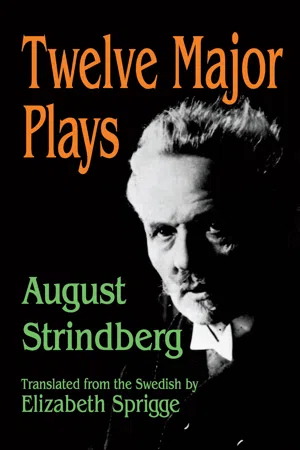
Twelve Major Plays
About this book
August Strindberg is one of the founders of the modern theater. George Bernard Shaw considered him "the only genuinely Shakespearian modern dramatist," Sean O'Casey called him "the greatest of them all." And to Eugene O'Neill he was "the greatest interpreter in the theater of the characteristic spiritual conflicts of our lives today." Twelve Major Plays includes the most famous and most characteristic Strindberg plays.This selection is particularly interesting in its depiction of the great range of Strindberg's moods and styles, from naturalism to expressionism, from ironic comedy to bitter tragedy. It displays his great gift for symbolic, mystical verse as well as his command of dramatic prose. In issues of sex and gender, Strindberg anticipated the modern temperament in society and drama alike.These translations gave American readers their first opportunity to know the true genius of Strindberg. Most previous versions in English had been based on existing German translations. Elizabeth Sprigge's unique achievement was to render the original Swedish texts into English that is at once fluent and accurate and that captures the full vigor and impact of the original plays.
Information
The Dance of Death
A Drama in Two Parts
Foreword
After Crime and Crime Strindberg wrote a number of historical dramas in which Shakespeare’s influence is apparent. Then came Easter, his tender play of redemption, but even before his marriage to Harriet Bosse, the wheel had turned and Strindberg was once more plunged into icy gloom. Memories racked him and the old poisoned streams of hatred and suspicion demanded further violent expression. He decided to write a Dance Macabre, using Saint-Saëns’ music; then, finding that the hated Ibsen had forestalled him by introducing this music in John Gabriel Borkman, Strindberg took the march, Entry of the Boyars, as theme tune for his new play, called by turn Dance Macabre, Fight with Death, Death in the Dance, The Vampire, and finally The Dance of Death.
Strindberg was uncertain at first whether to make his leading character a pilot captain, a retired professor, or a doctor, but finally chose a superannuated Captain of Artillery, O.C. of an island fortress. In this grim stone tower, which had once been a prison, Strindberg concentrated his sense of life’s malevolence. Again, as in The Father, the theme of the play is married misery, and Edgar, the larger-than-life Captain, destroys the peace of all who are in contact with him, as he staggers from one death throe to the next.
The immediate model for Edgar was the son of a Swedish Battery Commander who had fought on the Danish side in the Prusso-Danish war of 1864; but the Captain in the Dance of Death is a highly composite character. Not only is he a caricature of a friend of Strindberg’s who, as a Customs, Inspector, became such an insufferable bully that in the end he had no one left to talk to, but also of several other of Strindberg’s former associates, whom he now regarded as enemies— and of course the character also contains a great deal of Strindberg himself. The Captain’s behaviour is in the highest degree extraordinary and his defence is Strindberg’s own:
Life is so strange. So against me, so
vindictive that I became vindictive too …
In Kurt, the Quarantine Officer, returned after fifteen years abroad, divorced and robbed of his children, Strindberg depicted another of his selves, sensuous, well-meaning, weak. Even the use of the telegraph apparatus in the play derives from Strindberg’s own experience, for he was once apprenticed to the telegraph service and learnt to send out weather reports.
Alice, the Captain’s wife, is painted with the venom that memories of his love-hatred for Siri von Essen, his first actress wife, always roused in Strindberg, yet in The Dance of Death he does not, in his usual way, lay the chief responsibility for the disastrous marriage on the woman. It is interesting to consider what may have been in Strindberg’s mind as he depicted this bizarre couple. We know that at some point he had discovered from his horoscope, cast at his request by a friend, that the hour of his birth was dominated by Saturn and Venus, the most incompatible of planets. He may well have had this planetary conflict in mind while he was creating Edgar and his wife, Alice, in whom the saturnine evil and rancour run parallel with an unresolved passion whose traces influence even their most desperate moments. Another influence in the depiction of this marriage “not made in heaven” may well have been Swedenborg’s De coelo et inferno, for at this period Strindberg was deeply affected by his work.
By and large, with its battering cynical dialogue, its silent nightmare action, and the pounding of the Entry of the Boyars, Part One of The Dance of Death is a masterpiece of horror, a caricature of tragedy.1
In Part Two, Strindberg for the first time created adolescent characters. There are children in The Father and in Easter, but here in Judith and Allan, the Captain’s daughter and the Quarantine Officer’s son, are young adults in the turmoil of first love. It is probable that the fact that Strindberg had spent the summer of 1899 out in his beloved Baltic skerries, with several young nephews and nieces and one of his daughters by his first marriage, had something to do with this. While maintaining the horrific atmosphere of the play, these young characters are amusingly but tenderly drawn. As Judith’s mother, Alice, comments: “To think that flowers can grow out of filth!”
Part One of The Dance of Death, being in itself a full-length play, is usually presented alone, while Part Two, which is shorte...
Table of contents
- Cover Page
- Half Title Page
- Title Page
- Copyright Page
- Introduction
- The Father
- Miss Julie
- Creditors
- The Stronger
- The Bond
- Crime And Crime
- Easter
- The Dance of Death
- Swanwhite
- A Dream Play
- The Ghost Sonata
- The Great Highway
Trusted by 375,005 students
Access to over 1.5 million titles for a fair monthly price.
Study more efficiently using our study tools.
Frequently asked questions
Yes, you can cancel anytime from the Subscription tab in your account settings on the Perlego website. Your subscription will stay active until the end of your current billing period. Learn how to cancel your subscription
No, books cannot be downloaded as external files, such as PDFs, for use outside of Perlego. However, you can download books within the Perlego app for offline reading on mobile or tablet. Learn how to download books offline
Perlego offers two plans: Essential and Complete
- Essential is ideal for learners and professionals who enjoy exploring a wide range of subjects. Access the Essential Library with 800,000+ trusted titles and best-sellers across business, personal growth, and the humanities. Includes unlimited reading time and Standard Read Aloud voice.
- Complete: Perfect for advanced learners and researchers needing full, unrestricted access. Unlock 1.5M+ books across hundreds of subjects, including academic and specialized titles. The Complete Plan also includes advanced features like Premium Read Aloud and Research Assistant.
We are an online textbook subscription service, where you can get access to an entire online library for less than the price of a single book per month. With over 1.5 million books across 990+ topics, we’ve got you covered! Learn about our mission
Look out for the read-aloud symbol on your next book to see if you can listen to it. The read-aloud tool reads text aloud for you, highlighting the text as it is being read. You can pause it, speed it up and slow it down. Learn more about Read Aloud
Yes! You can use the Perlego app on both iOS and Android devices to read anytime, anywhere — even offline. Perfect for commutes or when you’re on the go.
Please note we cannot support devices running on iOS 13 and Android 7 or earlier. Learn more about using the app
Please note we cannot support devices running on iOS 13 and Android 7 or earlier. Learn more about using the app
Yes, you can access Twelve Major Plays by August Strindberg in PDF and/or ePUB format, as well as other popular books in Literature & Drama. We have over 1.5 million books available in our catalogue for you to explore.