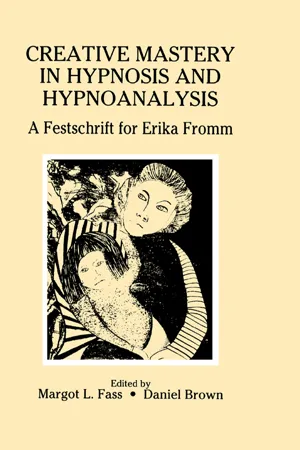
The scope of Erika Fromm's profound contributions to the clinical and research literature in hypnosis and related areas is reflected in this volume, which consists of chapters written by those who have worked closely with the noted psychologist and/or have been significantly influenced by her.
The subject matter presented here ranges from detailed accounts and personal observations relating to Fromm's distinguished career, to some very new and valuable data on the psychophysiological correlates of hypnosis, the phenomenology of self-hypnosis, and an integrative model for short-term therapy. Several extensions of clinical technique for the treatment of trauma and severe psychopathology are also discussed.
Professional therapists with an interest in personal growth, self-awareness, and creative mastery, whether or not they already have an interest in hypnosis, will derive significant benefits from this book. Readers who have previously eschewed hypnosis may find that this volume stimulates an interest that enriches their clinical practice and/or research.
eBook - ePub
Creative Mastery in Hypnosis and Hypnoanalysis
A Festschrift for Erika Fromm
- 358 pages
- English
- ePUB (mobile friendly)
- Available on iOS & Android
eBook - ePub
Creative Mastery in Hypnosis and Hypnoanalysis
A Festschrift for Erika Fromm
About this book
Information
I

THE WORK AND INFLUENCES OF ERIKA FROMM
The first section of this Festschrift provides an overview of the work and influence of Erika Fromm. Daniel Brown (chapter 1), one of Fromm’s students and colleagues for nearly 20 years, traces the development of Fromm’s ideas and significant contributions over nearly six decades. He places particular emphasis on her evolving ego-psychoanalytic perspective and its relevance to her understanding of dreams, hypnosis, self-hypnosis, and other altered states of consciousness and also to her humanistic values orientation in treating patients in hypnotherapy and hypnoanalysis. Fromm consistently emphasizes a few themes in her work: receptivity to preconscious and unconscious processes as manifested primarily in imagery; creative coping and mastery; the active problem-solving efforts of the individual; and the here-and-now reality-based relationship between patient and therapist, subject and experimenter, and teacher and student. These themes all reflect her belief in the ability each individual has to discover and master life problems when provided with the right kind of supportive relationship.
A modified version of Ernest R. Hilgard’s foreword to Hypnotherapy and Hypnoanalysis (chapter 2), Fromm’s main clinical textbook (Brown & Fromm, 1986), written by a leading authority on hypnosis, stands as a testimony to “the substantive nature of Erika Fromm’s contributions to the field of hypnosis, and to the quality of clinical work done by a practitioner who has become one of the leading hypnoanalysts in the world.
We have also included a more personal reflection by another seasoned hypnoanalyst on how Erika Fromm influenced the development of her own ideas. In ”Reflections on Hypnosis and Related Topics“ (chapter 3), Doris Gruenewald discusses her ideas and personal observations about the domain of hypnosis, which she sees as a multidimensional continuum that includes such factors as suggestibility, imagery capacity, memory alteration, role playing, and dissociation. This personal account indicates how Erika Fromm influenced the development of another hypnoanalyst’s own thinking.
The last section is an even more personal account of Erika Fromm’s influence. We have included (chapter 4) an excerpt from Andrew M. Greeley’s Confessions of a Parish Priest. He opens this autobiography with an account of his first experience with hypnosis. Through an hypnotic age regression facilitated by Erika Fromm, Greeley learned to appreciate the richness of the memories, images, and feelings that hypnosis made available to him. According to his own account, the personal experience was so compelling that it opened an inner world of creativity to him—a world that he has tapped productively ever since through the many novels he has written. He is one of many persons profoundly affected by the quality of relationship Erika Fromm can establish with others and her ability to enable them, through hypnosis, to discover and explore their own rich worlds of inner resources.
Chapter 1
ERIKA FROMM: AN INTELLECTUAL HISTORY
The Cambridge Hospital / Harvard Medical School
EARLY INFLUENCES
In a recent professional autobiography, Erika Fromm described two themes she considered most important in shaping the development of her professsional career (Fromm, 1987a). First, she always considered herself a “rebel against orthodoxy” (p. 207). Just as she rebelled as an adolescent to the very strict orthodox German Jewish household, throughout her adult life she has always actively questioned and challenged the status quo of society. Whether it be with respect to religion, science, psychoanalysis, or politics, as a scientist and clinician, Erika Fromm has never adhered to an approach or established set of ideas without first questioning its basic assumptions. Much in the spirit of a pioneer she applied this attitude as a useful means of forging new directions in many areas of inquiry.
Second, as a refugee from Nazi Germany, she had watched the Nazis gain power during her adolescence. Her deep distrust of the empty rigidity of the religious orthodoxy of her childhood was compounded by her horror of watching the development of her fellow countrymen’s blind allegiance to the new and far more irrational and destructive orthodoxy of Naziism. Her profound disillusionment in the followers of this new and insidious movement left its lasting mark. Erika Fromm fled from Germany to Holland shortly after finishing her doctorate degree, and to this day she considers Holland, not Germany, her home country. Since adolescence she has not spoken a word of German, while delighting in the chance to visit Holland and speak Dutch again.
Erika Fromm studied psychology at The University of Frankfurt under the Gestalt psychologist, Max Wertheimer, and psychopathology with Kurt Goldstein. Training in the Zeitgeist of Gestalt psychology clearly affected Fromm’s way of thinking and approaching problems. For example, Wertheimer (1945) was quite interested in “productive thinking.” Based on Gestalt principles, productive thinking was a departure from traditional logic and also from associationism. Productive thinking is an attempt to overcome the influence of habitual conceptions and routinized ways of approaching a problem. The productive thinker is aware of the relationship between elements and strives to restructure the elements into some new organization or new way of asking a question about the subject, until all the elements fit together into a new Gestalt. This approach must have had appeal for a young Erika Fromm.
Kurt Goldstein (1963) most influenced Fromm’s approach to clinical psychology, especially to psychological testing. Goldstein emphasized the “organism as a whole.” When a variety of psychological tools are used to study individual traits, the individual is viewed in a piecemeal fashion as a collection of various capacities and deficiencies. Goldstein emphasized the study of the total personality of the patient. Goldstein’s work focused on patients with organic brain conditions. He was particularly interested in the “concreteness” of brain damaged patients, (i.e., the loss of abstract ability). He also focused on the brain damaged patient’s disorganized performance on selected tasks caused by what he called the “catastrophic anxiety” experienced by such patients. While focusing on these particular attributes of brain damaged patients, Goldstein continued to emphasize the importance of keeping sight of the total person.
Fromm first became aware of Freud’s work when she was 15. She discovered a number of Freud’s works hidden behind a row of other books in her father’s library. She secretly poured through the pages of these seemingly forbidden works. From her early reading she developed an understanding of unconscious motivation and of the operation of impulses and defenses. Her interest in dynamic psychology continued throughout her graduate training, her clinical work in Holland, her externship under Samuel Beck at Michael Reese Hospital in Chicago in the late 1930s, and her formal psychoanalytic training in the late 1940s and early 1950s.
THE INTEGRATION OF ORGANICITY AND PSYCHODYNAMICS
From these disparate intellectual roots Erika Fromm faced the formidable task of integrating the Gestalt psychology of Wertheimer, Goldstein’s views of psychopathology, and Freud’s classical psychoanalytic theory. Much in the spirit of Gestalt psychology Fromm strove to integrate biological and psychodynamic perspectives on psychopathology into an understanding of the total personality. Dynamic and biological theories represented different perspectives on the organism as a whole. However, Goldstein himself had rejected drive theory. Although he believed in unconscious processes—what he preferred to call “nonconscious phenomena”—he did not believe that these phenomena were the result of persistent childhood experience. In that sense, Goldstein’s theory was nondynamic. Fromm could never accept this part of Goldstein’s thinking.
THE INTERFACE OF ORGANICITY AND PSYCHODYNAMICS
Some of Fromm’s earliest professional writing reflects Goldstein’s interest in organic brain conditions. She attempted to discriminate between and to integrate psychodynamic and biological perspectives on psychopathology. Her earliest works in Holland, for example, concern themselves with mental retardation (Oppenheimer, 1936), infection-induced dementia (Oppenheimer, 1937), and a case of deaf-muteness (Fromm, 1946). In this latter case study of an invalid 10-year-old, she was able to elucidate the complex interaction between organic determinants (complications from a middle ear infection) and psychodynamic determinants (selective inattention to fearful sounds in the service of self-preservation)
Some of her later papers in America reflect continued interest in this area. She devised a battery of psychological tests to assess organic and psychological sequelae to anoxia during labor and delivery (Benaron, et al., 1960). Following the development of her interest in hypnosis in the early 1960s, she devised a series of hypnotic experiments to distinguish between the effects of organic and psychological factors contributing to brain damage (Fromm, Sawyer, & Rosenthal, 1964; Gruenewald & Fromm, 1967). She used the hypnotic state to “suggest” brain injury to hypnotizable subjects. The responses of the hypnotic subjects simulating the brain condition were compared to various control conditions and scored by criteria for assessing organicity. Fromm and her colleagues concluded that hypnosis could be used to produce all of Goldstein’s classic signs of organicity (catastrophic anxiety, concreteness, and fatigability) in the absence of brain damage in hypnotizable subjects. The implication of these studies is consistent with what is relatively recently well known (i.e., that seemingly organic signs sometimes can be produced by psychological means).
PSYCHOLOGICAL TESTING: INTELLECTUAL ABILITY AND PSYCHODYNAMICS AS AN EXPRESSION OF THE TOTAL PERSONALITY
For the first two decades of her professional life, Fromm was one of a number of psychologists who pioneered the use of psychological testing. Because of her early interest in Gestalt theories of perception, it is no accident that Fromm became particularly interested in the Rorschach as a psychological instrument. She learned the Klopfer method of scoring in Europe. Later she studied the Beck scoring system with Dr. Beck in Chicago. In the 1940s and early 1950s she worked primarily as a child psychologist. She administered scores of psychological test batteries to children and, to a lesser extent, to adults within the greater Chicago area.
At the time that Fromm first arrived in Holland (1934/1935), psychologists did not hold positions in hospitals, which were run by psychiatrists. She worked as a research associate at The University of Amsterdam and was able to convince an influential psychiatrist at a large state hospital of the valuable contribution that psychological testing could make to diagnosis. As a result, a number of hospitals in Holland began to hire psychologists (Fromm, 1987a). In America, other Nazi refugee psychologists like David Rapaport were destined to make a similar impact and to contribute to the growing appreciation of psychological testing and the role of the psychologist in the mental health profession.
Fromm’s interest in psychological testing reached maturity in her book, Intelligence—A Dynamic Approach, co-authored with Lenore Hartman (Fromm & Hartman, 1955) This volume, and similar works, represent a continuation of her ongoing attempts to integrate organic and dynamic theory (Fromm, 1960; Fromm, Hartman, &Marschak, 1954, 1957). Many of the psychological tests she administered to children in the 1940s consisted of age-specific intelligence and aptitude tests. Since Binet’s introduction of standardized intelligence tests in the early 1900s, intelligence was viewed in American psychology as a genetically determined ability. Fromm brought to the American tradition of intelligence testing not only her background in Gestalt psychology, but also in dynamic psychology. Her perspective on psychological testing again called for an integration of the presumed organically determined notion of intelligence as a genetic trait and dynamic personality functioning, both aspects of the total Gestalt of the person. In a manner akin to Rapaport, Gill, and Schafer’s classic Diagnostic Psychological Testing (1945/1946), Fromm and Hartmann (1955) in their book, also argue for an appreciation of the dynamic significance of individual items on the various intelligence tests. Their work suggests that the psychologist needs to look beyond the objective pass-fail response to a given test item to the possible dynamic variables involved, including the idiosyncratic nature and meaning the item may have to the respondent.
In a systematic study, Fromm and her associates outlined about 50 variables that could affect responses to intelligence test items. Although Rapaport convincingly had shown the dynamic significance of WAIS subtest scores and responses to individual items in each subtest, Fromm and her colleagues applied this analysis to about 18 standardized intelligence tests commonly used by psychologists at the time. According to her view, a variety of impulses, ego functions, and superego variables potentially influence responses to children’s intelligence tests at every age level, from infancy through adolescence. Any given item on an intelligence test can tap a wide variety of personality dimensions. In this sense, Fromm’s work, much like Rapaport’s, stands as an important contribution to the evolution of psychological testing practice in America and especially to the value and credibility psychological testing has achieved within the clinical disciplines.
PSYCHOANALYTIC INFLUENCES
Short-Term Psychoanalytic Psychotherapy
Erika Fromm received her formal psychoanalytic training at the Chicago Institute for Psychoanalysis during the days of Franz Alexander and Thomas French. In those days, the Chicago Institute was unique among American psychoanalytic institutes in its departure from psychoanalytic orthodoxy. Fromm again thrived in the “rebellious” atmosphere of the Chicago Institute. The pioneering spirit of Alexander and French is best captured in a ground breaking volume entitled, Psychoanalytic Therapy: Principles and Application (Alexander & French, 1946). This book was the result of a clinical research study that focused on a search for a shorter and more efficient treatment than psychoanalysis had heretofore allowed, by attempting to extract from analysis its basic therapeutic principles. The volume, which marked the beginning of the psychoanalytic psychotherapy movement, was not well received by many psychoanalysts, who did not believe that quick therapeutic results could yield lasting changes in the dynamics and character structure of the patient, and were also likely to have been threatened by the book’s economic implications. Momentum developed within the psychoanalytic profession to influence the Chicago Institute to curtail distribution of the volume if the Institute wished to retain its association with the American Psychoanalytic Association.
Although the book’s professional market was lost, its ideas were not. Fromm was deeply influenced by its socially responsible and ethical message, namely, to provide the quickest, least expensive, and yet most effective treatment possible, as an expression of the clinician’s assertion of the primacy of the patient’s welfare. Later, she would take these ideas to a greater extreme that made some members of the Chicago Institute’s orthodoxy uncomfortable: Hypnoanalysis could provide a means of treatment that is quicker and as effective than even psychoanalytic psychotherapy. She came to believe that what could be done in 3 years of psychoanalysis could be done in 3 months, sometimes even 3 hours of hypnoanalysis (Brown & Fromm, 1986).
Dream Interpretation
At the Chicago Institute, Fromm developed a fruitful collaboration with Thomas French, the outcome of which was a new approach to dream interpretation. In the 1950s, French (1952–1958) embarked on an ambitious three volume treatise entitled The Integration of Behavior. Although there is much wisdom in these volumes they never received widespread recognition, probably because they require the reader to sift through many complicated analyses of clinical examples to find the essential points. One of these volumes, The Intrepretation of Dreams (Vol.2, 1954), describes a genuinely innovative approach to dream analysis. Erika Fromm worked closely with Tom French to rework the ideas contained in this volume and to make them more accessible to a professional audience. Fromm again drew on her background in Gestalt psychology for the collaboration. She resonated with French’s ego-psychological view of dreaming and dream organization, as well as with his search for a method that accounted for the “pattern of interrelated meanings” of any given dream. French was influenced by Fromm’s emphasis on articulating a method to approach dream interpretation. The product of this collaboration, Dream Interpretation: A New Approach (French & Fromm, 1964), greatly simplifies French’s earlier work, elaborates his earlier basic ideas, and outlines the method of dream interpretation in greater detail.
Like Freud (1900) in his Interpretation of Dreams, French and Fromm believed that dreams are expressions of conflict. However, they also viewed them as reflecting current real-life problems that may reactivate past conflicts. Unlike Freud, they believed that people do not dream directly about the past. The past is relevant to the dream only insofar as it is activated by a current emotional situation. Dreams are, as importantly, manifestations of ego functioning more than mere derivatives of id impulses. Dreams represented the ego’s problem-solving activity to which defensive operations are subordinate. Drawing on a botanical metaphor they describe dream activity as representing the “cambium layer of the mind … [a] … level where active growth, problem-solving, and learning all take place” (p. 188).
French and Fromm defined a “focal conflict” as a specific conflict that is activate...
Table of contents
- Cover
- Half Title
- Title Page
- Copyright Page
- Dedication
- Table of Contents
- Preface
- Foreword
- PART I THE WORK AND INFLUENCES OF ERIKA FROMM
- PART II THE NATURE OF HYPNOSIS
- PART III THE CLINICAL RELEVANCE OF HYPNOSIS
- PART IV THE MECHANISMS OF CHANGE IN THERAPY
- PART V CLINICAL APPLICATIONS AND NEW DIRECTIONS
- References
- Author Index
- Subject Index
Trusted by 375,005 students
Access to over 1.5 million titles for a fair monthly price.
Study more efficiently using our study tools.
Frequently asked questions
Yes, you can cancel anytime from the Subscription tab in your account settings on the Perlego website. Your subscription will stay active until the end of your current billing period. Learn how to cancel your subscription
No, books cannot be downloaded as external files, such as PDFs, for use outside of Perlego. However, you can download books within the Perlego app for offline reading on mobile or tablet. Learn how to download books offline
Perlego offers two plans: Essential and Complete
- Essential is ideal for learners and professionals who enjoy exploring a wide range of subjects. Access the Essential Library with 800,000+ trusted titles and best-sellers across business, personal growth, and the humanities. Includes unlimited reading time and Standard Read Aloud voice.
- Complete: Perfect for advanced learners and researchers needing full, unrestricted access. Unlock 1.5M+ books across hundreds of subjects, including academic and specialized titles. The Complete Plan also includes advanced features like Premium Read Aloud and Research Assistant.
We are an online textbook subscription service, where you can get access to an entire online library for less than the price of a single book per month. With over 1.5 million books across 990+ topics, we’ve got you covered! Learn about our mission
Look out for the read-aloud symbol on your next book to see if you can listen to it. The read-aloud tool reads text aloud for you, highlighting the text as it is being read. You can pause it, speed it up and slow it down. Learn more about Read Aloud
Yes! You can use the Perlego app on both iOS and Android devices to read anytime, anywhere — even offline. Perfect for commutes or when you’re on the go.
Please note we cannot support devices running on iOS 13 and Android 7 or earlier. Learn more about using the app
Please note we cannot support devices running on iOS 13 and Android 7 or earlier. Learn more about using the app
Yes, you can access Creative Mastery in Hypnosis and Hypnoanalysis by Margot L. Fass,Daniel Brown, Daniel Brown,Margot L. Fass, Daniel Brown, Daniel Brown in PDF and/or ePUB format, as well as other popular books in Psychology & Clinical Psychology. We have over 1.5 million books available in our catalogue for you to explore.