In the space of barely fifteen years, the history of masculinity has become an important dimension of social and cultural history. John Tosh has been in the forefront of the field since the beginning, having written A Man's Place: Masculinity and the Middle-Class Home in Victorian England (1999), and co-edited Manful Assertions: Masculinities in Britainsince 1800 (1991). Here he brings together nine key articles which he has written over the past ten years. These pieces document the aspirations of the first contributors to the field, and the development of an agenda of key historical issues which have become central to our conceptualising of gender in history. Later essays take up the issue of periodisation and the relationship of masculinity to other historical identities and structures, particularly in the context of the family. The last two essays, published for the first time, approach British imperial history in a fresh way. They argue that the empire needs to be seen as a specifically male enterprise, answering to masculine aspirations and insecurities. This leads to illuminating insights into the nature of colonial emigration and the popular investment in empire during the era the New Imperialism.
eBook - ePub
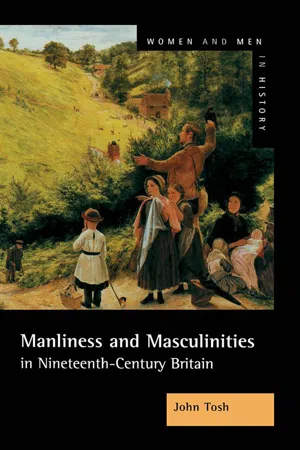
Manliness and Masculinities in Nineteenth-Century Britain
Essays on Gender, Family and Empire
- 232 pages
- English
- ePUB (mobile friendly)
- Available on iOS & Android
eBook - ePub
Manliness and Masculinities in Nineteenth-Century Britain
Essays on Gender, Family and Empire
About this book
Trusted by 375,005 students
Access to over 1.5 million titles for a fair monthly price.
Study more efficiently using our study tools.
Agendas
Chapter 1
The making of manhood and the uses of history
My title refers to the two areas of work in which I have been engaged in recent years. 'The making of manhood' perhaps suggests something new and challenging, and I hope to show that the history of masculinities is just that. But the second phrase — 'the uses of history' - sounds a lot less challenging until one recalls that most historians are not particularly concerned about the broader application of their subject: if pressed they are likely to take refuge in some notion of cultural capital - while quickly denying that this has anything to do with 'heritage'. I have been exercised by the question of relevance ever since, as a research student in African history, I wondered what contribution my study of the Lango people of Uganda might make to the process of nation-building.1
I shall return at the end of this lecture to the responsibility which historians have to the wider community, But the history of masculinity is a particularly good vantage point from which to make a general argument for the relevance of history. The first steps within the field of British history (less than thirty years ago) were influenced as much by activists as academics, and those ideological traces are still present today. Yet ultimately, I want to argue, the claims of this history on a wider public depend not on its overtones of political correctness, but on its participation in a shared scholarly discourse.
I
Fifty years ago, mention of 'manhood' was most likely to signal a pep-talk about courage and duty addressed to teenage boys, It was associated with public-school values, and with the mass movement which did so much to disseminate those values - the Boy Scouts. Today that use of the word has disappeared entirely: adult men don't any longer claim the authority to instil gender ideals in the young. Instead, 'manhood' has become a concept in a critical discourse of gender. It signals not an affirmation of masculinity, but a dissection of its social privileges - as, for example, in Anthony Rotundo's history, American Manhood (1993), or the recent work by Elizabeth Foyster, Manhood in Early Modern England (1999).
What does it mean to speak of 'the making of manhood'? From the perspective of the individual male, manhood is 'made' in the sense of being a personal accomplishment. In many small-scale societies in the world this is marked by a formalized initiation rite, usually in seclusion from women, in which boys graduate to manhood by instruction and by submitting to painful physical tests.2 In British society of the recent past both public-school education and apprenticeship to working-class trades included elements of this kind. But even when there is no institutional support, manhood was still essentially an achieved status. It was not a birthright, but lay within the power of one's peers to confirm or deny. Manhood was 'made' in the course of proving oneself 'one of the lads', by demonstrations of physical strength, sporting ability, sexual prowess, and so on. Moreover, manhood was made in a fixed mould. The injunction 'Be a man!' implied that there were only certain ways in which one could be a man, and that they demanded a high degree of effort and a suppression of self. Proving one's manhood was an experience with profoundly oppressive implications.
You will notice I have put this scenario into the past tense. Although recent research in secondary schools shows that the traditional masculine value system is alive and well,3 we live now in a culture which is much more open to gender diversity. Masculinity has fractured into a spectrum of identities. Though there were always distinctions of class, there was little room for manoeuvre within one's class. But now masculine identity is also defined in relation to sexuality, ethnicity, even consumer choice: we are no longer surprised when individuals redefine their masculinity, and the visual metaphors of gender which they deploy are themselves constantly shifting in meaning. The making of manhood now has a much more voiuntaristic character, suggesting not so much a single path as a range of alternatives. Significantly, 'manliness', the traditional word for prescriptive masculinity, has vanished from the lexicon. The masculine monolith is a thing of the past.
And - here we come to the second part of my title - history has been a vital resource in charting that course, For what historians have done is to demonstrate that manhood is not only made in the individual sense, but made in the historical sense of being a changing construct over time. That we now talk so readily of masculinities is itself testimony to the fruitful enquiries of historians. Aspects of manhood which were once central have disappeared - notably the martial honour which, as my colleague Robin Headlam Wells has shown, permeates Shakespeare's plays.4 Conversely, critical aspects of today's masculinity are of recent origin. Take for example the male work ethic. Protestantism spiritualized work, and made of it the pre-eminent: demand on a man's time and energy, the proof of his self-denial and perseverance. The notion of work as a creative act, the expression of one's very self, barely existed before the Industrial Revolution. Earlier generations had regarded labour as the wages of original sin, and certainly not as a means of gratification. It was the nineteenth-century bourgeoisie that saddled men with the full rigours of a self-punishing commitment to work.5
If masculinity was variable in the past, then logically it has the potential for change in the present and future. Awareness of something like the full range of historical masculinities challenges the aura of inevitability which attaches to mainstream notions of manhood, and it provides solid evidence of the alternatives. The way is then open to a critical appraisal of the codes by which men live in the present. This objective was uppermost in my mind, when I convened an informal study group on men's history in 1988 (around ten people meeting in my living room in north London). As someone formed by a military background and a particularly hidebound public school, I felt acutely the need for this kind of perspective. I'm glad to say that we stayed the course and collaborated fruitfully on the book I co-edited with Michael Roper in 1991, Manful Assertions. The subjects included the Victorian skilled artisan, the company executive of recent decades, and the culture of all-male middle-class institutions as seen through the medium of critical autobiography.6 It was the work we did on that book which convinced me that the history of masculinities had a serious future.
II
Where did this new approach to the past come from? It began roughly twenty-five years ago as part of a radical sexual politics. It may seem paradoxical that it was closely associated with women's history. After all, the early exponents of women's history believed that one of the principal uses of history hitherto had been to reinforce patriarchy by focusing exclusively on men's achievements in the past. But the relationship between masculinity and history soon became part of a wider feminist project. A number of feminist historians realized that it was not enough to restore women to a place in history; they must also critique the assumptions which had led to men monopolizing the record. Furthermore, if feminists were serious about understanding the historical dynamic of women's oppression, they must investigate the nature of men's stake in that oppression: gender was a power structure which must be analyzed as a system embracing both sexes.7 That approach had a growing following among feminist historians during the 1980s, and it was carried over into the journal Gender & History, founded by Leonore Davidoff in 1989.8
Where were the men in all this? Most male historians were hostile or at best indifferent, and they continued to work without regard to the gender of their subjects. But on the fringes of academia there was a small group associated with the 'men's movement'. During the last ten years that phrase has come to denote a backlash against feminism and women's rights, based on the recovery of an exclusive and supposedly 'authentic' masculinity, (Robert Bly is the best-known guru.) But back in the 1980s that backlash had not yet taken shape. The men's movement was a loose association of men's groups who supported feminism both materially and in print - in magazines like Achilles Heel.9 One facet of that support was a merciless autocritique of conventional masculinity, echoing the grounds of feminist attack in what to some seemed a self-indulgent guilt trip. But the appraisal of masculinity also reflected a more inward-looking preoccupation with the sources of oppression among men. The priority given to bread-winning and to public life was blamed for suppressing men's nurturing side. Upholding patriarchy was attacked as a burden which disfigured men's natures, even as it ground women down.10 A comparable perspective was applied to institutionalized homophobia. Long before Queer Theory directed a deconstructionist gaze at heterosexuality, gay historians showed how the rigid division between straight and gay not only oppressed gay men but censored intimacy between straight men. Gay and pro-feminist male historians worked closely together, and were sometimes - like Jeffrey Weeks for example - the same people, committed to an inclusive emancipatory project.11
Since women's history was by this time a highly effective arm of the women's movement, it is not surprising that this pro-feminist stance among men carried with it a historical agenda. The ideological imperative was sometimes quite clear. I recall attending a workshop in the mid-1980s organized by Marxism Today, where one of the participants spoke eloquently about the need for a new kind of male hero - one who would provide a role model for the anti-sexist man (or 'new man', as he was beginning to be called). One promising candidate was John Stuart Mill. Mill was not only the most eminent liberal philosopher of his age. From his twenties onwards he never wavered in his belief in the equal rights of women. He introduced the first motion in favour of a gender-blind franchise in the House of Commons in 1866, and when he married Helen Taylor in 1851 he insisted on signing a legal instrument renouncing the powers that marriage conferred on him as husband.12 On the other hand, Mill had much less to say about masculinity. For the early advocates of an inspirational men's history, Mill yielded place to Edward Carpenter, seer, social critic and grass-roots socialist. Carpenter was not only a committed supporter of feminism. In books like Love's Coming of Age (1896) he attacked the dead weight of sexual hypocrisy in late Victorian society, and deplored the emotional illiteracy of men, especially middle-class man - 'man the ungrown' as he called him.13 Above all for thirty years Carpenter led the life of an openly gay man with his partner George Merrill, risking prosecution under the law which had brought down Oscar Wilde. He was among the first sexual radicals to identify an 'intermediate sex', more adaptable and more creative because freed from the constraining stereotypes of masculine and feminine.
Another of the early aspirations of a new men's- history was for a 'good' past, a golden age when patriarchs were benevolent, when sexuality was nonprescriptive, and when men and women enjoyed a relationship of mutual respect. One early survey characterized pre-industrial society In terms of 'a sharing of personal and productive life by men, women and children', with the implication that something like these conditions might be restored when capitalist patriarchy had been dismantled.14 Robert Bly located men's ills in the failure of fathers to pass on to their sons the wisdom of the elders; so his golden age existed before the Industrial Rev...
Table of contents
- Cover
- Half Title
- Title
- Copyright
- Contents
- Acknowledgements
- Introduction
- PART ONE Agendas
- PART TWO Changing masculinities
- PART THREE Family
- PART FOUR Empire
- Index
Frequently asked questions
Yes, you can cancel anytime from the Subscription tab in your account settings on the Perlego website. Your subscription will stay active until the end of your current billing period. Learn how to cancel your subscription
No, books cannot be downloaded as external files, such as PDFs, for use outside of Perlego. However, you can download books within the Perlego app for offline reading on mobile or tablet. Learn how to download books offline
Perlego offers two plans: Essential and Complete
- Essential is ideal for learners and professionals who enjoy exploring a wide range of subjects. Access the Essential Library with 800,000+ trusted titles and best-sellers across business, personal growth, and the humanities. Includes unlimited reading time and Standard Read Aloud voice.
- Complete: Perfect for advanced learners and researchers needing full, unrestricted access. Unlock 1.5M+ books across hundreds of subjects, including academic and specialized titles. The Complete Plan also includes advanced features like Premium Read Aloud and Research Assistant.
We are an online textbook subscription service, where you can get access to an entire online library for less than the price of a single book per month. With over 1.5 million books across 990+ topics, we’ve got you covered! Learn about our mission
Look out for the read-aloud symbol on your next book to see if you can listen to it. The read-aloud tool reads text aloud for you, highlighting the text as it is being read. You can pause it, speed it up and slow it down. Learn more about Read Aloud
Yes! You can use the Perlego app on both iOS and Android devices to read anytime, anywhere — even offline. Perfect for commutes or when you’re on the go.
Please note we cannot support devices running on iOS 13 and Android 7 or earlier. Learn more about using the app
Please note we cannot support devices running on iOS 13 and Android 7 or earlier. Learn more about using the app
Yes, you can access Manliness and Masculinities in Nineteenth-Century Britain by John Tosh in PDF and/or ePUB format, as well as other popular books in History & 19th Century History. We have over 1.5 million books available in our catalogue for you to explore.