- 184 pages
- English
- ePUB (mobile friendly)
- Available on iOS & Android
eBook - ePub
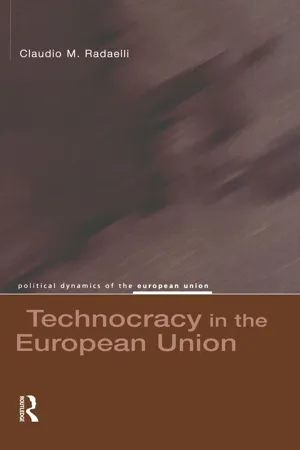
Technocracy in the European Union
About this book
One of the most common and strongest criticisms of the EU is that power is held by a select few who are unaccountable technocrats sitting in Brussels who without consultation formulate policies.
A fresh and innovative new series, written by leading authorities, providing students and researchers with a concise analysis of key topics relating to the state of the European Union and its future development. Combining insights from the theoretical literature with brief institutional descriptions, each book in the series focuses on the key questions, 'Where does power lie?', 'What are the likely scenarios for development?', thereby enabling the reader to gain a better sense of the dynamic processes of politics at EU level.
Information
Chapter One
The themes of the book
The political system of the European Union (EU), notably the European Commission, is in the firing line. At stake is the allegation of being a political system ruled by technocrats who ignore the basic thrust of democracy. Whilst democracy is based on legitimate consensus, free elections and participation, technocracy recognizes expertise as the sole basis of authority and power.
Complaints about the 'mandarins of Europe' are not new, but in the past Brussels had been able to make public policy in relative isolation from the ordinary citizen. The policy process was managed smoothly, and the citizen did not care much. Europeans differed in the degree of Euro-enthusiasm according to their nationality, but more fundamentally they were not obsessed with what was going on in Brussels and how democratic it was. The salience of 'Europe' was indeed low.
Things changed at the beginning of the 1990s. It all started with the ratification of the Treaty of Maastricht, an impenetrable maze (at least to the layman, but even experts conceded that the quality of the document in terms of standards of good legislation was poor) of technical provisions. But the political message – a single currency for Europe – was clear and citizens had to decide whether they were prepared to swallow it or not. In 1991 the Danes said no, and one year later, in France, the single currency proposal went through the electorate by a narrow margin. The press commented that 'The Danish referendum has exposed the gulf between the Europe planned by the technocrats and heads of states and the Europe of the people – a point Mr Jacques Delors, the European Commission president and arch-federalist, now concedes'.1 In France, 57 per cent of those who voted 'no' to the Treaty of Maastricht cited 'opposition to technocrats in Brussels.'2
Mr David Williamson, the then Secretary General of the Commission, agreed that 'ever since Danish voters rejected the Maastricht Treaty on European political and monetary union last June, it has suited friend and foe alike to single out the Commission as a power-hungry, centralising technocracy'.3 Governments started to capitalize on these feelings. Jacques Chirac entered his presidential campaign with a political pamphlet, La France Pour Tous, wherein he stated flatly that he did not believe in a Europe of technocrats. In his own words: 'Je ne crois pas à une Europe fabriquée à Bruxelles par des technocrates sans légitimité' (Chirac 1994: 105). Quite correctly, the Financial Times observed in the wake of presidential elections in France that 'certainly many people, young and old, who voted for Chirac do not intend to replace the demons of socialism with the disadvantages of sinking into an anonymous European Union run by technocrats'.4
Even the historical decision to launch the single currency with eleven participants taken at Brussels in May 1998 failed to impress public opinion, presumably puzzled by the row over the presidency of the European Central Bank. Yet the 'lack of a real sense of history in the making' – as the press put it – indicated a deep-rooted apathy which 'should be a cause for concern. For gone are the days when EU politicians could take decisions about the future without involving their citizens in the process.5
In addition, European governments have learnt a very profitable 'blame game' that does not help the cause of EU legitimacy. Although national policy makers are ultimately responsible for adopting EU decisions in the Council of Ministers, they have often blamed the European Commission for domestic decisions difficult to sell to their electorates. It has also been argued that the participation in the EU policy process has altered the balance of forces within domestic political systems between technocrats and politicians.6 The domestic political impact of the Treaty of Maastricht provides the best illustration of this phenomenon. Countries such as France, Italy, Germany and Spain have been struggling with the convergence criteria established by the Treaty of Maastricht. In these countries, the reform of the welfare state and the tax system has been undertaken with the aim of achieving the objective of monetary convergence. Experts in charge of monetary and macroeconomic policy have gained tremendous power from the EU-driven change of domestic economic policy. In Rome, an elite of technocrats working in the Treasury and the Bank of Italy found in the Treaty of Maastricht sufficient ammunition to tame what was perceived as the most powerful party system of the West (Dyson and Featherstone 1996a). Although Greece was not concerned with reaching the single currency in the first wave, the political activity of 'the pro-European technocrats in charge of economic policy'7 has been intense. Concluding on this point, the impact of the alleged technocratic system at work in Brussels has been profound in member states too.
Political scientists have detected a dramatic increase in the political power of expertise, well beyond the domain of EU politics and monetary policy. According to Robert Putnam, administrative elites (especially senior civil servants trained in natural sciences and technology) tend to 'agree that "politics" should be replaced by "rationality" . . . although on practical issues they may rarely agree which policy is uniquely "rational"' (Putnam 1977: 409). Andersen and Burns (1996: 244) debunk the 'established political mythology' according to which parliamentary institutions are the core of modern governance. The reality, instead, is one of post-parliamentary governance, where experts, large organizations, sectoral networks with the involvement of public and private actors represent the essence of modern governance. A question then arises: is technocracy getting a hold of the policy-making process?
Turning to the EU again, technocracy is not confined to the single currency. It is sufficient to mention the creation of the single market, a plethora of technical measures devised with the aim of assuring the free movement of capital, goods and people. The problem is that trade and capital have been substantially liberalized in the EU, with citizens' freedom of movement as a laggard in this process. Accordingly, citizens do not quite feel the benefits of the single market. The European Commission has (somewhat belatedly) launched the 'Citizens First' programme to make sure that the ordinary citizen appreciates the benefits of the single market, but the truth is that the process is one in which citizens have been least involved. In 1997 the periodical survey Eurobarometer suggested that people were not aware of their rights when moving from one member state to another. Many did not know of their right to vote in local elections in the country of residence, and 32 per cent held the false belief that there was an 'EU telephone number' for emergency services .8 This adds to the perception of a technocratic political system designed with only big capital and trade in mind.
European Union decisions have gone further than neutral measures for the smooth functioning of a single market. Currently, Brussels (the European Commission) and Strasbourg (the European Parliament) discuss fundamental ethical issues relating to biological engineering and the future of the human species. The decision-making system of the EU relies on a plethora of working groups, standardization bodies, and committees of experts (Egan 1998; Joerges et al. 1997; Pedler and Schaefer 1996; Schmidt and Werle 1998). Thus it is customary to read in the press that, as the Independent put it, 'a band of technocrats will assess the "morality" of granting the first European patent on a genetically engineered animal'. The comment went on to suggest that:
tomorrow, the Book of Genesis will be rewritten. In the unlikely setting of the European Patent Office in Munich, a group of international civil servants will decide whether living animals are part of the natural world or whether they can be artefacts – 'inventions' created by human ingenuity.9
Not only citizens, but also companies have occasionally shown hostility towards the EU. A few years ago, Jacques Calvet, chairperson of PSA Peugeot Citroen, in a letter to the Financial Times wrote:
the centralisation of power leads away from democracy. National parliaments are incapable of keeping track of the twists and turns of decisions of a handful of experts. Day in and day out, these technocrats alter economic realities that none of them understands or cares about.10
Companies feel that legislation is funnelled through the EU policy process without appropriate consultation and with an underestimation of the impact of European rules on firms, particularly small and medium enterprises.11 Inside the European Commission the problem is acknowledged as real. A senior British diplomat and head of a Commission cabinet in the 1980s has assessed the period 1985–95 (when the entrepreneurial Jacques Delors was head of the Commission) with the following words:
There were a lot of bright young things carried on the wave of Delors's power and influence. There were many high-class brains, but there was also culture of arrogance. The Commission believed it represented the pure strain of visionary European thinking. There was a smugness and a disdain for the expression of national concerns.12
The recent Treaty of Amsterdam contains an entire title on the quality of EU legislation. Good legislation requires consultation, regulatory impact assessment, and systematic evaluation of the results achieved by European public policies. But it also requires transparency. Mr Jean-Claude Piris, in 1994 head of the European Council's legal service (that is, the EU's senior lawyer in Brussels), stated that 'decision making in the European Union has become so complex that it is impossible for the ordinary citizen to understand'.13 Paradoxically, the 1996–7 intergovernmental conference in charge of Treaty revision was itself a veritable labyrinth for the European citizen. Two comments from the press give an idea of how the conference proceeded. The first comment refers to the start-up of the conference and is worth quoting at length:
The Maastricht treaty review conference, which opens today in Turin, is being billed as a chance to shape Europe for the 21st century. Leaders attending the launch ceremony in Lingotto – a Fiat car factory converted into a space-age conference centre – will have a set-piece exchange, lunch, and jet out of town. Then, it's over to the technocrats. For the next few months, almost all the serious preparation of 'Maastricht IF will be in the hands of near-anonymous constitutional experts meeting every week or so in Brussels to discuss possible revisions to the treaty. The process – known as an intergovernmental conference or IGC – involves rolling negotiations between a group of around 20 national representatives with staff support. These one-and half-day sessions are interspersed by meetings of foreign ministers and six-monthly summits between the 15 EU heads of government, where the grand bargains are struck. Maastricht I was widely condemned as an elitist exercise in which politicians and Brussels technocrats delivered a text which was about as dull as a London bus timetable. Yet Maastricht II risks being much the same, for all the promises of greater openness and transparency in the negotiations. Much of it concerns fine-tuning of legal instruments and decision-making.14
At the end of the conference, these predictions were confirmed. Even the Italian press, usually enthusiastic about European affairs, provided a rather gloomy assessment of the Amsterdam draft Treaty, arguing that:
Only the single currency has survived, apparently, in the massacre of ambitions. It was left standing alone with its algid anti-deficit stability pact, without any serious economic counterbalance, without the consensus of the Europe of the people and the unemployed.15
In conclusion, there is prima-facie evidence pointing to widespread technocracy in the EU. However, a number of questions must be addressed if the issue of EU technocratic policy making has to be taken seriously. First, what is technocracy and how does it operate? Second, what are the limitations (both from an empirical and a normative point of view) of technocracy? Third, why is it contended that the EU is a technocratic political system? Fourth, does the empirical analysis of EU public policy corroborate or falsify the statement that the EU is a technocracy?
This book tackles these questions step by step. Analysis must proceed beyond anecdotal evidence of the type mentioned above. This requires an examination of the key concept, technocracy. Hence, Chapter Two is dedicated to the fundamental characteristics of technocracy. Different authors have provided alternative (although not incommensurable) definitions of technocracy. Accordingly, Chapter Two will review succinctly the evolution of the concept and highlight the basic elements of technocracy. As technocracy comes, etymologically, from tekknē (art) and kratos (power), I will first offer a broad definition of technology based upon the idea of rational methodologies for the organization and control of human activities.16 If technology is the core element of power, it should not be restricted to machines or to the workplace. Second, I will illustrate the three dimensions of technocracy. Indeed, technocracy is the product of social transformations (the emergence of professionalism, and perhaps of a new 'class' of experts), techno-economic change, and, most crucially, a new form of power. For the purposes of this book, it is the third dimension, that is, the new politics of expertise, which deserves priority. Drawing upon an extensive literature, which goes from Bacon and Saint-Simon to contemporary writers, I will argue that technocratic politics changes the nature of power in that knowledge becomes the terrain of politics (Fischer 1990: 173). Most of the analysis of technocracy has been conducted in a sociological perspective, but for the aim of this book the political implications of the rule of expertise are of paramount importance. In a nutshell, technocratic politics is cemented in the conviction that the chaotic pluralist democracy, where pressure groups, mass movements and self-interested politicians divert the political system from the common good, can be formally respected but must be substantially overtaken by the rules of knowledge and rationality. No technocrat, nowadays, argues that Parliaments shoul...
Table of contents
- Cover
- Half Title
- Title
- Copyright
- Contents
- Series Editors' Preface
- Acknowledgements
- 1 The themes of the book
- 2 From technocratic utopias to the politics of expertise
- 3 Technocracy and European Union public policy making
- 4 The single currency: who won at Maastricht?
- 5 Tax policy in the European Union: technocracy or politicization?
- 6 Media ownership policy: the limits of technocratic regulation
- 7 Conclusions
- References
- Index
Trusted by 375,005 students
Access to over 1.5 million titles for a fair monthly price.
Study more efficiently using our study tools.
Frequently asked questions
Yes, you can cancel anytime from the Subscription tab in your account settings on the Perlego website. Your subscription will stay active until the end of your current billing period. Learn how to cancel your subscription
No, books cannot be downloaded as external files, such as PDFs, for use outside of Perlego. However, you can download books within the Perlego app for offline reading on mobile or tablet. Learn how to download books offline
Perlego offers two plans: Essential and Complete
- Essential is ideal for learners and professionals who enjoy exploring a wide range of subjects. Access the Essential Library with 800,000+ trusted titles and best-sellers across business, personal growth, and the humanities. Includes unlimited reading time and Standard Read Aloud voice.
- Complete: Perfect for advanced learners and researchers needing full, unrestricted access. Unlock 1.5M+ books across hundreds of subjects, including academic and specialized titles. The Complete Plan also includes advanced features like Premium Read Aloud and Research Assistant.
We are an online textbook subscription service, where you can get access to an entire online library for less than the price of a single book per month. With over 1.5 million books across 990+ topics, we’ve got you covered! Learn about our mission
Look out for the read-aloud symbol on your next book to see if you can listen to it. The read-aloud tool reads text aloud for you, highlighting the text as it is being read. You can pause it, speed it up and slow it down. Learn more about Read Aloud
Yes! You can use the Perlego app on both iOS and Android devices to read anytime, anywhere — even offline. Perfect for commutes or when you’re on the go.
Please note we cannot support devices running on iOS 13 and Android 7 or earlier. Learn more about using the app
Please note we cannot support devices running on iOS 13 and Android 7 or earlier. Learn more about using the app
Yes, you can access Technocracy in the European Union by Claudio M. Radaelli in PDF and/or ePUB format, as well as other popular books in Politics & International Relations & European Politics. We have over 1.5 million books available in our catalogue for you to explore.