Traditionally, people with psychotic symptoms have been treated with anti-psychotic or neuroleptic drugs. While this approach is beneficial to a number of people, there are many for whom it is problematic. Recent recognition of these problems has led to the development of effective complementary treatments of a specifically psychological nature.
In Cognitive Behavioural Interventions with Psychotic Disorders leading researchers and practitioners in this area provide a comprehensive overview for all those undergoing related training in psychology and psychiatry, as well as nursing and social work.
The book provides a general background to cognitive treatment, and also discusses specific uses of the therapy in treating those who have hallucinations, as well as those with delusions and schizophrenia. The contributors also suggest how cognitive behavioural approaches can be integrated with other strategies such as pharmacological methods, or in the context of the family.
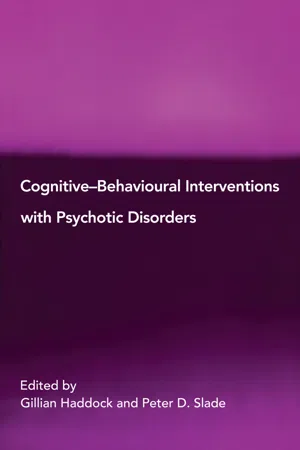
eBook - ePub
Cognitive-Behavioural Interventions with Psychotic Disorders
- 304 pages
- English
- ePUB (mobile friendly)
- Available on iOS & Android
eBook - ePub
Cognitive-Behavioural Interventions with Psychotic Disorders
About this book
Information
Part I
Historical Background
1
From Cognitive Studies of Psychosis to Cognitive-Behaviour Therapy for Psychotic Symptoms
Introduction
In the past few years a small number of researchers, mainly from Great Britain, have advocated the development of cognitive-behavioural interventions for psychotic patients, either as direct therapies for specific symptoms (e.g. Bentall et al., 1994a; Chadwick and Birchwood, 1994; Chadwick and Lowe, 1990; Fowler and Morley, 1989; Garety et al., 1994; Haddock et al., 1993; see Chapters 3, 4 and 7 of this book); as a way of enhancing patients’ coping skills (e.g. Tarrier et al., 1990; Tarrier et al., 1993; see Chapter 5 of this book); or as part of a normalising strategy designed to make patients more accepting of what would otherwise be disturbing experiences (e.g. Kingdon and Turkington, 1991, 1994; see Chapter 6 of this book). These authors have argued for renewed optimism about the prospects for developing individual psychological therapies adequate for the needs of the most seriously disturbed psychiatric patients, and have suggested that research into such therapies should be vigorously pursued as a matter of priority. In this chapter, I will show that this kind of optimism is consistent with recent advances in the understanding of the psychological mechanisms involved in psychotic symptomatology, and I will illustrate these advances by describing some of the investigations which my colleagues and I have carried out at Liverpool University. Before describing these recent advances, however, it will be useful to identify some inaccurate but widely held assumptions about the nature of psychotic disorders which in the past have tended to impede the development of psychological therapies for psychotic patients.
Pessimism and the Biological Zeitgeist
Paradoxically, recent advances in the cognitive-behavioural treatment of psychotic disorders have occurred following a period in which the scientific Zeitgeist has emphasised the importance of biological determinants of psychotic behaviour and de-emphasised the value of psychological theories and interventions. Nancy Andreasen (1984), in a popular account of the biological approach in psychiatry entitled The Broken Brain, looks forward to a time when the average psychiatric interview will be fifteen minutes in duration, when the starting point for psychiatric interventions will always be a diagnosis agreed according to operational criteria such as those given in the American Psychiatric Association’s Diagnostic and Statistical Manual (APA, 1987), and in which the most frequently used forms of psychiatric treatment will be those which involve adjusting the relative balance of different kinds of neurotransmitters in the brain by means of sophisticated medications. More recently, Samuel Guze has argued that, There can be no such thing as a psychiatry which is too biological’ (Guze, 1989, p. 315) and has suggested that disciplines such as neurochemistry and molecular genetics, rather than psychology, provide the vital background knowledge necessary for modern psychiatric practice.
Andreasen, Guze and other biological psychiatrists clearly see psychological treatments as having at best a marginal role in the management of severe mental illness. At its most extreme, this attitude has amounted to an almost complete rejection of social and psychotherapeutic methods of treatment (Herbst, 1987). Non-psychiatrists have at times also been sceptical about the value of individual psychological therapies for psychotic patients, although perhaps to a lesser degree. The psychologists Mueser and Berenbaum (1990), for example, in an editorial review published in a major psychiatric journal, concluded that outcome studies employing dynamic psychotherapy with ‘schizophrenic’ patients had been so disappointing that no further studies could be justified. However, these authors did recognise the value of behavioural and family therapies for ameliorating psychotic symptoms. Similarly, Alan Bellack (1992), a psychologist who has made important contributions to our understanding of the social deficits of ‘schizophrenic’ patients, recently argued that it is unlikely that cognitive rehabilitation treatments will prove efficacious with psychotic patients because the cognitive deficits underlying schizophrenia are poorly understood and because such therapies have not proved useful for patients suffering from brain damage. On Bellack’s view, instead of trying to treat core symptoms and deficits, psychologists should try and develop ways of helping schizophrenic patients cope with the limitations imposed on them by their disease. This point of view is particularly striking as, only six years earlier, Bellack (1986) had written a paper entitled ‘Schizophrenia: Behaviour therapy’s forgotten child’ in which he had chastised clinical psychologists for their failure to take the psychological treatment of psychosis seriously.
It will be useful, in passing, to examine two arguments which have been used to justify pessimism about the value of psychological therapies for psychotic patients. First, as Spring and Ravdin (1992) note, many researchers and clinicians have believed that the relative success of biological therapies means that research into the psychological treatment of psychosis is not warranted. On this view, the proven efficacy of neuroleptic medication indicates that costly and time consuming research into the psychological treatment of psychotic symptoms and behaviours is not necessary. However, this would be to adopt an over-generous view of the successes of biological interventions. While there is no doubt that a proportion of psychotic patients benefit from neuroleptic medications (Marder, 1992), even advocates of the biological approach admit that few patients, if any, can be said to be ‘cured’ by them (Andreasen, 1984). Moreover, recent research has indicated that a sizeable proportion of psychotic patients do not respond to medication at all (Brown and Herz, 1989), and that some may even do worse as a result of this kind of treatment (Warner, 1985). The efficacy of neuroleptic drugs is further limited by the substantial adverse effects associated with this kind of treatment, which are viewed as a serious impediment to therapy by some authors and a scandalous form of iatrogenesis by others (Breggin, 1993). Interestingly, in one of the few carefully conducted studies of attitudes towards neuroleptic medication, it was found that both patients and practising psychiatrists regarded side-effects as about as distressing to patients as the symptoms the drugs are used to treat (Finn et al., 1990). Indeed, the acknowledged inadequacy of currently available medical treatments for psychosis remains one of the main motivations for research into novel neuroleptics. Pessimism about the value of psychological therapies for psychotic patients cannot therefore be justified on the grounds that biological treatments already ‘do the job’.
A second, related argument has been that pessimism is warranted by the past failure of psychological therapies with psychotic patients, for example psychodynamic therapies (Mueser and Berenbaum, 1990). However, this argument cannot be sustained without presuming that the psychological treatment studies published to date exhaust the possible range of psychological interventions which nlight be carried out with psychotic patients. There is, of course, no reason to believe that the innovative skills of psychological researchers are any more limited than those of biological investigators. Indeed, the argument from past failure, if applied in the wake of the disappointing results of medical interventions already alluded to, would probably halt further research into chemotherapy overnight. History has no message for researchers in either the psychological or the biological domains.
What, then, has been the real cause of pessimism about psychological treatments for psychotic disorders? I would like to suggest that two conceptual fallacies have been at the root of this pessimism. These fallacies have been implicit in much of the biological theorising about psychotic behaviour which has been so popular in the recent past. The first is the assumption that psychotic disorders can be divided into a small number of discrete syndromes or symptom clusters. The second is the assumption that psychotic symptoms, because they reflect anatomical and physiological abnormalities in the brain, are not meaningful. I will suggest that neither of these assumptions survives close scrutiny of the relevant evidence. Furthermore, I will show how rejection of these assumptions has important implications for the future development of cognitive-behavioural treatments for psychotic patients.
Assumptions about Psychosis and Cognitive Interventions
Most of the current research into psychopathology takes as its starting point systems of psychiatric classification derived from the work of Kraepelin and others in the latter years of the last century (see Berrios and Hauser, 1988 and Boyle, 1991 for critical historical accounts). Although his methods would be judged unsophisticated by modern standards, Kraepelin was one of the first psychiatric researchers to collect information systematically about both the phenomenology of psychiatric disorders and their outcome as revealed by the careers of the patients whom he followed-up over many years. Kraepelin made the assumption (which was reasonable for the time) that phenomenological course and outcome data would converge to reveal a method of classifying psychiatric disorders which would ultimately lead to aetiological discoveries:
Judging from our experience in internal medicine it is a fair assumption that similar disease processes will produce identical symptom pictures, identical pathological anatomy and an identical aetiology. If, therefore, we possessed a comprehensive knowledge of any of these three fields - pathological anatomy, symptomatology, or aetiology - we would at once have a uniform and standard classification of mental diseases. A similar comprehensive knowledge of either of the other two fields would give us not just as uniform and standard classifications, but all of these classifications would exactly coincide.
(Kraepelin, 1907; quoted in Reider, 1974, pp. 260–1)
Following this kind of reasoning, Kraepelin, in the edition of his great textbook of psychiatry published in 1896, first collapsed a group of syndromes (previously described at various different times by Morel, Hecker and Kahlbaum) into the one disorder ‘dementia praecox’, so described because of its apparent early age of onset and chronic, deteriorating course. Contrasted against dementia praecox (renamed ‘schizophrenia’ by Bleuler in 1911) was the second major group of serious psychiatric disorders, the ‘manic depressive psychoses’ which, Kraepelin argued, generally began later in life and had a better outcome. This distinction, which has informed most subsequent attempts at psychiatric classification (see Boyle, 1991 for a historical account of developments from Kraepelin’s time to the present), has been described as one of the cornerstones of modern psychiatry (Kendell and Gourlay, 1970).
It is hard to overestimate the impact of Kraepelin’s system on both biological and psychological research into psychosis. The implication of his method of classification is that patients should be studied according to diagnostic grouping. Although patients diagnosed as schizophrenic according to his system present with diverse symptoms, it is assumed that these symptoms all reflect a common underlying disease process. Hence the most common research paradigm employed in psychological research into psychosis involves comparing a group of patients diagnosed as ‘schizophrenic’ with a group of individuals diagnosed as ‘normal’ (and perhaps, in order to control for the non-specific effects of illness, a group of patients diagnosed as suffering from some other kind of psychiatric disorder). Sarbin and Mancuso (1980) surveyed the Journal of Abnormal Psychology (formerly the Journal of Abnormal and Social Psychology) between the years 1959 and 1978, finding that 374 papers totalling 2,472 pages, or 15.3 per cent of the journal space, used the presence or absence of a diagnosis of schizophrenia as an independent variable in this way. There has been no sign that this trend has decreased in the years since Sarbin and Mancuso’s survey. This strategy can only hope to be successful, however, if those diagnosed as ‘schizophrenic’ have something in common which is absent in the case of the comparison groups.
When choosing dependent variables for research, most psychologists investigating psychotic behaviour have taken their lead from Bleuler (1911/1950), who assumed that schizophrenic symptoms reflect a core disorder of thinking. Investigators have thus tried to identify gross cognitive abnormalities in broadly defined groups of patients, usually without making any reference to the particular symptoms ex...
Table of contents
- Cover
- Half Title
- Title
- Copyright
- CONTENTS
- List of figures
- List of tables
- Notes on contributors
- Preface
- Acknowledgements
- Part I: Historical background
- Part II: Cognitive-behavioural interventions for psychotic symptoms
- Part III: Integrating with other therapeutic strategies
- Index
Trusted by 375,005 students
Access to over 1.5 million titles for a fair monthly price.
Study more efficiently using our study tools.
Frequently asked questions
Yes, you can cancel anytime from the Subscription tab in your account settings on the Perlego website. Your subscription will stay active until the end of your current billing period. Learn how to cancel your subscription
No, books cannot be downloaded as external files, such as PDFs, for use outside of Perlego. However, you can download books within the Perlego app for offline reading on mobile or tablet. Learn how to download books offline
Perlego offers two plans: Essential and Complete
- Essential is ideal for learners and professionals who enjoy exploring a wide range of subjects. Access the Essential Library with 800,000+ trusted titles and best-sellers across business, personal growth, and the humanities. Includes unlimited reading time and Standard Read Aloud voice.
- Complete: Perfect for advanced learners and researchers needing full, unrestricted access. Unlock 1.5M+ books across hundreds of subjects, including academic and specialized titles. The Complete Plan also includes advanced features like Premium Read Aloud and Research Assistant.
We are an online textbook subscription service, where you can get access to an entire online library for less than the price of a single book per month. With over 1.5 million books across 990+ topics, we’ve got you covered! Learn about our mission
Look out for the read-aloud symbol on your next book to see if you can listen to it. The read-aloud tool reads text aloud for you, highlighting the text as it is being read. You can pause it, speed it up and slow it down. Learn more about Read Aloud
Yes! You can use the Perlego app on both iOS and Android devices to read anytime, anywhere — even offline. Perfect for commutes or when you’re on the go.
Please note we cannot support devices running on iOS 13 and Android 7 or earlier. Learn more about using the app
Please note we cannot support devices running on iOS 13 and Android 7 or earlier. Learn more about using the app
Yes, you can access Cognitive-Behavioural Interventions with Psychotic Disorders by Gillian Haddock, Peter D. Slade, Gillian Haddock,Peter D. Slade in PDF and/or ePUB format, as well as other popular books in Psychology & Abnormal Psychology. We have over 1.5 million books available in our catalogue for you to explore.