![]()
Marketing strategy
Introduction and overview
INTRODUCTION
A strategy is a plan that integrates an organization's major goals, policies, decisions and sequences of action into a cohesive whole. It can apply at all levels in an organization and pertain to any of the functional areas of management. Thus there may be production, financial, marketing, personnel and corporate strategies, just to name a few. If we look specifically at marketing then there may be pricing, product, promotion, distribution, marketing research, sales, advertising, merchandising, etc. strategies. Strategy is concerned with effectiveness rather than efficiency and is the process of analysing the environment and designing the fit between the organization, its resources and objectives and the environment.
The strategic process refers to the manner in which strategy is formulated. There are several approaches:
■ the rational approach, making use of tools such as SWOT analysis and portfolio models
■ the flexible approach, which employs multiple scenario planning
■ the creative approach reflects the use of imagination in planning
■ the behavioural approach reflects the influence of power, politics and personalities; and finally,
■ the incremental approach is based on small adjustments or changes to previously successful strategies.
Nohria et al. (2003) put forward an analysis of 160 successful USA companies in the period 1986 to 1996. They all outperformed their competitors in terms of strategy their implementation. This supremacy was founded on:
■ clarity
■ consistent communication to customers, employees and shareholders
■ a value proposition relevant to targeted customers; and
■ a realistic appreciation of the company capabilities.
Marketing is about satisfying customer wants and needs and in the course of doing so facilitating the achievement of an organization's objectives. By paying attention to customer wants and needs, organizations are more likely to achieve their objectives in the market place. Of course, organizations have to compete with each other and so also have to satisfy customers' wants and needs at least as well as their competitors. Fortunately, organizations can do this in different ways. Competition involves finding a different way to satisfy customers from other organizations in the market place. In the pursuit of this end, products and services need to be seen as more than physical entities – it is the benefits they offer customers that are being purchased.
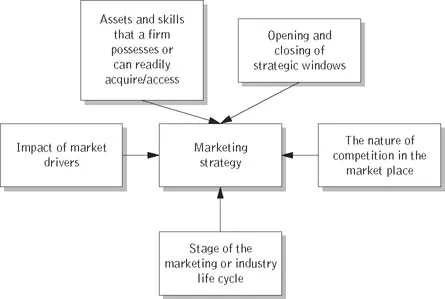
Competition involves positioning products and services in the minds of customers in such a way that the products and services are perceived to be different from one another. Marketing is about the competitive positioning of products and services in the minds of customers. It is also about the communication of messages and images (reflecting product and service positioning) and the means which are used to convey these messages and images to the customers (see Figure 1.1).
Marketing is also about managing relationships. In order to persuade the ultimate consumers of the products to buy, others concerned with the product have to be persuaded that what is on offer will satisfy customers' wants and needs. The chain of persuasion can stretch right back into the organization itself and involve employees of the company. This is the area where internal marketing has come to the fore in recent years. Building relationships with other organizations is also important. In fact this extends to anyone who has an interest or stake in the organization. Stakeholders are held to be those individuals or groups that have a ‘stake’ in the organization (see Carroll, 1993, p. 22). Stakeholders include customers, employees, management, stockholders, creditors, suppliers, community, and sometimes even competitors.
Shareholders are only one set of stakeholders in a business for customers, employees, suppliers and many others also have a vested interest in how the organization fares. The objective for a profit making organization might be to create value for its stakeholders in order to retain their interest and commitment of time and investment, financial or otherwise, to the organization.
During the 1980s and 1990s academics and practitioners in the field of strategic management began to focus on creating ‘shareholder value’ as the overall purpose of any commercial enterprise (Rappaport, 1986). The benefits suggested for this approach to strategic management were considered twofold: first, it put the interests of the owners of the business at the heart of strategy and, second, it engendered a more long-term approach to business decision-making than an emphasis upon profitability. Doyle (2000) argued that the creation of shareholder value should be used as the yardstick against which to measure marketing strategies. We might consider replacing the term “customers” with stakeholders in any definition of the role and scope of marketing since these include customers as well as the many other individuals, groups and organizations that deal with or are even employed by an organization. This could lead to defining marketing as:
Marketing is the management process responsible for identifying, anticipating and satisfying stakeholder requirements and in so doing serves to facilitate the achievement of the organization's objectives.
Figure 1.1 Factors impacting on marketing strategy The twenty-first century is seeing the development of strategic alliances and networks where firms work together towards shared goals and collaborate in their operations. Managing such relationships productively is almost certainly the key to success or failure.
The foregoing is at the heart of marketing strategy, which has to take into account the following factors:
1 the opening and closing of strategic windows
2 the impact of market drivers
3 the nature of competition in the market place
4 the stage of the market or industry life cycle
5 the assets and skills that a firm possesses or can readily acquire/access
6 stakeholder interests.
Cognizance of all of these factors is essential if effective long-term marketing strategies are to be evolved which will lead to a firm securing a strategic competitive advantage in industries or product markets. We will introduce these various ideas below.
Stakeholder interests and values
Stakeholder interests and values are important factors when considering strategic decisions (viz. Jensen, 2001). Stakeholder interests and values vary from firm to firm according to the industry and the markets that are served by the firm. Hence, there is no universal model which can be applied to every situation. However, to give some idea of the nature of these interests and the demands they place on a firm or other form organization consider the examples (Exhibits 1.1 and 1.2).
In undertaking an analysis of stakeholder interests, marketers should make sure the analysis considers how factors such as, product/service development and delivery, promotional mix, support services, manufacturing and production processes, R&D, and material purchasing affect the stakeholders' interested in healthcare in both the public and private sectors. The influence exerted by stakeholders over decisions related to these factors will depend on the power they wield and the attitude they have. In a private-sector organization management may have the most influence unless there is a single major shareholder with a very active interest in the business. Management's attitude towards decisions may therefore be the key determining factor in influencing what actions transpire.
EXHIBIT 1.1 SELECTED STAKEHOLDERS' INTERESTS FOR AN NHS ORGANIZATION
| Stakeholder | Interests |
Staff | ■ Provision of quality healthcare ■ Self-development and promotion prospects ■ Job satisfaction ■ Work in a safe and good quality environment |
Current patients | ■ Receive excellent care and attention ■ Enhance health prospects and life expectancy ■ Advice on how best to recover from treatment and avoid future health problems ■ Access to information ■ Support from medical staff |
Unions | ■ Responsibility to me... |