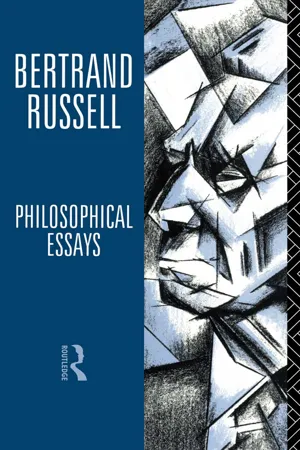
First published in 1966. This collection of essays dates from the first decade of this century and marks an important perio in the evolution of Bertrand Russell's thought. Russell intended the collection 'to appeal to those who take an interest in philosophical questions without having had a professional training in philosophy'- those people will find these writings just as illuminating today.
- 159 pages
- English
- ePUB (mobile friendly)
- Available on iOS & Android
eBook - ePub
Philosophical Essays
About this book
Information
Topic
PhilosophySubtopic
Philosophy History & TheoryI
THE ELEMENTS OF ETHICS1
I. THE SUBJECT-MATTER OF ETHICS
1. The study of Ethics is perhaps most commonly conceived as being concerned with the questions ‘What sort of actions ought men to perform?’ and ‘What sort of actions ought men to avoid?’ It is conceived, that is to say, as dealing with human conduct, and as deciding what is virtuous and what vicious among the kinds of conduct between which, in practice, people are called upon to choose. Owing to this view of the province of ethics, it is sometimes regarded as the practical study, to which all others may be opposed as theoretical; the good and the true are sometimes spoken of as independent kingdoms, the former belonging to ethics, while the latter belongs to the sciences.
This view, however, is doubly defective. In the first place, it overlooks the fact that the object of ethics, by its own account, is to discover true propositions about virtuous and vicious conduct, and that these are just as much a part of truth as true propositions about oxygen or the multiplication table. The aim is, not practice, but propositions about practice; and propositions about practice are not themselves practical, any more than propositions about gases are gaseous. One might as well maintain that botany is vegetable or zoology animal. Thus the study of ethics is not something outside science and co-ordinate with it: it is merely one among sciences.
2. In the second place, the view in question unduly limits the province of ethics. When we are told that actions of certain kinds ought to be performed or avoided, as, for example, that we ought to speak the truth, or that we ought not to steal, we may always legitimately ask for a reason, and this reason will always be concerned, not only with the actions themselves, but also with the goodness or badness of the consequences likely to follow from such actions. We shall be told that truth-speaking generates mutual confidence, cements friendships, facilitates the dispatch of business, and hence increases the wealth of the society which practises it, and so on. If we ask why we should aim at increasing mutual confidence, or cementing friendships, we may be told that obviously these things are good, or that they lead to happiness, and happiness is good. If we still ask why, the plain man will probably feel irritation, and will reply that he does not know. His irritation is due to the conflict of two feelings—the one, that whatever is true must have a reason; the other, that the reason he has already given is so obvious that it is merely contentious to demand a reason for the reason. In the second of these feelings he may be right; in the first, he is certainly wrong. In ordinary life, people only ask why when they are unconvinced. If a reason is given which they do not doubt, they are satisfied. Hence, when they do ask why, they usually have a logical right to expect an answer, and they come to think that a belief for which no reason can be given is an unreasonable belief. But in this they are mistaken, as they would soon discover if their habit of asking why were more persistent.
It is the business of the philosopher to ask for reasons as long as reasons can legitimately be demanded, and to register the propositions which give the most ultimate reasons that are attainable. Since a proposition can only be proved by means of other propositions, it is obvious that not all propositions can be proved, for proofs can only begin by assuming something. And since the consequences have no more certainty than their premisses, the things that are proved are no more certain than the things that are accepted merely because they are obvious, and are then made the basis of our proofs. Thus in the case of ethics, we must ask why such and such actions ought to be performed, and continue our backward inquiry for reasons until we reach the kind of proposition of which proof is impossible, because it is so simple or so obvious that nothing more fundamental can be found from which to deduce it.
3. Now when we ask for the reasons in favour of the actions which moralists recommend, these reasons are, usually, that the consequences of the actions are likely to be good, or if not wholly good, at least the best possible under the circumstances. Hence all questions of conduct presuppose the decision as to what things other than conduct are good and what bad. What is called good conduct is conduct which is a means to other things which are good on their own account; and hence the study of what is good on its own account is necessary before we can decide upon rules of conduct. And the study of what is good or bad on its own account must be included in ethics, which thus ceases to be concerned only with human conduct.
The first step in ethics, therefore, is to be quite clear as to what we mean by good and bad. Only then can we return to conduct, and ask how right conduct is related to the production of goods and the avoidance of evils. In this, as in all philosophical inquiries, after a preliminary analysis of complex data we proceed again to build up complex things from their simpler constituents, starting from ideas which we understand though we cannot define them, and from premisses which we know though we cannot prove them. The appearance of dogmatism in this procedure is deceptive, for the premisses are such as ordinary reasoning unconsciously assumes, and there is less real dogmatism in believing them after a critical scrutiny than in employing them implicitly without examination.
II. THE MEANING OF GOOD AND BAD
4. Good and Bad, in the sense in which the words are here intended (which is, I believe, their usual sense), are ideas which everybody, or almost everybody, possesses. These ideas are apparently among those which form the simplest constituents of our more complex ideas, and are therefore incapable of being analysed or built up out of other simpler ideas. When people ask ‘What do you mean by “good”?’ the answer must consist, not in a verbal definition such as could be given if one were asked ‘What do you mean by “pentagon”?’ but in such a characterization as shall call up the appropriate idea to the mind of the questioner. This characterization may, and probably will, itself contain the idea of good, which would be a fault in a definition, but is harmless when our purpose is merely to stimulate the imagination to the production of the idea which is intended. It is in this way that children are taught the names of colours: they are shown (say) a red book, and told that that is red; and for fear they should think ‘red’ means ‘book’, they are shown also a red flower, a red ball, and so on, and told that these are all red. Thus the idea of redness is conveyed to their minds, although it is quite impossible to analyse redness or to find constituents which compose it.
In the case of ‘good’, the process is more difficult, both because goodness is not perceived by the senses, like redness, and because there is less agreement as to the things that are good than as to the things that are red. This is perhaps one reason that has led people to think that the notion of good could be analysed into some other notion, such as pleasure or object of desire. A second reason, probably more potent, is the common confusion that makes people think they cannot understand an idea unless they can define it—forgetting that ideas are defined by other ideas, which must be already understood if the definition is to convey any meaning. When people begin to philosophize, they seem to make a point of forgetting everything familiar and ordinary; otherwise their acquaintance with redness or any other colour might show them how an idea can be intelligible where definition, in the sense of analysis, is impossible.
5. To explain what we mean by Good and Bad, we may say that a thing is good when on its own account it ought to exist, and bad when on its own account it ought not to exist. If it seems to be in our power to cause a thing to exist or not to exist, we ought to try to make it exist if it is good, and not exist if it is bad. When a thing is good, it is fitting that we should feel pleasure in its existence; when it is bad, it is fitting that we should feel pain in its existence. But all such characterizations really presuppose the notions of good and bad, and are therefore useful only as means of calling up the right ideas, not as logical definitions.
It might be thought that ‘good’ could be defined as the quality of whatever we ought to try to produce. This would merely put ought in the place of good as our ultimate undefined notion; but as a matter of fact the good is much wider than what we ought to try to produce. There is no reason to doubt that some of the lost tragedies of Aeschylus were good, but we ought not to try to re-write them, because we should certainly fail. What we ought to do, in fact, is limited by our powers and opportunities, whereas the good is subject to no such limitation. And our knowledge of goods is confined to the things we have experienced or can imagine; but presumably there are many goods of which we human beings have absolutely no knowledge, because they do not come within the very restricted range of our thoughts and feelings. Such goods are still goods, although human conduct can have no reference to them. Thus the notion of good is wider and more fundamental than any notion concerned with conduct; we use the notion of good in explaining what right conduct is, but we do not use the notion of right conduct in explaining what good is.
6. A fairly plausible view is that ‘good’ means the same as ‘desired’, so that when we say a thing is good we mean that it is desired. Thus anything is good which we either hope to acquire or fear to lose. Yet it is commonly admitted that there are bad desires; and when people speak of bad desires, they seem to mean desires for what is bad. For example, when one man desires another man's pain, it is obvious that what is desired is not good but bad. But the supporter of the view that ‘good’ means ‘desired’ will say that nothing is good or bad in itself, but is good for one person and perhaps bad for another. This must happen, he will say, in every case of a conflict of desires; if I desire your suffering, then your suffering is good for me, though it is bad for you. But the sense of good and bad which is needed in ethics is not in this way personal; and it is quite essential, in the study of ethics, to realize that there is an impersonal sense. In this sense, when a thing is good, it ought to exist on its own account, not on account of its consequences, nor yet of who is going to enjoy it. We cannot maintain that for me a thing ought to exist on its own account, while for you it ought not; that would merely mean that one of us is mistaken, since in fact everything either ought to exist or ought not. Thus the fact that one man's desire may be another man's aversion proves that ‘good’, in the sense relevant to ethics, does not mean the same as ‘desired’, since everything is in itself either good or not good, and cannot be at once good for me and bad for you. This could only mean that its effects on me were good, and on you bad; but here good and bad are again impersonal.
7. There is another line of argument, more subtle but more instructive, by which we can refute those who say that ‘good’ means ‘desired’, or who propose any other idea, such as pleasure, as the actual meaning of ‘good’. This line of argument will not prove that the things that are good are not the same as the things that are desired; but it will prove that, if this were the case, it could not be proved by appealing to the meaning of the word ‘good’. So far, it might be thought that such an argument could only have a purely logical importance. But in fact this is not so. Many ethical theories have been based upon the contention that ‘good’ means so-and-so, and people have accepted consequences of this contention which, if they had relied upon inspection untrammelled by false theory, they would almost certainly have rejected. Whoever believes that ‘good’ means ‘desired’ will try to explain away the cases where it seems as if what is desired is bad; but if he no longer holds this theory, he will be able to allow free play to his unbiased ethical perceptions, and will thus escape errors into which he would otherwise have fallen.
The argument in question is this: If anyone affirms that the good is the desired, we consider what he says, and either assent or dissent; but in any case our assent or dissent is decided by considering what the good and the desired really are. When, on the contrary, someone gives a definition of the meaning of a word, our state of mind is quite different. If we are told ‘a pentagon is a figure which has five sides’, we do not consider what we know about pentagons, and then agree or disagree; we accept this as the meaning of the word, and we know that we are getting information, not about pentagons, but merely about the word ‘pentagon’. What we are told is the sort of thing that we expect dictionaries to tell us. But when we are told that the good is the desired, we feel at once that we are being told something of philosophical importance, something which has ethical consequences, something which it is quite beyond the scope of a dictionary to tell us. The reason of this is, that we already know what we mean by the good, and what we mean by the desired; and if these two meanings always applied to the same objects, that would not be a verbal definition, but an important truth. The analogue of such a proposition is not the abov.e definition of a pentagon, but rather: ‘A pentagon (defined as above) is a figure which has five angles.’ Whenever a proposed definition sets us thinking whether it is true in fact, and not whether that is how the word is used, there is reason to suspect that we are not dealing with a definition, but with a significant proposition, in which the word professedly defined has a meaning already known to us, either as simple or as defined in some other way. By applying this test, we shall easily convince ourselves that all hitherto suggested definitions of the good are significant, not merely verbal, propositions; and that therefore, though they may be true in fact, they do not give the meaning of the word ‘good’.
The importance of this result is that so many ethical theories depend upon the denial of it. Some have contended that ‘good’ means ‘desired’, others that ‘good’ means ‘pleasure’, others again that it means ‘conformity to Nature’ or ‘obedience to the will of God’. The mere fact that so many different and incompatible definitions have been proposed is evidence against any of them being really definitions; there have never been two incompatible definitions of the word ‘pentagon’. None of the above are really definitions; they are all to be understood as substantial affirmations concerning the things that are good. All of them are, in my opinion, mistaken in fact as well as in form, but I shall not here undertake to refute them severally.
8. It is important to realize that when we say a thing is good in itself, and not merely as a means, we attribute to the thing a property which it either has or does not have, quite independently of our opinion on the subject, or of our wishes or other people's. Most men are inclined to agree with Hamlet: ‘There is nothing good or bad but thinking makes it so.’ It is supposed that ethical preferences are a mere matter of taste, and that if X thinks A is a good thing, and Y thinks it is a bad thing, all we can say is that A is good for X and bad for Y. This view is rendered plausible by the divergence of opinion as to what is good and bad, and by the difficulty of finding arguments to persuade people who differ from us in such a question. But the difficulty in discovering the truth does not prove that there is no truth to be discovered. If X says A is good, and Y says A is bad, one of them must be mistaken, though it may be impossible to discover which. If this were not the case, there would be no difference of opinion between them. If, in asserting that A is good, X meant merely to assert that A had a certain relation to himself, say of pleasing his taste in some way; and if Y, in saying that A is not good, meant merely to deny that A had a like relation to himself: then there would be no subject of debate between them. It would be absurd, if X said ‘I am eating a pigeon-pie’, for Y to answer ‘that is false: I am eating nothing’. But this is no more absurd than a dispute as to what is good, if, when we say A is good, we mean merely to affirm a relation of A to ourselves. When Christians assert that God is good, they do not mean merely that the contemplation of God rouses certain emotions in them: they may admit that this contemplation rouses no such emotion in the devils who believe and tremble, but the absence of such emotions is one of the things that make devils bad. As a matter of fact, we consider some tastes better than others: we do not hold merely that some tastes are ours and other tastes are other people's. We do not even always consider our own tastes the best: we may prefer bridge to poetry, but think it better to prefer poetry to bridge. And when Christians affirm that a world created by a good God must be a good world, they do not mean that it must be to their taste, for often it is by no means to their taste, but they use its goodness to argue that it ought to be to their taste. And they do not mean merely that it is to God's taste: for that would have been equally the case if God had not been good. Thus, good and bad are qualities which belong to objects independently of our opinions, just as much as round and square do; and when two people differ as to whether a thing is good, only one of them can be right, though it may be very hard to know which is right.
9. One very important consequence of the indefinability of ‘good’ must be emphasized, namely, the fact that knowledge as to what things exist, have existed, or will exist, can throw absolutely no light upon the question as to what things are good. There might, as far as mere logic goes, be some general proposition to the effect ‘whatever exists, is good’, or ‘whatever exists, is bad’, or ‘what will exist is better (or worse) than what does exist’. But no such general proposition can be proved by considering the meaning of ‘good’, and no such general proposition can be arrived at empirically from experience, since we do not know the whole of what does exist, nor yet of what has existed or will exist. We cannot therefore arrive at such a general proposition, unless it is itself self-evident, or follows from some self-evident proposition, which must (to warrant the consequence) be of the same general kind. But as a matter of fact, there is, so far as I can discover, no self-evident proposition as to the goodness or badness of all that exists or has existed or will exist. It follows that, from the fact that the existent world is of such and such a nature, nothing can be inferred as to what things are good or bad.
10. The belief that the world is wholly good has, nevertheless, been widely held. It has been held either because, as a part of revealed religion, the world has been supposed created by a good and omn...
Table of contents
- Cover
- Title Page
- Copyright Page
- Table of Contents
- Preface
- Preface to Original Edition
- I. The Elements of Ethics
- II. On History
- III. Science and Hypothesis (A Review)
- IV. Pragmatism
- V. William James's Conception of Truth
- VI. The Monistic Theory of Truth
- VII. On the Nature of Truth and Falsehood
Trusted by 375,005 students
Access to over 1.5 million titles for a fair monthly price.
Study more efficiently using our study tools.
Frequently asked questions
Yes, you can cancel anytime from the Subscription tab in your account settings on the Perlego website. Your subscription will stay active until the end of your current billing period. Learn how to cancel your subscription
No, books cannot be downloaded as external files, such as PDFs, for use outside of Perlego. However, you can download books within the Perlego app for offline reading on mobile or tablet. Learn how to download books offline
Perlego offers two plans: Essential and Complete
- Essential is ideal for learners and professionals who enjoy exploring a wide range of subjects. Access the Essential Library with 800,000+ trusted titles and best-sellers across business, personal growth, and the humanities. Includes unlimited reading time and Standard Read Aloud voice.
- Complete: Perfect for advanced learners and researchers needing full, unrestricted access. Unlock 1.5M+ books across hundreds of subjects, including academic and specialized titles. The Complete Plan also includes advanced features like Premium Read Aloud and Research Assistant.
We are an online textbook subscription service, where you can get access to an entire online library for less than the price of a single book per month. With over 1.5 million books across 990+ topics, we’ve got you covered! Learn about our mission
Look out for the read-aloud symbol on your next book to see if you can listen to it. The read-aloud tool reads text aloud for you, highlighting the text as it is being read. You can pause it, speed it up and slow it down. Learn more about Read Aloud
Yes! You can use the Perlego app on both iOS and Android devices to read anytime, anywhere — even offline. Perfect for commutes or when you’re on the go.
Please note we cannot support devices running on iOS 13 and Android 7 or earlier. Learn more about using the app
Please note we cannot support devices running on iOS 13 and Android 7 or earlier. Learn more about using the app
Yes, you can access Philosophical Essays by Bertrand Russell in PDF and/or ePUB format, as well as other popular books in Philosophy & Philosophy History & Theory. We have over 1.5 million books available in our catalogue for you to explore.