This edition of the Handbook follows the first edition by 10 years. The earlier edition was a promissory note, presaging the directions in which the then-emerging field of social cognition was likely to move. The field was then in its infancy and the areas of research and theory that came to dominate the field during the next decade were only beginning to surface. The concepts and methods used had frequently been borrowed from cognitive psychology and had been applied to phenomena in a very limited number of areas. Nevertheless, social cognition promised to develop rapidly into an important area of psychological inquiry that would ultimately have an impact on not only several areas of psychology but other fields as well.
The promises made by the earlier edition have generally been fulfilled. Since its publication, social cognition has become one of the most active areas of research in the entire field of psychology; its influence has extended to health and clinical psychology, and personality, as well as to political science, organizational behavior, and marketing and consumer behavior. The impact of social cognition theory and research within a very short period of time is incontrovertible. The present volumes provide a comprehensive and detailed review of the theoretical and empirical work that has been performed during these years, and of its implications for information processing in a wide variety of domains.
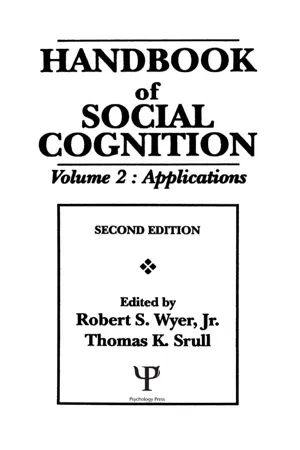
The handbook is divided into two volumes. The first provides an overview of basic research and theory in social information processing, covering the automatic and controlled processing of information and its implications for how information is encoded and stored in memory, the mental representation of persons -- including oneself -- and events, the role of procedural knowledge in information processing, inference processes, and response processes. Special attention is given to the cognitive determinants and consequences of affect and emotion. The second book provides detailed discussions of the role of information processing in specific areas such as stereotyping; communication and persuasion; political judgment; close relationships; organizational, clinical and health psychology; and consumer behavior.
The contributors are theorists and researchers who have themselves carried out important studies in the areas to which their chapters pertain. In combination, the contents of this two-volume set provide a sophisticated and in-depth treatment of both theory and research in this major area of psychological inquiry and the directions in which it is likely to proceed in the future.
- 536 pages
- English
- ePUB (mobile friendly)
- Available on iOS & Android
eBook - ePub
About this book
Information
1 | Stereotypes |
University of California, Santa Barbara
Contents
Cognitive Processes in Stereotype Formation
Categorization
Illusory Correlation
Stereotypes as Cognitive Structures
Early Approaches
Cognitive Representations of Groups and Group Members
Representation of Group Variability Information
Stereotyping and Information Processing
Stereotypes: Encoding and Retrieval Biases
Stereotyping and Inference
The Automaticity of Stereotyping
Affect, Cognition, and Stereotyping
Incidental Affect and Stereotyping
Integral Affect and Stereotyping
Stereotype Change
Models of Stereotype Change
Research Evidence
A Final Comment
Acknowledgments
References
What is a stereotype?
How do people develop stereotypes, and why?
Why are stereotypes so prevalent and persistent?
When and how are stereotypes used?
How can we change people’s stereotypes?
These are questions that all of us – lay people and social scientists alike – have pondered when we think about stereotypes and their effects on our perceptions of various ethnic groups. Although seemingly simple, these questions cut to the heart of the nature and functioning of stereotypes. They are questions of both societal and scientific concern and have been for a long time. Despite their importance, neither society nor science has dealt adequately with the issues and problems that these questions raise.
This chapter assesses what we have learned about some of those issues from social psychological research, and particularly from research guided by a social cognition approach to the topic. Our review and analysis is organized around questions much like those posed earlier. However, we shall see that, when approached scientifically, these broad questions actually mask a number of more specific questions, each of which presents its own issues for analysis.
A decade ago, Ashmore and Del Boca (1981) provided a useful summary of three conceptual approaches that have guided past theorizing and research on stereotyping and intergroup perceptions. They identified these approaches as the psychodynamic, sociocultural, and cognitive orientations.
The psychodynamic approach emphasizes the role of motivational forces and psychological benefits that can lead to and perpetuate the use of stereotypes. With its roots in Freudian thinking, this perspective includes the use of defense mechanisms such as projection and displacement of self-related sources of tension onto others, scapegoating, and an emphasis on how early childhood experiences affect intrapsychic needs in explaining intergroup perceptions. The sociocultural approach focuses on the variety of means by which intergroup beliefs and attitudes are acquired and maintained through social learning and social reinforcements. The focus is on how stereotypes and prejudice can be learned and perpetuated through socialization experiences, peer group influence, and media portrayals. The cognitive approach views stereotypes as belief systems or cognitive structures that can guide information processing, and it examines how those structures arise and how their influence on information processing affects perceptions of and interactions with members of stereotyped groups.
These orientations offer complementary, rather than competing, explanations for various phenomena involving intergroup perception. Therefore, it is likely that any single orientation is limited to providing only a partial account of these phenomena (Hamilton & Trolier, 1986; Stroebe & Insko, 1989). Nevertheless, most research on how stereotypes form and function has been guided by the concepts and methods of one of these approaches. In recent years, the cognitive approach has been particularly active and influential in generating such research. Like the other contributions to this handbook, this chapter emphasizes the advances in understanding that have been generated by an information processing analysis. However, as a means of placing this work in context, at several points we include commentary reflecting the other orientations and contrasting their emphases with those of the cognitive approach.
From the cognitive perspective, a stereotype can be defined as “a cognitive structure that contains the perceiver’s knowledge, beliefs, and expectations about a human group” (Hamilton & Trolier, 1986, p. 133). Stereotypes are abstract knowledge structures linking a social group to a set of traits or behavioral characteristics. As such, stereotypes act as expectancies that guide the processing of information about the group as a whole and about particular group members (Hamilton, Sherman, & Ruvolo, 1990). In addition to these generalized expectancies, one’s knowledge about particular group members (or exemplars) also may influence judgments about groups and their members.
COGNITIVE PROCESSES IN STEREOTYPE FORMATION
How do people develop stereotypes? We suspect that most people, if asked this question, would respond in one of two ways. On the one hand, they might point to the important influence of parents and other significant figures (e.g., teachers, peer groups) on the attitudes and beliefs that people develop in their formative years. On the other hand, they might cite the impact of public media, noting that people come to believe what they see about various ethnic groups as they are portrayed on television and in movies.
These would not be unreasonable answers to the question. In fact, these mechanisms are at the heart of sociocultural explanations of stereotyping. The seeds of people’s conceptions of various racial and gender groups are planted in early childhood by influential adults in their lives, and they are fostered and perpetuated through their repeated perceptions of members of these groups in certain social roles as they are portrayed in the media. The role of social learning processes in the formation and maintenance of stereotypes has been a major focus of intergroup research for a long time.
In addition to these processes, the cognitive approach to stereotyping has focused on other mechanisms that can contribute to the initial formation of stereotypic belief systems. Although this approach also has a long history, it has been the catalyst for an enormous amount of research during the last 15 years. This resurgence is due, at least in part, to several empirical discoveries during the 1970s that pointed to cognitive mechanisms and biases that, in and of themselves, could contribute to the formation of stereotypes, independently of actual intergroup conflict or of social influences from significant others.
Stereotyping depends on the perception that a group of persons comprises a meaningful social entity. If individual persons were not perceived as belonging to some social unit, then there would be no basis for developing a stereotype. Inherent in this process is the perceptual separation of different social categories.
Hence, stereotyping begins with the perceptual differentiation between groups of persons. That differentiation does not, in itself, mean that a stereotype will be formed; we know, for example, that there are blue-eyed and brown-eyed people, but we do not have rich stereotypes associated with these groups. The formation of the stereotype involves an additional step of associating certain attributes or features with those differentially perceived groups. That is, we develop beliefs about the attributes that are characteristic of each group and therefore distinguish between the groups. But these belief systems will not form if we have not already identified a collection of individuals as a group and differentiated those persons from some others. Therefore, any process that contributes to the differentiation between groups constitutes a potential basis for the formation of stereotypes. One of the key contributing factors to the resurgence of the cognitive approach to stereotypes was the fact that several lines of research provided evidence of how cognitive mechanisms can contribute to this process.
Categorization
In their perceptions of others, people often “see” others not (or not solely) as individual persons, but rather as members of social groups. Given that each person belongs to numerous social groups (based on gender, race, nationality, religion, occupation and socioeconomic status, political orientation, lifestyle, interests, etc.), viewing others in terms of such category memberships certainly captures some of the important elements of social structure and social life. In that sense, categorizing others into groups simply reflects social reality. However, beyond that, research has shown that aspects of people’s cognitive mechanisms and functioning contribute to and derive from this categorization process (Hamilton & Trolier, 1986; Miller & Brewer, 1986; Oakes & Turner, 1990; Taylor, 1981). These mechanisms can have important implications for people’s perceptions of and behavior toward group members.
The important role of categorization in stereotyping has been recognized for many decades. It was implicit in Lippmann’s (1922) insightful analysis of the use of stereotypes in perceptions of groups. Its role was emphasized explicitly by Allport (1954) in his classic analysis of stereotyping and prejudice. But it was the simultaneous and independent development of two quite different lines of work in the early 1970s that led to an explosion of research on the role of categorization in intergroup perception. One was the development of cognitive psychology and its focus on how acquired information is organized and stored in terms of long-term “knowledge structures.” The other was a program of research initiated by Tajfel (1969, 1970) that provided empirical documentation of the fundamental impact of the categorization process on social perception and behavior. Both of these initiatives focused attention on the role of cognitive factors in stereotyping and intergroup perception.
To understand the role of categorization in stereotyping, several questions need to be addressed. First, why do people categorize others into groups at all? Why not simply perceive and understand them as individuals? Second, what are the bases of social categorization? What determines the particular categorization(s) that will be used in any given situation? Third, when will the perceiver categorize others according to social groups, and when will others be perceived as individual persons? The pervasive importance of the categorization process becomes apparent as these and other issues are discussed in this chapter. We begin with the question of why people categorize others into groups.
Why Categorize?
Why would perceivers overlook the individuality of the persons they encounter and move instead to viewing them in terms of social categories? Two major forces driving such categorization are prevalent in the literature. One emphasis views categorization as a cognitive mechanism serving the informational needs of the perceiver. Specifically, the perceiver (a) must use a limited cognitive processing system to cope with a rich and complex social stimulus environment, yet (b) needs to understand and anticipate interactions with that environment. Categorization can facilitate meeting both of those demands. The second emphasis views social categorization as deriving from people’s desire to evaluate themselves positively, and therefore as motivated to see their own group as different from – and better than – other social groups. We consider each of these bases of categorization in the following subsections.
Categorization as Cognitive Efficiency. One reason to categorize others based on their apparent similarities derives from the sheer complexity of the social environment. The richness of social stimulation provided by that environment places processing demands on the human cognitive system. Therefore, attention is directed at some aspects of the social environment while others are ignored. Simplifying strategies for dealing with this information overload become functionally adaptive. As a consequence, perceivers group objects in their stimulus world into categories on the basis of their similarities and differences. Thus, categorization can be a response to the demands of information overload.
This function of perceiving others in terms of groups was demonstrated by Rothbart, Fulero, Jensen, Howard, and Birrell (1978). Subjects were presented information describing the attributes of individuals and were subsequently asked to rate the group composed of these persons on a series of attributes. The stimulus items (person-attribute pairings) were arranged such that the experimenters could determine whether subjects’ ratings of the group were based on an accumulation of their conceptions of individual persons or, alternatively, on their conception of the group as a whole. When the number of stimulus items was relatively small (low memory load condition), subjects’ judgments indicated that they organized the stimulus information in terms of the individual persons described. In contrast, when a large number of stimulus descriptions was presented (high memory load condition), subjects organized the descriptive information in terms of the group as a whole. Thus, under conditions of strained capacity, perceivers were less likely to develop person-based conceptions than to establish a categorical representation at the group level.
According to this cognitive view, then, categorization is, in part, a response to information overload, serving to simplify the perceiver’s processing task. In this sense, categorization involves information loss. But this is not the whole story. An important consequence of categorization is that it also affords information gain. That is, through categorization, persons typically are perceived in terms of social groups about whom the perceiver, through past experiences and social learning, has developed knowledge and beliefs. This accumulated knowledge and beliefs can then be applied in understanding individual group members through inference processes. Assuming that these representations are veridical to some extent (or at least might be “functionally accurate”; Swann, 1984), these stereotype-based elaborations are likely to be useful in going beyond the information available. Thus, from the cognitive perspective, categorization involves both information loss and information gain.
Categorization as Self-Enhancement. In addition to these cognitive mechanisms that promote categorization, several motivational factors have been proposed that contribute to this same process (Maass & Schaller, 1991; Stangor & Ford, 1992; Stroebe & Insko, 1989). The most prominent theoretical account emphasizing motivational roots of categorization is social identity theory (Tajfel & Turner, 1979, 1986; see also Turner, 1987). The central hypothesis of this theory is that a person’s self-esteem is, in part, derived from his or her membership in social groups. Because people typically want to maintain positive self-regard, they are motivated to hold favorable evaluations of the groups to which they belong. But there is no objective yardstick for gauging the desirability of any particular social group; such evaluations are inherently subjective. Therefore, people enhance their own group’s favorability by psychologically establishing its relative superiority in comparison with some out-group. Thus, people are motivated to accentuate the evaluative difference between in-group and out-group, thereby creating intergroup discrimination based on the desire to maintain positive identity.
The development of social identity theory was stimulated by the consistent finding of in-group bias – that people evaluate their in-groups more favorably than out-groups, even when the intergroup distinction is arbitrary or based on a trivial criterion (Tajfel, 1970; see later section on in-group/out-group differentiation). Evidence for this effect is pervasive (Brewer, 1979; Messick & Mackie, 1989) and consistent with social identity theory, although the important role of self-esteem maintenance in producing these intergroup effects has not been established clearly by research findings (Maass & Schaller, 1991; Messick & Mackie, 1989).
Bases of Social Categorization
As you are on your way to work early one morning, you notice a group of joggers running through a park. One of them is an attractive, 30-ish woman, well attired in her sweatshirt and sweatpants, headband, and running shoes. In noticing her, you might think of this woman in terms of any of several social categories to which she might belong. For example, you might categorize her as a woman, or as a runner, or more specifically, as a female runner. From her age group and expensive sportswear, you might regard her as a “yuppie.” Or, in more general terms, you might think of her as “a person who tries to stay physically fit.” Any of these might be plausible – and reasonably accurate – categorizations. On the other hand, you are unlikely to immediately think of her as “a resident of my community” (which also would be accurate).
This example illustrates that each person is a member of numerous social groupings, any one of which might serve as an appropriate categorical basis for perceiving the person. What determines which of several possible categorizations will be used in one’s perception of this person? At this point, it is...
Table of contents
- Cover
- Half Title
- Title Page
- Copyright Page
- Table of Contents
- Foreword
- Preface
- 1. Stereotypes
- 2. Cognitive Processes in Attitude Change
- 3. Cognitive Perspective in Political Psychology
- 4. Some Cognitive Structures and Processes Relevant to Relationship Functioning
- 5. Social Cognition and Health Psychology
- 6. Social Cognition and Clinical Psychology: Anxiety, Depression, and the Processing of Social Information
- 7. On the Synergy Between Theory and Application: Social Cognition and Performance Appraisal
- 8. Consumer Judgment and Decision Processes
- Author Index
- Subject Index
Trusted by 375,005 students
Access to over 1.5 million titles for a fair monthly price.
Study more efficiently using our study tools.
Frequently asked questions
Yes, you can cancel anytime from the Subscription tab in your account settings on the Perlego website. Your subscription will stay active until the end of your current billing period. Learn how to cancel your subscription
No, books cannot be downloaded as external files, such as PDFs, for use outside of Perlego. However, you can download books within the Perlego app for offline reading on mobile or tablet. Learn how to download books offline
Perlego offers two plans: Essential and Complete
- Essential is ideal for learners and professionals who enjoy exploring a wide range of subjects. Access the Essential Library with 800,000+ trusted titles and best-sellers across business, personal growth, and the humanities. Includes unlimited reading time and Standard Read Aloud voice.
- Complete: Perfect for advanced learners and researchers needing full, unrestricted access. Unlock 1.5M+ books across hundreds of subjects, including academic and specialized titles. The Complete Plan also includes advanced features like Premium Read Aloud and Research Assistant.
We are an online textbook subscription service, where you can get access to an entire online library for less than the price of a single book per month. With over 1.5 million books across 990+ topics, we’ve got you covered! Learn about our mission
Look out for the read-aloud symbol on your next book to see if you can listen to it. The read-aloud tool reads text aloud for you, highlighting the text as it is being read. You can pause it, speed it up and slow it down. Learn more about Read Aloud
Yes! You can use the Perlego app on both iOS and Android devices to read anytime, anywhere — even offline. Perfect for commutes or when you’re on the go.
Please note we cannot support devices running on iOS 13 and Android 7 or earlier. Learn more about using the app
Please note we cannot support devices running on iOS 13 and Android 7 or earlier. Learn more about using the app
Yes, you can access Handbook of Social Cognition by Robert S. Wyer, Jr.,Thomas K. Srull in PDF and/or ePUB format, as well as other popular books in Psychology & History & Theory in Psychology. We have over 1.5 million books available in our catalogue for you to explore.