![]()
Chapter 1
Images of Wilson
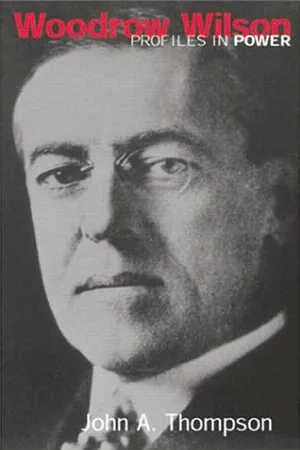
Woodrow Wilson was at one time the most famous political figure in the world. When in December 1918 he became the first serving US president to leave North America, his arrival in Europe to take part in the peace conference following the First World War was treated by multitudes like the Second Coming. One young American on his staff described his reception in Paris:
The parade from the station to the Murat house in Rue de Monceau, which is to be his official residence, was accompanied by the most remarkable demonstration of enthusiasm and affection on the part of the Parisians that I have ever heard of, let alone seen … Troops, cavalry and infantry, lined the entire route and tens of thousands of persons fought for a glimpse. The streets were decorated with flags and banners, Wilson’s name was everywhere, and huge ‘Welcome Wilson’ and ‘Honor to Wilson, the Just’ signs stretched across the streets from house to house.1
Wilsons receptions in England and Italy matched those given to him in France. What were the reasons for this popular acclaim? Many, including the President himself, took it to be a response to the ideals and principles he had proclaimed. In a series of speeches in Washington, both before and after American entry into the war, Wilson had called for ‘a new international order based upon broad and universal principles of right and justice’, including a league of nations that would afford ‘mutual guarantees of political independence and territorial integrity to great and small nations alike’, and thus ‘make it virtually impossible that any such catastrophe should ever overwhelm us again.2 These speeches, even the Fourteen Points address of January 1918 that referred to specific territorial questions, had consisted more of the elegant proclamation of general principles than of the formulation of precise proposals. But this had done nothing to diminish their moral force and popular appeal. To Europeans generally’, Victor Mamatey has written, ‘his speeches, circulated in hasty and execrable newspaper translations, in enemy countries moreover censored, were impressive but largely incomprehensible – a fact which stimulated rather than weakened the growth of the Wilsonian myth. The exalted and inscrutable are natural ingredients of myths’3 British liberals took a less cynical view. For a brief interval Wilson stood alone for mankind’, H.G. Wells recalled.
And in that brief interval there was a very extraordinary and significant wave of response to him throughout the earth. So eager was the situation that all humanity leapt to accept and glorify Wilson – for a phrase, for a gesture. It seized upon him as its symbol. He was transfigured in the eyes of men. He ceased to be a common statesman; he became a Messiah. Millions believed him as the bringer of untold blessings; thousands would gladly have died for him.4
To the authority of a pope, Wilson seemed to add the might of an emperor. Indeed, many of those cheering him were probably expressing gratitude for the American contribution to the Allies’ victory or hailing the man that they thought would dominate the peace conference. In 1918, even more clearly than in 1945, American power had determined the outcome of the European conflict. Although the United States had not entered the war until April 1917 and the 115,000 members of the American Expeditionary Force (AEF) who lost their lives represented only a fraction of the combat deaths suffered by the other major belligerents, it is quite possible that Ludendorff’s great offensive in the spring and early summer of 1918 would have succeeded had it not been for the Americans who came into the line in substantial numbers at this point and were blooded at Belleau Wood and Chateau-Thierry. Certainly, the psychological collapse of the German army in the autumn owed much to the seemingly endless supply of fresh American troops, then arriving at the rate of nearly 10,000 per day. By the time of the armistice, the two million American soldiers in France already outnumbered the British; had the war lasted a few months more, they would have outnumbered the French, too.
Even more important than its military and naval contribution to the defeat of the Central Powers had been America’s economic and financial strength. The enormous productive capacity of the American economy was heavily drawn on by the Allies before the United States itself became a belligerent, to the extent that by the autumn of 1916 almost 40 percent of the British Treasury’s war spending was in North America.5 The consequent trade imbalance was hard to finance and the British had almost run out of means to do so when the American declaration of war on Germany solved the problem by opening the way for intergovernmental loans. By 1919, the United States was owed over $10 billion by its co-belligerents and had in addition become a net creditor on its international private investment account to the tune of more than $3.5 billion.6 ‘Mr Wilson had not invented any new political philosophy’; the British diplomat and writer, Harold Nicolson; later observed. The one thing which rendered Wilsonism so passionately interesting at the moment was the fact that this centennial dream was suddenly backed by the overwhelming resources of the strongest Power in the world.’7
In whatever proportion it was the warrior or the priest that the European crowds were hailing, their acclaim itself enhanced the perception of Wilsons power. For this was a moment, in the wake of the collapse of the Tsarist, Habsburg, Hohenzollern and Ottoman empires, when democratic values were enjoying a new and much wider legitimacy. In a famous tract, John Maynard Keynes observed that
When President Wilson left Washington he enjoyed a prestige and a moral influence throughout the world unequalled in history. His bold and measured words carried to the peoples of Europe above and beyond the voices of their own politicians. The enemy peoples trusted him to carry out the compact he had made with them; and the Allied peoples acknowledged him not as a victor only but almost as a prophet. In addition to this moral influence the realities of power were in his hands. The American armies were at the height of their numbers, discipline, and equipment. Europe was in complete dependence on the food supplies of the United States; and financially she was even more absolutely at their mercy. Europe not only already owed the United States more than she could pay; but only a large measure of further assistance could save her from starvation and bankruptcy. Never had a philosopher held such weapons wherewith to bind the princes of this world.8
Keynes penned these words in a spirit of disillusionment, having been shocked and depressed by the extent to which the Treaty of Versailles departed from the terms of the Fourteen Points and the ‘spirit of unselfish and unbiased justice’ in which Wilson had said the settlement should be made.9 The vision of a new world order was shattered even more emphatically when the failure of the Senate to approve the peace treaty prevented the United States itself from participating in the League of Nations. In his attempt to rally public support for ratification, Wilson embarked in September 1919 on a speaking tour across the country in which he traveled 8,000 miles in 22 days and delivered 32 major addresses – all but one of them without benefit of amplification. This tremendous physical effort by a man already in poor health had to be cut short when he collapsed shortly after speaking in Pueblo, Colorado; a few days after his return to Washington, he suffered a severe stroke from which he never really recovered. The contrast between the pathetic invalid in the White House and the triumphant figure who had arrived in Europe a year earlier vividly symbolized Wilsons failure to achieve his high goals.
It has also shaped the images of Wilson that have persisted down the years. These have always diverged sharply. To those brought up in the Christian tradition, the rejection of his message by the forces of selfish nationalism and hatred on both sides of the ocean, and his own ‘martyrdom’ in the cause of world peace, could easily be assimilated to the story of an earlier Messiah. ‘Not Wilson, but humanity, failed at Paris’, declared the South African leader, Jan Christiaan Smuts.10 Certainly, many have shared Patrick Devlins view that ‘Wilson in the twentieth century represents idealism in action.’ Devlin, an eminent British jurist and Catholic, was inspired to make a detailed study of Wilson’s policy during the period of neutrality by the belief that the President was ‘under the control of an ideal’ that ‘sought to introduce into international affairs the Christian ideal of peace upon earth for men of goodwill to be brought about through the Christian ethic of service to others’.11 The leading modern authority on Wilson, Arthur S. Link, has described him as ‘primarily a Christian idealist… a man who almost always tended to judge policies on a basis of whether they were right by Christian standards, not whether they brought immediate material or strategic advantage’.12
This picture of Wilson has been broadly accepted by some who have seen it in a less favorable light. As Link himself has observed, there has always been a tendency in Europe to see him as
a well-intentioned idealist, a man good by ordinary Christian standards, but essentially a destructive force in modern history because he was visionary, unrealistic, provincial, and ignorant of European problems, and zealous and messianic in conceit but devoid of either practical knowledge or the humility to follow others better informed than he.13
This image owed something to the portraits painted by Keynes and Harold Nicolson, both of whom had served as junior members of the British delegation in Paris and had been bitterly disappointed by the extent to which the treaty violated the principles Wilson had laid down. Neither man was impressed by Wilson’s skill as a negotiator and Keynes concluded that ‘the President was like a nonconformist minister, perhaps a Presbyterian. His thought and his temperament were essentially theological not intellectual, with all the strength and the weakness of that manner of thought, feeling, and expression.’14
If Keynes’s condescending tone was very much his own, it also seemed to reflect the somewhat snobbish disdain that marked the attitude of many upper-class Europeans to the representatives of this new world power.
The first glance at the President [he remarked] suggested not only that, whatever else he might be, his temperament was not primarily that of the student or the scholar, but that he had not much even of that culture of the world which marks M. Clemenceau or Mr Balfour as exquisitely cultivated gentlemen of their class and generation.15
As well as arousing hopes and receiving plaudits in Europe, Wilson was the target of much hostility. No one expressed this more unreservedly than Sigmund Freud, viewing events from Vienna, that special victim of the First World War. The figure of the American President, as it rose above the horizon of Europeans, was from the beginning unsympathetic to me’ Freud confessed in the introduction to ‘a psychological study’ of Wilson that he composed in collaboration with the American diplomat William C. Bullitt who, as a young man, had resigned from the US delegation to the Paris peace conference in protest against the harsh terms of the German treaty. Freud stressed what he believed to be Wilson’s ignorance of European languages, culture, and geography, and his immersion in ‘the ideas and ideals of the middle-class Bible-reading British’. On the basis of biographical data supplied by Bullitt, Freud diagnosed Wilson as suffering from an unresolved Oedipus complex that caused him subconsciously to identify his father (who was a clergyman) with God and himself with Jesus Christ.16 None of this, in Freud’s view, enhanced Wilson’s grip on reality and, like others, Freud compared Wilson to Don Quixote, remarking that ‘many bits of his public activity almost produce the impression of the method of Christian Science applied to politics’.17 The same analogy appealed to the British Foreign Office, where for a time the code word for a league of nations was ‘Christian Science’.18
Skepticism about the Wilsonian ideal of collective security persisted among professional diplomats in Britain as elsewhere through the interwar years.19 It found academic expression in an influential work by a former Foreign Office official holding (somewhat ironically) the Wilson Professorship of International Relations in the University of Wales at Aberystwyth. In The Twenty Years’ Crisis, originally published in 1939, E.H. Carr contrasted the approach to politics of ‘the “intellectual” and the “bureaucrat”, the former trained to think mainly on a priori lines, the latter empirically’. In Carr’s view, utopianism with its insistence on general ...