Drawing on twenty years of teaching experience, author Mark Rush systematically builds the fundamentals of violin playing from the ground up. The book focuses on proper setup from how to stand, to holding the violin, to the best way to move the bow. These are fundamental components necessary for success and the earlier these good habits are established the better.
- 112 pages
- English
- ePUB (mobile friendly)
- Available on iOS & Android
eBook - ePub
Playing the Violin
About this book
Information
1
THE ELEMENTS OF GOOD POSTURE
The key to an optimal violin setup lies in establishing a good basic posture. All physical disciplines emphasize posture as an essential building block. Violin playing is no different, yet paradoxically even holding the violin tends to encourage terrible postural deformations. Let's acknowledge from the start that playing the violin is not particularly natural or comfortable. It takes much practice and physical conditioning to finally feel at home with the instrument. Even then, most violinists continue to “tinker” with the violin setup throughout their lives in an effort to find greater ease, comfort, and efficiency.
For any player, poor posture eventually becomes an enormous handicap. By applying a few basic principles, however, we can go a long way toward eliminating bad tendencies. Let's start by taking a look at the spine itself.
THE SPINE
Understanding the basic shape of the spine is critical to establishing good posture, and not just for violin playing! Notice the backward S shape of the spinal column. Our spines naturally curve forward in the cervical and lumbar regions and backward in the thoracic area.
Maintaining these curves in the spine is a question of alignment — ears in line with shoulders, shoulders over hips, and hips over knees and feet. Unfortunately, daily life tends to conspire against our best efforts to establish good posture. Sitting at computers, in car seats, and in most furniture encourages us to slouch and slump.
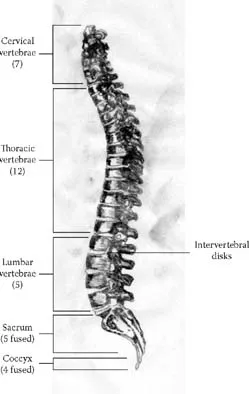
Illustration by Sophie Gibson-Rush
POSTURE
All physical disciplines, whether in sports or the arts, emphasize the importance of good postural principles. In yoga, to name but one example, posture and body alignment is a critical element. Great attention to alignment is required to perform a yoga asana well.
In the yoga sitting pose, perfect alignment can be observed — ears over shoulders, shoulders over hips, chest open with the shoulder blades slightly descending into the back. The natural curvature of the back is optimal.
For violinists, attention to good posture is the important first step toward a successful violin setup.

Photo by Michael Venera
THE STANDING POSITION
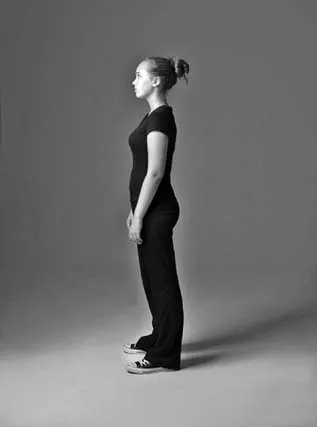
The photographs demonstrate good principles of posture. Again, notice the alignment of the ears, shoulders, hips, knees, and feet. The feet are directly under the hips and shoulders. The chest is open and lifting.
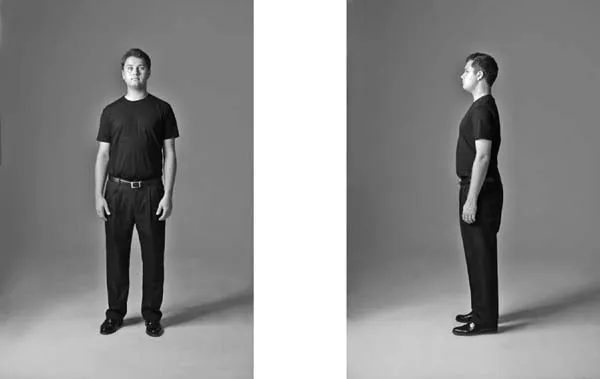
Poor posture tends to fall into two categories: kyphosis — the upper back is rounded and the head thrust forward (slumping), and lordosis — the lower back is curved inward excessively (swayback). Locked knees oft en accompany swayback posture.
In this example of kyphosis, or slumping, the shoulders are rounded, the head held forward, and the chest collapsed. Don't do this.
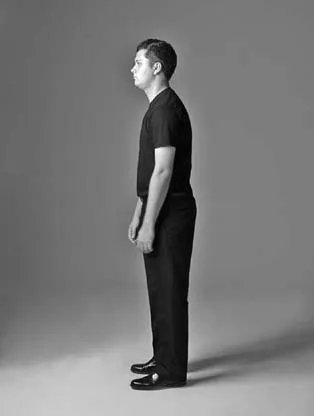
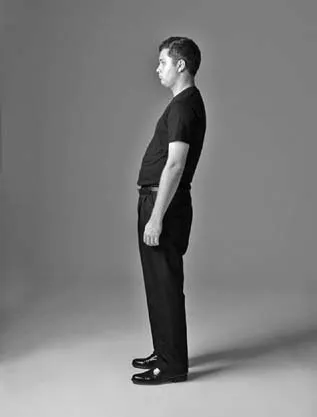
Here is an extreme example of lordosis, or swayback. Notice that the proper alignment discussed above is distorted. Don't do this either.
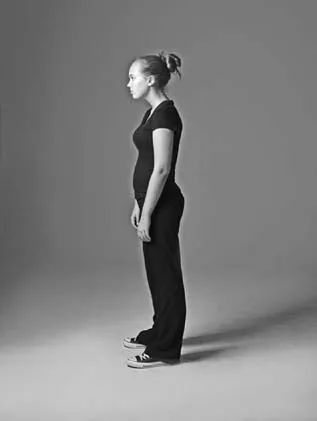
Here, the student is standing swaybacked, with shoulders rounded and head forward.
Here, the posture is corrected.
THE SITTING POSITION
It is equally important to apply the principles of good posture to the sitting position since violinists do a great deal of playing in a chair.
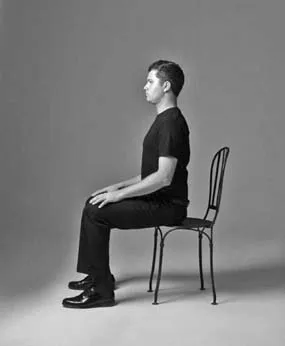
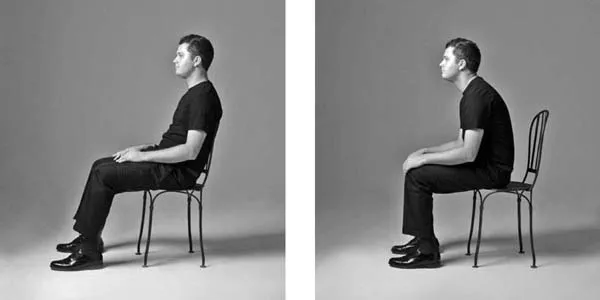
Notice the line of the ears, shoulders, and hips. The chest is open and the feet are under the knees. In violin playing, it is important to sit at the edge of the chair.
Now look at the next two photographs. Look familiar? These examples illustrate tendencies to avoid. In the first, the model sits swaybacked (lordosis), and in the second, he sits slumping (kyphosis), a common position for people at the computer.
THE ARMS
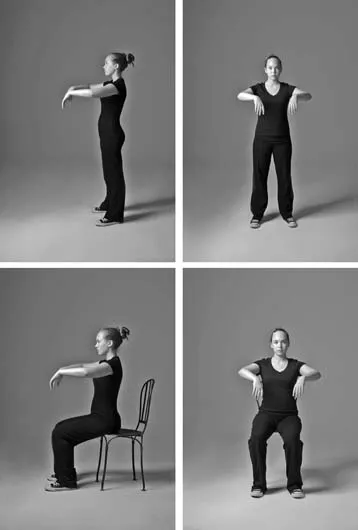
For a violinist, good posture includes the feeling of suspended arms. Unfortunately, this is not a particularly natural thing to do. It takes years, in fact, for a violinist to develop the muscles to the point at which holding the arms aloft becomes comfortable. When we play, the deltoid muscles in both arms must work to suspend the arms. For less experienced players, this usually represents a major hurdle to overcome and will initially cause some discomfort. It is very important to avoid raising the shoulders while holding the arms aloft.
These photographs illustrate front and side views of good posture, both sitting and standing, with the arms suspended.
CONCLUSION
Developing good postural habits means greater ease of playing. When the body alignment is poor, the muscles we use to play work in oppos...
Table of contents
- Cover
- Half Title
- Title Page
- Copyright Page
- Table of Contents
- Acknowledgments
- Introduction
- 1 The Elements of Good Posture
- 2 Holding the Violin
- 3 The Left Hand and Arm
- 4 Holding the Bow
- 5 Putting Right and Left Together
- 6 More on Bowing
- 7 Vibrato
- 8 On Practicing
- Selected Bibliography
- Index
Trusted by 375,005 students
Access to over 1.5 million titles for a fair monthly price.
Study more efficiently using our study tools.
Frequently asked questions
Yes, you can cancel anytime from the Subscription tab in your account settings on the Perlego website. Your subscription will stay active until the end of your current billing period. Learn how to cancel your subscription
No, books cannot be downloaded as external files, such as PDFs, for use outside of Perlego. However, you can download books within the Perlego app for offline reading on mobile or tablet. Learn how to download books offline
Perlego offers two plans: Essential and Complete
- Essential is ideal for learners and professionals who enjoy exploring a wide range of subjects. Access the Essential Library with 800,000+ trusted titles and best-sellers across business, personal growth, and the humanities. Includes unlimited reading time and Standard Read Aloud voice.
- Complete: Perfect for advanced learners and researchers needing full, unrestricted access. Unlock 1.5M+ books across hundreds of subjects, including academic and specialized titles. The Complete Plan also includes advanced features like Premium Read Aloud and Research Assistant.
We are an online textbook subscription service, where you can get access to an entire online library for less than the price of a single book per month. With over 1.5 million books across 990+ topics, we’ve got you covered! Learn about our mission
Look out for the read-aloud symbol on your next book to see if you can listen to it. The read-aloud tool reads text aloud for you, highlighting the text as it is being read. You can pause it, speed it up and slow it down. Learn more about Read Aloud
Yes! You can use the Perlego app on both iOS and Android devices to read anytime, anywhere — even offline. Perfect for commutes or when you’re on the go.
Please note we cannot support devices running on iOS 13 and Android 7 or earlier. Learn more about using the app
Please note we cannot support devices running on iOS 13 and Android 7 or earlier. Learn more about using the app
Yes, you can access Playing the Violin by Mark Rush in PDF and/or ePUB format, as well as other popular books in Media & Performing Arts & Classical Music. We have over 1.5 million books available in our catalogue for you to explore.