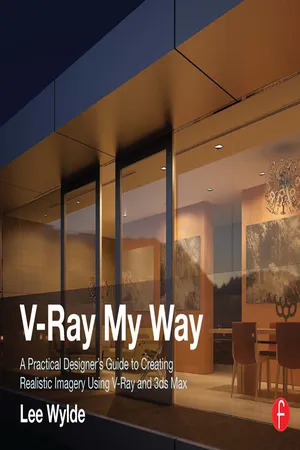
V-Ray My Way: A Practical Designers Guide to Creating Realistic Imagery Using V-Ray & 3ds Max is a practical, hands-on guide to creating some of the most stunning computer-generated images possible. It caters to the design masses; architects, engineers, interior designers, industrial designers, photographers, and enthusiasts will find this book essential in their quest to express themselves through visual communication. V-Ray My Way is an accumulation of 13 years of experimental experience and will have you creating content within minutes, help grow your company, help develop your portfolio, and help you make that career leap. Additional resources and exercises are available at the book's companion website, http://routledgetextbooks.com/textbooks/_author/wylde-9780415709637/
eBook - ePub
V-Ray My Way
A Practical Designer's Guide to Creating Realistic Imagery Using V-Ray & 3ds Max
- 210 pages
- English
- ePUB (mobile friendly)
- Available on iOS & Android
eBook - ePub
V-Ray My Way
A Practical Designer's Guide to Creating Realistic Imagery Using V-Ray & 3ds Max
About this book
Information
CHAPTER 1
MY EXPERIENCE AND BACKGROUND STORY
‘To infinity and beyond’, the instantly recognizable phrase that shaped the public’s perception of computer visualization forever.
It was at the time of the release of the first Toy Story movie that I was sat in rural England in a small town called Sheffield, wondering what I wanted to do with my life. At 15 years old who actually knows what they want to do in life? However, Woody, Buzz and the rest of the gang had me mesmorized and keen to discover more about this phenomenal art.
At 15 I was the youngest in my year at high school. I had always been creative and teachers would often hurl abuse at me for doodling during history or religious education classes.
I had a computer at home and was taking computer classes at school, but these were nothing compared to the industry that was out there in the real world.
Luckily one day I was in a high street retail store and came across a magazine called 3D World. It was packed to the brim with industry information and glossy renderings of characters, creatures and vehicles, and I knew that this was my starting point.
The publication contained tutorials, albeit a little advanced for me but nevertheless incredibly useful. The most useful aspect was the CD-ROM with 30 day trial software that I yearned for every month. This was perfect, an ideal way to
learn the very basics at my own pace. I spent the next six months glued to my rather slow, rather inefficient Acer laptop following the steps to create meshes, render flowers and model spaceships.
My dedication and inquisitiveness had led me part of the way into a new career; however I was not prepared for the next stage of my life.
In the year 2000 I was accepted onto the British Government’s Modern Apprenticeship Scheme. I joined a bustling architectural practice called Hadfield Cawkwell Davison. This was a new world to me; there were roughly 70 people in the company. Each studio was filled with architectural models, building materials, fabric samples, drawings and lots of coffee. My position was as an architectural apprentice.
With my pen in my shirt pocket I arrived on my first day ready to design the next building worthy of the architect of the year award. My ambition was strong but the likelihood of winning architect of the year was fairly low.
I soon came across the graphics department, a group of long-haired designers who listened to 1980s’ music with Starbucks cups on their desks. I was in awe and wanted to move in as soon as possible. At this time the production of artwork for architectural projects consisted of handdrawn scanned images, digitally finished in Photoshop. Nostalgically mounted on the walls were the most beautiful hand-drawn and water-colored architectural illustrations.
I was desperate to join this department but it was not to be, well not for a year and a half anyhow.
For those agonizing 18 months I was responsible for archiving, photocopying and tea-making. How fruitful life seemed. On the other hand the social aspect was amazing, I moved to different departments to help the interior designers. During the 18 months I managed to teach myself 3D Studio Max and AutoCAD.
The department had a copy of 3D Studio Max which at this time was version 3. I was granted access to the dongle during the studio’s downtime (which was after 5:30 p.m.). The practice did send me on training days for AutoCAD, but this was only 2D, and as ambitious as I was back then, I wanted 3D training.
I was in a position where I had to prove myself, yet not look as though I was above my station. One of the partners at the practice was very hands on, constantly mixing with the design team and providing creative direction. I knew this was the person I had to impress.
I had secretly modeled a whole building in 3D of a current project and had managed to render the facade and add trees and pavements etc. Looking back now they were dismal, but just what I needed to progress in my career. The practice, like others all over the UK at that time used an external consultant for high-end visualizations.
Having presented my boss with the output he was genuinely surprised that I had created the images. I showed him the files and explained how I had achieved the end result. I soon started to work on interior schemes and moved to the interior design department. From that day I was sent on my way to learn parts of professionally accredited 3D courses for intermediate and advanced 3D Studio Max users. Happy days.
During 2002 the incredibly annoying user-friendly 3D program was released called SketchUp. Architects at the time were praising the software and thought it was the best thing since sliced bread. I hated it. (I do not now, I find it a key part of my workflow). Having learned the technical aspects of 3D Studio Max I felt threatened that suddenly everyone could produce 3D with relative ease. Versatile, unique, with customizable outputs, no render times, SketchUp was industry-changing.
Once the management had figured out the time to create visuals using 3D Studio Max versus the time taken using SketchUp, well let’s say I was less than pleased when I was told to use SketchUp instead.
Reluctantly I found myself using SketchUp almost every day for the remainder of my four years with the practice. I developed my own way of working, from taking briefs to photographing textures, making briefing sheets and eventually by default, setting up the company 3D department. It
was fun, and that was the most important thing. I did not want to be an architect or an interior designer at that time, I had forgotten about climbing the career ladder. I simply enjoyed my creative time working with others to deliver stunning graphics for client meetings.
Come 5:30 p.m. we would be hooking everyone’s machines up to try and figure out how to network render using 3D Studio Max. It certainly gave the IT department something new to experiment with. We were using 3D Studio Max more and more as production software after SketchUp had been pushed as far as it possibly could.
Back then we thought that the light tracer function was a gigantic breakthrough for us to use. When I look back now it makes me laugh, there were studios in the US and London using all sorts of wizardry and we had not a clue, we were in a bubble, but at least it was fun for us to explore and develop our skills.
We spent hours, days and weekends reading through online tutorials, reading through training manuals purchased from high street book stores and just generally experimenting. Books were virtually useless to us. They were too scientific, academic if you will. We needed fresh, industry-related direction.
That is the first lesson in life that I had learned, nothing is easy, or otherwise everyone would be doing it. I had developed my skills in texturing, lighting and modeling
enough to be able to create large scenes for leading retailers in the UK.
Finding Nemo was released in the UK during this year which quantified my admiration for Pixar, and how I longed to be the tea boy at their studios if given the chance. In fact I think I would be their tea boy now if I could wander in and out of each department looking at their stunning artwork.
‘3D is a fad, there is no future in it, you are wasting your time.’ The parting words from a member of staff as I left my first job to join another leading design practice in the UK. I decided to depart from my first job for a number of reasons. I thoroughly enjoyed my creative days there; however I was young and had not grasped the corporate side of the working environment. With suits on one side of the office and Hawaiian shirts on the other, it was not exactly a recipe for a balanced workplace. At 19 years old I wanted to broaden my horizons and decided the best thing to do was to take my capabilities elsewhere.
In 2005 I started my own company called Foothill Studios. I was 20 and full of energy ready to make my company work. I had seen the invoices from 3D consultants in my first job and thought to myself that I could provide a similar service much cheaper.
I had no idea what I was getting myself into, but it felt great at the time, a real sense of adventure. With my glossy
business cards ready, functioning website ready and price list ready it was time to market myself.
The great thing about the UK is that you can cold call and with a little tenacity can actually speak to the people you need to in order to pitch yourself. The decision makers if you will. This worked remarkably well for me and literally within the first week I had three projects to deliver.
My main aim at that time was to target architects, private property developers and interior designers throughout the UK. I created endless spreadsheets of business hit lists and allocated myself a time per week to speak to each one.
At the time I was mainly funded by the Bank of Mum and Dad; my father and I had built a new loft-space on my parents’ house and I used it to operate my small studio from.
I had a unique style that I could pitch to clients; this combined with value for money certainly made me relevant to small and medium enterprises (SMEs). For the first year my clients mainly consisted of interior designers, architects and developers. This was a fantastic market at the time; developments were springing up all over the UK and all required artwork for planning authority approvals, marketing, public information etc.
One of the pivotal moments at this time came when I was contacted by a reputable furniture designer and manufacturer
based in London. They had seen my work through a third party who had specified their furniture in a concept pitch.
After making inquiries the company had managed to track me down, where at the time I was fast asleep in bed after a whole night of rendering. Watching scan-lines come down my screen, just waiting for errors I had made, forcing me to re-render was tiresome work back then.
It was my mother who had come running up three flights of stairs yielding the wireless phone in her hand. ‘There is a lovely man on the phone from London, he wants to talk to you about your work.’
I was half asleep and wearing The Matrix pajamas at the time. I do not think my professionalism was in question from what I was wearing, rather perhaps from my mother’s interrogation of my potential client.
I was asked to travel to London the following week to meet the company in their very posh and rather swanky showroom in Clerkenwell. I lived three hours north of London and had only been there on vacation a few times. There was something about the place that electrified my aspirations.
My meeting was with the global account manager and a few other members of the design team. I had not realized at this point in my life just how significant the commercial furniture industry was.
My mother must have made a good impression as the first question was ‘How is your Mother?’. I spent hours discussing their current range of office furniture, their visualization requirements and how knowledgeable I was with their catalogues.
Luckily I was very knowledgeable, for I had modeled their furniture from 2D drawings for other clients to produce 3D mock-up images. It was far more cost effective for me to provide clients with renderings of furniture systems rather than have the system transported, erected, photographed, dismantled and delivered back to their showroom.
The meeting was incredibly successful. Armed with numerous brochures, samples and their supplier contacts directory I returned to the train for a three-hour journey north. Within a few days, much to the dismay of my father, furniture items started arriving at my parents’ house, for my reference.
It seemed I was going to need a bigger boat. Along with the furniture were requisitions for 3D furniture mock-ups for projects throughout the country. I had more work than I had estimated for in my business plan. In fact I had exceeded my targets by more than 300 percent.
The contact list of suppliers, distributors and other companies was a fantastic opportunity for me to grow. The list comprised of over 50 companies throughout the UK all potentially requiring my services.
It took three months to contact all companies and to pitch to them. I had immediate success and found myself creating new material for retail projects, commercial projects and high-end branded interiors. This is where I learned my second big lesson in life.
I had more work than I could cope with. My machine at the time had been kindly donated by my first employer. I had upgraded the RAM but that was all I could do for it. Inevitably it needed replacing to handle the amount of rendering work I had to carry out. I was also receiving requests for animations.
I needed new kit. Lesson number two; do not rush into anything, research thoroughly.
Given the need for speed at this time and not wanting to have delays with other clients I ordered shiny new machines from BOXXTECH in the US. The kit cost an arm and a leg. It arrived on Christmas Eve, how fitting. My father had signed for the boxes and was less than pleased that stacks of boxes were taking up his living space. ‘What the bloody hell is all this?’.
He thought that one computer should last forever and that my old machine should still be able to do the job. ‘New machines, Dad, make more money.’ Enough said, he was fine with the justification.
Onwards and upwards, I had unpacked all the elements. Brushed aluminum render servers lay glittering on my bedroom floor. The modeling machine was an impressive 16 GB RAM dual quad core beast. I kept my old machine in the corner for post-production work.
Now I had the necessary tools, I needed to really progress and deliver higher quality work. I wanted to pitch for animation projects, architectural, vehicle and product design etc. I had little experience in animation, but being young and tenacious I proceeded to punch above my weight.
‘Lee, someone is on the phone from America!’, the words my father was shouting from three floors down. Unlike my mother who would have dashed up three flights of stairs, my father took a more practical approach to announcing client calls.
It seems my decision to pitch above my comfort level had paid off; my first international client from the US. They required a 15-minute animation of a cruise liner with dolphins jumping out of the water, retracting marina, jet skis and all sorts of crazy elements. I didn’t have a clue how on earth I was going to do it, so naturally I said yes.
I do not have many regrets in life, but looking back this had a firm place on the regret pile. This project should have been undertaken by a London-based studio with 10 latte-drinking animators packing state-of-the-art machinery and a monster render farm at their disposal.
Nope, it was to be undertaken by myself. With my dog at my side, who was often my strongest critic I must say, I began to come up with strategies to complete the project. I was incredibly good at planning and setting key stage deliverables and timelines for design projects.
With an overwhelming sense of commitment to the client, I made two lists. One list had elements of the projects I could do without using Uncle Google to fill me in on the bits I lacked the knowledge to complete. The other list, which at this point was demoraliz...
Table of contents
- Cover
- Half Title
- Title Page
- Copyright Page
- Dedication
- Table of Contents
- Acknowledgments
- 1 My Experience and Background Story
- 2 Methodology (How to Use this Book)
- 3 Introduction to My Workflow
- 4 Interior Daytime Scenes
- 5 Interior Evening Scenes
- 6 Interior Mockup Scenes
- 7 Exterior Daytime Scenes
- 8 Exterior Evening Scenes
- 9 Automotive Scenes
- 10 Shooting HDRIs
- Index
Trusted by 375,005 students
Access to over 1.5 million titles for a fair monthly price.
Study more efficiently using our study tools.
Frequently asked questions
Yes, you can cancel anytime from the Subscription tab in your account settings on the Perlego website. Your subscription will stay active until the end of your current billing period. Learn how to cancel your subscription
No, books cannot be downloaded as external files, such as PDFs, for use outside of Perlego. However, you can download books within the Perlego app for offline reading on mobile or tablet. Learn how to download books offline
Perlego offers two plans: Essential and Complete
- Essential is ideal for learners and professionals who enjoy exploring a wide range of subjects. Access the Essential Library with 800,000+ trusted titles and best-sellers across business, personal growth, and the humanities. Includes unlimited reading time and Standard Read Aloud voice.
- Complete: Perfect for advanced learners and researchers needing full, unrestricted access. Unlock 1.5M+ books across hundreds of subjects, including academic and specialized titles. The Complete Plan also includes advanced features like Premium Read Aloud and Research Assistant.
We are an online textbook subscription service, where you can get access to an entire online library for less than the price of a single book per month. With over 1.5 million books across 990+ topics, we’ve got you covered! Learn about our mission
Look out for the read-aloud symbol on your next book to see if you can listen to it. The read-aloud tool reads text aloud for you, highlighting the text as it is being read. You can pause it, speed it up and slow it down. Learn more about Read Aloud
Yes! You can use the Perlego app on both iOS and Android devices to read anytime, anywhere — even offline. Perfect for commutes or when you’re on the go.
Please note we cannot support devices running on iOS 13 and Android 7 or earlier. Learn more about using the app
Please note we cannot support devices running on iOS 13 and Android 7 or earlier. Learn more about using the app
Yes, you can access V-Ray My Way by Lee Wylde in PDF and/or ePUB format, as well as other popular books in Computer Science & Computer Graphics. We have over 1.5 million books available in our catalogue for you to explore.