Introduction to Optical Components
eBook - ePub

Introduction to Optical Components

  1. 183 pages
  2. English
  3. ePUB (mobile friendly)
  4. Available on iOS & Android
eBook - ePub

Introduction to Optical Components

About this book

"This book provides a practical description of optics that satisfies the needs often encountered by some engineers in the practice of their profession. Optical components, including optical sources and detectors, have found their way into products that we buy for the house, and into industrial equipment. As a textbook, it provides an efficient tool for the student to gain in-depth knowledge of a subject, with homework problems to test and verify mastery of the subject."
— Antonio Sanchez-Rubio, MIT Lincoln Laboratory, Lexington, Massachusetts, USA

"This book covers all the experimental tools, described meticulously and with clear illustrations, which students will need to perform their experiments. I wish I had this book when I taught an optics course!"
— A.K. Ramdas, Purdue University, West Lafayette, Indiana, USA

This book provides readers with a brief introduction to optical components. Materials presented in this book prepare readers to deal with optical components in the areas of optics and optical technology. Introduction to Optical Components features nine chapters with topics ranging from lenses (materials, magnifiers, and cameras); mirrors (spherical, ellipsoidal, and aberrations); diffraction gratings (holographic and multilayer dielectric); polarizers (birefringent, reflective, and Jones matrix algebra); windows (UV and AR coating materials); filters (neutral density and Raman); beamsplitters (plate, cube, and pellicle); sources (light-emitting diodes and lasers); and detectors (thermal, photon, and photodetector noise). This text also features a detailed discussion of non-ideal effects for practical components using minimal amounts of derivations (that do not compromise essential physical, mathematical, or material properties). While there are numerous books that feature "optical" in their title, to date, no textbook on optical components exists. It is for this reason that Introduction to Optical Components is such a vital resource. The technical level of this book is equivalent to an undergraduate course in the optics and optical technology curriculum. Students are required to have little familiarity with optics. Practitioners in optics and optical technology will also find this book useful. Each chapter includes numerous mathematical equations; tables providing useful optical parameters for many optical materials; and end-of-chapter questions and their corresponding solutions.
Frequently asked questions

Yes, you can cancel anytime from the Subscription tab in your account settings on the Perlego website. Your subscription will stay active until the end of your current billing period. Learn how to cancel your subscription.
No, books cannot be downloaded as external files, such as PDFs, for use outside of Perlego. However, you can download books within the Perlego app for offline reading on mobile or tablet. Learn more here.
Perlego offers two plans: Essential and Complete
  • Essential is ideal for learners and professionals who enjoy exploring a wide range of subjects. Access the Essential Library with 800,000+ trusted titles and best-sellers across business, personal growth, and the humanities. Includes unlimited reading time and Standard Read Aloud voice.
  • Complete: Perfect for advanced learners and researchers needing full, unrestricted access. Unlock 1.4M+ books across hundreds of subjects, including academic and specialized titles. The Complete Plan also includes advanced features like Premium Read Aloud and Research Assistant.
Both plans are available with monthly, semester, or annual billing cycles.
We are an online textbook subscription service, where you can get access to an entire online library for less than the price of a single book per month. With over 1 million books across 1000+ topics, we’ve got you covered! Learn more here.
Look out for the read-aloud symbol on your next book to see if you can listen to it. The read-aloud tool reads text aloud for you, highlighting the text as it is being read. You can pause it, speed it up and slow it down. Learn more here.
Yes! You can use the Perlego app on both iOS or Android devices to read anytime, anywhere — even offline. Perfect for commutes or when you’re on the go.
Please note we cannot support devices running on iOS 13 and Android 7 or earlier. Learn more about using the app.
Yes, you can access Introduction to Optical Components by Roshan L. Aggarwal,Kambiz Alavi in PDF and/or ePUB format, as well as other popular books in Technology & Engineering & Electrical Engineering & Telecommunications. We have over one million books available in our catalogue for you to explore.
1
Lenses
1.1 INTRODUCTION
The earliest known lenses date back to 750 BC, and were made from polished crystal, often quartz. One such example of an ancient lens in the collection of the British Museum (#90959) was ground and polished with one plane surface and one slightly convex surface. Lenses are commonly used as magnifiers for viewing small objects. Lenses are also used in optical systems such as binoculars, cameras, eyeglasses, microscopes, telescopes, and other optical systems. For additional information on lenses, the following books are recommended: Fowles (1975); Hecht and Zajac (1974); Jenkins and White (1976).
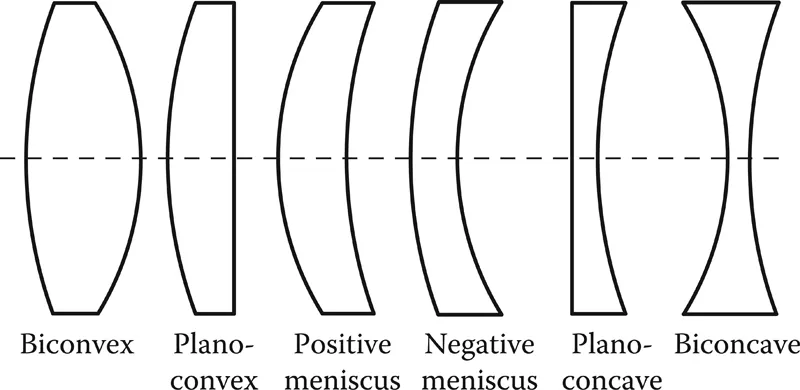
There are six types of lenses: biconvex, plano-convex, positive meniscus, negative meniscus, plano-concave, and biconcave, as shown in Figure 1.1.
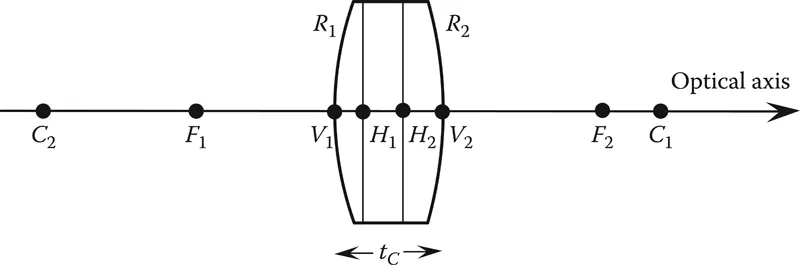
We now consider a biconvex lens of refractive index n, diameter D, focal length f, front focal length fF, and back focal length fB located in a medium of refractive index of 1.0 (vacuum or air). Figure 1.2 shows a thick lens with radii of curvature R1 and R2 for the two lens surfaces, and center thickness tC.
The optical axis of the lens (C2C1) intersects the two surfaces of the lens at points V1 and V2. V1V2 is equal to tC. C1 and C2 denote the centers of curvature of the two lens surfaces. V1C1 is equal to R1. V2C2 is equal to R2. F1 and F2 denote the front and back focal points of the lens. H1 and H2 denote the primary and secondary principal planes, respectively. An object ray, propagating parallel to the optical axis to the right, is considered to continue through the lens up to the principal plane H2 and then passes through the back focal point F2. The distance F1H1 or H2F2 is equal to the focal length f. The distance F1V1 is equal to the front focal length fF. The distance V2F2 is equal to the back focal length fB. The distances V1H1 and V2H2 are given by (Fowles 1975).
V1H1=δ1=ftC(n1nR2)
(1.1)
V2H2=δ2=ftC(n1nR1)
(1.2)
Distances V1C1, V2C2, V1H1, V2H2, F1H1, and H2F2 are positive if they point to the right, and negative if they point to the left. As shown in Figure 1.2, R1 is positive, R2 is negative, δ1 is positive, and δ2 is negative. The edge thickness of the lens is given by
tEtCD28(1R11R2)
(1.3)
Image
FIGURE 1.1 Six types of lenses.
Image
FIGURE 1.2 Thick lens with center thickness tC.
In the paraxial approximation, focal length f is given by
1f=(n1)[1R11R2+(n1)tCnR1R2]
(1.4)
Front focal length fF is given by
fF=fδ1
(1.5)
Back focal length fB is given by
fB=f+δ2
(1.6)
Effective focal length of a combination of two thin lenses of focal lengths f1 and f2 separated by a distance d is given by
1f=1f1+1f2df1f2
(1.7)
Back focal length for this combination of the two lenses is given by
fB=f(1df1)
(1.8)
Location of the f lens on the left-hand side of the f2 lens is given by
Lff2=fdf1
(1.9)
Figure 1.3 shows a plane parallel beam of light incident upon a biconvex lens.
All the light rays pass through the focal spot and then diverge. The diameter of the focal spot is determined by the diffraction of light and the quality of the lens. For a perfect lens, the back focal spot F2 consists of a bright spot known as the Airy disc, which is surrounded by rings. Eight-four percent of the light goes into the Airy disc and 16% into the rings. The diameter of the Airy disc is equal to 1.22fλ/D, where λ is the wavelength of light and D is the diam...

Table of contents

  1. Cover
  2. Half Title
  3. Title Page
  4. Copyright Page
  5. Dedication
  6. Table of Contents
  7. Preface
  8. Acknowledgments
  9. Authors
  10. Chapter 1 Lenses
  11. Chapter 2 Mirrors
  12. Chapter 3 Diffraction Gratings
  13. Chapter 4 Polarizers
  14. Chapter 5 Optical Windows
  15. Chapter 6 Optical Filters
  16. Chapter 7 Beamsplitters
  17. Chapter 8 Light Sources
  18. Chapter 9 Light Detectors
  19. Appendix
  20. References
  21. Index