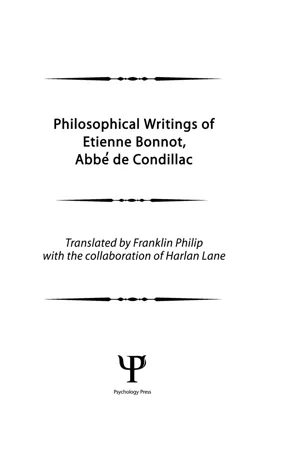
This highly readable translation of the major works of the 18th- century philosopher Etienne Bonnot, Abbe de Condillac, a disciple of Locke and a contemporary of Rousseau, Voltaire, and Diderot, shows his influence on psychiatric diagnosis as well as on the education of the deaf, the retarded, and the preschool child. Published two hundred years after Condillac's death, this translation contains treatises which were, until now, virtually unavailable in English: A Treatise on Systems, A Treatise of the Sensations, Logic.
- 352 pages
- English
- ePUB (mobile friendly)
- Available on iOS & Android
eBook - ePub
About this book
Information
Book II:
A Treatise on the Sensations
Ut potero, explicabo: nec tamen, ut Pythius Apollo, certa ut sint et fixa, quae dixero: sed ut homunculus, probabilia conjectura sequens. (Cicero)
Important Notice to the Reader
I forgot to alert the reader to something I ought to have mentioned and perhaps repeated several times in this work. But I trust that acknowledging this oversight is just as effective and avoids the inconvenience of repetition. Thus I forewarn the reader that it is very important to put himself exactly in the place of the statue we are going to observe. He should begin to live when it does, have only a single sense when it has only one, acquire only those ideas that it acquires, contract only the habits that it contracts: in short, he must be only what it is. The statue will judge things as we do only when it has all the senses and all the experiences we do: and we will judge in the same way it judges only when we suppose ourselves deprived of everything that it lacks. I believe that readers who put themselves exactly in its place will have little difficulty in understanding this work; others who do not will meet with innumerable difficulties.
As yet the reader does not understand what the statue is that I propose to observe, and this warning will doubtless seem misplaced; but that will be one further reason for taking heed and remembering it.
Précis of the Treatise on Sensations
The main purpose of this work is to show how all our knowledge and all our faculties come from the senses or, to be more precise, from sensation: For in truth, the senses are only occasional causes. They do not have sensations, it is the mind alone that has sensations as occasioned by the sense organs; and the mind draws, from the sensations that modify it, all its knowledge and all its faculties.
This inquiry can contribute enormously to advancing the art of reasoning; it alone can explicate that art right down to its underpinnings. Indeed, we will not discover a reliable way of steadily guiding our thoughts if we do not know how they were formed. What to we expect of thos philosophers who have continual recourse to the notion of an instinct that they cannot define? Do they fancy that they can exhaust the source of our errors, as long as they impute such mysterious ways to the mind? We must then observe ourselves from the first sensations that we experience; we must sort out the principle of our first mental opertions, go back to the origin of our ideas, spell out their elaboration, follow them up to the limits that nature has prescribed for us: in short, we must, as Bacon said, renew all human understanding.
But, it may be objected, everything has been said, once we repeat, following Aristotle, that our knowledge comes from the senses. There is no one with a keen mind who cannot conduct this explication that you think so necessary, and nothing is so useless as to dwell with Locke on the details. Aristotle shows much more genius when he is satisfied with embracing the whole structure of our knowledge in a general maxim.
Aristotle, I agree, was one of the greatest geniuses of antiquity, and those who make this objection are doubtlessly clever. But in order to convince oneself how unfounded their criticism of Locke is and how useful it would be for them to study this philosopher instead of criticizing him, it is sufficient to hear them reason, or to read their works if they have written on philosophical matters.
If these men combined a precise method with much clarity and precision, they would have some right to consider useless the efforts that metaphysics has made to know the human mind; but we could well suspect them of estimating Aristotle so highly only in order to deprecate Locke; and of deprecating Locke only in the hope of casting aspersions on all metaphysicians.
A long time ago it was said that all our knowledge originated with the senses. Nonetheless, the Peripatetics were so far from knowing this truth that despite their considerable intelligence, they never knew how to explicate it, and after several centuries, it still remained to be discovered.
A philosopher often declares himself in favor of the truth without knowing what it is: sometimes he follows the crowd, he concurs with the opinion of the majority; sometimes more ambitious than docile, he resists, he struggles, and sometimes he succeeds in leading the masses astray.
Thus almost all sects were formed: they often reasoned haphazardly; but sooner or later some were bound to be sometimes right since they always contradicted each other. I do not know what was Aristotle's motive when he proposed his principle on the origin of our knowledge. But what I do know is that he left us no work where this principle was developed and that, moreover, he sought to be in contradiction with the opinions of Plato in every respect.
Immediately after Aristotle came Locke, for we must not count the other philosophers who wrote on the same subject. This Englishman doubtless shed a lot of light on the matter, but there still remained some obscurity. We shall see that most of the judgments that are intermingled with our sensations escaped his notice; that he did not appreciate how much we need to learn to touch, to see, to hear, and so forth; that all the faculties of the mind appeared to him to be innate qualities; and that he did not suspect that they could take their origin from sensation itself.
He was so far from compassing the full extent of the nature of man that, were it not for Molyneux, perhaps he would never had occasion to observe that he mixes up judgments with visual sensations. He explicitly denied that this was the case with the other senses. Thus he believed that we naturally use them by a kind of instinct, without reflection having contributed to our using them.
M. de Buffon, who tried to trace the history of our thoughts, creates an imaginary man and invests him in a single stroke with habits that he should have made him acquire. He did not know by what series of judgments each sense developed. He says that in animals, the smell is the first sense; that it alone will take the place of all the others, and that right from the start before receiving the lessons of touch, it determines and directs all animal movements.
This Treatise on Sensations is the only work which strips man of all his habits. By observing the birth of sensation, we show how we acquire the use of our faculties; and those who have grasped the system of our sensations will agree that it is no longer necessary to have recourse to vague words such as instinct, involuntary response, and the like, or that if we do use them, at least we can form precise ideas of them.
But to fulfill the goal of this work, it was absolutely necesary to put before our eyes the basic source of all our mental operations: thus we would never lose sight of them. It will be sufficient to indicate it in this precis.
If man had no interest in attending to his sensations, the impressions that objects make on him would pass as shadows and leave no trace. After several years, he would be as at the first instant, without having acquired any knowledge and without any mental processes other than that of having sensations. But the nature of his sensations does not allow him to remain suspended in this trance. As they are necessarily agreeable or disagreeable, he is interested in finding the one and in ridding himself of the other; and the more keen the contrast between pleasures and pains, the more it occasions action in the mind.
Then the privation of an object that we judge necessary for our happiness gives us this malaise, this disquiet that we call "need," and from which arise desires. These needs recur depending on conditions, often new ones even arise, and it is this that develops our knowledge and our faculties.
Locke is the first to observe that the disquiet caused by the privation of an object is the basic source of our motives. But he has it born of desire, whereas precisely the opposite is true; moreover, he makes more of a difference between desire and will than there in fact is; finally, he examines the influence of this disquiet only in a man with the use of all his senses and all his faculties.
It thus remains to show how this disquiet is the mainspring of our actions given us by our habits of touch, sight, hearing, feeling, taste, comparison, judging, reflection, desiring, loving, hating, fearing, hoping, wanting; in short, that all the habits of the mind and body arise through this disquiet.
For this, it was necessary to go further back than this philosopher did. But since we are unable to observe our first thoughts and our first movements, it was necessary to make inferences, and consequently to make different assumptions.
Nevertheless, it was not yet enough to go back to sensation. In order to discover the progress of all our knowledge and of all our faculties, it was important to distinguish what we owed to each sense, an inquiry that had not yet been attempted. Thereby the four parts of this Treatise on Sensations are formed: The first, which treats the senses that by themselves do not judge external objects; The second, on touch, or the only sense that judges external objects by itself; Third, how touch teaches the other sense to judge external objects; Fourth, on needs, ideas, and the activities of an isolated man who enjoys the use of all his senses.
This discussion shows clearly that the object of this work is to reveal which are the ideas that we owe to each sense and how, when they are reunited, they give us all the knowledge necessary for our survival.
It is thus sensations that give rise to the whole system of man: A complete system of which all the parts are connected and mutually sustaining. It is a sequence of truths: the first observations prepare the way for those that must follow them; the last ones confirm those that preceded them. If, for example, in reading the first part, we begin to think that it may well be the case that the eye does not judge sizes, shapes, locations, and distances by itself, we are completely convinced when we learn in the third how the sense of touch gave him all these ideas.
Although this system rests on assumptions, all the conclusions that we draw from it are attested to by our experience. There is no man, for example, limited to the sense of smell; such an animal could not safeguard its own survival; but for the truth of the arguments that we have advanced in observing him, only a little reflection on ourselves is needed make us recognize that we could owe to the senses of smell all the ideas and faculties that we discover in this man and that it would not be possible for us to acquire others with this single sense. We could have been content merely to consider the sense of smell by abstracting from the senses of sight, hearing, taste, and touch: if we made some assumptions, it is because they make this abstraction easier.
Précis of the First Part
Locke distinguishes two sources of our ideas, the senses and reflection. It would be more precise to recognize only a single one, either because reflection is underlying only sensation itself, or because it is less the source of ideas than the channel by which they are derived from the senses.
This imprecision, as slight as it may seem, is responsible for a lot of obscurity in his system; for it makes him powerless to explicate its rudiments. Thus this philosopher is content to recognize that the mind perceives, thinks, doubts, believes, reasons, knows, wills, reflects; that we are convinced of the existence of these operations because we find them in ourselves, and that they contribute to the progress of our knowledge; but he did not feel the necessity of discovering their bases and elaboration, he did not suspect that they could be only acquired habits; he seems to have regarded them as something innate, and he says only that they are perfected through use.
In 1746 I tried to explain the development of the faculties of the mind. This attempt appeared novel, and had some success; but it owed this success to the abstruse way in which I carried it out. For such is the fate of discoveries about the human mind: when they are exposed in broad daylight they seem so simple that we read things we never suspected and yet believe that we have learned nothing.
There you have the flaw in the Treatise on Sensations. When the reader finds in the introduction: "Judgment, reflection, passion, all the operations of the mind, in short, are only sensation itself variously transformed," he believes he sees a paradox denuded of any kind of proof; but hardly has he finished reading this work than he is tempted to say: "This is a very simple truth and no one would be ignorant of it." Many readers have not resisted this temptation.
This truth is the chief object of the first part of the Treatise on Sensations. But as it can be demonstrated considering all our senses at once, I shall not separate them at this point and that will be an occasion to present it in a new light.
If a multitude of sensations occur all at once with the same degree of liveliness, or nearly, man is up to this point only an animal that has sensations: experience alone suffices to convince us that, in this case, the multitude of impressions suppresses all mental activity.
But let us allow only a single sensation to remain, or even, without entirely taking away the others, let us only diminish their force: immediately the mind is more particularly occupied with the sensation that preserves all its liveliness, and this sensation becomes attention, without it being necessary to assume anything additional in the mind.
I am, for example, not very attentive to what I am seeing, I am even completely inattentive, if all my senses assail my mind on all sides; but the visual sensations become attention as soon as my eyes devote themselves exclusively to the action of objects. However, the impressions that I experience can then be, and sometimes are, so extensive, varied and numerous, that I perceive an infinity of things without being attentive to any one of them; but hardly do I rest my gaze on an object than the particular sensations that I receive from it are the very attention that I give to it. Thus a sensation is attention, either because it is alone, or because it is livelier than all the others. Let a newly acquired sensation have more liveliness than the first one, it in turn becomes attention. But the more forceful the former, the more enduring the impression that it made. Experience proves this.
Our capacity for having sensations is thus shared between the sensation that we had and the one we are having. We perceive them both at the same time; but we percieve them differently: one seems past, the other present.
To perceive or to experience these two sensations is the same thing: now this experience takes the name "sensation" when the impression is being made on the senses, and it takes the name "memory" when this sensation, which is not currently occurring, presents itself to us as a sensation that occurred. Memory is thus only sensation transformed. We are thereby capable of two kinds of attention: the one exercised by memory and the other by the senses.
As soon as there is twofold attention, there is comparison; for to be attentive to two ideas or to compare them is the same thing. Now we cannot compare them without perceiving some difference between them or some resemblance: to perceive such relations is to judge. The actions of comparing and judging are thus only attention itself: thus sensation becomes successively attention, comparison, and judgment.
The objects that we compare have a multitude of relations, either because the impressions which they make on us are completely different, or because they only differ by degree, or because while similar, they combine differently in each object. In this case the attention that we give to the objects first includes all the sensations that they occasion. But as this attention is so divided, our comparisons are vague, we grasp only confused relations, our judgments are imperfect or uncertain: we are thus obliged to shift our attention from one object to another, considering their properties separately. Ha...
Table of contents
- Cover
- Title
- Copyright
- Contents
- Preface
- BOOK I: A TREATISE ON SYSTEMS
- BOOK II: A TREATISE ON THE SENSATIONS
- BOOK III: LOGIC, OR THE FIRST DEVELOPMENTS OF THE ART OF THINKING
Trusted by 375,005 students
Access to over 1.5 million titles for a fair monthly price.
Study more efficiently using our study tools.
Frequently asked questions
Yes, you can cancel anytime from the Subscription tab in your account settings on the Perlego website. Your subscription will stay active until the end of your current billing period. Learn how to cancel your subscription
No, books cannot be downloaded as external files, such as PDFs, for use outside of Perlego. However, you can download books within the Perlego app for offline reading on mobile or tablet. Learn how to download books offline
Perlego offers two plans: Essential and Complete
- Essential is ideal for learners and professionals who enjoy exploring a wide range of subjects. Access the Essential Library with 800,000+ trusted titles and best-sellers across business, personal growth, and the humanities. Includes unlimited reading time and Standard Read Aloud voice.
- Complete: Perfect for advanced learners and researchers needing full, unrestricted access. Unlock 1.5M+ books across hundreds of subjects, including academic and specialized titles. The Complete Plan also includes advanced features like Premium Read Aloud and Research Assistant.
We are an online textbook subscription service, where you can get access to an entire online library for less than the price of a single book per month. With over 1.5 million books across 990+ topics, we’ve got you covered! Learn about our mission
Look out for the read-aloud symbol on your next book to see if you can listen to it. The read-aloud tool reads text aloud for you, highlighting the text as it is being read. You can pause it, speed it up and slow it down. Learn more about Read Aloud
Yes! You can use the Perlego app on both iOS and Android devices to read anytime, anywhere — even offline. Perfect for commutes or when you’re on the go.
Please note we cannot support devices running on iOS 13 and Android 7 or earlier. Learn more about using the app
Please note we cannot support devices running on iOS 13 and Android 7 or earlier. Learn more about using the app
Yes, you can access Philosophical Works of Etienne Bonnot, Abbe De Condillac by F. Philip,H. Lane in PDF and/or ePUB format, as well as other popular books in Psychology & History & Theory in Psychology. We have over 1.5 million books available in our catalogue for you to explore.