- 304 pages
- English
- ePUB (mobile friendly)
- Available on iOS & Android
eBook - ePub
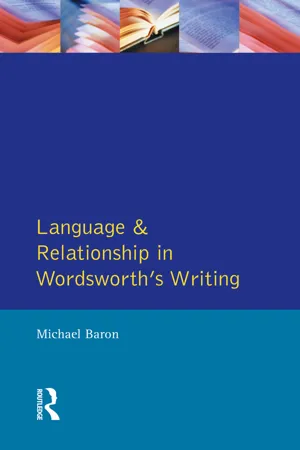
Language and Relationship in Wordsworth's Writing
About this book
William Wordsworth (1770-1850) needs little introduction as the central figure in Romantic poetry and a crucial influence in the development of poetry generally. This broad-ranging survey redefines the variety of his writing by showing how it incorporates contemporary concepts of language difference and the ways in which popular and serious literature were compared and distinguished during this period. It discusses many of Wordsworth's later poems, comparing his work with that of his regional contemporaries as well as major writers such as Scott. The key theme of relationship, both between characters within poems and between poet and reader, is explored through Wordsworth's construction of community and his use of power relationships. A serious discussion of the place of sexual feeling in his writing is also included.
Information
Chapter 1 Poetry, language and difference
DOI: 10.4324/9781315845760-2
Poetry and languages
So much of Wordsworth’s writing about poetry, in verse and in prose, is concerned with the nature of language, and so many of his best-known poems have elements of dialogue or represented speech, elements that can seem to be merely incidental to the poem as a whole but are still somehow at its heart. Dialogue in ‘Resolution and Independence’, the poem that Coleridge thought had all Wordsworth’s strengths and weaknesses, peters out into metaphor (‘his voice to me was like a stream / Scarce heard’) but remains a formative part of the experience of the poem – if it did not, Lewis Carroll’s parody in the poem of the White Knight (‘“What is it that you do,” I cried, / And thumped him on the head’) would not work. The nature of language is a central Romantic field of speculation, especially as it relates to what humans have in common. Often ‘humans’ turns out to mean members of the same nation, race or even social class, but these differences are usually ignored or disguised in theoretical discussion. But in more pragmatic discussions of spoken language such as guides to pronunciation, which abounded in the late eighteenth century, language difference is the point at issue: difference that reflects region or education (and therefore financial status and gender). Wordsworth’s writing explores both spoken and written language, and I shall argue that we should read it in the light of contemporary thinking about language, whether theoretical or pragmatic. Doing so helps us to understand, I think, the very powerful oddities of poems like ‘Resolution and Independence’: why is it that speech matters in a poem that Wordsworth himself used in the 1815 ‘Preface’ to illustrate the workings of a purely visual imagination?
Choice word, and measured phrase; above the reachOf ordinary men; a stately speech!Such as grave Livers do in Scotland use
This detail is typical of ‘Resolution and Independence’ in that it seems merely accidental but can be shown to raise important issues. Language makes relationship by making distinctions, not just between the objects and ideas referred to, but between language users as well. Recent surveys of contemporary usage have been much occupied by the question of how it differs among speakers of the same ‘language’ (English, French, or whatever else it might be), and educational writers concern themselves with the questions of how much it can be allowed to differ while remaining the same ‘language’, and of how spoken language relates to a written standard.1 These questions need not be politically motivated, but they are easily absorbed into political frameworks, and that is one reason why we should be as clear as we can be about the implications of language differences in earlier periods.
Are these questions relevant to readers of Wordsworth? What differences can be perceived, and what do they signify? Wordsworth is best known for his claim that poetic language should be modelled on the (spoken) language of men in ‘low and rustic life’. In these lines from ‘Resolution and Independence’ (a ‘literary’ title if ever there was one: the Wordsworths privately referred to the poem as ‘the Leech-gatherer’) he has trouble placing the leech-gatherer’s language. The lines register a certain surprised admiration, as if appearance and language conflict. A simple reading suggests that the Leech-gatherer is a cut above the average rustic, but Wordsworth is more specific than that. The man’s language is said to share qualities of diction and syntax with the language of Scots people of a certain kind, though it is not itself Scottish. What does the comparison mean? What did it mean to Wordsworth’s first readers? Is the Leech-gatherer’s language to be thought of as typical of Cumbrian rustics, or is it strange because it is idiosyncratic? If the former, then the narrator’s surprise is hard to explain unless he is imagined as unfamiliar with Cumbrian language. Either way the reader is called on to perform acts of recognition involving language difference, even though the topic is submerged because Wordsworth makes no attempt to represent language variation orthographically.2
Had Wordsworth used a phonetic representation of variant language – as Bums had done, and as some of Wordsworth’s Cumbrian contemporaries did – he would have raised questions that, I suppose, he did not want to raise. Probably his sense of vocation, his ambition to be a great national 3 poet like Spenser or Milton, prevented it because it was natural to assume, then as now, that a national poet must write in a national language. There was a well-developed sense of what was correct, even though the now familiar concept of ‘standard English’ had not been established; and the arbiters of taste were metropolitan professionals. These matters would have greatly complicated the question of how poetic language can be like spoken language, the central topic of the Preface to Lyrical Ballads. For Wordsworth considers that topic in general terms, without taking into account the fact that spoken language varies in a way that written language does not. Written language is subject to codes of taste and decorum, and these are the subject of Wordsworth’s critical consideration, both explicit and implicit, but he writes of spoken language as if it were without variation, either historical or geographical, except in terms of a general distinction between town and country, the potentially national and the distinctly local. But, brought up in Cumberland and educated there and in Cambridge, he can hardly have been unaware of the differences. It was on his journey from Hawkshead to Cambridge, he tells us in The Prelude, that he first found language shocking, when he heard a woman curse.4 It is usually assumed that Wordsworth’s variable and malleable phrase ‘the very language of men’ / ‘a selection of the language really spoken by men’5 points to a single kind of language. There is no doubt that he goes to some lengths in the Preface to define a standard, which critics from Coleridge onwards have found problematic or illusory,6 but I want to argue that this need not rule out of bounds the question whether the metaphor of speech for writing doesn’t suggest a diversity of models rather than a single one. Such an enquiry does not replace previous arguments, but it might supplement them by looking at a familiar topic from an unfamiliar angle. One general reason for doing this is that Wordsworth’s prose is at least as cogent, if not more so, in defining what he did not like as what he did; and the particularity of his adverse criticism gives us access to a range of contemporary ideas about language (among other things) that cannot be summed up in a single formula. Scorn, even rage, is not the preserve only of the older Wordsworth (the author of, say, the sonnet on ‘Illustrated Books and Newspapers’ – ‘Avaunt this vile abuse of pictured page!’); on the contrary, there is evidence that he was a satirist manqué, more in Junius’s vein than Pope’s, in spite of a deep-seated fear of inflicting personal harm. That much is clear from the ‘Letter to the Bishop of Llandaff, ‘The Convention of Cintra’, even the earlier fragmentary essay on morals; not to mention the ‘Essay, Supplementary to the Preface’ and the ‘Letter to a Friend of Burns’, where he finally attacked Jeffrey after eight years of provocation.
How could individual differences in speech be seen and recognised as regional or class differences? To what extent do arguments that literary language should be like spoken language take these differences into account? Answers to those questions are partly matters of history, partly of the way we choose to read the poems. Wordsworth was not the first nor the last poet who made prominent use of speech idioms. Chaucer thematised dialectal variation in ‘The Reeve’s Tale’ and the obliquities of spoken syntax in ‘The Wife of Bath’s Prologue’, and the analogy between poetry and speech has become something of a critical commonplace since Eliot pronounced that all poetic revolutions move poetic language closer to common speech and found the process occurring with Dryden as well as with Wordsworth.7 Like Wordsworth, Eliot writes of ‘common speech’ as if it were an unproblematic term, although his poetic practice, in The Waste Land and elsewhere, certainly includes an awareness of dialect and sociolect. Eliot’s theorising ignores differences that must have been matters of personal experience to a provincial American who strove to become both metropolitan and English, whereas his poetry arguably does not. I suggest that Wordsworth’s case has similarities, and that the sense of language differences in his poems should lead us to read the Preface in an open-ended way. The argument that poetry should be somehow like speech is both complex in itself – oblique and possibly contradictory because dialectology did not exist as a science in the late eighteenth century – and probably awkwardly related to his poetic practice.
In what sense were these distinctions available to Wordsworth and his readers in the first decade of the nineteenth century? They are explicit in some theoretical discussions, in the example of other poets who chose to write in dialect, and they are strongly implicit in the critical practice of reviewers. Joseph Priestley had begun to explore the relation between spoken and written language in terms of diversity and standardisation, noting that spoken language is more diverse than written.8 In A Course of Lectures on the Theory of Language, and Universal Grammar (1762) he noted that the ‘use of letters [tended] … to fix the modes of it [i.e. language]’ (p. 135); that in a politically unified nation like the Roman empire (unlike the warring Greek states) there is a natural tendency to imitate the language of established power and that ‘by this means Dialects, though used in conversation, would hardly ever be introduced into writing; and the written language would be capable of being reduced very nearly to a perfect uniformity’ (p. 137). Here Priestley is writing specifically about dialects but his subject is language variation, change and uniformity in general. The argument as a whole implies a progression from separate languages and states to uniformity and centralised power, a process he also observed among the ancient Hebrew tribes. There may also be a suggestion that uniformity is equated with maturity, for Priestley certainly implies written language is the language of political sophistication.
Such an argument could obviously be used for nationalistic purposes, as it was by Johann Herder and others during the next four decades. Herder wrote that a nation could not exist without a distinct language and tradition of poetry; and the upshot of his researches and those of his followers was to find – in fact to create by putting into print – a body of poetry which would express the spirit of the German nation. It has to be remembered that the ‘German nation’ was a political project at the time, not an actuality, and that his theory was a powerful political tool for those whose interest it was to unite the German states against potential and then actual French aggression. Yet Herder acknowledged that any theory of language that presupposed an origin in speech9 must come to terms with the fact that spoken language varies enormously more than written language does: national variations coexist with regional variations:
...What explains all the peculiarities, all of the idiosyncracies of orthography if not the awkward difficulty of writing as one speaks? What living language can be learned from its tones in bookish letters? And hence what dead language can be called to life? The more alive a language – the less one has thought of reducing it to letters, the more spontaneously it rises to the full unsorted sounds of nature – the less, too, it is writeable, the less writeable in twenty letters; and for outsiders, indeed, often quite unpronounceable.10
Table of contents
- Cover Page
- Half-title Page
- Series Page
- Title Page
- Copyright Page
- Dedication Page
- Table Of Contents
- Acknowledgements
- Abbreviations
- Note on texts
- Introduction
- 1 Poetry, language and difference
- 2 Community
- 3 Power
- 4 Familial authority
- 5 Vision and time: a critique of reading
- 6 The collaborative imagination: place, time and textuality in some later poems
- Bibliography
- Index
Trusted by 375,005 students
Access to over 1.5 million titles for a fair monthly price.
Study more efficiently using our study tools.
Frequently asked questions
Yes, you can cancel anytime from the Subscription tab in your account settings on the Perlego website. Your subscription will stay active until the end of your current billing period. Learn how to cancel your subscription
No, books cannot be downloaded as external files, such as PDFs, for use outside of Perlego. However, you can download books within the Perlego app for offline reading on mobile or tablet. Learn how to download books offline
Perlego offers two plans: Essential and Complete
- Essential is ideal for learners and professionals who enjoy exploring a wide range of subjects. Access the Essential Library with 800,000+ trusted titles and best-sellers across business, personal growth, and the humanities. Includes unlimited reading time and Standard Read Aloud voice.
- Complete: Perfect for advanced learners and researchers needing full, unrestricted access. Unlock 1.5M+ books across hundreds of subjects, including academic and specialized titles. The Complete Plan also includes advanced features like Premium Read Aloud and Research Assistant.
We are an online textbook subscription service, where you can get access to an entire online library for less than the price of a single book per month. With over 1.5 million books across 990+ topics, we’ve got you covered! Learn about our mission
Look out for the read-aloud symbol on your next book to see if you can listen to it. The read-aloud tool reads text aloud for you, highlighting the text as it is being read. You can pause it, speed it up and slow it down. Learn more about Read Aloud
Yes! You can use the Perlego app on both iOS and Android devices to read anytime, anywhere — even offline. Perfect for commutes or when you’re on the go.
Please note we cannot support devices running on iOS 13 and Android 7 or earlier. Learn more about using the app
Please note we cannot support devices running on iOS 13 and Android 7 or earlier. Learn more about using the app
Yes, you can access Language and Relationship in Wordsworth's Writing by Michael Baron in PDF and/or ePUB format, as well as other popular books in Literature & English Literary Criticism. We have over 1.5 million books available in our catalogue for you to explore.