- 208 pages
- English
- ePUB (mobile friendly)
- Available on iOS & Android
eBook - ePub
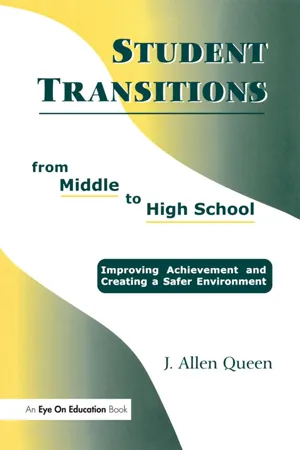
Student Transitions From Middle to High School
About this book
This book shows administrators and teachers what they can do to make their students' ninth grade experience a successful one. Practical and research-based, this book showcases strategies to help you reduce your dropout rate, enhance student achievement, and provide a safe environment for your ninth grade students.
Information
1
From Middle School to High School
Most students attending public school today will experience several formal transitions, or the process of moving from one level of schooling to another, prior to kindergarten and concluding after graduating from high school. Five major transitions from home to college can be identified for most students.
We usually think of the first transition as from home to kindergarten, but for a growing segment of the population there is a variety of formal experiences such as church preschool, Head Start or private day-care that actually serve as the first transition from home to a group setting. Few parents keep their children at home exclusively before kindergarten. In the second transition, most children attend an elementary school that ranges from kindergarten through the fifth grade. Students are exposed to the third formal transition with the middle school experience beginning in sixth grade and culminating in eighth grade, or in some instances, ninth grade. Thereafter, students transition into high school for the fourth experience, usually ranging from grade nine or ten through twelve. Upon the completion of the twelfth grade, students have their fifth transition by entering college/ post secondary education or the workforce. Not surprising is the fact that some students have more transitions than these four if their family moves often or they attend schools having unusual organizational patterns. It is the fourth transition, or the move from middle school to high school, that will be the focus of this book.
The transition from middle school to senior high school can be traumatic for young adolescents, yet it is considered to be another rite of passage in life that young people must experience in order to move to the next level of education.
This chapter continues by identifying strategies that can ease the transition from the middle school to the senior high school. Throughout the chapter, the areas emphasized are the perception of students and parents with respect to transition, a review of the methods for easing the transition, and the related duties and responsibilities of the school administrator, the teacher, and the school guidance counselor.
It is important to understand that in implementing any type of transition program there must be substantial support, a level of preparedness and continued consistency throughout the process. In order for this implementation to be successful, individual needs and group needs must be considered.
Two Different Types of Transitions
There are two distinct forms of transition. One form of transition is systematic and built into the structure of the public school system; the other is developmental and incorporates physical, intellectual, social and emotional change. From this perspective, systematic transitions include the process that occurs during the changes in the various levels found within the educational system, and the second form references the various types and stages of development from early childhood to early adulthood.
The main function of the first stage of transition is usually for basic childcare or to compensate for limited or inefficient developmental experiences, but many social skills, both positive and negative, may be experienced for the first time. During the second transition to the elementary school beginning at kindergarten, the focus shifts to a greater emphasis on basic skills in literacy and mathematics, and in most classrooms, an intentional attempt to teach the process of socialization. As the student moves to the third transition, from elementary to middle school, we see a greater emphasis on the mastery of basic skills, more content in social studies and the sciences, and in the better classrooms, teachers challenging students with higher levels of problem solving and character development. From middle school to high school, which emphasizes a balanced curriculum focusing on the acquisition of knowledge and developing a conceptual understanding across various subjects, students experience the fourth and often most challenging transition that will occur: The ninth grade and starting high school.
Varying concerns surface during the transition of students from one school level to the next, ranging from issues involving various teaching methods to the actual learning process. Researchers studying school transitions believe that the transitions between schools need to be smooth to avoid extremely drastic changes and to limit the negative impact on students. In the age of high-stakes testing and an underestimated number of students quitting school, many transitionalists advocate that it is imperative that well developed programs be implemented to maximize student success (Balfanz and Legters 2001). We will review this process in much greater detail later in the book.
The General Impact of Student Transitions
Students affected by the transition from middle school to high school are often classified by gender, behavior problems, low academic performance, or socio-economic status. At one time females had the most difficulty with the transition to high school, but with the age of terrorism and school violence, the anxiety has balanced equally to males and females. Peer relations are extremely important to both male and female students. Upon entering the high school, students of both genders often find it extremely difficult to adjust because their friendship circle has been disconnected.
Another problem that is evident during the transition process involves those who experienced behavioral difficulties during the elementary school years. Students with behavioral problems constantly disrupt the class setting and often end up in confrontations with other students or the classroom teacher. These students have an extremely difficult time adjusting to any school environment and most will become serious discipline problems in middle school and high school (Queen 2002).
Students sometimes experience difficulty making a successful transition because they are not academically prepared for the next school level. Due to an inadequate preparation for the next level, they often make lower scores on tests, fail to complete homework assignments, and rarely comprehend the assigned activity. This leads to higher levels of frustration, failure, and once at high school, the greater probability of dropping out of school.
Sadly, most individuals affected by the transition periods are students from low socio-economic environments. Many African American and Hispanic students living in poverty may lack the parental support that could enable them to make more successful transitions. These support structures include the degree of parental interest and participation in school and related events, and the extent to which parents supplement the learning process with educational activities. Perhaps the most important factor is the degree parents have conversations with their children about school and learning.
African American males are identified as the individuals who experience the most difficulty when making a successful transition from the middle school to the high school. In many cases, African American males fall into categories pertaining to behavior problems, low academic performance, and low socio-economic status. The problem may be the result of a disproportionate representation of African American males that are in classes designed for learning-disabled students, which usually results in an inappropriate placement because of classroom behavior. Once a student is placed outside the realm of the education process, the placement begins to take a form and procedure that inhibits learning opportunities, which in turn become fewer opportunities, which negatively impacts the school experience (Anderson, Jacobs, Schramm, and Splittgerber 2000; Hauser, Simmons, and Pager 2001).
School boards and administrators have struggled with the question of which organizational pattern best serves the needs of students. For economic and educational reasons the most common configurations include grades K-5, 6-8, and 9-12; grades K-6, 7-9, and 10-12; grades K-6 and 7-12; and grades K-12 in single-school districts (Freshcorn 2000). In all but one configuration, students face at least two and often three school transitions as they progress through the public school organization. A related issue is the recent proliferation of the middle school, grades 6-8. With such a configuration, many students must adapt to a school transition between the fifth and sixth grades and the eighth and ninth grades. This has become more of a problem that may have been overlooked with all the excitement and promise of the middle school movement.
The Schools and Transitions
Public schools were formed during the colonial period. Students were housed in the same building under the instruction of one teacher. Students were taught basic academic and social skills in order to participate in a largely rural economy. However, this organizational structure was insufficient to meet the growing socio-economic needs of American society. With increased industrialization and urbanization, societal needs precipitated the development of the high school. During the last quarter of the nineteenth century, public high schools spread rapidly throughout the United States.
The elementary and high school structures remained intact until the introduction of the junior high school (grades 7-9) in the 1920’s. Critics of the junior high school argued that it resembled high school too closely, ignoring the unique needs of adolescents during a unique developmental stage in their lives. The middle school movement (encompassing grades 6-8), developed from this criticism. The purpose of the middle school remains today to serve as a transition for students as they develop from childhood into adolescence. The middle school incorporates programs and structures uniquely designed for students at this developmental stage. The middle school movement gained strength throughout the country and expanded rapidly during the 1980’s (McEwin 1990).
The popularity of the middle school concept, coupled with economic and demographic indicators, has caused an increased number of students to face school transition between the eighth and ninth grades. The National School Board Association (1997) predicts that student enrollment will peak in this country by the year 2007, with the highest increase at the high school level. Financially, school boards are spending substantial funds to improve existing facilities. If the middle school is to remain as an accepted school structure, we must be aware of student problems following a school transition between the eighth and ninth grade.
Several theories attempt to explain adolescent development. Most textbooks include three main areas of cognitive, social, and physical development. A challenge to those of us working with middle school and high school students is to gain a better understanding of adolescent behavior. Detailed information on the stages of human growth and development is an essential starting point of the process and can be found in numerous education and psychology textbooks.
The critical transition from middle school to high school occurs as students are experiencing the pain of adolescence. This significant move into a new school involves “disrupting relationships with teachers and peers at a time when teenagers are becoming more independent from their families and experiencing less parental involvement in their schooling” (Schiller 1999). “During the first year of high school, students encounter a new social environment in which they are unknown to teachers and many peers and at a stage when their identity is formative. High school represents both an opportunity to develop in new or continuing directions and also the risk of being perceived in terms limited to ethnicity or academic competence” (Oxley, Croninger, and DeGroot 2000). While some students are successful in using this opportunity to redefine themselves socially or academically, the competitive and impersonal environment of the high school devastates others. “The larger size of high schools and the tendency of secondary school teachers to use less individualized instruction and to base assessment of student progress on social comparisons increase the latter risk” (Oxley et al. 2000). The success or failure experienced during this transition can be the turning point in the social and academic lives of students (Schiller 1999).
Understanding adolescence and the needs of the students is crucial, not only in providing the necessary support for these students, but also for building a program that reflects the needs of all students. According to the work done by Zsiray, Larsen, and Liechty (1996), teenagers generally need the following: to develop their own values and not just parrot their parent’s ideas; to find out what they can do and be proud of their own accomplishments; to develop close relationships with boys and girls their own age; and to be accepted, loved, and respected for who they are and what they believe. The most important task of the adolescent is the search for identity. The search occurs in three primary ways: by developing values, by developing pride in one’s achievements, and by developing close relationships with peers. By secondary school age, “students have gained the cognitive ability to reflect on themselves and often experience self-consciousness, and they have begun to interact with wider, more diverse groups that are removed from family and neighborhood. These are the conditions that permit adolescents to explore and experiment with different roles and interests and later to achieve more sustained commitments and identifications” (Oxley et al. 2000). The challenge then becomes, how do educators build a school program that allows students to search for their identity and be successful academically and socially?
As middle school students move to high school, they encounter the opportunity to make new friends and have more choices. Conversely, they have an increased opportunity to be picked on and teased by older students, to get lost, to receive harder work, and to make lower grades. These student problems can be limited by providing a supportive middle school environment with a transition program addressing the needs of students and their parents that facilitates communication between middle school and high school educators (Mizelle 1999).
It is important to remember that early adolescence is a stage of thinking for students. At this point in life, adolescents think and develop ‘what if’ situations as they begin to experience both the joys and challenges of this new stage. Cognitive development encompasses ways in which one perceives, interprets, and reacts to the environment. These interactions allow the adolescent to develop strategies to learn to make positive decisions and resolve personal conflict (Queen 1999).
The change in thinking abilities impacts the early adolescent’s outlook on life in general, and affects social interaction. In terms of socialization, the adolescent is extremely interested in socializing or interacting with his or her peers, and they have a strong need to fit into the group.
Because the feeling of belonging is such a high priority to many adolescents, submitting to peer pressure is common, and the early adolescent follows fads and often worries about measuring up to idealized standards that have been established by peers, often from unreliable to even ridiculous sources. Peer relationships tend to be an important source of support for adolescents, and developing relationships is a very important goal (Hicks 1997). Additionally, these individuals have become more self-conscious and usually overly concerned about other people’s reaction to them. They become increasingly concerned with their appearance, believing that everyone is paying more attention to their appearance than they are.
The most challenging part of this stage for parents and teachers is defiant, but usually normal behavior, and the unbelievable rejection of adult standards. Ironically or perhaps comically, adolescents value the opinion of adults. Remember? We “oldies” experienced and survived adolescence and now can easily remember emulating adults during this stage. Some of these emulations were not positive, even dangerous. We all can recall adolescent friends who never made it to their twenty-first birthday. As former adolescents and now as parents, teachers and school leaders, we know the importance of guidance and direction from responsible adults.
During the middle years, rapid growth occurs. There is a shift in hormone production that affects metabolism, body growth, and sexual maturation. This may be the real reason we have physical education for boys and physical education for girls. Temporary physical awkwardness may occur at this developmental stage, especially for males.
Not only is the transition period destructive to self-esteem, but the adolescent also fluctuates between hyperactivity and lethargy as metabolism varies. Voice changes and growth of pubic hair are two major changes occurring during this stage. Most adolescents become more self-conscious at this time. We know that adolescent students hate to get up early, and according to several reputable studies, students would benefit if classes started later. Most middle school and high school classes begin before 8:00 AM.
In many middle schools, students are taught by teacher teams and individually monitored in teacher-student advisement periods. The middle school curriculum expresses a concern for the development of the individual child so that he or she can cope with the high school environment. In middle schools, students first began to change classes and receive instruction from several teachers on a daily basis.
The middle school is considered to be a place where adolescents can function in the appropriate learning environment by placing a special emphasis on the young adolescent or “preadolescent learner” between the ages of 10 and 15 (Queen 1999, 189).
The major purpose of the high school is to prepare students for the adult world of college or work. H...
Table of contents
- Cover
- Title Page
- Copyright Page
- Dedication
- Acknowledgements
- Table of Contents
- About the Author
- Queen’s Twelve Factors for Successful Transitions
- 1 From Middle School to High School
- 2 The Role of Educators Must Change
- 3 Improving Transitions for Increased Student Achievement
- 4 Examining Exemplar Programs Throughout the United States
- 5 Developing an Effective Transitional Plan for the Local School System
- 6 Defining the Problem
- 7 Reducing Teacher, Student, and Parent Fears
- 8 Responsibility and Civility
- 9 Ninth-Grade Transitions and Improvements
- 10 Examining Exemplar Programs
- 11 Developing and Effective Transitional Plan for the Local School System
- 12 Games and Activities for Students
- 13 Games and Activities for Teachers and Staff Development
- Appendix A Queen’s Twelve Factors for Successful Transitions
- Appendix B Surveys, Tips, and Related Resources
- References
Trusted by 375,005 students
Access to over 1.5 million titles for a fair monthly price.
Study more efficiently using our study tools.
Frequently asked questions
Yes, you can cancel anytime from the Subscription tab in your account settings on the Perlego website. Your subscription will stay active until the end of your current billing period. Learn how to cancel your subscription
No, books cannot be downloaded as external files, such as PDFs, for use outside of Perlego. However, you can download books within the Perlego app for offline reading on mobile or tablet. Learn how to download books offline
Perlego offers two plans: Essential and Complete
- Essential is ideal for learners and professionals who enjoy exploring a wide range of subjects. Access the Essential Library with 800,000+ trusted titles and best-sellers across business, personal growth, and the humanities. Includes unlimited reading time and Standard Read Aloud voice.
- Complete: Perfect for advanced learners and researchers needing full, unrestricted access. Unlock 1.5M+ books across hundreds of subjects, including academic and specialized titles. The Complete Plan also includes advanced features like Premium Read Aloud and Research Assistant.
We are an online textbook subscription service, where you can get access to an entire online library for less than the price of a single book per month. With over 1.5 million books across 990+ topics, we’ve got you covered! Learn about our mission
Look out for the read-aloud symbol on your next book to see if you can listen to it. The read-aloud tool reads text aloud for you, highlighting the text as it is being read. You can pause it, speed it up and slow it down. Learn more about Read Aloud
Yes! You can use the Perlego app on both iOS and Android devices to read anytime, anywhere — even offline. Perfect for commutes or when you’re on the go.
Please note we cannot support devices running on iOS 13 and Android 7 or earlier. Learn more about using the app
Please note we cannot support devices running on iOS 13 and Android 7 or earlier. Learn more about using the app
Yes, you can access Student Transitions From Middle to High School by J. Allen Queen in PDF and/or ePUB format, as well as other popular books in Education & Education General. We have over 1.5 million books available in our catalogue for you to explore.