- 308 pages
- English
- ePUB (mobile friendly)
- Available on iOS & Android
eBook - ePub
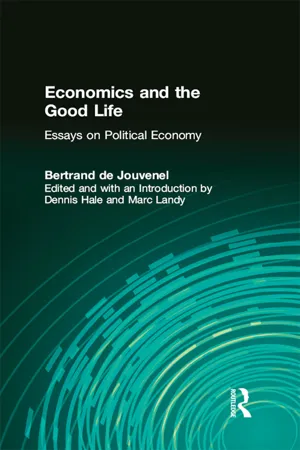
Economics and the Good Life
About this book
Bertrand de Jouvenel (1903-1987) was known in the United States primarily as a political scientist. His best-known works--On Power, Sovereignty, and The Pure Theory of Politics--all made distinctive contributions to our understanding of the modern state, and to the creation of a political science capable of civilizing that state. His work in the field of economics is relatively unknown in the United States, but like many writers in the contemporary field of political economy, de Jouvenel is not interested in expanding the claims of economy at the expense of polity. On the contrary, his thinking is governed by the oldest and most fundamental of political concerns, the definition of the good life.The good life is not a product of the marketplace, but of deliberate and collective decision--that is, a task for thoughtful citizens and statesmen, and not simply the sum of millions of separate and amoral "consumer preferences." De Jouvenel is well known for his opposition to the distended state, but he was no anarchist. His eloquent warnings to keep the state in its proper sphere were accompanied by a richly sophisticated discussion of what the proper sphere is--an aspect of his work that comes through very clearly in this volume.Written between 1952 and 1980, the essays range from a discussion of technology to reflections on such fundamental economic concepts as "amenity" and "welfare." They include the deeply theoretical as well as the practical and the concrete. All are informed by de Jouvenel's insistence that a science which seeks to understand the production and distribution of "goods" must be concerned in the first place with the good itself. Economics and the Good Life is a companion volume to The Nature of Politics: Selected Essays of Bertrand de Jouvenel. Like the earlier volume, this collection is accompanied by an editor's introduction that places the essays in the wider context of de Jouvenel's work. This work is essential to the libraries of economists, political theorists, historians, and sociologists.
Part One:
The Elements of Political Economy
“So it seems that individuals as such are quite incapable of weighing rightly or meaningfully the value of government activities. And if the public authority seeks to rest its own appreciation of its service as against others which might be provided out of the same resources, or its appreciation of some of its services as against others, on some form of subjective appreciation by consumers as such, it must go terribly astray. In other words it seems that public policies cannot be made to rest upon what people desire in their private capacities.”
—“The Idea of Welfare,” 1952
1
The Idea of Welfare
I
Last winter I was in America attending “The Great Debate” [on U.S. troop commitments in Europe—Eds.]. During the extended hearings held by the four assembled committees on Armed Services and Foreign Affairs of the two Houses, two different points were dealt with: there was the constitutional or formal issue: did the President have the right to commit troops to Europe on his own, without the consent of Congress? And there was the substantial issue: should troops be sent?
In short who was to decide and what was to be done? All of political theory can, in my view, be ranged under these two headings of who and what.
Who is the legitimate authority? To whom does Imperium sive Sovereignty belong, and by whom is it to be exercised? How is this exercise conferred? How is it partitioned out into potestates? What is the legitimate province of the several potestates? All this, and much more, constitutes the realm of who: a major sector of political science.
But surely not a more important one than the realm of what. What is the proper decision? By what standards appraised? Based on what assumptions as to man’s nature and summum bonum, as to the final cause of society and the proper purposes of government?
My interest lies with the second sector. This can be designated as the theory of political choice or the theory of the best decision. We may indeed name it at will, as explorers do of uncharted lands, for, to my limited knowledge, very little work has been done in that field for a very long time. The problem of who has held sway. Why this predominance of the problem of who?
Three reasons may be propounded. First, it is the problem of attribution of power, a thing which men covet. Competition for power communicates its warmth to discussions about titles to power. Secondly, when the attribution of power is in doubt, the legitimacy of authority in question, such disorders follow that the problem of the best measures becomes academic, and the first need of society is for a recognized authority. Thus it is in fact necessary to begin chronologically with the problem of the legitimate authority. Whenever that has been in dispute—as in France it was during the delphinian stage of the Hundred Years War, or indeed more recently with the duality of Vichy and London or Algiers, terrible consequences follow. It was of course the great achievement of Ancien Régime Europe to settle the problem of who by monarchic succession. (This, however, left the vexatious problem of the passing of the crown into foreign hands.) And politics has of course been mainly concerned during almost the last three centuries with shifting the notion of legitimacy which now applies to the team emerging out of a periodic auctioning of political leadership.
The third reason for the major importance assigned to the problem of who is that men are very prone to think that the proper decision follows ipso facto from the choice of the proper ruler. The candidates for office certainly seem to think so. The whole faction which surrounds and supports pretenders thinks so.
This linking of the “proper decision” with the “proper ruler” can be regarded in two ways. It can be maintained that anything he-who-is-entitled-to-command, does command, is therefore right. This is arbitrary government. Such theory is the theory of despotism, whether it applies to the anointed or to the elected, to any individual or group of people. It seems incredible that the theory of despotism should ever have been held, and even more so that it should be held today by a great many people quite unconscious that they do. That has been and is possible because the relationship between the “proper ruler” and the “proper decision” is more often regarded the other side up.
The proper ruler shall take the proper decision because we have recognized before adjudging him the proper ruler that his future decisions shall be proper, either because generally speaking he has been rightly equipped morally and intellectually to take the right decisions, or because, more definitely, we have chosen him on the strength of the decisions he proposed to take on his program.
Choosing rulers on the strength of a judgment of character was of course the principle of the representative system, which has now been discarded: the choice is based on the program. Therefore it can be said that there is no point in discussing what those who govern should do since they are enabled to govern only in consideration of the decisions they in advance promised to make.
To this there are two answers. It may be observed that in fact the commitments are very vague and general. A government arising out of an election takes its promises only as a limiting factor of its decisions. But it is more meaningful and fertile to make another answer. Assuming, against evidence but for logical purposes, that decisions in democracy are not made by those in power but by the people themselves, then indeed for those in power there is no problem of what to do; what to do is for them “given”; but in that view of things “the people” make the decisions. Then for them there is a problem of what.
There is a problem of what for you and for me. Assume that on the morrow of a popular referendum offering the choice of measures A and B, we agree that A is the “right” measure since it has been chosen, yet on the eve of the referendum we can make no such abandon of our own judgment to that of the community, as we do not know what the community prefer. We have to vote in order to know which we ourselves think best of A or B.
However eager modern political science shows itself to take choices as given, these must in fact, at some stage or other, be made. Indeed a democracy is by definition a regime where every individual, qua citizen, is supposed to be choosing for the community the decisions it should take through the proper agencies. This is a continuous process known as the movement of opinion. The choice may be, at some moments merely a “paper choice,” we would rather have this decision than that, but these paper choices do weigh or are supposed to. For the man in office, it is a continuous process of effective choices.
Are these choices of what should or should not be done entirely irrational? Who would go so far? Yet sociologists are prone to treat them as irrational. This is regrettably implied in the focusing of interest upon the evolution of such choices (for instance in dynamic pollstering) rather than upon the act of choice itself. If this act is at all rational, made by reasoning with the help of criteria and with the use of assumptions, then the choice of criteria and of assumptions are of the utmost interest to the political theorist. And if the process is rational it follows that the reasoning can be improved, the method of choice perfected. Which is surely something worth our labor.
It is difficult to deny at least that some people use some apparatus of thought to make some decisions. As soon as this is granted it becomes important to study and improve this apparatus. This seems to evoke the opposition of many political scientists. They feel on safely scientific ground only as long as they study opinion as given. I wonder whether here the urge to be scientific does not constitute an obstacle to science. A physicist does not feel at his most scientific when he asks people to give him their impression as to the relative weights of different items and classifies the replies. He deems it his office to provide these people with means of actually comparing the weights. In the same manner I think political science should not shirk the task of elaborating a method whereby a better political decision may be known from a worse.
Political decisions are sometimes called “courses,” which is a good enough word because it evokes their execution over time and the deployment of their effects over time. Obviously to know a better decision from a worse you must have some view of these effects, that is some understanding of social mechanisms, and some means of appraising the value of effects.
If for instance the question at stake be the suppression of gambling, you may adjudge this a good decision on the grounds that gambling is morally bad, and then you may contemplate the execution of this decision over time, foresee that it will not be executed, that it will tend to increase disobedience to law, perhaps corruption of the repressive force, and you will have to weigh these disadvantages.
This is just an instance of a simple political problem. It involves values and assumptions, but these do not make the problem unmanageable. The values will be given different weights by different people. And it is interesting to know why. Assumptions may be different, and it may be possible to test their relative adequacies. To say that this makes the problem incapable of being stated with precision is equivalent to denying the possibility of algebra.
The importance of stating the problem and then inducing individuals to state their values and assumptions lies to a great part in the consequence of tying them down to values and assumptions which they must then carry over to other problems. It is already a great thing to get a given individual to use throughout the political field the same values and assumptions, a consistency he often fails to observe. But also the bringing of values and assumptions to bear on several different problems must lead him to reject certain assumptions which he is not willing to accept in all cases and to redress some estimations of values, which he is not willing to adhere to throughout.
Should political science do this sort of thing, that is, work towards a methodology of political choice? I think it should, but it is a fact that it does not.
II
In the meantime economists put us to shame because they have courageously embarked upon a job which really lies in our province. I am of course alluding to those two important segments of economics known as national income accounting and the new welfare economics. Such work bears a direct relation to the preoccupations of those who govern. If the politician asks the political scientist: “What should I do?” there is either no reply, or a purely formal one (“Execute the will of the people” but that tells me nothing as to what I myself should will), or again it may be: “Attend to Bonum Commune.” This looks more promising. But unfortunately no criteria are provided by which I may tell how to maximize Bonum Commune.
The economist on the other hand does offer something more concrete. He states that it is good to increase the National Income and offers means to measure its increase. He also states that it is good to alter the distribution of personal incomes in any way that causes a greater sum of satisfactions than dissatisfactions. It is the fashion among welfare economists to deny that they are comparing satisfactions. But “the lady doth protest too much”. That is in fact what they do. Professor Pigou insists upon it with vigorous honesty. “Welfare relates to satisfactions.”1
The politician uses the language of welfare economics: he expounds his achievements in terms of increases of the national income; and he justifies measures hurtful to some by claiming that others have so profited as to make the balance of alterations favorable. While it can be said that politicians are indebted for their mode of thought to the disciplines mentioned—and that is most apparent in the use of national income accounting—it can also be said that these disciplines refine the actual attitude of politicians, and this is most apparent in the attitude to distribution of incomes or satisfaction.
Anyhow the close relationship between live politics and academic work is precisely that which one would reasonably expect between politics and political science, and which in fact is not to be found. Such a connection did exist in the days of Hobbes, Locke, Burke, Siéyes, Benjamin Constant, in fact up to say the eighties of the last century. Actual political discussions drew largely upon doctrinal discussions on the form of government. Today they draw upon the contributions of economics. This one tends to explain in what seems to me a facile manner by saying that now problems are mainly economic. What this means really is that problems are appraised in the language of economics. Take for instance the problem of “how much rearmament Europe can stand.” This is discussed in terms of allocation of national product, but what is really at issue is not that national incomes cannot stand more than so much rearmament, it is in fact that European opinion is not so conscious and convinced of its military peril as to be willing to accept a substantial (or indeed any) compression of its way of life: that is a political situation; economics provides a language.
The present glaring precedence of economics over political science in the counsels of government does not seem to me due so much to the nature of the problems as to the attitude of economists as against that of political scientists. The economists have been more daring. They have forged ahead because they have wanted to be effective and have to that end ventured assumptions. The purpose of this lecture is to investigate these assumptions and to find how far we can trust a language which is being widely used, and is providing an inspiration to those in responsible positions. It is stretched even to provide comparisons of the welfare of different societies, even the welfare of different civilizations in different centuries. It is currently invoked to find what contribution different nations should fairly make to a common purpose, such as Western defense. These are very delicate problems. Have we indeed got an instrument of measurement allowing us to do all these things? If we have, this effects a major revolution in political science, of which we must take cognizance and to which we must gear our thoughts. If we have not such an instrument while it is commonly thought that we have, then there is a potential danger of major mistakes being made. Finally it may be that there is an apparatus of thought which can be used for some purposes and not for some others, under some assumptions and not under some others, which we should seek to define in cooperation with economists.
III
In the dismal days of equilibrium theories, which showed that under frictionless conditions, not to be found in reality, a general equilibrium would result about which nothing much could be said, the Western mania for measuring stood economics in good stead. Estimates of wealth or of national income were made at various times by adding up monetary values. These estimates came to be lined up by people who were not regarded as real economists, such people as Mulhall or Webb. It seemed interesting to try and make them comparable by eliminating the influence of price changes. It then appeared that this wealth or this national income moved up with greater or lesser speed in different periods and that it was best to have it move up as rapidly as possible. It came to be regarded as a rough “measure” of the common good, though the word was never pronounced.
In the meantime, preoccupation with poverty made it of major interest to find whether the standard of life of the least favored was being satisfactorily improved. It came to be adjudged a chief concern of the state to improve it, if necessary at the expense of the better placed. The idea of welfare thus took some shape as the idea of an increase in the national income coupled with a redistribution among individuals to the benefit of the least favored. After various tentative formulations, finally the idea was fully and coherently set forth in that famous book: Professor Pigou’s Economics of Welfare. This can be said to have opened an era of fruitful thinking for economists, in the sense that henceforth they had criteria for advising this or that policy.
Let me here stress that the setting up of criteria for government action was made possible to economists by their implied philosophy. They will of course insist that they have no metaphysics and pass no value judgments. But that is quite false. Whatever else they may think outside their department, as economists they have a view of man, and derive from it value judgments. To the economist as such, man is essentially a consumer. Therefore, whatever ontological views the economist may hold in his private capacity, as an economist he adopts the Hobbesian view of human nature as a seat of desires; man desires, the things he desires are to him good, they are goods in the economic language. And they are worth precisely what the desirer is willing to give for them. Therefore various goods can be compared and added up, however different in nature, because they have this in common that they are desired, and can be compared because they are more or less desired. This comparing and adding up is valid in the case of one man choosing the parcel of goods most agreeable to him within the ambit of his resources. And this validity may be carried over to the case of a great number of men exercising their choices simultaneously on the market. They are regarded as one consumer; though of course the choices here are weighted by the distribution of incomes. But this being given, at a...
Table of contents
- Cover
- Half Title
- Title Page
- Copyright Page
- Table of Contents
- Preface
- Editors’ Introduction
- Prologue
- Part One:The Elements of Political Economy
- Part Two: Problems of Postwar Reconstruction
- Part Three: The Political Economy of Natural Resources
- Index
Trusted by 375,005 students
Access to over 1.5 million titles for a fair monthly price.
Study more efficiently using our study tools.
Frequently asked questions
Yes, you can cancel anytime from the Subscription tab in your account settings on the Perlego website. Your subscription will stay active until the end of your current billing period. Learn how to cancel your subscription
No, books cannot be downloaded as external files, such as PDFs, for use outside of Perlego. However, you can download books within the Perlego app for offline reading on mobile or tablet. Learn how to download books offline
Perlego offers two plans: Essential and Complete
- Essential is ideal for learners and professionals who enjoy exploring a wide range of subjects. Access the Essential Library with 800,000+ trusted titles and best-sellers across business, personal growth, and the humanities. Includes unlimited reading time and Standard Read Aloud voice.
- Complete: Perfect for advanced learners and researchers needing full, unrestricted access. Unlock 1.5M+ books across hundreds of subjects, including academic and specialized titles. The Complete Plan also includes advanced features like Premium Read Aloud and Research Assistant.
We are an online textbook subscription service, where you can get access to an entire online library for less than the price of a single book per month. With over 1.5 million books across 990+ topics, we’ve got you covered! Learn about our mission
Look out for the read-aloud symbol on your next book to see if you can listen to it. The read-aloud tool reads text aloud for you, highlighting the text as it is being read. You can pause it, speed it up and slow it down. Learn more about Read Aloud
Yes! You can use the Perlego app on both iOS and Android devices to read anytime, anywhere — even offline. Perfect for commutes or when you’re on the go.
Please note we cannot support devices running on iOS 13 and Android 7 or earlier. Learn more about using the app
Please note we cannot support devices running on iOS 13 and Android 7 or earlier. Learn more about using the app
Yes, you can access Economics and the Good Life by Gary Becker,Bertrand de Jouvenel in PDF and/or ePUB format, as well as other popular books in Economics & Economic Theory. We have over 1.5 million books available in our catalogue for you to explore.