- 288 pages
- English
- ePUB (mobile friendly)
- Available on iOS & Android
eBook - ePub
About this book
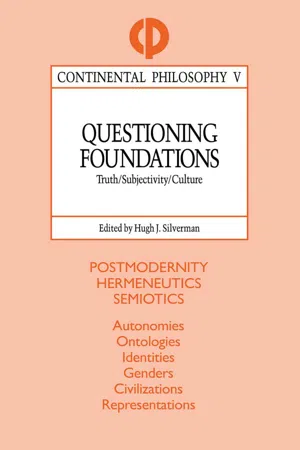
The continental tradition in philosophy has long focused its energies on the question of foundations. These ssays reopen conventional understandings of the classical themes on which philosophy has been based since its inception.
Information
PART I
TRUTH
Chapter 1
THE TRUTH OF HERMENEUTICS*
How does hermeneutic ontology speak about truth? This question must take into account the widely held suspicion that the philosophical position of hermeneutics is relativist, anti-intellectualist and irrationalist (or, at best, traditionalist). For it lacks that instance of truth which the metaphysical tradition has always thought in terms of patency (the incontrovertible givenness of the thing) and the correspondence of the proposition to the evidence of the thing. The Heideggerian critique of the notion of truth as correspondence seems to deprive hermeneutics of this instance, and even to make it impossible for hermeneutics to “save the phenomena,” to acknowledge the experience of truth common to us all. This experience occurs when we openly espouse the validity of an affirmation, put forward a rational critique of the existing order (a mythical tradition, an idolum fori, an unjust social structure), or correct a false opinion by passing from appearance to truth. Without these usages of truth, thought seems to abdicate its vocation. Yet can they still be guaranteed without some idea of patency, and thus of correspondence?
One can reply to such a question only by trying to reconstruct, or perhaps construct, the positive terms of a hermeneutic conception of truth. This must be done on the basis of, and beyond, the “destruction” of correspondence-truth as carried out by Heidegger. At the beginning, however, let us recall the essential motives for Heidegger's rejection of the notion of truth as correspondence.
We are concerned to put to rest the misapprehension that in Being and Time Heidegger looks for a more adequate description of the meaning of Being and the idea of truth, as if the notions of Being handed down to us by the metaphysical tradition were partial, incomplete, inadequate, and therefore false descriptions of Being as it is really given, and truth as it really occurs. That this might not be Heidegger's intention is, from the very beginning, less than clear. However, it may be appreciated well enough if one reflects that such an intention would inevitably be contradictory, even in light of the features at play within truth as correspondence itself. With the evolution of Heidegger's work after Being and Time it becomes clear that his ontology cannot in any way be taken for a kind of existentially phrased neo-Kantianism (the structure of reason and its a priori having fallen into the thrownness and finitude of Dasein's project).
At the same time, it is clear that the objection to the conception of truth as correspondence is not made solely on the basis of its being inadequate to describe the experience of truth faithfully. For with the acknowledgment of inadequacy, one sees that one cannot retain a conception of truth as correspondence, since this implies a conception of Being as Grund, as the insuperable first principle which reduces all questioning to silence. Moreover, precisely the meditation on the insufficiency of the idea of truth as the correspondence of judgment to thing has put us on the track of Being as event. Admittedly, to say that “Being is event” (as Heidegger, quite rightly, never actually said)1 is apparently also to give a descriptive proposition that claims to be “adequate.” But to remark upon this superficially, as occurs repeatedly in all the “winning” arguments of metaphysics (the argument against skepticism is a typical example), is to placate and satisfy only those who bow before the ontological implications of the principle of noncontradiction. It does not persuade anyone to change their view, however. And above all, it does not allow thought to take a further step. In general, Heidegger has taught us to reject the untroubled identification of the structures of Being with the structures of our historical grammar and language. Thus, he has also taught us to reject the immediate identification of Being with what is sayable without performative contradictions in the context of the language we speak.
To say that Being “is” event means to pronounce in some way, still in the language of metaphysics, consciously accepted and verwunden, the ultimate proposition of metaphysics. The logic of foundation is being carried to extremes. It is the same process of unfounding [sfondamento], albeit experienced differently, that Nietzsche “described” with the proposition “God is dead.”
It would not be rash to reconstruct the middle Heidegger's thought as an elaboration of this contradiction. This would resolve (dissolve) the Kehre entirely in Verwindung, in the resigned resumption-distortion-acceptance of metaphysics and nihilism. We recall this ensemble of problems only to remind ourselves that, in attempting to construct a hermeneutic conception of the experience of truth in positive terms, beyond the destruction of correspondence-truth, we must let ourselves be guided by the same motives that led Heidegger to that destruction in the first place. Such motives are not reducible to the search for a description that is truer because it is more adequate. They have, instead, to do with the impossibility of still thinking Being as Grund, as first principle, given only to the exact contemplation, panoramic but soundless, of nous. Recalling the motives for Heidegger's criticism of correspondence-truth is crucial if we are to overcome the aporias that seem to threaten the hermeneutic conception of truth, and not only in the view of its critics. Such a conception must be constructed on the basis of what Heidegger calls “opening.” It will avoid the risks to which the critics of hermeneutics have drawn our attention (irrationalism, relativism, and traditionalism), only to the extent that we remain faithful to the motives of the Heideggerian destruction. This destruction did not set out to propose a more adequate conception of truth, but aimed to “respond” to the meaning of Being as event.
Referring to this guiding thread, we can resolve, or at least articulate in a more positive manner, a problem that post-Heideggerian hermeneutics does not seem to have posed in the right terms: the question of the relation between truth as opening and truth as correspondence (or, what is in many ways the same thing, between truth in philosophy and the human sciences and truth in the positive sciences). Every reader of Truth and Method will appreciate that it is not clear whether Gadamer intends to suggest that the human sciences have a truth of their own, founded upon interpretation, or whether he wishes to affirm this “model” of truth as valid for every experience of truth in general (and thus for the experimental sciences too). Either way, this “obscurity” in Gadamer may be easily explained by noting that in Truth and Method the Heidegger to which he makes most constant and wide-ranging reference is the Heidegger of Being and Time.2
Now, on the basis of Being and Time, we can say that the simple presence to which both banal everydayness and scientific objectivism are reduced arises from a partial attitude that cannot serve as the only model for thinking Being. Inauthentic thought, which is the ontology that needs to be destroyed, and will later become the metaphysics that forgets Being in favor of beings, takes simple presence and the objectivity of objects as models for thinking not only entities within the world, but also Being itself. To escape inauthenticity or the “lethean” distortions of metaphysics, we must avoid this undue extension of the simple presence of entity-objects to Being.
Gadamer does not seem to venture further than this in his criticism of modern scientism in Truth and Method. For him, such scientism is not the fatal outcome of metaphysics. Still less is it a fact bound up with the destiny and history of metaphysics, as it clearly is for Heidegger after Being and Time. Even Rorty's thesis in Philosophy and the Mirror of Nature, in which he distinguishes between “epistemology” and “hermeneutics” in terms that may well be drawn back to correspondence and opening, seems to be a reformulation (“urbanized” like Gadamer's) of a position whose basis may be found in Being and Time.3 Epistemology is the construction of a body of rigorous knowledge and the solution of problems in light of paradigms that lay down rules for the verification of propositions. To be sure, these rules do not necessarily imply that whoever follows them gives a truthful account of the state of things, but at least they do not exclude it. Moreover, they allow a conception of science and scientific practice to survive which are for the most part in harmony with the traditional metaphysical vision of the proposition-thing correspondence.
Hermeneutics, by contrast, unfolds in the encounter with different paradigmatic horizons. Resisting evaluation on the basis of any correspondence (to rules or to the thing), such horizons manifest themselves as “poetic” proposals of other worlds, of the institution of different rules (within which a different “epistemology” is in force).
We will not pursue the suggestions or problems that arise from Rorty's hypothesis, which seems common to a Gadamerian perspective, although Gadamer has always been very reticent on the subject of the relation between knowledge in the interpretive sciences and knowledge in the strict, or natural sciences. One relevant difference between his position and Rorty's consists in the fact that, on the moral plane at least, Gadamer grants a kind of supremacy to knowledge in the human sciences (especially in Reason in the Age of Science). The natural sciences, inevitably linked to technology and with a tendency toward specialization (not only in knowledge, but also in pursuing ever more specific ends, possibly in conflict with the general interests of society), must be “legitimized” by a thought which relates them back to the logos, to the common consciousness expressed in the natural-historical language of a society and its shared culture. The continuity of this consciousness, even in the sense of a critical reconstruction, is assured precisely by the human sciences, and by philosophy above all. In the terminology of Being and Time (and later, Vom Wesen der Wahrheit), the opening, which occurs in language and its founding events (like the work of art), is truth in its most original sense. It serves, too, as a point of reference for the legitimation of correspondence-truth in the sciences.
The sciences, however, insofar as they specialize via the construction of artificial languages, “do not think,” as Heidegger and Gadamer have said. As for Rorty, his position seems to be more radical than Gadamer's. There is no residue of the distinction between the natural sciences and the human sciences. Each form of knowledge may be in either a hermeneutic “phase” or in an epistemological one, according to whether it is living through a “normal” or “revolutionary” period. However, this excludes any possible hierarchy between types of knowledge. It also excludes any privileged place for human rationality in general, such as Gadamer's logos-language (and common sense, dense with history).
Yet just how radical is this difference between Gadamer and Rorty? Both relate truth as correspondence back to truth as opening. This is understood either (in Gadamer) as an historico-cultural horizon shared by a community that speaks the same language, or (in Rorty) as a paradigm that, without necessarily being identified with a linguistic community or cultural universe, nonetheless contains the rules for the solutions of its own problems and shows itself to be a foundation that is not founded, not even by that historical continuity still active in Gadamer. However, the problem ultimately remains the same for both thinkers. For Gadamer too the historical continuity which legitimizes the opening, and prevents its reduction to an arbitrary and casual paradigm, is nonetheless a limited community. It cannot be extended to a limit such as would link it with humanity in general, at least not explicitly. There holds for Rorty, but probably for Gadamer as well, a certain “Weberian” relativism. One can speak of truth in the sense of conformity with rules, given with the opening itself, only within an historical-cultural opening or paradigm. At the same time, the opening as such cannot be said to be “true” on the basis of criteria of conformity, but is (at least for Gadamer) original truth. For it institutes the horizons within which all verification and falsification are possible. The “hermeneutic” experience of the opening is more or less explicitly “aesthetic.” This is clear in Rorty, who thinks the encounter with other paradigms as an encounter with a new system of metaphors.4 Not by chance does Gadamer himself begin Truth and Method by affirming the significance of truth in art. But in Gadamer the encounter with other openings of the world, which is interpretation, is an aesthetic experience only to the extent that the latter is thought in historical terms, as an integration, or better, as a present “application” of a call whose origin lies in the past.
In effect, we should turn more to Gadamer than to Rorty for an articulation of the hermeneutic doctrine of truth as opening. This is so even if in Gadamer the problems entailed by this conception are brought into relief, forcing us to return to Heidegger, to his thought after Being and Time, and to what have seemed to be the fundamental demands motivating the critique of correspondence-truth found in that work.
If truth as opening is not thought as the incontrovertible givenness of an object possessed by a clear and distinct idea and adequately described in a proposition that faithfully reflects the idea, then the truth of the opening can, it seems, only be thought on the basis of the metaphor of dwelling. At bottom, this holds not only for Gadamer, but for Rorty as well. I can do epistemology, I can formulate propositions that are valid according to certain rules, only on the condition that I dwell in a determinate linguistic universe or paradigm. Dwelling is the first condition of my saying the truth. But I cannot describe it as a universal, structural, and stable condition. There are two reasons for this: because historical experience (and that of the history of science as well) displays the irreducibility of heterogenous paradigms and cultural universes, and because in order to describe the opening as a stable structure, I would need a criterion of conformity which would then be the more original opening.
I shall speak, then, of truth as opening in terms of dwelling. I call it truth because, like rules with respect to individual propositions, it is the first condition of every single truth.
Dwelling in the truth is, to be sure, very different from showing and rendering explicit what already is. In this respect Gadamer is right when he observes that belonging to a tradition, or even in Wittgensteinian terms, to a form of life, does not mean passively undergoing the imposition of a system of prejudices. In certain contemporary readings of Nietzsche, this would be equivalent to the total reduction of truth to a play of forces.5 Dwelling implies, rather, an interpretive belonging that involves both consensus and the possibility of critical activity. Not for nothing, one could add, do modern dictatorships give an ever greater place to the techniques of organizing consensus. Dominion through consensus is more secure and more stable. There is a certain difference from pure constriction established here, which perhaps humanizes the exercise of even the most despotic power. It certainly recognizes, albeit paradoxically, the decisive significance of a conscious adhesion to a tradition, and the always active interpretive character of staying in a tradition. As a metaphor for speaking of hermeneutic truth, dwelling would need to be understood as though one were dwelling in a library. Whereas the idea of truth as correspondence represents knowledge as the possession of an “object” by way of an adequate representation, the truth of dwelling is, by contrast, the competence of the librarian who does not possess entirely, in a point-like act of transparent comprehension, all of the contents of all the books among which he lives, nor even the first principles upon which the contents depend. One cannot compare knowledge as possession by command of first principles to the competence of the librarian. The librarian knows where to look because he knows how the volumes are classified and has a certain idea of the “subject catalogue.”
It is therefore senseless and misleading to accuse hermeneutics of being reduced to relativism or irrationalism, whereby each articulation within the opening, each epistemology, would be merely the revelation of what always already is. The conflict of interpretations would then be nothing but a conflict of forces that have no “argument” whatsoever to offer, other than the violence by which their predomination is secured. But thrownness into a historical opening is always inseparable from an active participation in its constitution, it...
Table of contents
- Cover
- Half Title
- Title Page
- Copyright Page
- Table of Contents
- Introduction
- Part I. Truth
- Part II. Subjectivity
- Part III. Culture
- Notes
- Bibliography
- Notes on Contributors
Trusted by 375,005 students
Access to over 1.5 million titles for a fair monthly price.
Study more efficiently using our study tools.
Frequently asked questions
Yes, you can cancel anytime from the Subscription tab in your account settings on the Perlego website. Your subscription will stay active until the end of your current billing period. Learn how to cancel your subscription
No, books cannot be downloaded as external files, such as PDFs, for use outside of Perlego. However, you can download books within the Perlego app for offline reading on mobile or tablet. Learn how to download books offline
Perlego offers two plans: Essential and Complete
- Essential is ideal for learners and professionals who enjoy exploring a wide range of subjects. Access the Essential Library with 800,000+ trusted titles and best-sellers across business, personal growth, and the humanities. Includes unlimited reading time and Standard Read Aloud voice.
- Complete: Perfect for advanced learners and researchers needing full, unrestricted access. Unlock 1.5M+ books across hundreds of subjects, including academic and specialized titles. The Complete Plan also includes advanced features like Premium Read Aloud and Research Assistant.
We are an online textbook subscription service, where you can get access to an entire online library for less than the price of a single book per month. With over 1.5 million books across 990+ topics, we’ve got you covered! Learn about our mission
Look out for the read-aloud symbol on your next book to see if you can listen to it. The read-aloud tool reads text aloud for you, highlighting the text as it is being read. You can pause it, speed it up and slow it down. Learn more about Read Aloud
Yes! You can use the Perlego app on both iOS and Android devices to read anytime, anywhere — even offline. Perfect for commutes or when you’re on the go.
Please note we cannot support devices running on iOS 13 and Android 7 or earlier. Learn more about using the app
Please note we cannot support devices running on iOS 13 and Android 7 or earlier. Learn more about using the app
Yes, you can access Questioning Foundations by Hugh J. Silverman in PDF and/or ePUB format, as well as other popular books in Philosophy & Literary Criticism Theory. We have over 1.5 million books available in our catalogue for you to explore.