Those of us who have watched the process have said that the Earth Summit has failed ... Multinational corporations, the United States, Japan, the World Bank, the International Monetary Fund have got away with what they always wanted ... the Summit has ensured increased domination by those who already have power. Worse still, it has robbed the poor of the little power they had. It has made them victims of a market economy that has thus far threatened our planet ... few negotiators realised how critical their decisions are to our generation. By failing to address such fundamental issues as militarism, the regulation of transnational corporations, the democratisation of international aid agencies and the inequitable terms of trade, my generation has been damned." - Wagaki Mwangi, Kenyan, Youth delegate to the Earth Summit
eBook - ePub
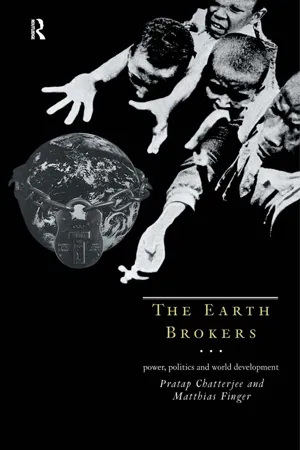
The Earth Brokers
Power, Politics and World Development
- 204 pages
- English
- ePUB (mobile friendly)
- Available on iOS & Android
eBook - ePub
About this book
Information
Part I
THE DOCUMENTS
1
WHOSE COMMON FUTURE?
The essence of the philosophy of the World Commission on Environment and Development can actually be found on the very first page of the Brundtland report. This report, the Commission says:
is not a prediction of ever increasing environmental decay, poverty, and hardship in an ever more polluted world among ever decreasing resources. We see instead the possibility for a new era of economic growth, one that must be based on policies that sustain and expand our environmental resource base. And we believe such growth to be absolutely essential to relieve the great poverty diat is deepening in much of the developing world…. We have the power to reconcile human affairs with natural laws and to thrive in the process. In this, our cultural and spiritual heritages can reinforce our economic interests and survival imperatives…. This new reality, from which there is no escape, must be recognized and managed.1
We cannot in this book go into the history of how the UN system created the World Commission on Environment and Development. Nevertheless, let us briefly recall here the context within which the Brundtland Commission emerged. It is the context of the New Cold War and the re-emerging East-West conflict at the beginning of the 1980s. It is against this threat to ‘our common security’ – highlighted by the debate about the Euromissiles, as well as by the nuclear winter theory – that the Brundtland Commission was created. Not surprisingly, the title of the Brundtland report, Our Common Future, is very similar to the title of the Palme report, Our Common Security, whose main concern was the nuclear threat.2 As a matter of fact, the Brundtland report devotes an entire chapter to a quite radical critique of the arms race, to conclude that ‘the nations must turn away from the destructive logic of an “arms culture” and focus instead on their common future’3. We also note that the Brundtland report actually remains the only document in the entire UNCED process that explicitly deals with the military as a problem. This can be explained by the fact that the Brundtland Commission was born in the context of the Cold War.
What is more, the Brundtland Commission sees at least part of its role as helping to break out of the international deadlock caused by the Cold War. In her preface, ex-Premier Brundtland says: ‘After a decade and a half of standstill or even deterioration in global cooperation, I believe the time has come for higher expectations, for common goals pursued together, for an increased political will to address our common future’.4 It might well be that in the initial phase of the Commission the environment was actually more of a rallying point to foster cooperation among nation-states than the real common challenge.
In the process of its work, the Commission identified the real challenges as population and human resources, food security, species and ecosystems, energy, industry, and the urban challenge. But by breaking down the environmental question into these six challenges, the Brundtland Commission managed to redefine the global environmental crisis in terms of a problem that can be solved by nation-states and their cooperation in promoting economic growth. And such growth, the Commission says, can essentially be achieved by manipulating and improving technology and social organization.5 Overall, one can say that not much thinking seems to have gone into the analysis of the real causes of today's crisis. The major concern does not seem to be the crisis, but the potential conflicts between nation-states that could arise because of a lack of development. Let us now look at each of the six challenges the Commission has identified in more detail.
POPULATION
In the beginning of its section on population, the Brundtland report states that ‘present rates of population growth cannot continue’.6 And: ‘Nor are population growth rates the challenge solely of those nations with high rates of increase. An additional person in an industrial country consumes far more and places far greater pressure on natural resources than an additional person in the Third World’.7 Despite these statements, the analysis put forth by the Commission on population issues is, in our opinion, basically flawed. It rests on the assumption of two fundamental relationships, both of which must be balanced: there should be a balance between population size and available resources on the one hand, and between population growth and economic growth on the other.8
Population is basically seen as an input problem at the national level. The question is whether there are enough natural resources to sustain a certain number of people within given national boundaries. There is also mention, in the report, that people should have equitable access to the overall resources pool, as such equitable access as well as further economic growth are both important means to get fertility rates down. Says the Commission: ‘sustainable economic growth and equitable access to resources are two of the more certain routes towards lower fertility rates’.9 In other words, lowering fertility is seen by the Commission as being achievable through social and economic development alone.
Since ‘almost any activity that increases well-being and security lessens people's desires to have more children than they and national ecosystems can support’,10 the second strategy envisaged by the Commission is to balance population growth rates with economic growth rates. Starting with the realistic assumption that populations will continue to grow, the Commission advocates higher economic growth as well as better education – called ‘improving the human potential’ – and technological improvements in order to make more efficient use of the available natural resource base, or even enhancing this natural resources base. Again, this is achievable through economic growth. Overall, then, the Commission's main recommendation for dealing with population growth is more development: ‘A concern for population growth must therefore be part of a broader concern for a more rapid rate of economic and social development in the developing countries.’ 11
While the Commission certainly pursues the laudatory aim of providing equitable access to resources, this is combined with advocating further growth in order to raise the poor to the levels of the rich. Yet, this is a dangerous idea because the Commission's own figures show that the rich are consuming the vast bulk of resources, which is the major reason for the present crisis to begin with. The Commission's own figures show, for example, that the populations of the Northern countries, with a quarter of the world's inhabitants, consume fifteen times as much paper as their counterparts in the South. Demand from the poor for fuelwood is another major cause of deforestation, but given that the numbers of people consuming trees for paper, furniture and construction purposes are much smaller than those felling them for fuel, and the proportion of wood used is considerably higher, it would surely be more effective to act in the North first.
None of these ratios is at all new. The economist E.F. Schumacher used similar figures in his famous book Small is Beautiful, published in 1973.12 He showed that the United States with 5.6 per cent of the world's population was consuming 63 per cent of the world's natural gas, 44 per cent of the world's coal, 42 per cent of the world's aluminium, and 33 per cent of the world's copper and petroleum, all non-renewable resources. He said:
It is obvious that the world cannot afford the USA. Nor can it afford Western Europe or Japan. In fact, we might come to the conclusion that the Earth cannot afford the ‘modern world’…. The Earth cannot afford, say, 15 per cent of its inhabitants – the rich who are using all the marvellous achievements of science and technology – to indulge in a crude, materialistic way of life which ravages the Earth. The poor don't do too much damage; the modest people don't do much damage. Virtually all the damage is done by, say 15 per cent … The problem passengers on spaceship Earth are the first class passengers and no one else.
In the Brundtland report and in many other reports similar ratios can be found for the consumption of most resources and for the production of most pollutants. But, after quoting such figures, the Commission fails to draw the logical conclusions. It even misses the real point, since it concludes that poverty is the cause of environmental degradation and that higher living-standards will therefore reduce population growth and wasteful consumption. The Commission clearly does not seem to understand that economic growth leads to more consumption and that more consumption leads to more pollution. Even the currently accepted indicators of national income show that those activities that lead to the quickest economic growth cause an increase in pollution. For example, the World Bank reports that ‘environmentally benign activities usually contribute a smaller portion to national income than do environmentally malignant ones’.13 Had the Commission realized this and not been blinded by the development myth, it might have concluded that redistribution and de-industrialization would serve the global environment better than further economic growth.
FOOD SECURITY
Under this heading the Brundtland Commission expresses its concern about how to feed the planet's growing population. The report goes through a wide variety of statistics to show that most of the world has too little to eat despite the fact that food production has continuously outstripped population growth. It also discusses a series of environmental problems impacting negatively on global food production, such as soil erosion, soil acidification, deforestation, and desertification, as well as soil and water pollution. Yet, very optimistically, the report states that ‘global agriculture has the potential to grow enough food for all’.14 Let us see how the Commission comes to such a conclusion and how it conceives of global food security.
Given the Commission's assumption that there is enough food, it sees food security basically as a distribution problem. And such a problem can, of course, be solved by better management, especially on the ‘ultimate scale of distribution’, i.e. the global scale. In addition, food security is also seen as a traditional political problem, especially on the level of national agricultural policy. The argument of the Commission is in fact very close to the argument we can see in GATT: it is specially subsidized production which is seen as being environmentally (and economically) damaging, since subsidies (in the North) lead to surpluses, which depress international market prices, which in turn ‘keeps down prices received by Third World farmers and reduces incentives to improve domestic food production’.15 In short, it states that it is ‘the short-sighted policies that are leading to degradation of the agricultural resource base’.16 There is no mention of the skewed system of food production such as monocultures, the loss of seed varieties, multinational control, land ownership, and much more.
Cursory mention is made in the report of the fact that most of the planet's scientifically stored genetic material is in the hands of Northern laboratories and that private companies are increasingly seeking proprietary rights to improved seed varieties while ignoring the rights of the country they were imported from. Only a few years ago, India for example still had some 30,000 varieties of rice, all of which had different functions and were adapted to different climatic and other conditions. Today, only fifteen varieties cover three-quarters of the country.17 If the native crops are slowly destroyed or forgotten, and the world's poor have to depend on expensive, less robust and imported seeds, they will never be able to support themselves.
Overall, the problem of Southern agricultural exports is badly fudged in the Brundtland report. While the Commission spends a fair amount of time on the subject of the North dumping subsidized grain in the South, there is hardly any correlation drawn between hunger and poverty and the fact that large private land holdings in the South are being used to grow cash crops for export to the North, rather than feeding the people in the country. The one section on the subject points out that during the 1983–84 famine in the Sahel, Burkina Faso, Chad, Mali, and Niger harvested record amounts of cotton, i.e. 154 million tons of cotton fibre, a sevenfold increase over the harvest in 1962. At the same time, the Sahel region set a record for cereal imports, i.e. 1.77 million tons, up almost nine times over a corresponding period of just over 20 years. The Commission does not draw a conclusion from this, nor does it mention that, simultaneously, world cotton prices have been steadily falling.
The answer of the Brundtland Commission is to emphasize economic growth, export diversification, commodity agreements, and other subsidy policies so that people can actually afford food. As Brundtland points out, the Southern countries cannot compete against Northern food exports because their prices are artificially lowered by subsidies like the EC's Common Agricultural Policy. But countries have to realize that they face a Catch 22 situation. They can only buy this cheap food with foreign exchange, which they can only get by selling cash crops and natural resources at steadily falling prices, thus accelerating the erosion of local self-sufficiency. Yet, would it not be better to take a lesson from the decade-long nosedive in prices and stop depending on exports? Why should a country spend its valuable foreign exchange buying food and selling cash crops whose prices are falling? Does it not make sense to grow the food for the local people first?
In short, the Commission regards the problems as basically technical and political ones, such as the poor design of irrigation systems, the incorrect application of agricultural devices, subsidy allocation, and so on. The problem, however, is systemic. The report, moreover, takes population and its growth as given. The challenge is not, as Brundtland suggests, ‘to increase food production to keep pace with demand’.18 In doing so, the Commission basically imagines a technofix: ‘new technologies (will) provide opportunities for increasing productivity while reducing pressures on resources’.19 To sum up, the Commission envisages some sort of second Green Revolution, which, this time around, will not only be managed globally, but moreover include local people, especially women, in the overall management scheme. To recall, the Green Revolution subsidized the buying of seed, fertilizers, and pesticides, but of course the only people who could afford to buy these were the ones who had access to capital and were then...
Table of contents
- Cover Page
- Half Title page
- Title Page
- Copyright Page
- Contents
- Acronyms and Abbreviations
- Introduction
- Part I The Documents
- Part II Non-governmental Organizations
- Part III Business and Industry
- Part IV Finance and Institutions
- Part V Conclusions
- Notes
- Bibliography
- Index
Trusted by 375,005 students
Access to over 1.5 million titles for a fair monthly price.
Study more efficiently using our study tools.
Frequently asked questions
Yes, you can cancel anytime from the Subscription tab in your account settings on the Perlego website. Your subscription will stay active until the end of your current billing period. Learn how to cancel your subscription
No, books cannot be downloaded as external files, such as PDFs, for use outside of Perlego. However, you can download books within the Perlego app for offline reading on mobile or tablet. Learn how to download books offline
Perlego offers two plans: Essential and Complete
- Essential is ideal for learners and professionals who enjoy exploring a wide range of subjects. Access the Essential Library with 800,000+ trusted titles and best-sellers across business, personal growth, and the humanities. Includes unlimited reading time and Standard Read Aloud voice.
- Complete: Perfect for advanced learners and researchers needing full, unrestricted access. Unlock 1.5M+ books across hundreds of subjects, including academic and specialized titles. The Complete Plan also includes advanced features like Premium Read Aloud and Research Assistant.
We are an online textbook subscription service, where you can get access to an entire online library for less than the price of a single book per month. With over 1.5 million books across 990+ topics, we’ve got you covered! Learn about our mission
Look out for the read-aloud symbol on your next book to see if you can listen to it. The read-aloud tool reads text aloud for you, highlighting the text as it is being read. You can pause it, speed it up and slow it down. Learn more about Read Aloud
Yes! You can use the Perlego app on both iOS and Android devices to read anytime, anywhere — even offline. Perfect for commutes or when you’re on the go.
Please note we cannot support devices running on iOS 13 and Android 7 or earlier. Learn more about using the app
Please note we cannot support devices running on iOS 13 and Android 7 or earlier. Learn more about using the app
Yes, you can access The Earth Brokers by Pratap Chatterjee,Matthias Finger in PDF and/or ePUB format, as well as other popular books in Politics & International Relations & Environment & Energy Policy. We have over 1.5 million books available in our catalogue for you to explore.