eBook - ePub
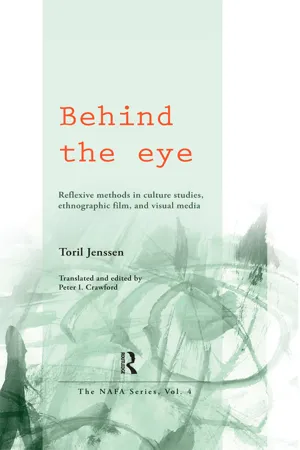
Behind the Eye
Reflexive Methods in Culture Studies, Ethnographic Film, and Visual Media
- 216 pages
- English
- ePUB (mobile friendly)
- Available on iOS & Android
eBook - ePub
Behind the Eye
Reflexive Methods in Culture Studies, Ethnographic Film, and Visual Media
About this book
How is film used in research, and what are the implications of using audio-visual material in the development of scientific knowledge? This book confronts the strategies and challenges of using film in research contexts with a focus on the concept of reflexivity and the relationship between the researcher and informant. Jenssen examines reflexivity with respect to specific social science methodologies and to the cultural forms of expression of modernity. She also covers the historical role of visual media in knowledge production and in the communication and dissemination of research, and shows how visual media underpin important aesthetic and ethical issues related to the construction of social life. This book is an accessible and provocative read for those in media studies and visual anthropology, as well as for all scholars and students who use film in research.
Information
1
Science and Visual Communication
Perceptions of how film may be used in the service of science have changed over time. Visual anthropology is now often regarded as a sub-discipline within the social sciences in which the use of film as a tool in ethnographic studies and communication is discussed theoretically. The term ethnography usually covers written accounts from the fieldwork of anthropologists in other cultures. However, it is difficult to give any clear and concise definition of ethnographic film. It constitutes neither a genre nor operates with a clearly defined methodology (MacDougall 1978, p. 405). The development of visual anthropology has influenced the perception of science in anthropology as such. It has tried to force mainstream anthropology into rethink itself, particularly due to the debates on the representational crisis but also recent years’ focus on phenomenology. Visual anthropology refers to documentary film, which theoretically is linked to general film theory, with links to literature studies and linguistics, and fiction film as the primary textual object of study. These diverse bodies of theory come together in a wide academic field encompassing media, communication and cultural studies, where the rapprochement between the traditions of the humanities and the social sciences takes place. My intention is neither to present an outline of this vast area nor to give a comprehensive account of the historical development of visual anthropology, a task already performed by others (Brigard 1975; Heider 1976; Loizos 1993; Meyer 1997). I prefer to start out by considering processes that have contributed to the development of a reflexive perspective in ethnographic film and visual media. The predecessor of (ethnographic) film was photography, the revolutionary invention of which had a profound impact on society in general and created new opportunities for scientific activities. I will briefly look at the history of imagery with the eyes of a sociologist.
The visible and the evident
According to Jenks (1995, p. 2), the dominance of vision, compared with the other senses, has been the most important factor in the development of modernity in the western world. Since antiquity, vision has been perceived as the sense that gives us our most immediate access to our surroundings. The ways in which we perceive thought have been governed by a visual paradigm. To observe, to see, and to know have been inextricably linked since the inception of modern science. The concepts we use today concerning thought and ideas are closely related to visibility, that something becomes clear or visible as a mental picture or notion. Vision thus has a long established relationship to cognitive learning.
The advent of photography in the 19th century marked the invention of a new tool in modernity’s purge of magic, mysticism and illusions from the forms of thought that began with the birth of the new natural science in the preceding centuries (von Wright 1991). The ‘us’ and ‘them’ dichotomy grew out of philosophical thoughts about how the senses transported the ‘outer’ nature to the ‘inner’ soul of humanity and became knowledge. The dichotomy later permeated the observational methods of sociology. In our contemporary visualised society we could possibly replace it with ‘vision’ or the ‘visible’ (Jenks 1995, p. 12). The terms ‘observation’ and ‘observer’ have been instrumental in socio-cultural research since the beginning of the 20th century, often alongside a distanced, withdrawn, and disengaged perception of the field of study. The scholar stayed in the background, as far as possible invisible, tacitly and passively trying not to interfere with the object of study. This notion of observation reduced social experience and the act of seeing to perception. It was the phenomenon called the ‘innocent eye’, a mechanical process tarnished neither by imagination, purpose nor desire (Jenks 1995, p. 4). However, a purely physical sight will see nothing, the innocent eye is blind.
The modern ideals of science had found a spokesman in August Comte, regarded as the founder of sociology. To Comte, sociological positivism was the beacon of a rationalist and reformist trend that had developed in response to the social and moral unrest that followed the French revolution. Sociology was to become the master of the sciences, replacing and supplanting all other forms of thought. Specific knowledge would now grow out of general scientific knowledge and be linked to matters immediately available to human experience, i.e. the regulated life surrounding us. Studying these positively evident phenomena, the scientist would be able to confirm or reject assumptions based on deduction on the basis of pure observation. A technology of optical lenses, the telescope and the microscope, received renewed attention. It was no longer a question of looking for the essential structure of things and values had no place in research, people were obsessed with seeing things as they ‘simply’ were. Pre-modern faith in the creations of God was being replaced by a modern faith in optical precision.
Jenks links the observer’s studies of ‘things themselves’ to the development of consciousness, moving from a religious and metaphysical awareness to paying attention to the visualised world: ‘As humankind’s attention is directed more and more closely towards itself and its immediate environment, quite simply more and more objects enter into ‘vision’’ (Jenks 1995, p. 5). What the photography gave to modern science was an ability to document the visible and give evidence of the real. The empirical trends of the enlightenment later to be known as positivism had already introduced the criterion of the visible. We know only what we see (Slater 1995, p. 6). Reality is of a material nature to which we have access through the sight. Right from the beginning, photography was regarded as a medium capable of rendering a precise, mechanical and impersonal representation of an object. The culmination of modernity was marked by the invention of a tool to represent, dominate, research, and change the world through the technology of vision.
In the service of truth
The photograph had a long history from the camera obscura era of the renaissance, in which experiments with light helped to constantly develop the ability to represent reality visually. In 1839, Daguerre in France announced that he had succeeded in permanently capturing reality in images and his results were presented to the French Academy of Science in Paris. Within a few years a technology enabling multiple copying of images was invented and this marked the start of a thriving development in optical work. The first photographic book was Fox Talbot’s The Pencil of Nature (1844). The title of Talbot’s first report to the Royal Society, 31 January 1839 was ‘Some account of the art of photographic drawing, or, the process by which natural objects may be made to delineate themselves without the aid of the artist’s pencil’ (Slater 1995, p. 223).
Until then, scientific expeditions had been equipped with their own drawing artists, which could now be replaced by photographers. The French expedition ‘Recherche’, sent by the French king to northern Norway in 1837 to explore the phenomenon of aurora borealis, the northern light, included an artist by the name of Bevalait (Brekke 1982). Copies of his drawings of the northern light, as well of those of landscapes, people and boats, all very rich in detail, today decorate the walls of many public and private buildings in Norway but most probably were, at the time, rather considered as scientific illustrations than as art.1 When the Danish scientist, Sophus Tromholt, came to the Alta region in 1882 in order to study aurora borealis, he brought with him his own camera and was one of the first persons to attempt to photograph the phenomenon. He refers to the work of the French expedition in his book ‘Under the rays of the northern light. Accounts from the land of the Lapps’, mentioning the location Bossekop as ‘a classical spot in the history of science’ (Tromholt 1885, p. 41, my translation). He praises the French for their ‘… eminent depictions of the northern lights … to be found in the atlas forming part of their major work, Voyages en Scandinavie, in which the results of the expedition are presented, depictions, the beauty and truth of which have not been surpassed in more recent publications …’.(op. cit., p. 2). In the preface he writes about himself that ‘The author brought with him a photographic apparatus, and by the use of this the lights at these high latitudes have drawn the pictures which he believes will make his book the more interesting and clear’ (Tromholt 1885, p. 2, my translation).2 Later, the camera, both still cameras and film cameras, became an important tool in scientific research on the phenomenon and numerous photographs reveal the diverse formations of the northern light.
Anything that can be seen can be reproduced in a photograph. The photograph, following realist trends in art in general, reduced the world to objectively described phenomena, facts without an inherent meaning. The photograph contributed in providing evidence that the supernatural was non-existent. The only meaning one may find in the material world is governed by the significance of human will and purpose, an instrumental meaning determined by human desire (Jenks 1995, p. 221). Modern visions are linked to progress and modernisation through control of the physical behaviour of material objects. Within this logic, vision became a determining factor in the methods of modernisation and became part and parcel of the epistemology of the modern, as an important tool in the human control of the social and material transformation of society.
The technology that reveals all
What mainly impressed people when the photograph (or the daguerreo-type) became common was the depth of detail, which was so clear that it could be taken for reality. Even when subjected to the scrutiny of the microscope the impression of reality was there (Slater 1995, p. 233), it had not been significantly dissolved. The magnifying glass provided a similar degree of awe. With it one could see, ‘… the slightest folds in stuff, lines in a landscape invisible to the naked eye. By means of glass we draw near to the distance’ (Newhall quoted in Slater 1995, p. 233).
This artificial realism reached its climax in the invention of the stereo scope in 1833, an apparatus which, by focusing simultaneously on two images, creates an impression of contrast and depth, and became immensely popular. Designed like a Victorian style piece of furniture it was used by people to observe nature as well as to take photographs. Three months after it had been given royal certification the invention was sold in 250,000 copies in Paris and London alone. Oliver Wendell Holmes described the stereoscope’s ability to ‘… produce an appearance of reality which cheats the sense with its seeming truth’ (quoted in Slater 1995, p. 234), and Newhall wrote:
The mind feels its way into the very depths of the picture. The scraggy branches of a tree in the foreground run out at us as if they would scratch our eyes out. The elbow of a figure stands forth so as to make us almost uncomfortable. Then there is such a frightful amount of detail, that we have the same sense of infinite complexity which Nature gives us. A painter shows us masses; the stereoscopic figure spares us nothing … The sun is no respecter of persons or of things (quoted in Slater 1995, p. 234).
The ability of vision to capture the material world through the manipulation of light had become almost perfect with the stereoscope. People were both shy and terrified, which was quite apparent in the un-relaxed body and facial expressions of people in contemporary photographs (Benjamin 1978, p. 244). The minute details of the new visual aids ensured that no details escaped the viewer. What the stereoscope and the camera implied was that, in principle, everything was visually accessible for the scrutinising gaze, not just for the instant moment but for ever. What were the effects of this on the general public at the time? Benjamin indicates that the urban population of the 1850s belonged to a generation ‘… that was not obsessed with going down to posterity in photographs, rather shyly drawing back into their private space in the face of such proceedings’ (Benjamin 1978, p. 251).
Prior to the actual industrialisation of photography, peddlers and charlatans soon took on the new invention alongside serious photographers. Some were convinced that, ‘…every conceivable object of Nature and Art will soon scale off its surface for us’ (Newhall quoted in Slater 1995, p. 234). Some people envisaged a comprehensive collection of stereoscopic images covering all imaginable phenomena of this world. Anybody could now learn about the world by carrying ‘copies’ of its objects and people, which had been reduced to surfaces. The whole enterprise of photography was discussed in public and many had objections towards the invention. Leipziger Stadtanzeiger stated: ‘To try to capture fleeting mirror images is not just an impossible undertaking, as has been established after thorough German investigation; the very wish to do such a thing is blasphemous. Man is made in the image of God, and God’s image cannot be captured by any machine of human devising’ (quoted in Benjamin 1978, p. 241).
Another objection was based on the fact that the photograph, due to its representational capacity, was taking over some of the functions of art. Baudelaire, for example, insisted that the photograph should, ‘revert to its proper duty, which is to serve as the handmaiden of science and the arts’ (Benjamin 1978, p. 256). The art of photography was undoubtedly an invention that profoundly affected people. Even towards the end of the century, when fashion dictated a sensation of twilight in the image, which rendered the objects of the image in semi-obscurity, ‘… a pose was more and more clearly in evidence, whose rigidity betrayed the impotence of that generation in the face of technical progress’ (Benjamin 1978, p. 248).
Concealing personality
The concept of ‘personality’ is commonly understood to emerge in the late 19th century as the result of complex social processes. The concept implied and led people to becoming aware of themselves and their appearance. The photograph was regarded as a frightening invention that revealed what most people would like to conceal. There seems no doubt that the technology of image production played an important role in the modernisation and urbanisation processes of the time.
In the 18th century, public forms of presentation were artistic and expressive, rarely based on the individual self. Speakers and discussants would use their bodies, voices and costumes, as well as wigs and facial paint, a thoroughly organised creation of effects that underlined the energetically presented points of view. An insistent and passionate gesticulation would often be employed, using the most aggressive articulations of bodily expression. Johansen (1989, pp. 91-92) refers to a report in The Guardian from June 1713: ‘Nobody has the right to, just because I am not of the same conviction as him, to take away some of my clothes, or re-dress me to their own taste…I acknowledge every man’s freedom to wave with his own hat, grabble in his own pockets, adjust his own wig, toss his own neck, shake his own head and moreover gesticulate in whatever manner he finds enriching to his eloquence…’ Amusing reports exist, where speakers and debaters are described being very enthusiastic, they ‘bend backwards and forwards, they bend the body almost to the ground’, they ‘use the arms as windmills.’
In public speech, the form had an expressive individuality serving as decorum, the presentation itself being of value. In contemporary coffee shops, the germ of a bourgeois public, anyone could sit down at any table and engage in an ongoing debate. Nowhere would the conversation be more professional and impersonal. It was a question of what was being said and how, rather than by whom, or whether what was said referred to personality. This was why people would exhibit a most ardent and enthusiastic involvement. The social mask was perfectly accepted, no one looking for a face behind the mask. Delivering oneself was not an option.
During the second half of the 19th century the intensity of forms of public expression had become outstanding and extraordinary in the large cities of Europe. The way people dressed had also undergone profound changes. Extravagant markings of personality were no longer the case, people preferring to dress in a simple, almost anonymous manner. Richard Sennett describes in detail how this was apparent in the dress style of both women and men, which from the 1840s has been described as the most boring style in history. It was ‘… the beginning of a style of dressing in which neutrality – that is, not standing out from others – was the immediate statement’ (Sennett 1974, p. 161). According to Sennett, these changes in popular life were determined by the secularisation processes of the 19th century. They found their expression in scientific positivism, in Darwinism, in people’s attitudes towards art, in everyday thought, as well as in substantial psychological changes. The political sphere was characterised by class hate, upheaval, and violent events, with actual massacres of people taking place in France 1848, 1851, and 1870-71. Part of the explanation may also be found in the relationship between cosmopolitanism and provincial life. The more popular and colourful the provincial style was, the more anti-popular the urban style became. The cosmopolitan style became to simplify one’s appearance so that you did not stand out.
Other explanations of people appearing reserved include, according to Sennett, well-known concepts of alienation, the fact that people felt that they had been separated from their own bodies, the industrial society having finally eliminated the human aspects of life. However, again according to Sennett, there were other reasons, the matter being even more complex. It was the case of the link between external signs and internal personality that mattered to people. ‘People took each other’s appearances in the street immensely seriously; they believed they could fathom the character of those they saw …’ (Sennett 1974, p. 161). The way people dressed was symbolically interpreted as representing their inner life. The external and visible forms revealed a hidden and underlying meaning. It was during this phase that the whole concept of personality became important, even though the outer appearances remained strictly impersonal.
This pa...
Table of contents
- Cover
- Half Title
- Title
- Copyright
- CONTENTS
- Preface
- Introduction
- 1. Science and visual communication
- 2. Approaching art
- 3. Ethnographic film and the development of knowledge. The basis of experience
- 4. Reflexivity in qualitative social science
- 5. Reflexivity as a social and cultural phenomenon
- 6. Ethics and the visualised other
- 7. The dance of the dead souls
- 8. The gaze of multiplicity
- List of references
- Name and subject index
Trusted by 375,005 students
Access to over 1.5 million titles for a fair monthly price.
Study more efficiently using our study tools.
Frequently asked questions
Yes, you can cancel anytime from the Subscription tab in your account settings on the Perlego website. Your subscription will stay active until the end of your current billing period. Learn how to cancel your subscription
No, books cannot be downloaded as external files, such as PDFs, for use outside of Perlego. However, you can download books within the Perlego app for offline reading on mobile or tablet. Learn how to download books offline
Perlego offers two plans: Essential and Complete
- Essential is ideal for learners and professionals who enjoy exploring a wide range of subjects. Access the Essential Library with 800,000+ trusted titles and best-sellers across business, personal growth, and the humanities. Includes unlimited reading time and Standard Read Aloud voice.
- Complete: Perfect for advanced learners and researchers needing full, unrestricted access. Unlock 1.5M+ books across hundreds of subjects, including academic and specialized titles. The Complete Plan also includes advanced features like Premium Read Aloud and Research Assistant.
We are an online textbook subscription service, where you can get access to an entire online library for less than the price of a single book per month. With over 1.5 million books across 990+ topics, we’ve got you covered! Learn about our mission
Look out for the read-aloud symbol on your next book to see if you can listen to it. The read-aloud tool reads text aloud for you, highlighting the text as it is being read. You can pause it, speed it up and slow it down. Learn more about Read Aloud
Yes! You can use the Perlego app on both iOS and Android devices to read anytime, anywhere — even offline. Perfect for commutes or when you’re on the go.
Please note we cannot support devices running on iOS 13 and Android 7 or earlier. Learn more about using the app
Please note we cannot support devices running on iOS 13 and Android 7 or earlier. Learn more about using the app
Yes, you can access Behind the Eye by Toril Jenssen in PDF and/or ePUB format, as well as other popular books in Social Sciences & Anthropology. We have over 1.5 million books available in our catalogue for you to explore.