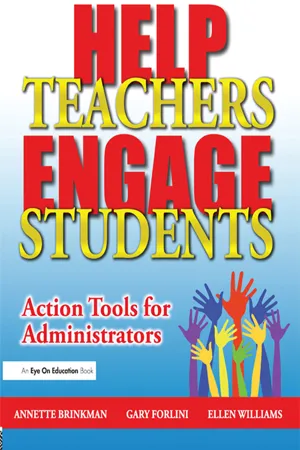
eBook - ePub
Help Teachers Engage Students
Action Tools for Administrators
- 208 pages
- English
- ePUB (mobile friendly)
- Available on iOS & Android
eBook - ePub
Help Teachers Engage Students
Action Tools for Administrators
About this book
This unique, hands-on reference for school administrators offers guidelines for effective student engagement as well as reproducible action tools that will enable you to identify and share The Big Eight Student Engagement Strategies with your teachers, promote teacher growth and provide support for new and/or struggling teachers, collect data to help you consult and coach teachers effectively in student engagement, and provide direct assistance with skills and strategies to sharpen student engagement.
Information
1
Recognizing Performance Standards
Everyone wants teachers to succeed. Despite the obvious truth that districts cannot afford high levels of teacher failure, administrators recognize they have a moral obligation to help teachers and to give them all the support possible. Ultimately, children respond and learn best in a culture of support and achievement.
Active involvement in building teachers’ skills helps build a positive culture within a school—a culture of trust. In an 18–month study of teacher turnovers, Barnes, Crowe, and Shaefer (2003) found that every teacher job turnover costs a district $1,500 or more per teacher for the training, rehiring, and record keeping that had been involved. Looking at small and large districts, the study found that the costs of teacher turnover—recruiting, hiring, and training—are substantial. Barnes, et al. (2003) cite numerous examples: In Granville County, North Carolina, for instance, the cost of each teacher who left the district was just under $10,000. In a small rural district such as Jemez Valley, New Mexico, the cost per teacher was $4,366. In Milwaukee, the average cost per teacher-leaver was $15,325. In a very large district like Chicago, the average cost was $17,872 per leaver. The total cost of turnover in the Chicago Public Schools is estimated to be more than $86 million per year. It is clear that thousands of dollars walk out the door each time a teacher leaves (Gary Barnes, Ph.D., Benjamin Schaefer, National Commission on Teaching and America’s Future).
Performance Standards: Four Domains for Evaluation
Surely, we are not the first to codify the practices of good instruction, nor will we be the last. Most school districts have developed their own standards, or domains, for classroom instruction, which become benchmarks for formal and informal observations that every building administrator conducts on a regular basis. Many, perhaps most, of these local standards derive from or resemble national standards, so it makes sense for us to begin with these.
With the kind permission of the Granite School District in Utah, we use their standards as we discuss teacher performance requirements (Granite School District, 2006). Granite’s standards of teacher performance not only reflect published national standards such as The Five Core Propositions set forth by the National Board for Professional Teaching Standards (1987) and the work of Charlotte Danielson (1996, 2000), a former teacher and administrator who consults on teacher quality and evaluation, they result also from a three-year collaborative process in which a committee of administrators, teachers, and union representatives piloted and consulted and fine-tuned this body of work.
Standards like these help frame for you what effective, successful teaching practice entails—in essence, what an effective teacher practices. While you already know all or most of this—by instinct and/or through experience—it’s useful to review these to maintain a complete and objective view of teacher performance.
Domain I. In most districts, Domain I captures the essential elements of instruction and assessment. This domain represents how teachers interact with students to promote, produce, and assess learning:
Domain I: Instruction and Assessment
A. The educator consistently communicates clearly and accurately.
B. The educator uses a variety of effective instructional strategies.
C. The educator uses a variety of engagement strategies.
D. The educator involves students and/or staff in meaningful learning.
E. The educator makes reasonable and appropriate individual accommodations.
F. The educator uses assessment to guide instruction and verify that meaningful learning is taking place.
G. The educator systematically reviews and reinforces concepts to support long-term learning (Granite School District, 2006).
Domain II. Planning and preparation are vital to a productive classroom culture. Before any successful educator stands before a class, he or she will have spent substantial time planning and organizing materials for lessons that are based on the differentiated needs of students. And this teacher will have developed and accessed data that help inform differentiation. Domain II captures the essential ingredients of planning and preparation:
Domain II: Planning and Preparation
A. The educator uses appropriate curriculum materials in planning for instruction.
B. The educator plans and prepares for the needs of diverse learners.
C. The educator sets goals and makes instructional decisions based on data gathered from multiple sources.
D. The educator applies knowledge of developmentally appropriate practices when planning instruction.
E. The educator collaborates with colleagues in planning instruction, effectively using resources, and providing support (Granite School District, 2006).
Domain III. Educators who create an environment conducive to learning increase the likelihood that students will thrive. Marilyn Jageur Adams (1997), noted brain researcher, has observed “the brain learns in direct proportion to its emotional security,” and so it is critical that every successful teacher develop strategies for creating and maintaining an environment that encourages children to explore the subjects at hand and to feel secure doing so.
Teachers who are unable to nurture and sustain a culture for learning often create uncertainty and develop negative relationships with students due to their lack of consistency and their failure to communicate in positive, constructive ways. Without effective classroom management routines and techniques in place, optimal learni...
Table of contents
- Cover
- Title Page
- Copyright Page
- Contents
- Preface and Purpose
- The Big Eight
- 1 Recognizing Performance Standards
- 2 Diagnosing and Prescribing
- 3 Moving Toward Gradual Release
- 4 Expectations
- 5 Attention Prompts
- 6 Proximity
- 7 Cueing
- 8 Signals
- 9 Time Limits
- 10 Tasking
- 11 Voice
- 12 The Process in Context
- Appendix
- Reference
Trusted by 375,005 students
Access to over 1.5 million titles for a fair monthly price.
Study more efficiently using our study tools.
Frequently asked questions
Yes, you can cancel anytime from the Subscription tab in your account settings on the Perlego website. Your subscription will stay active until the end of your current billing period. Learn how to cancel your subscription
No, books cannot be downloaded as external files, such as PDFs, for use outside of Perlego. However, you can download books within the Perlego app for offline reading on mobile or tablet. Learn how to download books offline
Perlego offers two plans: Essential and Complete
- Essential is ideal for learners and professionals who enjoy exploring a wide range of subjects. Access the Essential Library with 800,000+ trusted titles and best-sellers across business, personal growth, and the humanities. Includes unlimited reading time and Standard Read Aloud voice.
- Complete: Perfect for advanced learners and researchers needing full, unrestricted access. Unlock 1.5M+ books across hundreds of subjects, including academic and specialized titles. The Complete Plan also includes advanced features like Premium Read Aloud and Research Assistant.
We are an online textbook subscription service, where you can get access to an entire online library for less than the price of a single book per month. With over 1.5 million books across 990+ topics, we’ve got you covered! Learn about our mission
Look out for the read-aloud symbol on your next book to see if you can listen to it. The read-aloud tool reads text aloud for you, highlighting the text as it is being read. You can pause it, speed it up and slow it down. Learn more about Read Aloud
Yes! You can use the Perlego app on both iOS and Android devices to read anytime, anywhere — even offline. Perfect for commutes or when you’re on the go.
Please note we cannot support devices running on iOS 13 and Android 7 or earlier. Learn more about using the app
Please note we cannot support devices running on iOS 13 and Android 7 or earlier. Learn more about using the app
Yes, you can access Help Teachers Engage Students by Gary Forlini,Ellen Williams,Annette Brinkman in PDF and/or ePUB format, as well as other popular books in Education & Classroom Management. We have over 1.5 million books available in our catalogue for you to explore.