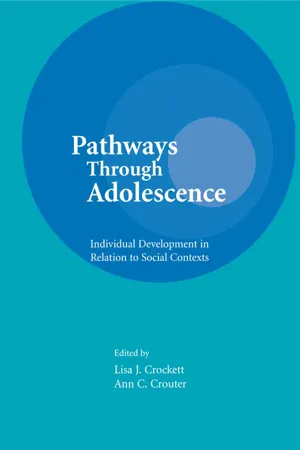
Adolescent researchers are increasingly aware that they must examine development both across time and across context. To do so, however, requires new conceptualizations and methodological approaches to the study of development, including attention to the pathways young people choose in adolescence and follow into adulthood. This volume assembles work by key researchers in the field who are struggling to understand how developmental trajectories are constructed and maintained throughout the adolescent period.
A complete understanding of developmental pathways requires the recognition that adolescents' social contexts--family, school, neighborhood, and/or peer group--are important influences on the choices they make at this developmental period. Researchers have traditionally studied contexts in isolation rather than examining the interrelationships among contexts and their implications for adolescent development. The present volume seeks to address this gap in the literature, with attention given not only to the interrelationships among contexts for white, middle-class youth, but also to these issues for minority adolescents in neighborhoods that vary in terms of access to resources. It concludes with an examination of researcher-community collaboration as a strategy to move communities toward a greater awareness of adolescent development and the problems facing youth in their community, and as a means to promote potential avenues for policy change and intervention.
eBook - ePub
Pathways Through Adolescence
individual Development in Relation To Social Contexts
- 286 pages
- English
- ePUB (mobile friendly)
- Available on iOS & Android
eBook - ePub
Pathways Through Adolescence
individual Development in Relation To Social Contexts
About this book
Information
Publisher
Psychology PressYear
2014Print ISBN
9781138977983
9780805815009
Edition
1eBook ISBN
9781317780762
PART ONE
DEVELOPMENTAL TRAJECTORIES IN ADOLESCENCE
CHAPTER TWO
Developmental Sequences in Delinquency: Dynamic Typologies
There has been recent interest in the notion of developmental sequences, pathways, or progressions in delinquent behavior (Farrington, Ohlin, & Wilson, 1986; Huizinga, Esbensen, & Weiher, 1991; Loeber & LeBlanc, 1990; Loeber et al., 1993), although it is not perfectly clear whether references to such sequences or pathways refer to growth curves of particular kinds of delinquent behavior, normative behavior patterns for specific ages, sequences of ages of initiation of different behaviors, or the movement between various types and levels of involvement in delinquent behavior. In addition, given a particular notion of a sequence or pathway, it is not clear what kinds of procedures can or should be used in identifying a specific pathway and the individuals who traverse it. Also, as Loeber et al. (1993) noted, there are only a few studies examining developmental sequences of delinquency, and even fewer prospective studies examining this issue. As a result, little is known about the paths taken in a delinquent or criminal career or the long-term adult outcome of child and/or adolescent delinquent involvement, although some findings and considerations about these issues can be found in Moffit (1993), Farrington (1986), and Elliott (1994).
In this chapter, a typological approach is used to provide some preliminary examination of developmental sequences in delinquent behavior over the child to adolescent years. Thus, the focus is on the through-time movement of individuals through various types or combinations of delinquent behavior, rather than on the through-time changes or relationship of particular variables. In this sense, a pathway represents a particular sequence of behaviors traversed by some group of individuals that is different from the sequences of behaviors followed by others. The importance of focusing on persons and types of persons, rather than variables, in developmental research has been recently emphasized by Bergman and Magnusson (1992). Analyses that relate variables to each other do not generally allow identification of groups having different developmental behavioral patterns.
In some previous work (Huizinga et al., 1991; Huizinga, Esbensen, & Weiher, 1993), the use of both empirical typologies derived through cluster analysis and conceptual typologies based on a priori definitions have been illustrated. However, because delinquent behavior is not a uniform domain, but rather a heterogenous collection of problem behaviors (whose unifying theme is that they are problematic and proscribed by law), exactly what kinds of delinquency and levels of involvement should be included in an examination of developmental progressions in delinquency is not obvious. Distinctions in frequency, seriousness, and ‘kind’ of behavior are all possible. In this chapter, the work of Loeber (1988) and Loeber et al. (1993) is followed by conceptually identifying overt or aggressive behaviors and covert or concealing behaviors, and classifying individuals on the basis of their involvement in one or both of these kinds of behaviors. In addition, a status offense-public disorder set of offenses is used to identify individuals engaged in these behaviors. This conceptual framework allows the separation of aggression (a factor of some current concern) from other forms of delinquent behavior, so that the developmental relationship of other kinds of behavior to aggression can be examined.
The ability to identify transitions between behavioral patterns in a longitudinal typology also affords the opportunity to examine etiological factors that influence these transitions. A preliminary examination of some explanatory factors that describe adolescents who move to an aggressive status, who terminate involvement in this behavior, or who are not involved in aggression over a several-year period is also provided to illustrate this potential.
SOME COMMENTS ON A PERSON-CENTERED DEVELOPMENTAL TYPOLOGY
Given the use of a person-oriented typological approach in this chapter, it is perhaps appropriate to further specify the variable-oriented versus person-oriented distinction, and to provide some further details of the use of a typological approach in obtaining a developmental perspective (although only some concepts of such an approach are illustrated in later sections of this chapter). In focusing on the relationship between variables, the goal is often to understand how one, or several, variables affect other variables. Frequently this involves the use of omnibus models, with the supposition that the variables have the same relationship or ‘work the same way’ for everyone (i.e, for all elements of some population), and to eliminate individual differences by considering such differences as ‘error’ that hides true underlying multivariate relationships. In contrast, a person-oriented typological approach assumes that there may be types or patterns of person/individual characteristics that give rise to various subgroups, and within each subgroup the variable relationships ‘work in different’ ways. The use of such a typological approach clearly presumes that the over-time configurations of individual situations and characteristics are not the same for everyone, but that these personal configurations are not so unique that they prevent the identification of groups with similar developmental stages or processes.
In addition, the developmental typological approach often focuses on state-to-state or type-to-type changes, thus providing descriptions of evolving stages of individual characteristics and behavior patterns. Thus, the approach provides probabilities for an array of qualitatively, as well as quantitatively, different outcomes; provides probabilities for particular sequences or paths that relate initial to outcome states; and provides for a variety of person-situation configurations (Runyon, 1980). The use of person-centered developmental typologies to obtain descriptions of changing behavioral configurations or types over time helps answer the question, ‘Given a particular behavioral history, what behavior patterns are likely to come next?’ These typologies are also useful in examining the influence of etiological variables on behavioral transitions and thus explain why some individuals with a common behavioral history move to a particular behavioral pattern, while similar individuals move to another.
The use of a person-oriented typological approach to provide a developmental perspective is not particularly new (e.g., Carter, Morris, & Blashfield, 1982; Huizinga, 1979; Rice & Mattson, 1966; Runyan, 1980). But the emphasis on the importance of this approach in providing an appropriate developmental perspective appears more recent (Bergman & Magnusson, 1992; Cairns, 1986; Cairns, Cairns, & Neckerman, 1989; Magnusson & Bergman, 1990). There are, however, a number of methodological issues that arise in the construction of such typologies. How are the types to be identified? How are the transitions between types to be described? How is the influence of etiological variables to be examined? There are a number of answers to each of these questions, but for none is there one generally accepted procedure, nor is there a fully developed, generally available package that attempts to integrate the pieces of a full person-oriented developmental, typological analysis. That is, current analytic strategies are not designed to search for and identify types of individuals with different developmental sequences, nor are they equipped to identify covariance matrices with nonlinear interactions for different unspecified and unknown subgroups.
To identify the developmental types in a developmental dataset, in which there are measures taken on the same subjects at a number of time points, a simple procedure is to conceptually divide measurement variables into distinct parts (e.g., high, medium, low), and then at each time point to cross-classify individuals by their position on each of the variables. Alternatively, numerical taxonomy or cluster-analytic methods could be used at each time point to identify “clusters” or types of persons in the time-ordered multivariate space. These procedures are generally available as part of standard statistical computer packages.1 Given a set of types at each time point, the developmental or longitudinal types can then be formed by grouping those who belong to the same sequence of types across time, and the resulting developmental types might be considered a set of multivariate developmental profiles.2 If there are measures from several domains at a given time point, all the measures could be used simultaneously in the classification process, or separate classifications could be created for each domain and the final types constructed by cross-classifying the distinct partitions formed within each domain. Additionally, it should be noted that there is no requirement that the measures or domains of measurement used in a developmental typology remain constant over time.
Once the types have been identified, descriptions of the types at each time point are relatively straightforward. However, descriptions of the movement between types across time often become more cumbersome, and frequently face a “plethora of types” problem. Some options include simple description of type-to-type transitions, tree diagrams, listings of sequences of time-ordered types, and the use of transition matrices, which provide the probabilities that an individual in a given type at one point in time will move to another type at the next point in time. In addition, the concepts of absorbing states, occupation and passage times, and recurrent versus transient states can be usefully borrowed from Markov chain analysis (see, e.g., Parzen, 1962), although it seems unlikely that the transition matrices of developmental processes would satisfy the Markov property (i.e., that the movement from one state to the next is only dependent on the current state and not on prior history).
In examining etiological or predictive variables, at least three options for examining the ability to predict certain state-to-state transitions, sequences of state-to-state transitions, or final-outcome states can be identified. First, the explanatory or predictive variables can be included in the formation of the original types or classification. Descriptive relationships between levels of explanatory variables and particular stages of the developmental types may then become clear as a description of the developmental typology is constructed. Second, separate classifications based on the explanatory variables could be created at particular time points, and the resulting partition of individuals cross-classified with the original developmental typology or at specific time points of the typology, thus specifying conditional transition probabilities that depend on levels and interactions of postulated explanatory variables. Third, the transition probabilities could be expressed as functions of the explanatory variables. Except for Markov models (see, e.g., Tuma & Hannan, 1984), however, the statistical machinery for obtaining estimates of these functions is not available, hence in general, this is currently not a viable option.
With this overview of the construction of a person-centered developmental typology, the remainder of this chapter returns to the relatively simple example of such a typology that employs data from a study of delinquency.
METHODS
Sample
The data used in this chapter come from the Denver Youth Survey (DYS),3 an ongoing longitudinal study of the develo...
Table of contents
- Cover
- Half Title
- Title Page
- Copyright Page
- Table of Contents
- Foreword
- Preface
- Part I: Developmental Trajectories in Adolescence
- Part II: Risks From Within and Without: Resilience in Context
- Part III: Interrelations Among Social Contexts
- Part IV: Approaches to Intervention
- Part V: Future Directions
- Author Index
- Subject Index
Trusted by 375,005 students
Access to over 1.5 million titles for a fair monthly price.
Study more efficiently using our study tools.
Frequently asked questions
Yes, you can cancel anytime from the Subscription tab in your account settings on the Perlego website. Your subscription will stay active until the end of your current billing period. Learn how to cancel your subscription
No, books cannot be downloaded as external files, such as PDFs, for use outside of Perlego. However, you can download books within the Perlego app for offline reading on mobile or tablet. Learn how to download books offline
Perlego offers two plans: Essential and Complete
- Essential is ideal for learners and professionals who enjoy exploring a wide range of subjects. Access the Essential Library with 800,000+ trusted titles and best-sellers across business, personal growth, and the humanities. Includes unlimited reading time and Standard Read Aloud voice.
- Complete: Perfect for advanced learners and researchers needing full, unrestricted access. Unlock 1.5M+ books across hundreds of subjects, including academic and specialized titles. The Complete Plan also includes advanced features like Premium Read Aloud and Research Assistant.
We are an online textbook subscription service, where you can get access to an entire online library for less than the price of a single book per month. With over 1.5 million books across 990+ topics, we’ve got you covered! Learn about our mission
Look out for the read-aloud symbol on your next book to see if you can listen to it. The read-aloud tool reads text aloud for you, highlighting the text as it is being read. You can pause it, speed it up and slow it down. Learn more about Read Aloud
Yes! You can use the Perlego app on both iOS and Android devices to read anytime, anywhere — even offline. Perfect for commutes or when you’re on the go.
Please note we cannot support devices running on iOS 13 and Android 7 or earlier. Learn more about using the app
Please note we cannot support devices running on iOS 13 and Android 7 or earlier. Learn more about using the app
Yes, you can access Pathways Through Adolescence by Lisa J. Crockett,Ann C. Crouter in PDF and/or ePUB format, as well as other popular books in Psychology & Developmental Psychology. We have over 1.5 million books available in our catalogue for you to explore.