eBook - ePub
Consultation In Community, School, And Organizational Practice
Gerald Caplan's Contributions To Professional Psychology
- 242 pages
- English
- ePUB (mobile friendly)
- Available on iOS & Android
eBook - ePub
Consultation In Community, School, And Organizational Practice
Gerald Caplan's Contributions To Professional Psychology
About this book
Offering an historical perspective on the development of mental health consultation and community mental health, this book's intent is twofold. First, it describes and evaluates Harvard psychiatrist Gerald Caplan's innovative approach to consultation and related activities with respect to the current and future practice of clinical community, school and organizational psychology. Second, it pays tribute to Caplan whose ideas on prevention, crisis theory, support systems, community mental health, mental health consultation and collaboration and population-orientated psychiatry have influenced the practice of professional psychology and allied fields.; The text is divided into three sections: the first provides background information for the remainder of the volume; the second documents Caplan's influence on the way psychology has been applied in various settings; andthe last considers his contribution's present and past influence. The text is aimed at consultant and practising psychologists, community and school psychology graduates and professionals involved with community mental health services.
Information
Publisher
Taylor & FrancisYear
2019Print ISBN
9780415763271
9781560322641
Edition
1eBook ISBN
9781317722410
Part One
The Ideas, Career, and Contributions of Gerald Caplan
Chapter 1
Gerald Caplan’s Contributions to Professional Psychology: Conceptual Underpinnings
North Carolina State University
University of North Carolina at Chapel Hill
INTRODUCTION
Consultation … denote[s] the process of interaction between two professional persons—the consultant, who is a specialist, and the consultee, who invokes his help in regard to a current work problem with which the latter is having some difficulty, and which he has decided is within the former’s area of specialized competence. The work problem involves the management or treatment of one or more clients of the consultee, or the planning or implementation of a program to cater to such clients. (Caplan, 1963, p. 470)
With the advancement of this definition and approach to practice, the delivery of psychological services was forever changed. No longer was a psychologist restricted to a traditional role of conceptualizing a client’s problems as the result of an internal pathology and then providing psychotherapy. Instead, the psychologist now was able to function at a higher systems level, helping clients by working with consultees and incorporating a new set of assumptions, models, and techniques to prevent the occurrence of psychological problems in the entire client population.
It seems difficult to overestimate the impact that child and community psychiatrist Dr. Gerald Caplan has had on the modern practice of psychology in communities, schools, and organizations. From creating methods of mental health consultation in the late 1940s, to adapting public health principles for the field of mental health in the 1950s, to training many future leaders of various helping professions from the 1950s on, to pioneering principles that propelled the community mental health movement in the 1960s, to refining social support system interventions in the 1970s, to maintaining and promoting a population-oriented approach throughout the 1980s and 1990s, Dr. Caplan has fashioned a remarkable career dedicated to prevention in its broadest sense. His many achievements have affected not only clinical, school, community, counseling, and organizational psychology, but psychiatry, social work, medicine, and nursing as well.
Many of Caplan’s ideas have had and continue to have a forceful impact on the practice of professional psychology. Although the above quote, the title of this volume, and the content of many of its chapters suggest that consultation is Caplan’s principal contribution, it is but one piece of a conceptual framework designed to prevent mental illness and promote mental health in the population at large. It is the goal of this chapter to acquaint the reader with the specific elements of this framework.
Following a synopsis of Caplan’s career, we offer descriptions of four conceptual models (i.e., the population-oriented prevention, primary prevention, crisis, and support systems models) and six methods for practice (i.e., community organization, crisis intervention, consultation, collaboration, support systems intervention, and mediation) that are associated with Caplan. Figure 1 depicts these models and methods and, as such, serves as an advance organizer for the content of this chapter. The chapter concludes with an assessment of Caplan’s impact on professional psychology.
THE AUTHORS’ ASSUMPTIONS
Before proceeding further, we wish to make explicit four assumptions. First, although the above models and methods are intertwined and unable to be separated in practice, we have chosen to present each one individually in this chapter for the sake of clarity. Second, because each of the models and techniques merits greater attention than space permits, we present several lists of selected books to consult for additional information, and refer to other chapters in this volume that describe relevant content in greater detail. Although intended to be helpful, we realize the inherent limitations of this approach due, in part, to the vastness of the topics addressed. For example, a recent annotated bibliography (Trickett, Dahiyat, & Selby, in press) on the topic of primary prevention alone lists over 1,300 published articles from 1983 to 1991.
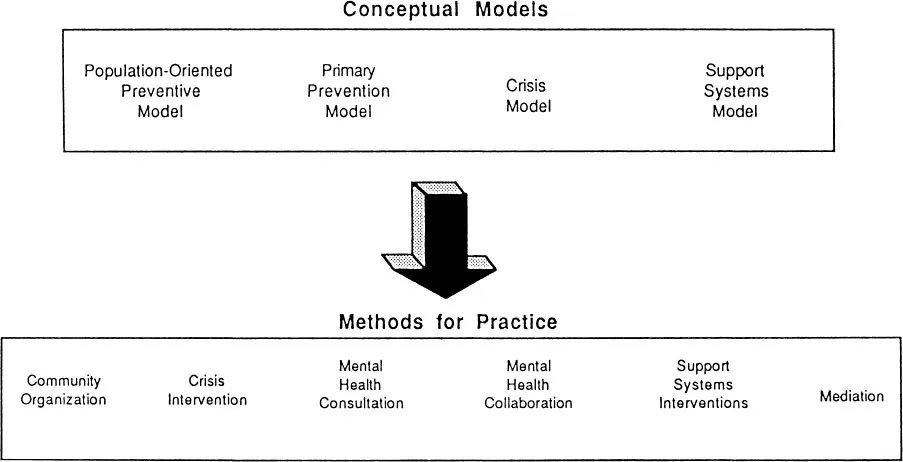
Figure 1 Gerald Caplan’s conceptual models and methods for promoting mental health and preventing mental illness.
Third, Caplan’s work may be best interpreted within the context of community mental health, but this is not the explicit focus of the present chapter and volume, which emphasize Caplan’s impact on professional psychology generally, and community, school, and organizational psychology specifically. Interested readers are referred to Schulberg and Killilea’s (1982) festschrift for a comprehensive treatment of Caplan’s work specifically within the framework of community mental health.
Last, but perhaps most importantly, although we attempt to describe concepts associated with Caplan, it is essential to realize that Caplan has worked with many collaborators through the years, and many of the concepts have been developed and extended by individuals having no direct connection to Caplan. It is outside the scope of this chapter to specify precisely how others have contributed to the development of these ideas. Instead, we describe the four models and six methods for practice as revealed primarily through Caplan’s writings. We apologize in advance for failing to acknowledge all other individuals who have contributed significantly to these models and methods, which, in the final analysis, go well beyond the thinking of one child and community psychiatrist.
THE CAREER OF GERALD CAPLAN1
The Early Years
Gerald Caplan was born in 1917 and was raised in Manchester, England, where he attended Manchester Grammar School. He later went on to Manchester University, from which he earned a special bachelor of science degree in anatomy and physiology in 1937, and his medical degree (MB, ChB) in 1940.
Caplan’s first job out of medical school was as a house physician at Winson Green Mental Hospital in Birmingham, England. There, Caplan met and married Ann Siebenberg. In 1943, Caplan and his wife moved to Swansea, South Wales, where he assumed the position of deputy medical superintendent at the Cefn Coed Mental Hospital. While in Wales, Caplan developed and helped to market the “Caplan Electroconvulsive Apparatus,” a lightweight electroconvulsive machine. His series of experiments on electroshock treatment formed the basis of a thesis for which he earned the advanced degree of MD from Manchester University.
From 1945 to 1948, Caplan trained in child psychiatry under John Bowlby’s direction at the Tavistock Clinic in London. He also received training in psychoanalysis at the Psychoanalytic Institute. Kate Friedlander served as Caplan’s analyst during this training period, and Anna Freud was the control analyst for Caplan’s first psychoanalytic treatment case.
From 1948 to 1952, Caplan lived in Israel, where he assisted in developing the fledgling Jewish state. Initially, he was put in charge of army psychiatry, and later undertook the job of senior advisor in mental health to the Ministry of Health. He also organized the first Department of Mental Health in the state of Israel. Due to a political reorganization, Caplan resigned from the ministry and accepted a position at the Hadassah Hebrew University Medical School. There he established the Lasker Mental Hygiene and Child Guidance Center during the years 1949–1952. At the Lasker Center, Caplan began to build a program of preventive child psychiatry. In particular, his method of “counseling the counselors” (known today as “consultation”) enabled staff members to deal more effectively with the more than 1,000 disturbed children who were referred for treatment each year (Caplan, 1970; Rosenfeld & Caplan, 1954).
During a U.S. lecture tour in 1951, Caplan met Erich Lindemann of the Harvard School of Public Health. These two had been unaware of each other’s work relative to methods of prevention, yet it was apparent that they were thinking along similar lines. These similar interests led Caplan to request a 1-year sabbatical with Lindemann at Harvard. However, Caplan’s request for leave was denied by his superiors at Hadassah. If he were to leave, there would be no guarantee that his position would remain open for him should he return to Jerusalem. In 1952, Caplan left for Boston to begin what would turn out to be a 26-year career at Harvard. Interestingly, Caplan later remarked that, if his Hadassah position had been guaranteed, he would almost certainly have returned to Jerusalem at the end of his 1-year sabbatical (Caplan-Moskovich, 1982).
The Years 1953–1963
When Lindemann moved to the Harvard Medical School as head of the Department of Psychiatry at Massachusetts General in 1953, Caplan replaced him as head of the Community Mental Health Program at the Harvard School of Public Health, where he remained until 1964. During that time, Caplan was involved in many activities, some of which are listed below.
1 He learned about, modified, and applied conceptual models of public health for use in the mental health field (Caplan, 1961a, 1964). In particular, Caplan evolved a new model of prevention of mental disorders, incorporating the now familiar notions of primary, secondary, and tertiary prevention, and attempted to shift the focus of preventive efforts from individuals to populations.
2 At the Boston Psychoanalytic Institute, Caplan continued his training in psychoanalysis, which he completed in 1955. Until 1970, Caplan maintained a clinical practice that included seeing several patients weekly for intensive individual psychoanalysis.2
3 Caplan, Lindemann, and others advanced the model of crisis as a central fulcrum for primary prevention. The emphasis was on the crisis period as one in which individuals are more open to outside influence, and, therefore, to short-term interventions by nonspecialist counselors.
4 Caplan developed, described, defined, and evaluated techniques of mental health consultation (Caplan, 1961a, 1963, 1964).3
5 Caplan headed a graduate training program in community mental health that produced more than 100 graduates, many of whom went on to leadership positions in psychology, psychiatry, medicine, public health, social work, and nursing. Two contributors to this volume, James G. Kelly (Chapter 4) and Ira Iscoe (Chapter 5), were postdoctoral fellows under Caplan’s direction at the Harvard School of Public Health.
6 Caplan was influential in shaping mental health policy in the state of Massachusetts and the entire United States, as the Community Mental Health Centers Act, P.L. 88-164, became a reality in 1963. In his foreword to Caplan’s (1964) Principles of Preventive Psychiatry, then Director of the National Institute of Mental Health Dr. Robert H. Felix termed the book a “bible” for community mental health workers.
The Years 1964–1977
In 1964, Caplan moved from the Harvard School of Public Health to the medical school. There his work continued, until his departure from Harvard in 1977. Caplan’s significant professional accomplishments from this period are listed below.
1 Caplan refined techniques of mental health consultation, the definitive statement of which is contained in The Theory and Practice of Mental Health Consultation (Caplan, 1970). This book, considered a classic reference within professional psychology, is the most frequently cited book in articles that appeared in the Journal of School Psychology from 1963 to 1982 (Oakland, 1984).
2 Caplan organized a highly successful multidisciplinary staff seminar on Human Relations and the Law at Harvard Law School, which ran for 3 years (Caplan, 1989).
3 Continuing his lifelong commitment to Zionism, from 1969 to 1977 Caplan studied the intercommunity conflicts of Arabs and Jews in Jerusalem. This work centered on the community mental health aspects of these conflicts, with special emphasis on mediation (Caplan & Caplan, 1980).
4 Although the beginnings of support systems may be traced to Caplan’s work in the early 1950s (Caplan-Moskovich, 1982), Caplan and his associates refined and documented support systems theory and practice during the mid-1970s (Caplan, 1974; Caplan & Killilea, 1976).
The Years 1977–the Present
In 1977, Professor Caplan took early retirement from Harvard and settled in Jerusalem, although little evidence has accumulated over the past 16 years to suggest he retired at all. From 1977 to 1985, Caplan directed a department of child and adolescent psychiatry in the Hadassah Hebrew University teaching hospitals in Jerusalem. During this period, he explored mental health collaboration and other profession...
Table of contents
- Cover
- Half Title
- Title Page
- Copyright Page
- Table of Contents
- Contributors
- Foreword
- Preface
- Part One: The Ideas, Career, and Contributions of Gerald Caplan
- Part Two: Caplan’s Contributions to the Practice of Psychology
- Part Three: Assessing the Present and Future Impact of Caplan’s Contributions
- Author Index
- Subject Index
Trusted by 375,005 students
Access to over 1.5 million titles for a fair monthly price.
Study more efficiently using our study tools.
Frequently asked questions
Yes, you can cancel anytime from the Subscription tab in your account settings on the Perlego website. Your subscription will stay active until the end of your current billing period. Learn how to cancel your subscription
No, books cannot be downloaded as external files, such as PDFs, for use outside of Perlego. However, you can download books within the Perlego app for offline reading on mobile or tablet. Learn how to download books offline
Perlego offers two plans: Essential and Complete
- Essential is ideal for learners and professionals who enjoy exploring a wide range of subjects. Access the Essential Library with 800,000+ trusted titles and best-sellers across business, personal growth, and the humanities. Includes unlimited reading time and Standard Read Aloud voice.
- Complete: Perfect for advanced learners and researchers needing full, unrestricted access. Unlock 1.5M+ books across hundreds of subjects, including academic and specialized titles. The Complete Plan also includes advanced features like Premium Read Aloud and Research Assistant.
We are an online textbook subscription service, where you can get access to an entire online library for less than the price of a single book per month. With over 1.5 million books across 990+ topics, we’ve got you covered! Learn about our mission
Look out for the read-aloud symbol on your next book to see if you can listen to it. The read-aloud tool reads text aloud for you, highlighting the text as it is being read. You can pause it, speed it up and slow it down. Learn more about Read Aloud
Yes! You can use the Perlego app on both iOS and Android devices to read anytime, anywhere — even offline. Perfect for commutes or when you’re on the go.
Please note we cannot support devices running on iOS 13 and Android 7 or earlier. Learn more about using the app
Please note we cannot support devices running on iOS 13 and Android 7 or earlier. Learn more about using the app
Yes, you can access Consultation In Community, School, And Organizational Practice by William P. Erchul in PDF and/or ePUB format, as well as other popular books in Social Sciences & Social Policy. We have over 1.5 million books available in our catalogue for you to explore.