- 176 pages
- English
- ePUB (mobile friendly)
- Available on iOS & Android
eBook - ePub
About this book
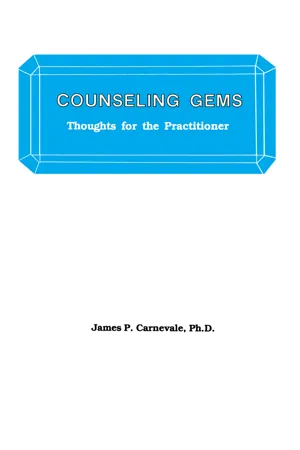
First published in 1989. Counselling Gems provides 'how to' think about situations, it contains 110 'gems' arranged under eight section headings and helps the practitioner to gain ideas that can be used you understand better counseling and clients. It also provides an opportunity to know how a practitioner thinks about their role and relates to basic ways of thinking of clients, their problems and self. Through a sharing approach narrative, this text also reflects counselor educator and supervisor's basics concepts, aids the implementation of these concepts and contains useful notes of students made from hundreds of comments made by Dr Carnevale during practices.
Information
Techniques and Procedures
65
There's no such thing as nothing.
In another section of this book I mention asking the clients what they are thinking and finding it usually important. I must say, however, that many clients do not always want to share what they are thinking or may not be aware of what they are thinking. In either case, clients will often answer the question, "What are you thinking?" with answers such as:
"Nothing...."
"I don't know..."
"Actually my mind is a blank right now...."
"I wasn't thinking anything...."
The beginning counselor may believe the client and not pursue the issue. Usually to do so is a mistake.
For clients not to be thinking something is impossible. The mind is always functioning; it is always thinking. Even when we sleep, we think. Our thoughts may not be sequential; they may not seem to be logical; they may not seem to fit the present conversation. So clients may not feel comfortable in sharing their thoughts at any given moment. That's fine. And I may choose to allow them to avoid telling me what they are thinking—but not because I believe that their minds are blank. My choice of whether to pursue an issue will be influenced by many factors, but believing clients who say they are not thinking of anything is not one of them. I don't want my students to believe it, either. The client cannot not think, and don't forget that.
66
Don't listen to the client's story. Listen for their life-style within the story.
Clients generally expect to tell you what their problems are and then why they have these problems—and this gives them license to tell you the story of their lives. In my experience their story is usually a justification of why they are as they are, and "the problem" is usually someone else's fault. Some clients are more subtle about this formulation than others, but the bottom line is usually, "Ain't it awful and what else could I do?"
The client has told this story many times before they see a counselor, and they usually have it well rehearsed. They also can usually make the story interesting. But "the story" is usually irrelevant—at least in terms which the client emphasizes. If you must listen to a client's story, then use the story to ascertain patterns of the client's behavior (not all the others in the cast of characters). If you can begin to see patterns of the client's behavior in the relationships, you may be able to move in on the client's life-style and the mythology behind the life-style. This will happen only if you listen to your client within a certain context. Otherwise, the "story" is usually a waste of time and money—although I know a great many counselors who make a good living doing just that: wasting their client's time and money.
67
Client history: On my terms only!
Clients enter counseling expecting to tell the counselor about their life histories. Unfortunately, many counselors expect to listen to it—and do! And they listen to the client's history on the client's terms, in the client's way, with the client's emphasis. Listening to the story is an easy way for the counselor to earn money, but I'm convinced that it rarely benefits the client. The client's history does have a place in counseling, but not as a central focus of the process—and certainly not in the format which the client is likely to use.
When I consider the client's history, it is not to look for causes of present behavior or present difficulties. Present behaviors or present relationships are the result of present choices based upon present perceptions and present belief systems. Changes can only take place in the present. The present is where the primary focus of the counseling process must be. When I begin to find things in the client's present life that lead to certain hunches on my part about their unconscious beliefs, I may then look to their past to find similar patterns of behavior or similar situations to see if indeed a history exists of doing things in a certain way that is consistent If we find such a consistency, we can explore what seems to be supporting it. And at times, examining a constant pattern of behavior over a long period of time can be less threatening to the client and raise less resistance and defensiveness. But we go to the client's past only when I am looking for something very specific, and it is always directly related to something in the client's present life: an early memory, the relationship with Mom or Dad, interactions with siblings, early success experiences and early failures—all dealing with early definitions of self, of people, of love or trust, or of life in general.
Usually we find that given the client's perceptions of the reality of an early period, definitions of self, people, and/or life were very reasonable. They made sense. And perhaps the difficulties the client is having today stem from maintaining those early definitions when they no longer are appropriate or valid. Often the client constructs these early definitions of self or others, never questions them again, and lives his or her life seeing the world and dealing with it through these lenses. So using history to understand the present can be very helpful; but the emphasis must be on the here and now. The counselor's responsibility is to keep it there and use the past only when necessary and in a very precise way.
68
Patterns of behavior, early memories, familiar situations—all can be keys to early intentionality.
When I do allow the client to narrate material or to tell me "the story" I try to find similar patterns of behavior at different parts of "the story" and I ask the client to help me make sense of the apparent pattern. Inevitably we can begin to see how the pattern has been used in different situations in the same way; the intentionality of such behavior often becomes evident. So, too, for early memories of a current event or situation in the client's life. If something is of real significance in the client's present life, I often ask the client if something is vaguely familiar about the situation; does he or she have any early memories of a similar event in younger life? If the answer is yes, we can often explore these early memories (which are often safely distant and less threatening than the present) and then we can find greater meaning to the current events in the client's life.
This is the way I use history. I find something significant in the present, find its counterpart in the client's past, bring together this past and present, and help the client discover how he or she is using this particular situation in creating his or her life...again!
69
Your insight is good. Your client's developing that insight is better.
After you have been a counselor for a while, and if you have been reasonably good at it, you will start seeing the dynamics of your client; you will start seeing the real problem of your client long, long before your client does. Student counselors are usually amazed at how quickly I can describe each client, the client's life-style, and the probable area of discontent in the client's life. Often I can do so in minutes.
But although the ability to gain this insight is important, the ability to help your client gain this insight is much more important. This second ability is the ultimate goal of the student counselor...and the much more difficult to accomplish.
70
Transference: When it happens, you've struck gold! Go for it!
The client's problem is always the script they have developed and relied upon to deal with life and with people. Sooner or later the client will start doing to the counselor that part of their script that creates the difficulty in the client's life. It is bound to happen; and when it does, the counselor has the golden chance. Calling attention to the dynamics occurring in the office at that very moment and examining the client's assumptions underlying the behavior which just happened (not something the client has been telling you happened with somebody else) is an extremely powerful experience. If the counselor can step outside the normal reaction to the client and what the client is doing to the counselor and ask the client to examine what the client is doing or trying to do—not as a challenge but as a professional, examining the data—the client's troublesome script becomes the focus of the interview. Finally! Finally you can deal directly with what the client perceives, believes, and acts upon. You can question what the client hopes or expects will happen, what effect the client actually is having on the counselor, and how the client's script is working against him or her. It is a wonderful therapeutic moment.
One experience of this kind will not induce a great change in the client's life-style. But a number of these experiences will begin to weaken the clients' resistance to change, will direct the clients' attention to themselves rather than others when things start going badly, and true change in life-style becomes a real possibility.
To illustrate how important I think capitalizing upon the actual interaction between client and counselor can be, I suggest that one such experience is worth ten of anything else that can take place during the counseling interview—at least ten!
71
Catharsis doesn't cure anything; but it may be a step toward curing.
Some counselors believe that catharsis, in and of itself, is a good thing. They believe the expression of a strong feeling such as rage or grief or fear unlocks a curative power in the individual. Believing this, a great deal of time and energy is spent in therapy trying to get the client to express these strong feelings, over and over again, until the bad feeling is used up and the client feels good again.
I don't agree with this position at all. In my experience, people can go for years expressing "the feeling" and never seem to get over it. In fact, the more they express their rage or grief, the better they seem to become in expressing it (they can cathart on a moment's notice) and the less good it seems to do. They are less at ease at the end of each catharsis. I believe this is so because the focus is placed on expressing and experiencing the rage or grief itself, rather than to that which feelings are attached.
I believe that people do indeed try to avoid bad feelings. I believe that people resort to using defense mechanisms in order to avoid perceiving, thinking, or believing something is true, because these perceptions, thoughts, or beliefs trigger very unpleasant feelings. But the perceptions, or thoughts or beliefs are important. Feelings they trigger are only reactions to thoughts or beliefs. These perceptions, thoughts, or beliefs must be explored, analyzed, and re-assessed, not the feelings that follow them. Feelings are the natural response to what we believe is true. One doesn't change a natural response to a situation. One may change the meaning they give to a situation; this in turn will change the emotional response to the situation. But changing the meaning we attach to a reality is important. Feelings reflect the meaning of the situation, not the situation itself.
So, when my clients finally stop avoiding the truth and stop avoiding the feeling of rage or pain that accompanies the truth, I allow them time to allow the great passion to pass. Then I focus on material that triggered the strong feelings, not the feelings themselves. Now that the client has stopped avoiding the painful feelings, we can finally get to the material that triggers the pain. This is the stuff of therapeutic change. This is where I spend my efforts.
In summary, then, catharsis is important, but only to the extent that it allows the client and me to get to material that is triggering the painful feelings the client has been successfully avoiding. After catharsis, a new stage of therapy begins.
72
I actually throw a "counselor switch" on and off at will.
As students hear me discuss the counseling process, see me demonstrate counseling, and describe client behavior—motivation, life-style, myths, etc.—they often ask if I can still enjoy friends, love my wife, and be comfortable with people in general. Definitely! A gynecologist is able to go home and enjoy sex with his or her spouse! So, too, can the counselor leave the office and be "one of the guys or gals."
Of course, the g-y-n would be more likely to notice something wrong with the spouse's reproductive organs than the typical person. So, too, the counselor will never again be able to see people through the naive eyes of the layman. But counseling is, for me, a definite set of responsibilities, permissions, and expectations that I don't accept unless I choose to. When I do choose to be a counselor, I throw a switch; I begin to focus my attention and my energy in a very special way; and I behave accordingly. My "style" of counseling is very different from my "style" of teaching or being a friend. I am genuine in all these situations. But how I am is definitely a reflection of what the situation calls for. I don't throw the counseling switch unless I want to.
73
The best basis for establishing the counseling relationship is that of the counselor's competence, not of being friendly.
As I view student counselors during their early sessions with clients, I watch them time and time again fail to pick up on the client's body language or choice of words, or fail to ask an obvious question. When I later suggest they should have done so, I'm inevitably...
Table of contents
- Cover Page
- Title Page
- Copyright Page
- Introduction
- Contents
- Section I Counseling Philosophy Points of View
- Section II Goals and Boundaries of Counseling
- Section III Clients' Reasons for Counseling
- Section IV Counselor's Role
- Section V Problems in counseling
- Section VI Techniques and Procedures
- Section VII Do And Don't
- Section VIII Termination
- About The Author
Trusted by 375,005 students
Access to over 1.5 million titles for a fair monthly price.
Study more efficiently using our study tools.
Frequently asked questions
Yes, you can cancel anytime from the Subscription tab in your account settings on the Perlego website. Your subscription will stay active until the end of your current billing period. Learn how to cancel your subscription
No, books cannot be downloaded as external files, such as PDFs, for use outside of Perlego. However, you can download books within the Perlego app for offline reading on mobile or tablet. Learn how to download books offline
Perlego offers two plans: Essential and Complete
- Essential is ideal for learners and professionals who enjoy exploring a wide range of subjects. Access the Essential Library with 800,000+ trusted titles and best-sellers across business, personal growth, and the humanities. Includes unlimited reading time and Standard Read Aloud voice.
- Complete: Perfect for advanced learners and researchers needing full, unrestricted access. Unlock 1.5M+ books across hundreds of subjects, including academic and specialized titles. The Complete Plan also includes advanced features like Premium Read Aloud and Research Assistant.
We are an online textbook subscription service, where you can get access to an entire online library for less than the price of a single book per month. With over 1.5 million books across 990+ topics, we’ve got you covered! Learn about our mission
Look out for the read-aloud symbol on your next book to see if you can listen to it. The read-aloud tool reads text aloud for you, highlighting the text as it is being read. You can pause it, speed it up and slow it down. Learn more about Read Aloud
Yes! You can use the Perlego app on both iOS and Android devices to read anytime, anywhere — even offline. Perfect for commutes or when you’re on the go.
Please note we cannot support devices running on iOS 13 and Android 7 or earlier. Learn more about using the app
Please note we cannot support devices running on iOS 13 and Android 7 or earlier. Learn more about using the app
Yes, you can access Counseling Gems by James P. Carnevale in PDF and/or ePUB format, as well as other popular books in Psychology & Education in Psychology. We have over 1.5 million books available in our catalogue for you to explore.