- 336 pages
- English
- ePUB (mobile friendly)
- Available on iOS & Android
eBook - ePub
About this book
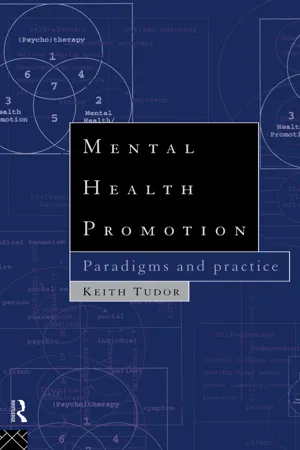
Mental health promotion is an emerging field of interest to many health professionals. This book traces its history, defines it and distinguishes it from mental illness prevention. Mental health is viewed as a positive concept and seperate from mental illness and psychopathology. Based on original research, the conceptual analysis developed in the book offers policy makers and practitioners a coherent and comprehensive framework within which to design and implement practice. Mental Health Promotion:
* offers a new conceptual paradigm for mental health promotion
* applies it to policy, assessment, consultation, education and training
* provides a comprehensive, international literature review
Suitable for a wide variety of courses at student and professional level in psychiatry, nursing, social work and community work, Mental Health Promotion is a significant addition to the study of health promotion.
Information
Part I
Defining the field
Introduction to Part I
Part I defines the field of community mental health promotion (CMHP) and introduces its conceptual framework. It discusses the constituent elements of CMHP - mental health (Chapter 1), health promotion (Chapter 2) and community (Chapter 4) - and develops the elements of the four paradigm analysis and framework through the chapters.
Chapter 1 discusses mental health, distinguishing it from mental illness by clearing the ground that is mental illness through discussions of madness, mental illness legislation, the medical response to madness and mental illness, and other, theoretical responses. Definitions of mental health are reviewed and summarised. The conceptual framework is introduced by discussion of its two axes, based on subjectivist-objectivist assumptions about the nature of social science, and about assumptions about the nature of society from social regulation to radical change. These dimensions are elaborated with reference to different notions of mental health.
Chapter 2 discusses the history and definitions of health promotion, health education and illness prevention. The differences and commonalities between different views are understood in terms of the four paradigm analysis of social theory.
Chapter 3 on mental health promotion (MHP) distinguishes between MHP and mental illness prevention. Eight elements of mental health are introduced to provide a comprehensive basis for the promotion of mental health, with a focus on individuals. Through the eight elements, this chapter draws together literature on mental health and other related areas. The chapter considers two areas of MHP - amongst 'the mentally ill' and in the workplace. The conceptual framework is again used as a way of understanding different notions and views.
Chapter 4 on community uses the paradigm framework as an organising framework for discussion of different concepts of community. The eight elements are reviewed, with the focus on the community. The social policy of community care in Britain is compared with 'the Italian experience' of psychiatric reform and community care. The concept of community mental health (CMH) is developed through four discussions about the public's response, the meaning of CMH, community participation and social change.
Chapter 5 on CMHP brings together the chapters and discussions in Part I in a review of CMHP. The literature on Community Mental Health Centres is reviewed as is their practice as regards CMHP. Four discussions - on community psychology, psychotherapy, advocacy and 'the Italian experience' - are developed as making an important impact on CMHP. CMHP is regarded as comprising two elements: challenging myths of mental illness (although not in the usual way in which this is understood) and as promoting mental health. Another aspect of the paradigm framework is introduced, namely, the possible and proposed movement between the paradigms.
1 Mental health
Mental health is predominantly a euphemism for mental illness. This is widespread in legislation, social policy, medicine, psychiatry, sociology and psychology as well as in practice. Such ambiguity has its roots, first, in the fear of the unknown and the irrationality (unreason) of insanity, secondly, in the historical, legislative response to lunacy, thirdly, in the medicalisation of madness, and, finally, in liberal and even radical notions of mental illness. Expanding on these four themes, mental illness is briefly considered in order to clear the ground for discussion of the main concern of this book - mental health and its promotion. A definition of the field of mental health is offered, through discussion of various definitions of mental health. A conceptual framework for understanding the different definitions and their implications is introduced (and further developed in Chapter 2).
Mental Illness
The fear of the unknown
The history of madness is the history of people's fear and society's exclusion of the unknown, the 'other'. This operates in a number of ways in relation to gender, race and class.
'Woman', de Beauvoir (1972) argues, represents the 'Other' in a duality based on the male self as subject which is 'as primordial as consciousness' (p. 16) and is maintained by dualistic thought and oppression. Chesler (1972) writes about women and 'madness' in mythology and history, the development of female psychology, aspects of the female psychiatric career, as well as aspects of the psychiatric system. Her central theme is the damage to women, perpetuated by psychiatrists and psychiatric institutions: 'women, by definition, are viewed as psychiatrically impaired whether they accept or reject the female role - simply because they are women' (Chesler, 1972, p. 115). Busfield (1988) brings together two arguments about women and mental health: one, that women's mental illness is a product of their oppression; and second, that mental illness is a label used to control and confine women's action, one which involves the exercise of patriarchal power. Thus, in practice, women in Britain are diagnosed and treated differentially.1
- Of all people diagnosed by GPs as 'mentally ill', 55% are women and 45% are men and yet men are more likely to be referred for specialist help (D. Thompson and Pudney, 1990).
- Women are twice as likely as men to be diagnosed as suffering from 'clinical depression' (Department of Health and Social Security [DHSS], 1986) and between two and three times more likely to be prescribed minor tranquillisers.
- Women are one and a half times more likely to be admitted to psychiatric hospital than men and admission rates rise steadily for women aged between 35 and 44 (DHSS, 1986).
Drawing on disciplines as diverse as anthropology, history, art and literature, Francis (1991) argues that the very notion of madness suggests the notion of race (and vice versa). The archetypes of unreason all assume the superiority of white Western philosophic thought: from Caliban's lasciviousness and inarticulacy, through the 'discovery' of 'the dark continent' (Africa); through the Darwinian attempts to classify and establish a hierarchy of the species and subsequent racist anthropometry; and the racist connotations of the savage 'animality of madness' (Foucault, 1971); to the psychiatric misdiagnosis of black people (Gabriel, 1987; Fernando, 1988; G. Harrison et al., 1988).2 Other factors, evidenced by research since the early 1980s, highlight the inequalities of the 'treatment' of black and minority ethnic people within the psychiatric system.
- Black people, in particular young Afro-Caribbean men, are more likely than white people to be removed by the police under Section 136 of the Mental Health Act 1983 (MHA) (A. Rogers and Faulkner, 1987; Bean et al., 1991).
- Black people are more likely to be retained in hospital under Sections 2, 3 and 4 of the MHA (Department of Health [DoH]/Home Office, 1992).
- There are disproportionate numbers of black people within the psychiatric population (Francis et at, 1989). Afro-Caribbeans are ten times more likely to be diagnosed as white people (G. Harrison et ai, 1988).
- Black people receive on average larger doses of medication than white people and have less access to alternative treatment (Littlewood and Cross, 1980; Littlewood and Lipsedge, 1982).
- A disproportionate number of black people have died 'in care'.
Society, in the form of the superior or dominant community, also assumes the moral and practical right to segregate and banish such fearful 'otherness', whether 'hysterical' women, schizophrenic blacks or the feckless (and therefore undeserving) poor: 'this community acquired an ethical power of segregation, which permitted it to eject, as into another world, all forms of social uselessness' (Foucault, 1971, p.58). Foucault argues that the other world is or was defined by labour, that is, one's social usefulness and productivity3 This is echoed in class-related aspects of mental illness.
- Hollingshead and Redlich (1958) examined the difference in concepts of mental health and illness, depending on class, showing a correlation between class and treated mental illness.
- G.W. Brown and Harris's (1978) study on the Social origins of depression found that, amongst those with children at home, working-class women were four times more likely to suffer from depression.
- In a major study on lifestyles, Blaxter (1990) correlated psychosocial illness with class, a situation exacerbated by old age, and commented on the detrimental impact of low income and social isolation.
- People in socially disadvantaged groups have a higher lifetime prevalence of major mental health (illness) problems and poor access to care (WHO, 1991b).
- The impact of poverty, low income and inadequate social security benefits, poor housing, and unemployment, on people with mental health problems is also highlighted by the Association of Metropolitan Authorities ([AMA], 1993).
The legislative response to lunacy
Historically, many of the terms used to describe the unknown distress that people experienced 'in their minds', which are now considered derogatory, then represented both a fear of the unknown and a concern about the social control of vagrancy. Considerations reflected both in early legislation and through the association of 'mental illness' with 'dangerousness'.
Foucault (1971), in his major study of Madness and civilisation, traced the history of confinement in Europe, and particularly in France and the legislation supporting this. In Britain, prior to the eighteenth century, common law (and common 'sense') had distinguished between idiots, being 'simple', and lunatics, being less understandably 'mad'. In many ways, although the terms and labels have changed, this distinction has continued to influence both public thinking and governmental legislation and policy: the Idiots Act 1886, for instance, provided separately for 'imbeciles' and 'idiots', although the Lunacy (Consolidation) Act 1890 ignored the distinction between mental illness and mental handicap. The Vagrancy Act 1714 had associated lunacy with criminal deviance whilst the Vagrancy Act 1744 defined a 'lunatick or mad person', a definition consolidated one hundred years later in the Lunatics Act 1845, which defined lunatics as of 'unsound mind', a redefinition favoured a century later by the Royal Commission on Lunacy and Mental Disorder. It was not, however, until early in the twentieth century that the distinctions between and consequences of this terminology were made explicit, both in terms of the responsibility for one's mental state and the provision needed - and this at a time when public and medical opinion favoured the segregation of 'mental defectives'. The Mental Deficiency Act 1913 distinguished between the feeble-minded: those who needed care or control for the protection of themselves or others; imbeciles', those who could guard themselves against common physical dangers, such as fire, water and traffic, but who were incapable of managing themselves or their affairs; idiots', those unable to guard themselves against common physical dangers; and moral defectives: those with vicious or criminal propensities. This history of definitions and names is important in that it lies behind moves in more recent times to rename and reclaim terms in the field of mental illness.
The Mental Health Act 1959 was the first to be so named, despite its focus on diagnosis, treatment and detention, and was regarded, at least by the Department of Health and Social Security (DHSS), as 'enlightened and forward-looking' (DHSS, 1976, p.l). This Act repealed much of the previous Lunacy, Mental Treatments and Mental Deficiency Acts of the previous seventy years (and repealed or amended twenty-three such Acts, dating back to 1800); defined and distinguished between 'mental illness', 'severe subnormality', 'subnormality' and 'psychopathic disorder'; and introduced and codified the powers and arrangements for various forms of compulsory treatment of patients, the periods of detention, powers of guardianship, and the respective roles of the various people involved in the arrangements for admission and discharge of patients. The Mental Health Act 1983 (MHA 1983), influenced by professional and civil liberties lobbies and the philosophy of 'the least restrictive alternative' to compulsory treatment, consolidated changes which had occurred since the 1959 Act; updated the 1959 definitions, changing 'subnormality' to 'mental impairment'; and introduced the person and role of the approved social worker. The DoH/Welsh Office's Code of practice (1990, 1993) to the MHA 1983 has consolidated much of the 'good practice' implicit in the legislation, and has clarified some of the duties of local and health authorities and other statutory agencies under the MHA 1983.
Other governmental policies which have an impact on the management of mental illness and mental health are reviewed in Chapter 6. An alternative view of the MHA is offered by the Campaign Against Psychiatric Oppression (CAPO) (undated) which demands its withdrawal.
The history of the legislative response to mental illness has been one of definition, categorisation and, commonly, incarceration - what Foucault (1971) refers to historically as 'the great confinement' - of people considered to be socially undesirable or dangerous. The notion of dangerousness in relation to mental illness is an important one as the historical connection remains active in the collective psyche, emerging in often hostile public response to issues of 'mental health', fuelled by tabloid media publicity about 'psycho-killers', and often with a racist twist: 'we would conjecture that the criteria on which bail applications are based [and refused] are related to subjective notions of dangerousness and public menace which bears little relation to objective measures of safety and risk' (Browne et al., 1993, p. 108).
The medicalisation of madness
In response to the concern of the social control of madness there was a growth in the establishment of madhouses in the late seventeenth century, given further legitimacy in 1808 by the legalisation of the county lunatic asylum. Porter (1990) argues that, increasingly, medical practitioners took over from the lay 'mental entrepreneurs' who had previously run these institutions for two reasons: the specialisation necessary in a congested occupation (medicine); and the professional and financial benefits to medical career prospects. Foucault (1971) suggests three elements which symbolise society's structures and values and which contribute to the medicalisation of madness:
Family-Child relations, centred on the theme of paternal authority; Transgression-Punishment relations, centred on the theme of immediate justice; Madness-Disorder relations, centred on the theme of social and moral order. It is from these that the physician derives his power to cure.
(Foucault, 1971, p. 274)
Foucault argues that these relations encapsulate and reify the importance of the doctor/psychiatrist-patient relationship which moves, through the historical development of ideas, from an essentially moral one to one obscured by the 'myths of scientific objectivity' (Ibid., p. 276). Psychiatry also echoes the medical model of the diagnosis-treatment-cure approach: the doctor determines the disease, the diagnosis determines the treatment, and the diagnosis determines the prognosis and/or 'cure' (although in practice this formulation often begin...
Table of contents
- Cover Page
- Half Title page
- Series page
- Title Page
- Copyright Page
- Dedication
- Contents
- List of figures
- List of tables
- List of boxes
- Foreword
- Acknowledgements
- List of abbreviations
- Introduction
- Part I Defining the field
- Part II Developing the field
- Part III Breaking out of the field
- Appendices
- Appendix 1 Notes on community organising
- Appendix 2 Mental health promotion targets
- Appendix 3 A job description for community mental health promotion
- Appendix 4 Mental health promotion course
- Notes
- Bibliography
- Author index
- Subject index
Trusted by 375,005 students
Access to over 1.5 million titles for a fair monthly price.
Study more efficiently using our study tools.
Frequently asked questions
Yes, you can cancel anytime from the Subscription tab in your account settings on the Perlego website. Your subscription will stay active until the end of your current billing period. Learn how to cancel your subscription
No, books cannot be downloaded as external files, such as PDFs, for use outside of Perlego. However, you can download books within the Perlego app for offline reading on mobile or tablet. Learn how to download books offline
Perlego offers two plans: Essential and Complete
- Essential is ideal for learners and professionals who enjoy exploring a wide range of subjects. Access the Essential Library with 800,000+ trusted titles and best-sellers across business, personal growth, and the humanities. Includes unlimited reading time and Standard Read Aloud voice.
- Complete: Perfect for advanced learners and researchers needing full, unrestricted access. Unlock 1.5M+ books across hundreds of subjects, including academic and specialized titles. The Complete Plan also includes advanced features like Premium Read Aloud and Research Assistant.
We are an online textbook subscription service, where you can get access to an entire online library for less than the price of a single book per month. With over 1.5 million books across 990+ topics, we’ve got you covered! Learn about our mission
Look out for the read-aloud symbol on your next book to see if you can listen to it. The read-aloud tool reads text aloud for you, highlighting the text as it is being read. You can pause it, speed it up and slow it down. Learn more about Read Aloud
Yes! You can use the Perlego app on both iOS and Android devices to read anytime, anywhere — even offline. Perfect for commutes or when you’re on the go.
Please note we cannot support devices running on iOS 13 and Android 7 or earlier. Learn more about using the app
Please note we cannot support devices running on iOS 13 and Android 7 or earlier. Learn more about using the app
Yes, you can access Mental Health Promotion by Keith Tudor in PDF and/or ePUB format, as well as other popular books in Psychology & Education in Psychology. We have over 1.5 million books available in our catalogue for you to explore.