eBook - ePub
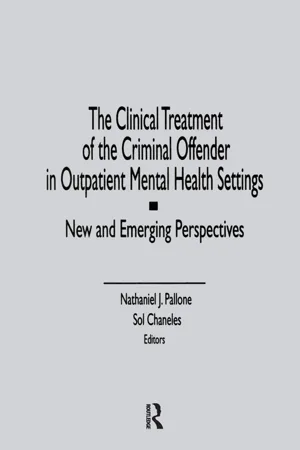
The Clinical Treatment of the Criminal Offender in Outpatient Mental Health Settings
New and Emerging Perspectives
- 178 pages
- English
- ePUB (mobile friendly)
- Available on iOS & Android
eBook - ePub
The Clinical Treatment of the Criminal Offender in Outpatient Mental Health Settings
New and Emerging Perspectives
About this book
This volume brings together in a single source a set of perspectives by leaders in the clinical treatment of criminal offenders in outpatient settings, particularly those whose crimes have involved domestic violence and/or substance abuse. More than a set of "how to" techniques, it addresses the question of which offenders can successfully be treated in what settings by which techniques. It is a valuable resource not only for those concerned with prisons, probation, and parole, but also for those responsible for the delivery of mental health services in the community.
Information
Drug Use and Felony Crime: Biochemical Credibility and Unsettled Questions
SUMMARY. Though there is widespread belief that drug abuse is related to felony crime, precise linkages have not yet been established, in some measure because prospective linkages have been studied not only through the variant methods of social and “hard” science, but also because the methods of biochemical laboratory assay developed to detect the presence of drugs in the physical system have become more technologically discerning. Representative studies from the social sciences, relying on the self-reports of convicted felons, and from the “hard” sciences, utilizing “more” and “less” sensitive methods of laboratory assay, yield data that propose, at the extremes, that one of every six or one of every two felonies is at the least “lubricated” by drug use or abuse. But there is insufficient evidence as yet to conclude to the differential effects of specific substances with known biochemical properties that produce particular biochemical effects on the acceleration of particular types of felony crime. In future inquiry to establish such precise links, biochemistry and neuropsychopharmacology will take the lead. Largely as a result of the introduction of wide-scale drug testing of worker populations, increased attention has been engendered among biomedical scientists about “bandwidth fidelity” issues in the detection of controlled dangerous substances. Adoption in several states of “pathological intoxication” laws endorsed by the American Psychiatric Association and the burgeoning of the “designer drug” industry combine to produce a forensic Wonderland.
The United States is a nation apparently obsessed by the use and abuse of chemical substances. In a typical year, the aggregate total of arrests made exclusively for offenses related to sale and possession of “controlled dangerous substances” (opium, cocaine, marijuana, or synthetics) or to alcohol (driving under the influence, public drunkenness, other violations of liquor laws, such as sale to minors) is nearly double the aggregate total of arrests made in all jurisdictions for all felony crimes combined [cf. McGarrell & Flanagan, 1985, pp. 451-461]. Of all arrests (some 12,000,000) in all jurisdictions in the U.S. for all offenses (felony, misdemeanor), some 449,000 are made for violent felonies and some 1,930,000 for property felonies, while some 3,500,000 are made exclusively for alcohol offenses and some 662,000 exclusively for drug offenses not associated with those felony crimes enumerated in the U. S. Department of Justice’s Index of Serious Crime (i.e., homicide, assault, rape, robbery, weapons possession, burglary, forgery or fraud, larceny).
Though arrests for specific drug offenses account for a discernible proportion of all U.S. arrest activity, is there evidence that the use of “controlled dangerous substances” contributes to the commission of other crimes, particularly of felonies? From Wolfgang’s studies in the 1950’s onward, a considerable body of research evidence, much of it summarized by Collins [1981] and Roizen [1981], appears to have established a consistent link between alcohol and violent crime. But, despite what is generally conceded to be an “epidemic” in the use of “controlled dangerous substances” within the past two decades and the consequent and widespread belief that drug use/abuse similarly represents a contributory factor in felony crime, reinforced by press accounts that focus only on the proportion of arrest activity related exclusively to drug offenses without simultaneous explanation that these arrests are not related to felony offenses [Graham, 1987], little systematic research effort has been undertaken to establish precise linkages. The determination of consistent linkages of stable magnitude is important at the theoretical level in the understanding of criminogenesis and, at the pragmatic level, both in the design of programs of rehabilitation or treatment in the jails and prisons and/or through pre-trial diversion programs and in the determination of criminal responsibility in individual cases by way of specification of aggravating or mitigating factors.
ENGINE, LUBRICANT, OR MOTIVE?
Conceptually, the use or abuse of psychoactive substances — whether “controlled” and “dangerous” or not, and whether obtained illegally or through medical prescription — might be associated with felony crime in several ways:
• As engine, functioning so as to induce a person “under the influence” to commit a criminal act of which he/she might otherwise seem incapable. An otherwise peaceable male ingests a particularly strong dose of a mood-altering central nervous system stimulant (e.g., illegally-obtained LSD or medically-obtained amphetamine), for example, quickly develops the delusion that he possesses super-human strength and simultaneously finds himself intolerant of disagreement by others; a fistic conflict ensues, resulting in a charge of aggravated assault.
• As lubricant, functioning so as to facilitate what, at least post-hoc, appears to be a predisposition to criminal behavior. An otherwise well-controlled but sexually undiscriminating man in his mid-30’s, for example, ingests a quantity of a central nervous system depressant (marijuana, barbiturates), and, while “under the influence,” appears to “lose” the capacity to differentiate the ages of women younger than himself, and is charged with statutory rape.
• As motive, functioning as the goal to which criminal activity is directed. A person long habituated to heroin, for example, or to certain cough syrups for that matter, burglarizes a suburban house in order to obtain goods than can be sold to support his habit with the crime committed typically while this offender is not “under the influence.”
The engine and lubricant functions correspond to what McGlothlin [1985] has called the “direct pharmacological effects” of drug use, among which he catalogs “drug-induced disinhibition resulting in impulsive actions, crimes of negligence such as those resulting from driver-impaired performance, and the occasionally reported use of drugs … as a means of fortifying [oneself] to engage in criminal activities,” while the motive function corresponds to what he has called an “indirect effect.”
To establish precise links between drug use/abuse and felony crime, the research evidence should reveal what controlled dangerous substances function as engine, lubricant, or motive in relation to which crimes. Self-report evidence from convicted offenders concerning whether they were or were not “under the influence” during criminal activity may be inadequate to illuminate precise linkages with biochemical credibility unless accompanied by bio-chemical verification; but biochemical evidence concerning whether arrestees were “under the influence” at the point of arrest, especially if not under “hot pursuit” circumstances, may be insufficient to determine whether drug use/abuse functions phenomenologically either as engine or as lubricant for criminal behavior.
BIOCHEMICAL CREDIBILITY
For a variety of reasons, however, the current body of research data fails of such precision. A particularly troublesome lacuna in the literature is the absence of careful consideration of the typical biochemically-determined neuropsychological sequelae to the use and abuse of psychoactive substances of various sorts. Indeed, among current studies, McGlothlin’s [1985] alone is attentive to biochemical issues in a meaningful way. As cataloged in a variety of standard sources on psychopharmacology [e.g., Hofmann & Hofmann, 1975; Schatzberg & Cole, 1986; Perry, 1987], each of the major classes of “abusable” drugs possesses specific biochemical properties which produce predictable neuropsychological sequelae; these range from euphoria, aggressivity, and overwhelming impulsivity (as in the case of psychotomimetic central nervous system stimulants, such as cocaine and the amphetamines) to persistent passivity and withdrawal (as in the case of narcoleptic central nervous system sedatives and depressants).
Is it reasonable to believe that substances with variant biochemical properties contribute equally and uniformly to criminal activity across the spectrum of types of felony crime, regardless of the character of each type of crime? Or is it more reasonable to suppose that “abusable” substances may be differentially related to the emission of criminal behavior of one sort, but not of other sorts — i.e, that the use/abuse of drugs with particular biochemical properties which produce predictable, but very particular, neuropsychological effects accelerates or contributes to particular types of criminal activity, but not necessarily to other types?
Absent contrary evidence, it is biochemically credible to suppose that the use or abuse of central nervous System stimulants and perhaps of hallucinogens acceleratescrimes of violence and personal victimization. Among the property crimes, it seems likely that burglary alone might be accelerated by stimulants. Conversely, it is likely that the central nervous system depressants retard violent behavior of all sorts. These speculations, however, do not necessarily point to drug use or abuse as the primaryenginefor crime; instead, drug use might more convincingly be regarded as a lubricant which potentiates other pre-disposing factors, both intra- and extra-personal. And almost certainly it is the “profit crimes” of burglary and robbery that are implicated when the acquisition of abusable substances functions as motive. In McGlothlin’s [1985, pp. 154–155] formulation:
… there is some evidence that drug use contributes to crime directly by potentiating impulsive and violent behavior; however, the overall significance of this contribution is certainly small … barbiturates have been found to potentiate assaultiveness … amphetamines and cocaine in high doses can produce paranoid reactions resulting in violence, although there are relatively few such accounts in the literature … Marijuana and the stronger hallucinogens are also capable of producing psychotic reactions, and there are occasional references to violent behavior during these episodes [but] marijuana typically decreases both expressed and experienced hostility … there is growing evidence that the pseudo-hallucinogen, phencyclidine, has a fairly high potential for producing combative and violent behavior … Opiates produce a reliable sedating reaction without the increased emotional lability and aggressiveness accompanying alcohol and barbiturate use. Thus, the pharmacological properties of opiates would be expected to decrease rather than potentiate criminal behavior, and this is generally consistent with the available evidence … Finally, and perhaps this is the issue of major concern, there is the question of income-generating crime among individuals with expensive drug habits [and] commission of acquisitive crimes during a period of withdrawal.
CONFLICTING DATA FROM VARIANT METHODS OF INQUIRY
Earlier studies of the relationship between drug use/abuse and felony crime prototypically relied on data from self-reports, often of the offender but sometimes of the victim, as the standard index of criminogenic drug use or abuse, with but few inquiries relying on independent observations and yet fewer based on laboratory assessments of whether drugs (licit or illicit) could be detected in the physical system of an accused (or witnessed) offender. Independent observations (most often, by arresting police officers, or, far less frequently, by a knowledgeable witness) varied, but essentially only marginally, from self-reports of victim or offender. Current studies of the relationship between drug use/abuse and felony crime can be categorized by method of inquiry into those which utilize self-report data and those which employ laboratory assay methods. Among the self-report studies, there is a further distinction between those investigations which inquire into the drug use/abuse habits of known offenders and those which inquire into the criminal behavior patterns of known drug users. Among the laboratory assay studies, there is also a further distinction, predicated on the “sensitivity”of the specific methodology used to detect metabolites which biochemically succeed the ingestion of “controlled dangerous substances,” typically among samples of arrestees; and then, given the relative infrequency of instant apprehension, often long after the criminal event.
Moreover, in virtually each report, it is necessary to regroup the reported data so as to eliminate those cases in which the offenses of record are related exclusively to drugs. With variant social science and biochemical research methodologies employed, and, frankly, given the tendency of social scientists to misconstrue data from the “hard” sciences, that the current body of evidence fails to yield firm conclusions concerning precise linkages between drug use/ abuse and felony crime may not be surprising.
McGlothlin’s Study of Known Drug Abusers
A number of investigations, of which McGlothlin’s [1985] is a prime exemplar, have analyzed data on criminal activity among relatively small samples of known drug abusers, principally those who have applied for treatment in drug rehabilitation facilities operated mental health authorities.
McGlothlin’s sample consisted of some 581 self-identified male narcotics addicts (mean age = 25; no racial data supplied) admitted to a treatment program in California who were followed over a ten year period after admission through collection of police arrest records as well as interviews. Data concerning arrests for drug and other offenses, extent of drug dealing activity, employment, number of crimes self-reported annually, the number of man-days per year during which each subject self-reported as engaged in criminal activity, and a variety of other variables were arrayed in several ways. Of the several arrays, the most pertinent is that which contrasts subjects who used narcotics on a daily basis with those who used narcotics on other than a daily basis. In this contrast, the daily users (”addicts") were arrested significantly more frequently each year for felony property offenses and for drug offenses, but not for violent felonies; more frequently self-reported as engaged in drug dealing (58% vs. 16%); and self-reported a significantly higher number of property crimes per year (47 vs. 17), a higher level of income from crime ($9100 vs. $1700), and a significantly smaller proportion of man-days p...
Table of contents
- Cover
- Half Title
- Title Page
- Copyright Page
- Table of Contents
- About the Editors
- Introduction
- “Privatizing” the Treatment of Criminal Offenders
- Men Who Abuse Their Spouses: Social and Psychological Supports
- Men Who Abuse Their Spouses: An Approach to Assessing Future Risk
- Treating Abusive Parents in Outpatient Settings
- Treatment Needs and Services for Mothers with a Dual Diagnosis: Substance Abuse and Mental Illness
- Drug Use and Felony Crime: Biochemical Credibility and Unsettled Questions
- Outpatient Treatment for Substance-Abusing Offenders
- Alcohol Abuse and the Young Offender: Alcohol Education as an Alternative to Custodial Sentencing
- The Convergence of the Mentally Disordered and the Jail Population
- Outpatient Treatment of the Sexually Motivated Murderer and Potential Murderer
Trusted by 375,005 students
Access to over 1.5 million titles for a fair monthly price.
Study more efficiently using our study tools.
Frequently asked questions
Yes, you can cancel anytime from the Subscription tab in your account settings on the Perlego website. Your subscription will stay active until the end of your current billing period. Learn how to cancel your subscription
No, books cannot be downloaded as external files, such as PDFs, for use outside of Perlego. However, you can download books within the Perlego app for offline reading on mobile or tablet. Learn how to download books offline
Perlego offers two plans: Essential and Complete
- Essential is ideal for learners and professionals who enjoy exploring a wide range of subjects. Access the Essential Library with 800,000+ trusted titles and best-sellers across business, personal growth, and the humanities. Includes unlimited reading time and Standard Read Aloud voice.
- Complete: Perfect for advanced learners and researchers needing full, unrestricted access. Unlock 1.5M+ books across hundreds of subjects, including academic and specialized titles. The Complete Plan also includes advanced features like Premium Read Aloud and Research Assistant.
We are an online textbook subscription service, where you can get access to an entire online library for less than the price of a single book per month. With over 1.5 million books across 990+ topics, we’ve got you covered! Learn about our mission
Look out for the read-aloud symbol on your next book to see if you can listen to it. The read-aloud tool reads text aloud for you, highlighting the text as it is being read. You can pause it, speed it up and slow it down. Learn more about Read Aloud
Yes! You can use the Perlego app on both iOS and Android devices to read anytime, anywhere — even offline. Perfect for commutes or when you’re on the go.
Please note we cannot support devices running on iOS 13 and Android 7 or earlier. Learn more about using the app
Please note we cannot support devices running on iOS 13 and Android 7 or earlier. Learn more about using the app
Yes, you can access The Clinical Treatment of the Criminal Offender in Outpatient Mental Health Settings by Letitia C Pallone in PDF and/or ePUB format, as well as other popular books in Psychology & Medical Law. We have over 1.5 million books available in our catalogue for you to explore.