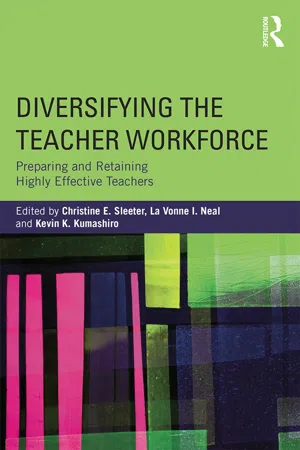
Diversifying the Teacher Workforce critically examines efforts to diversify the teaching force and narrow the demographic gap between who teaches and who populates U.S. classrooms. While the demographic gap is often invoked to provide a needed rationale for preparing all teachers, and especially White teachers, to work with students of color, it is far less often invoked in an effort to examine why the teaching force remains predominantly White in the first place. Based on work the National Association for Multicultural Education is engaged in on this phenomenon, this edited collection brings together leading scholars to look closely at this problem. They examine why the teaching force is predominantly White from historical as well as contemporary perspectives, showcase and report available data on a variety of ways this problem is being tackled at the pre-service and teacher credentialing levels, and examine how a diverse and high-quality teaching force can be retained and thrive. This book is an essential resource for any educator interested in exploring race within the context of today's urban schools.
eBook - ePub
Diversifying the Teacher Workforce
Preparing and Retaining Highly Effective Teachers
- 210 pages
- English
- ePUB (mobile friendly)
- Available on iOS & Android
eBook - ePub
Diversifying the Teacher Workforce
Preparing and Retaining Highly Effective Teachers
About this book
Information
PART I Communities of Practice: Supporting Culturally Efficacious Leaders and Teachers
DOI: 10.4324/9781315818320-2
1 A COMPETING THEORY OF CHANGE: CRITICAL TEACHER DEVELOPMENT
DOI: 10.4324/9781315818320-3
Teachers are agents of change, but are they subjects or objects of reform? The way educational leaders respond to this question has important implications for the teachers of color we develop in the 21st century. Current teacher effectiveness reform positions teachers as individual objects who can be refined using high-stakes evaluation systems to improve student achievement (Rand Education, 2013). This position supposes that if teacher evaluation systems closely monitor and eliminate teachers who contribute to stagnant learning gains and persistent achievement gaps then low student achievement in schools will disappear. However, we challenge reform efforts that attempt to fix teachers as objects of reform; we instead situate teachers as subjects for change. We offer a competing theory of change, critical teacher development theory, positioning teacher development as a socioconstructivist process in which teachers work as change agents in knowledge-centered communities of practice that assess, implement, and refine rigorous and culturally responsive pedagogy to increase achievement for all students.
Teachers of color are important for all students (Epstein & Gist, 2013). Yet, research suggests that rather than becoming change agents, they can be changed by oppressive school systems (Achinstein & Ogawa, 2011). Thus, intentional efforts, anchored within critical social theories of resistance, must guide the recruitment, preparation, and induction of teachers of color. Collins (1998) separated oppressive from liberating uses of theory, explaining that “the difference lies in distinguishing between theory as dogma or closed systems of ideas to be verified and tested, and theory as a story or narrative operating as an open system of ideas that can be retold and reformulated” (p. 200). As educators, we are committed to theorizing social justice for teachers of color and view them as knowledge producers and innovators who create resources and theories that enrich the learning experiences of teachers and students alike (Bernal & Aragon, 2004; Freire, 1970). Collins posed three questions as a way to assess the epistemological criteria of a critical social theory, or in this case, our critical teacher development theory: (a) Does the social theory speak the truth to people about the reality of their lives, (b) does the theory equip people to resist oppression, and (c) does the critical social theory move people to struggle?
We view teachers of color as critical assets for redefining effective teaching for culturally and linguistically diverse students and have drawn from their historical and emerging knowledge systems as well as instructional practices to develop critical teacher development theory. Therefore, this theory challenges teacher education and professional development programs through the intentional inclusion of learning and teaching methods that integrate teachers’ cultural, linguistic, and instructional knowledge systems. Thoughtful and targeted focus on nondominant perspectives at each stage of the teacher development continuum (e.g., recruitment, preparation, retention, induction, ongoing professional development) can equip teachers of color to be advocates for social justice in schools. For instance, during teacher preparation, culturally responsive practices can be fostered through instructional opportunities that enable teacher candidates of color to synthesize and apply diverse cultural understandings of learning and teaching. After program completion, teachers continue in communities of practice (CofP)—which Lave and Wenger (1991) described as groups who share a common concern regarding a task—and through dialogue, participants learn how to improve performance. The CofP help participants grow as culturally efficacious teachers equipped with the tools to responsively combat schools’ hegemonic realities. During their induction phase, mentors are key stakeholders who work to facilitate and foster teachers’ construction of knowledge and instruction in meaningful ways in CofP.
Culturally responsive CofP provide spaces for teachers to engage in critical dialogue that serves as a buffer against school contexts saddled with limited economic and human capital resources. Through this process, teachers affirm in community their sociocultural consciousness of the school, geographic community, and classroom context. They become efficacious in their beliefs and practices for successfully raising student achievement in adverse schooling environments. Teachers, as an empowered professional body, can embrace their sociopolitical commitments as lifelong work vested in community.
To illustrate how our critical teacher development theory is evidenced in the real lives of teachers, we feature the Academy for Teacher Excellence (ATE) at the University of Texas at San Antonio to capture the journey visionary leaders and teachers embark on as they grow in evolving culturally responsive CofP.
Stance as Researchers
In order to spotlight the voices of color in our study, we chose portraiture as a method to convey ATE’s diverse and rich approach for fostering and sustaining teacher development. As scholars of color, we commit to challenging majoritarian tales of deficit by offering culturally responsive and sociopolitically conscious perspectives on teacher development. Portraitures’ search for goodness parallels our commitment to highlight the strengths of teachers of color and can be employed “as a way of reflecting its cross between art and science, its blend of aesthetic sensibilities and empirical rigor, and its humanistic and literary metaphors” (Lawrence-Lightfoot, 2005, p. 6). Therefore, we offer a portrait to cultivate the mind’s eye to “see” how ATE’s program offers a competing vision of a culturally and linguistically diverse community of educational leaders who are equipped, committed, and empowered with tools to improve students’ academic achievement.
ATE’s initial program entry interviews, teachers’ reflections on their professional development, mentors’ classroom observations, and field notes were all used as archival data to develop the program portrait. The beginning of each section opens with reflections from the designers of ATE (authors Flores and Claeys), which are included to paint a coherent and textured picture of the program’s development in general, and more specifically as evidence of the critical teacher development theory for which we argue. Although the portrait’s opening sections are written in first person, the remainder is structured from a third-person perspective to present a coherent set of findings for the reader.
“Seeing” the ATE's Theory of Change
After analyzing the archival data on ATE’s journey toward creating and implementing a theory of change, three key themes emerged: visionary leadership, the work of vision building, and the development of agents of change in CofP. The following portrait describes the reflections, decisions, and commitments the leadership team and teachers made at different points in the program’s development.
Visionary Leadership
As a former teacher and counselor, I often witnessed the educational disparities firsthand. When I was an early childhood bilingual education teacher, I focused on providing a learning environment that promoted children’s development. After all, that is why I went into teaching, to make a difference, and I personally think that I was successful. I witnessed how children thrived. But early in my career, I began to notice that my way of thinking was not necessarily aligned with some of the other teachers in the building. I was asked, “Why are you wasting so much of your time with those kids and families?” This type of questioning, rather than deterring me, made me dig in my heels and take a stance on my position. Yes, there were other well-intentioned teachers, but some of them were not necessarily equipped with the tools to work with a culturally and linguistically diverse population. What I witnessed was that Latino bilingual teachers and other teachers of color were best equipped, as were some White teachers, but not always. As a school counselor, I saw that the differential treatment of children was even more rampant. Effective teachers had commitment to the community and understood their role as advocates, and their children were successful. Still, there were others who approached teaching from a deficit perspective, with low expectations, and taught content with mediocrity. Later, as a university bilingual teacher-training coordinator, I felt that I was in a position to bring about change. Because of my desire to create greater equitable and responsive schooling practices, this eventually led me to my doctoral program.
Throughout my studies, I copiously read the literature on teacher development. Some nagging questions I had: Why were some teachers responsive to their students’ needs, whereas others were oblivious? Why did they not have a sense of commitment? Had the teacher preparation program failed to prepare them adequately? Was the teacher preparation program targeting those with personal commitment to the community? What personal ideas or motives drove these teachers’ decisions? Ultimately, these queries led me to my dissertation topic, which examined the epistemological beliefs and practices of bilingual education teachers. But even being a newly minted PhD and new faculty member did not quell my desire to bring about change in teacher preparation. I reached out to several like-minded mentors and colleagues to discuss issues and actively search for funding to set these ideas in motion. (Belinda Bustos Flores, ATE’s founder, 2013)
Flores eventually formalized these ideas, drawing from her team’s collective experience as teachers, counselors, leaders, and educators to design a comprehensive plan for preparing teachers as effective educators for diverse student populations. A key component of the program’s conceptual framework was the idea of the culturally efficacious teacher, defined as an individual who demonstrates a strong ethnic–cultural identity, self-determination, critical reflection, positive efficacy, sociocultural competence, and transformative practices (Flores, Clark, Claeys, & Villarreal, 2007). The culturally efficacious teacher has strong interdisciplinary–disciplinary content, has pedagogical knowledge and skills, uses learners’ cultural capital to create a supportive learning environment, is confident about his or her capacity to ensure the success of students regardless of the context, and is adaptable to change by engaging in the iterative process of continuous critical reflection and praxis.
ATE’s leadership team rejected the notion that there is a finite point that one achieves along this journey; rather, they saw the educator as a perpetual learner. They envisioned becoming a culturally efficacious teacher as a transformative journey commencing during teacher preparation, continuing in the novice years, and enduring throughout the educator’s career. Teacher candidates, novices, and career teachers need the assistance of mentors to acclimate to the professional demands of the changing landscape (Flores, Hernández, García, & Claeys, 2011). To actualize this transformative vision, which takes into account that change is constant and that we must be at the forefront of innovation, the team sought to create a support structure that would anchor this vision and actualize a theory of change.
The Work of Building a Vision
I was fortunate to have institutional support from my dean, Bambi Cardenas, to further develop a proposal. To help us capture our ideas, I sought support from an expert grant writer—Abelardo Villarreal. In fact, he introduced me to the theory of change model (Rogers, 2008) that is used for developing grant proposals as well as transforming and evaluating organizations. We were eventually awarded a Title V for Hispanic Serving Institutions grant to establish ATE. The next step was to recruit the right personnel to ensure that the vision would come to fruition. (Belinda Bustos Flores, ATE’s founder, 2013)
When I came on board, I knew I had joined a dynamic visionary duo with passion and commitment to education specifically for ethnically diverse students and teachers. ATE would allow me not only to coordinate the implementation of the project but also to engage in critical reflection, innovation, and leadership undertakings. After 10 years, I am proud to say that ATE continues to be at the vanguard in pioneering compelling approaches for preparing and mentoring culturally efficacious educators for the 21st century. (Lorena Claeys, ATE’s executive director, 2013)
In developing the support structures to prepare culturally efficacious teachers, ATE’s team wanted to go beyond efforts already in existence while keeping in mind the vision. For instance, there was a demand for teachers in critical teaching areas while at the same time there was a need for greater diverse representation in the teacher corps. From these collective understandings, Flores and the team designed ATE to support teacher candidates in their holistic development to become culturally efficacious teachers by recruiting from the Latino population as well as targeting other students of color and students from low-income or first-generation populations. To support these teachers’ development and success, ATE’s leadership committed to creating an infrastructure and to recruiting experienced educators as mentors. Through professional development, the mentors’ knowledge and skills were augmented to assist teacher candidates, interns, and novices through their professional journey.
Although providing well-trained induction mentors is vital as a support mechanism (Flores et al., 2011), ATE’s team considered the notion of self-care to be a missing component in teacher preparation and induction. In an effort to support candidates’ and teachers’ life and career transitions, one of the team members, Norma Guerra, utilized her LIBRE Model (Guerra, Flores, & Claeys, 2009), a strengths-based problem-solving and coping-strategies approach, as the basis for developing Career Transitioning Guidance. ATE leadership believed that the Teacher Academy Learning Community, in conjunction with critical elements such as Career Transitioning Guidance, would provide a safe environment for teacher candidates to support each other as they transitioned and navigated institutional systems first as learners and then as teachers.
As candidates transitioned from the teacher preparation program to the classroom, the leadership team noticed that their initial induction activities were prototypical in that campus mentors were assigned at the beginning of internship– novice year. Even when pairing teachers and mentors based on instructional assignments, the lack of time during and after school prevented an effective mentoring experience (Flores et al., 2011). Subsequently, the induction support model was refined to include experienced educators and create the Teacher Academy Induction Community of Practice, which was initially based on Lave and Wenger’s (1991) community of practice notion and subsequently supported by research as an effective means for supporting teacher development (Jimenez-Silva & Olson, 2012).
To address ATE teachers’ commitment and retention in the classroom, in addition to the face-to-face inductio...
Table of contents
- Cover Page
- Half Title Page
- Title Page
- Copyright Page
- Table of Contents
- Preface
- Introduction: Why a Diverse Teaching Force Must Thrive
- Part I Communities of Practice: Supporting Culturally Efficacious Leaders and Teachers
- Part II Teacher Education Programs: The Promise and Possibilities of Preparing a Culturally Diverse Teaching Force
- Part III Recruiting and Retaining Teacher Candidates of Color: University Partnerships With Public Schools
- Part IV Diversity Plans, Demographic Trends, and Accreditation in Higher Education
- Contributor Biographies
- Index
Trusted by 375,005 students
Access to over 1.5 million titles for a fair monthly price.
Study more efficiently using our study tools.
Frequently asked questions
Yes, you can cancel anytime from the Subscription tab in your account settings on the Perlego website. Your subscription will stay active until the end of your current billing period. Learn how to cancel your subscription
No, books cannot be downloaded as external files, such as PDFs, for use outside of Perlego. However, you can download books within the Perlego app for offline reading on mobile or tablet. Learn how to download books offline
Perlego offers two plans: Essential and Complete
- Essential is ideal for learners and professionals who enjoy exploring a wide range of subjects. Access the Essential Library with 800,000+ trusted titles and best-sellers across business, personal growth, and the humanities. Includes unlimited reading time and Standard Read Aloud voice.
- Complete: Perfect for advanced learners and researchers needing full, unrestricted access. Unlock 1.5M+ books across hundreds of subjects, including academic and specialized titles. The Complete Plan also includes advanced features like Premium Read Aloud and Research Assistant.
We are an online textbook subscription service, where you can get access to an entire online library for less than the price of a single book per month. With over 1.5 million books across 990+ topics, we’ve got you covered! Learn about our mission
Look out for the read-aloud symbol on your next book to see if you can listen to it. The read-aloud tool reads text aloud for you, highlighting the text as it is being read. You can pause it, speed it up and slow it down. Learn more about Read Aloud
Yes! You can use the Perlego app on both iOS and Android devices to read anytime, anywhere — even offline. Perfect for commutes or when you’re on the go.
Please note we cannot support devices running on iOS 13 and Android 7 or earlier. Learn more about using the app
Please note we cannot support devices running on iOS 13 and Android 7 or earlier. Learn more about using the app
Yes, you can access Diversifying the Teacher Workforce by Christine E. Sleeter,La Vonne I. Neal,Kevin K. Kumashiro in PDF and/or ePUB format, as well as other popular books in Education & Education General. We have over 1.5 million books available in our catalogue for you to explore.