- 250 pages
- English
- ePUB (mobile friendly)
- Available on iOS & Android
eBook - ePub
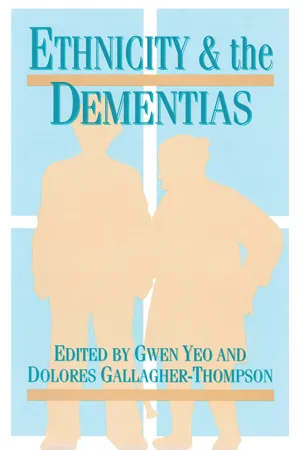
Ethnicity and Dementias
About this book
A practical approach for professionals working with people suffering from dementias, this book focuses on dementias, including Alzheimer's disease, from a multi-cultural perspective.
Information
Part 1
Overview of Issues
The increasing ethnic diversity of the older population in the United States is rapidly putting a rainbow in the graying of America. To ignore the implications of dementia, arguably the most devastating and widespread set of geriatric conditions, for the growing population that does not fit into the typical European American mold is to deny the importance of the unique needs for the soon-to-be one fifth of older Americans.
The unique dementia-related issues for elders and their families from ethnic minority backgrounds include lack of research with specific ethnic groups, indications of differences in risk (and conflicting data for some populations) for certain types of dementia, need for culturally and linguistically appropriate assessment techniques, variations in cultural meanings attached to changes in cognitive function, and lack of education in cultural competence to enable providers to work appropriately with elders and their families from different ethnic backgrounds.
Chapter 1
Background
Gwen Yeo
After the dramatic increase in the past decade in knowledge about Alzheimer’s disease and other dementias, the time has come to explore the relevance of that knowledge to the rapidly increasing population of elders of color in the United States. Although the literature on the epidemiology, assessment, and family support of people with dementia among the ethnic minority populations is still relatively thin, this book represents an effort to present the current level of understanding and to increase the resources available to clinicians and researchers.
DEMOGRAPHICS
The populations that fall into the four federally designated ethnic minority categories in the United States are the focus in this collection. These designations are American Indian/Alaska Native, Asian/Pacific Islander, Black, and Hispanic.1 These ethnic minority populations of older Americans are growing even faster than the exploding population of older adults as a whole. By 2020, elders (those ages 65 and over) in these categories are projected to make up more than 22% of all older Americans (U.S. Bureau of the Census & National Institute on Aging, 1993). In California, these elders of color already constitute more than 20% of the older population; this percentage is projected to reach 41% by 2020 (California Department of Finance, 1988; U.S. Census of Population & Housing, 1990). Although far from perfect, the best estimate of the current size of the ethnic minority population comes from the decennial U.S. Census, based on respondents’ self-reported identification. Because the risk of dementia increases with age, Table 1 presents the numbers and percentages of elders 65 and over and 85 and over in the ethnic minority categories in 1990. Slightly more than 27 million people age 65 and over classified themselves as non-Hispanic White, and almost 313,000 classified themselves as “other race.”
Table 1 Older U.S. Populations in Ethnic Minority Categories: 1990 Census
| 65 and older | 85 and older | |||
| Race or ethnicity | n | % | n | % |
| Total | 31,241,831 | 3,080,165 | ||
| American Indian or Alaska Native | 114,453 | 0.4 | 9,205 | 0.3 |
| Asian or Pacific Islander | 454,458 | 1.5 | 29,738 | 1.0 |
| Black | 2,508,551 | 8.0 | 230,183 | 7.5 |
| Hispanic origina | 1,161,283 | 3.7 | 94,564 | 3.1 |
Note. Table compiled from data from the U.S. Bureau of the Census (1992).
aHispanics may be of any race..
HETEROGENEITY
It is important to recognize that within these categories immense variability is found, much of which affects the perception and response to dementia. The most important source of diversity within the four ethnic minority categories is national origin and culture (tribal in the case of American Indian populations). As an example, Table 2 indicates the major groups identified in the 1990 Census within the Asian/Pacific Islander category of elders. Among the elders lumped together in this, the most rapidly growing of the four categories, 70% were born outside the United States, ranging from 28% for Native Hawaiian and 17% for Japanese American to 98% for Vietnamese and Cambodian, with the large Chinese and Filipino groups reported to be 84% and 95%, respectively (Young & Gu, 1995).
Even within these subcategories of discrete national origin (e.g., Filipino), there is a wide range of levels of acculturation and ethnic identity, education, income, length of residence in the United States, rural or urban background, religious affiliation and participation, and family support; any one of these may influence the interaction between provider and patient with suspected cognitive impairment or that between the provider and family members. For example, in the metropolitan areas of many states on both coasts, at least three different language groups are found among elders labeled Chinese, including elders who were born in mainland China, Taiwan, Hong Kong, or Vietnam; whose income varies from well below poverty level to extremely wealthy; and whose educational backgrounds vary from no years of schooling to graduate degrees.
Table 2 Ethnicity of Asian and Pacific Islander Elders 65 and Older: 1990
| Ethnic group | N | % |
| Total Asian | 439,723 | 96.8 |
| Chinese | 133,977 | 29.5 |
| Japanese | 105,932 | 23.3 |
| Filipino | 104,206 | 22.9 |
| Korean | 35,247 | 7.8 |
| Asian Indian | 23,004 | 5.1 |
| Vietnamese | 18,084 | 4.0 |
| Cambodian | 3,724 | 0.8 |
| Laotian | 3,697 | 0.8 |
| Hmong | 2,535 | 0.6 |
| Thai | 1,416 | 0.3 |
| Other Asian | 7,901 | 1.7 |
| Total Pacific Islander | 14,735 | 3.2 |
| Hawaiian | 10,233 | 2.3 |
| Samoan | 2,047 | 0.5 |
| Guamanian | 1,523 | 0.3 |
| Other Pacific Islander | 930 | 0.2 |
Note. Table compiled from data from the U.S. Bureau of the Census (1992).
Almost every interaction with an older patient and every decision a provider must make about care are affected by the cultural backgrounds of both patient and provider, from assessment of function to prescription of medications to working with family caregivers to executing advance directives about life-sustaining care. Some of the most difficult issues for physicians and other members of the geriatric team involved with management of dementia patients include those discussed briefly below.
1 Taking an adequate history and obtaining appropriate assessments of cognitive function with elders who speak little or no English. Use of interpreters makes adequate assessment problematic, especially if family members are doing the translating. Because there are no language equivalents for many concepts, because some assessment instruments developed in the United States contain questions that are not appropriate for other cultures or other languages, and because family members may not understand the importance of exact translations or may feel protective of an older relative, the diagnostic process can become extremely difficult. There are few cognitive assessment batteries that have been developed and validated for non-English-speaking elders in the United States; most of those that do exist are featured or referenced in this volume.
2 The variation in the meaning of cognitive impairment and behavior change in old age in different cultures. In many cultures, confusion, disorientation, and memory loss are seen as normal parts of aging; in others, they may be associated with a stigma of “craziness.” There may be many reasons that family members who experience the gradual deterioration of intellectual function that accompanies dementia would not feel that it is appropriate or desirable to seek assistance from American health care providers. In some societies, there may be a non-Western health care belief that could explain the changes observed, so that family members would be more likely to consult healers from traditions other than Western biomedicine. It is extremely important for providers faced with elders not acculturated to U.S. society to learn to elicit explanatory models of illness used by older patients and their families in order to understand and negotiate appropriate and acceptable management techniques.
3 Working with family systems and other sources of support. Western-based models of caregiver education and caregiver support are frequently not seen as relevant in cultural traditions that emphasize the responsibility of the family for the care of the elder or filial piety. Culturally prescribed gender roles may be important in understanding the expectation that an older son or his wife assume a major caregiving burden when a daughter might be available, or that only sons make decisions and daughters provide the day-to-day care. In some traditions, a major source of support for elders, their caregivers, or both is the church or other religious communities.
4 Differing perceptions of institutionalization and decision making related to health care. In some cultural groups, nursing home care is considered abandonment and is completely unthinkable, even in cases of extreme stress and burden to family caregivers. In some cases, family members have requested providers to inform the elder that the hospital requested that she or he be moved to a nursing home because they are not able to tell the elder directly. Decisions about health care are sometimes traditionally ...
Table of contents
- Cover
- Half Title
- Title Page
- Copyright Page
- Dedication
- Table of Contents
- Contributors
- Preface
- Acknowledgments
- Part 1: Overview of Issues
- Part 2: Assessment of Cognitive Status with Different Ethnic Populations
- Part 3: Working with Families of Dementia Patients from Different Ethnic Populations
- Part 4: Special Issues and Special Populations
- Part 5: Implications for the Future
- Index
Trusted by 375,005 students
Access to over 1.5 million titles for a fair monthly price.
Study more efficiently using our study tools.
Frequently asked questions
Yes, you can cancel anytime from the Subscription tab in your account settings on the Perlego website. Your subscription will stay active until the end of your current billing period. Learn how to cancel your subscription
No, books cannot be downloaded as external files, such as PDFs, for use outside of Perlego. However, you can download books within the Perlego app for offline reading on mobile or tablet. Learn how to download books offline
Perlego offers two plans: Essential and Complete
- Essential is ideal for learners and professionals who enjoy exploring a wide range of subjects. Access the Essential Library with 800,000+ trusted titles and best-sellers across business, personal growth, and the humanities. Includes unlimited reading time and Standard Read Aloud voice.
- Complete: Perfect for advanced learners and researchers needing full, unrestricted access. Unlock 1.5M+ books across hundreds of subjects, including academic and specialized titles. The Complete Plan also includes advanced features like Premium Read Aloud and Research Assistant.
We are an online textbook subscription service, where you can get access to an entire online library for less than the price of a single book per month. With over 1.5 million books across 990+ topics, we’ve got you covered! Learn about our mission
Look out for the read-aloud symbol on your next book to see if you can listen to it. The read-aloud tool reads text aloud for you, highlighting the text as it is being read. You can pause it, speed it up and slow it down. Learn more about Read Aloud
Yes! You can use the Perlego app on both iOS and Android devices to read anytime, anywhere — even offline. Perfect for commutes or when you’re on the go.
Please note we cannot support devices running on iOS 13 and Android 7 or earlier. Learn more about using the app
Please note we cannot support devices running on iOS 13 and Android 7 or earlier. Learn more about using the app
Yes, you can access Ethnicity and Dementias by Gwen Yeo,Dolores Gallagher Thompson, Gwen Yeo in PDF and/or ePUB format, as well as other popular books in Psychology & History & Theory in Psychology. We have over 1.5 million books available in our catalogue for you to explore.