![]() The Context
The Context![]()
Demographic Trends Affecting Professional Technical Services Staffing in ARL Libraries
Stanley J. Wilder
SUMMARY. This paper presents demographic data from the Association of Research Libraries to argue that professional staffing in technical services/cataloging positions is declining. Two factors are identified as possible causes: first, a consistent and long-term drop-off in hiring, and second, unusually high retirement rates resulting from the advanced age of these staff.
[Article copies available/or a fee from The Haworth Document Delivery Service: 1-800-HAWORTH. E-mail address: <[email protected]> Website: <http://www.HaworthPress.com> © 2002 by The Haworth Press, Inc. All rights reserved.] KEYWORDS. Demographics. aging, librarianship, cataloging, retirements, hiring, library staffing
The supply of professional expertise in Association of Research Libraries (ARL) technical services operations has tumbled in recent years, due to two separate-but-related phenomena: a drastic reduction in hiring, and high levels of retirements. Viewed at the level of an individual library, reducing the resources devoted to professional technical services staffing may be a natural response to increased productivity. Viewed collectively, however, the speed and extent of these changes are more troubling, calling into question whether the future supply of technical services expertise can satisfy even a reduced level of need.
The data supporting these assertions come from the unpublished data sets of the ARL Annual Salary Survey from 1980 to 2000.1 Most of the variables in these sets appear annually, but age data exist only for the years 1986, 1990, 1994, 1998, and 2000. It is also important to note that while cataloged were considered as part of the undifferentiated technical services job category prior to 1983, they were thereafter counted separately. Similarly, reference librarians were counted among public services positions until they too got their own category in 1983. For the purposes of this paper, the cataloger and technical services categories are considered together unless otherwise noted.
Entries
The first problem facing professional technical services staffing lies in reduced hiring. The number of individuals hired for technical services/cataloging jobs dropped 46% between 1985 and 2000. This drop was not part of a general trend in ARL, because the overall number of new hires increased by 27% in the same period. Put another way, technical services/cataloging jobs accounted for 23% of all hiring in ARL libraries in 1985, but fell to just 10% of all hiring by 2000.
A similar phenomenon is taking place among new professionals, which can be defined as new hires in their first professional position. In 1980, 36% of new professionals filled technical services/cataloging positions, compared to just 12% in 2000. Over the same period, about 40% of new professionals consistently filled public services/reference positions.
New professionals are critically important for the entire population, as the primary source of young people, and an indicator of hiring trends. But new professionals are especially important to technical services/cataloging positions because these have historically been, along with public services/reference positions, the most important point of entry for new professionals in ARL libraries. In 1980, for example, 69% of all new professionals were hired for these two categories alone.2
The Salary Survey data cannot answer all the questions these numbers raise. For example, it is conceivable that there has been an analogous reduction in the number of library school students inclined to take up technical services/cataloging careers, or that some portion of the explanation lies in unsuccessful recruitment efforts. But the extent of the drop, its consistency over an extended period of time, and across a large number of large academic libraries, makes unavoidable the conclusion that a fundamental shift has occurred in the staffing priorities of academic libraries away from professional technical services/cataloging positions.
Whatever its source, the effect of the drop in hiring of new and experienced professionals to technical services/cataloging positions has had the inevitable effect of reducing the overall number of staff in these areas, down 35% between 1985 and 2000. This change is more remarkable given that the 2000 data contain six additional libraries.
Retirements
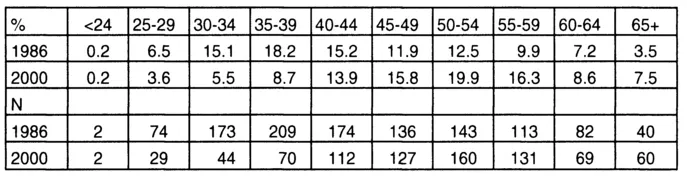
The drop in hiring, and especially the drop in hiring of new professionals, is certainly an important part of a related phenomenon, the advancing age of cataloging staff. As a group, librarians are older than comparable professionals,3 but catalogers are old relative to other librarians. For example, 16% of ARL catalogers were aged 60 and over in 2000, compared with 10% of the overall ARL population. Most if not all of that 16% can be expected to retire by 2005. Viewed from another perspective, 32% of catalogers are aged 55 and over, almost twice as many as in the comparable reference population. It is thus possible that fully one-third of the 2000 ARL cataloging population will retire by 2010.
Catalogers were old in the 2000 data, but it is the aging or that population that poses the most substantial problem. As Figure 1 illustrates, just over 40% of catalogers were under age 40 in 1986, which made them somewhat younger than the larger ARL population of the time. This is as one would expect, considering the prominent role cataloging served as a point of entry for young librarians noted above. In only 14 years, cataloging has gone from being one of ARL's youngest subgroups to one of its oldest.
Taken as a whole, the situation is something of a vicious circle: it starts with a sharp drop in hiring of technical services/cataloging staff, especially new professionals. With the supply of recruits reduced, the number of catalogers drops, and the group that remains begins to age quickly, approaching retirement at a higher rate. It could be that reduced hiring for technical services/cataloging staff serves as a disincentive to library schools' students who might otherwise choose careers in these areas. This might account for some of the difficulty libraries have had in recruiting staff for these positions.
Conclusion
Professional technical services/cataloging jobs are by their nature apprenticeships, requiring long years of experience to obtain full proficiency. As these data show, however, ARL libraries are voting with their feet: they clearly do not need as many of these staff as they once did. Nonetheless, it doesn't seem likely that the need for advanced bibliographic expertise will go away altogether. In a period when large numbers of the most experienced technical services/cataloging staff reach retirement age, it remains to be seen whether libraries will be able to secure enough of this expertise to satisfy their lower level of need.
![]()
A New Look at US Graduate Courses in Bibliographic Control
Daniel N. Joudrey
SUMMARY. The current state of graduate bibliographic control education in the United States is examined through reviewing the literature, analyzing Web sites for 48 LIS programs, and corresponding with and interviewing bibliographic control educators. In reviewing the recent bibliographic control education literature, six primary themes were identified: background/contextual information, theory versus practice, responsibilities and skills needed by catalogers, relations between educators and practitioners, the universality of cataloging, and curricular issues. Each of these areas is examined in depth. The study conducted examined the number and types of bibliographic control education available in LIS programs in the US. It also collected information on which textbooks were being used in each course. It appears from the study that some courses are increasing in number. The primary areas of bibliographic control education examined include organizing infor...