- 246 pages
- English
- ePUB (mobile friendly)
- Available on iOS & Android
eBook - ePub
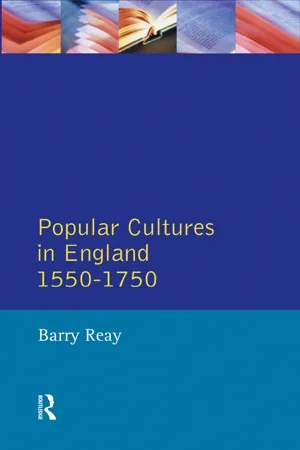
Popular Cultures in England 1550-1750
About this book
Explores the important aspects of popular cultures during the period 1550 to 1750. Barry Reay investigates the dominant beliefs and attitudes across all levels of society as well as looking at different age, gender and religious groups.
CHAPTER ONE
Sexualities
I
The Somerset quarter sessions rolls for 1657 contain a series of complaints against a woman called Mary Coomb, the wife of an innkeeper from a small village near Axbridge in central Somerset. A wheelwright, John Barber, alleged all-night drinking sessions which disturbed people in the community, and also some rather outrageous sexual behaviour. Barber deposed that Coomb had lain on the Axbridge road, calling out to passers-by ‘wishing all good fellows to come & occupie wth her’, ‘spreading of her leggs abroad, saying come play wth my Cunt and make my husband a cuckwalld’. She put her hand down the codpiece of Barber’s apprentice. She told Barber that his wife was ‘fucking with William Fry, wch [Barber complained] caused a debate for a long time betweene me & my wife and likewise he and his wife’. On one occasion, when Barber went to her house, ‘shee shut ye door and would force me to be naught with her spreading of her legs & shewing her comoditie saying come rouge look thee here wt thou shalt play withall’. She said ‘come & thrust thy pricke in my Cunt and there shalbe an end to all bussiness’.1
Here was a woman who was promiscuous in both speech and sexuality. As we shall see, there was an early modern correspondence between the mouth and genitals: a woman with a loose mouth was a woman with a loose vagina. Indeed, there was a belief that the umbilical cord linked the tongue and the sexual organs. Hence it was to be cut long in men to provide them with long tongues and penises, and cut short in women to give them short tongues and tight vaginas.2
Of course there are several readings of this text, and it is important to realise that we are hearing only one mediated voice. One response might be that the woman was mad, but it is significant that this was not alleged in the deposition. Barber does complain that Coomb’s behaviour was animal-like, ‘tumbling herselfe in the highway more liker to a swine than a christian’. He does not impute madness.
When we are confronted with a cultural extract such as this, our immediate reaction is to seek the familiar: we recognise the ‘cunt’ and the ‘fucking’. Yet it is the differences which are more important to the cultural historian: the significance of the mouth/vagina correspondence, for example, or the use of the words ‘cuckold’ and that freighted term ‘commodity’. The meanings of sex are inconstant. The history of sex acts, as Lawrence Stone once observed, ‘is a somewhat boring topic’ given the human body’s rather limited repertoire.3 What are far more interesting are the taboos and the attempts to control such sexual activities, the meanings attached to sex acts. Sexuality is a social, cultural, and temporal construct. Concepts of pornography – to take just one example – have changed over time. Pornography, as we know it, certainly existed in the early modern world, but was presented primarily as a subtext of biological reproduction, or was there to make a religious or political point. Pornography as an end in itself is a recent construct.4
Thus we have to be prepared to encounter sexual worlds different from our own.5 It is a simple point to make, if often missed by those who ransack the past to locate the familiar or to chart some logical progression towards the present. Indeed, our very categorisation, our privileging of sex, is a current preoccupation, a product of our culture. Sex is central to our identity and self-definition. It is, in the words of Jeffrey Weeks, ‘a unified domain’, a ‘thing in itself’ (like politics or religion), ‘a continent of knowledge with its own rules of exploration and its own expert geographers’.6 We must not assume – in fact it is extremely unlikely – that this was so in the past.
The historian must also look for dissonance, for cultural jarring. Anyone who has studied the early modern conduct books or household manuals, in which ministers of the church dispensed advice on marriage and the family, is certain to be taken with the aggressiveness of Mary Coomb’s behaviour. The advice literature of the time assumed female modesty, chastity, and obedience, teaching that ‘the ornament of a woman consisted in chaste and honest conditions’ and that men were ‘stronger and more able to beare and support the infirmities and weaknesses of their wives’.7 But Coomb is aggressive in her sexuality; she is active, not passive. Her husband, John, is a shadowy figure in the depositions. He is there at the beginning of the document to establish the legal identity of Mary, but thereafter appears only as the putative cuckold – indeed holds her clothes for her as she lies in the highway. The case of Mary Coomb provides an entry into the subject matter of this chapter: the contours of sexual worlds recognisable yet different from our own.
II
The sociologist Anthony Giddens has characterised the sexuality of modern western societies, relatively free from the bonds of reproduction, as ‘decentred’ or ‘plastic sexuality’.8 If modern sexuality is indeed ‘plastic’, early modern sexuality could be described as married or procreative sexuality, for the matrices of marriage and reproduction dominated the meanings, languages, and practices of early modern sex.9 Premarital sex occurred, and was even tolerated – but within boundaries. The dominant framework was intention to marry.
People married at widely varying ages. Most married in their twenties, but from 20 to 25 per cent of women and 25 to 30 per cent of men were aged 30 or over when they first married. Although many London-born women, of all classes, married while still in their teens, national reconstitutions show that only 3 or 4 per cent of men and 11 to 13 per cent of women were married under the age of 20; indeed, more couples were marrying in their late thirties and forties.10 This meant that for large numbers of women and men there were years of sexual maturity, and presumably sexual desire, before marriage. And not all did marry: demographers have calculated that in the seventeenth century some 25 per cent of men and women in their early forties had never married.11
Illegitimacy ratios (the number of illegitimate births per 100 registered births) were low: from about 1.0 to 4.4 over the whole period 1550–1750, with peaks from 1590 to 1610 and after 1750, and low rates in the second half of the seventeenth century. The period from 1570 to 1640 had rates of from 2.9 to 4.3, but these were ‘composites’ of lower levels in the south and east and higher rates in the north and west. Individual parishes and periods had higher (and lower) ratios. Colyton, for example, reached 9.5 in the 1720s; in Terling the illegitimacy ratio was only 0.8 during the period 1650–99.12 But this measurement is a misleading gauge of a community’s experience of the phenomenon of illegitimacy. If estimated as a percentage of first births rather than all births (a more realistic measurement), the figures would be higher. At an extreme, with illegitimacy ratios of from 10 to 12 per cent, it has been suggested that up to a half of first births in mid-eighteenth-century London were illegitimate.13 A family reconstitution study of a nineteenth-century rural parish in Kent found that although the illegitimacy ratio was only 5.0, over a third of the households in that community contained family members who had direct experience of illegitimacy.14 We may need to make such upward mental adjustments when considering the local impact of childbirth outside of marriage. Nonetheless, it is significant that the ages of those women bearing illegitimate children were about the same as those marrying, suggesting that childbirth outside wedlock reflected interrupted intended marriage rather than blatant disregard for the institution.15
Although historians have spent much time measuring the phenomenon, illegitimacy is something of a blunt classification which most probably obscures complex social scenarios and human relationships. Bastardy, as David Levine and Keith Wrightson have observed, was a ‘compound phenomenon’.16 Attitudes must have varied according to the type of illegitimacy. The woman who bore a single illegitimate child to an unmarried man, and the woman who was in a long-term relationship (even if she had several children), were no doubt treated differently to those who fell pregnant to married men or who had a variety of liaisons. Peter Laslett has argued for the existence of ‘bastard-bearing sub-cultures’, ‘a series of bastard-producing women, living in the same locality, whose activities persisted over several generations, and who tended to be related by kinship or marriage’.17 Yet detailed local studies suggest that the neat demarcation between legitimate and illegitimate implied by Laslett’s influential typology has little value in understanding the context or meaning of illegitimacy. ‘Bastard bearers’ included a few families which could perhaps be described as ‘deviant’, but for the most part illegitimacy should be seen as part of the normal sexual culture of the hamlets of the past.18 Anthea Newman’s charting of the linkages between families who produced illegitimate children in eighteenth- and early-nineteenth-century Ash-next-Sandwich has demonstrated the way in which illegitimates and unmarried mothers were scattered amongst conventional unions and legitimate progeny. Many of the mothers of illegitimates eventually married in church, and we would not have our figures and tables if ‘bastards’ had not been baptised in the first place.19 This is not to argue for a widespread tolerance of illegitimacy, nor to claim that attitudes to unmarried mothers and children born out of wedlock were as benign as those towards pregnant brides. But (as was hinted earlier) many families in a village or hamlet must have had kin who had directly experienced unmarried motherhood. Illegitimacy was a risk that virtually all women confronted.
Another quantitative marker of sexuality explored by demographers is the rate of bridal (or prenuptial) pregnancy. Roughly 20 to 25 per cent of brides were pregnant when they entered the church in the early modern period, but in some parishes the figure was as high as 30 or even 50 per cent.20 Clearly these figures represent the mere tip of a hidden number of actual acts of sexual intercourse, not to mention heterosexual activity which stopped short of coitus.21 The statistics hint at two types of prenuptial intercourse: that where sexual activity resulting in pregnancy led to marriage (marriage which was ‘courtship-led’) and that where anticipation of marriage led to sexual activity and pregnancy (courtship which was ‘marriage-led’). From just under 50 per cent to nearly 70 per cent of pregn...
Table of contents
- Cover
- Half Title
- Title Page
- Copyright Page
- Dedication
- Table of Contents
- Acknowledgements
- Introduction
- 1. Sexualities
- 2. Orality, Literacy, and Print
- 3. Religions
- 4. Witchcraft
- 5. Festive Drama and Ritual
- 6. Riots and the Law
- 7. Popular Cultures
- Select Bibliography
- Index
Trusted by 375,005 students
Access to over 1.5 million titles for a fair monthly price.
Study more efficiently using our study tools.
Frequently asked questions
Yes, you can cancel anytime from the Subscription tab in your account settings on the Perlego website. Your subscription will stay active until the end of your current billing period. Learn how to cancel your subscription
No, books cannot be downloaded as external files, such as PDFs, for use outside of Perlego. However, you can download books within the Perlego app for offline reading on mobile or tablet. Learn how to download books offline
Perlego offers two plans: Essential and Complete
- Essential is ideal for learners and professionals who enjoy exploring a wide range of subjects. Access the Essential Library with 800,000+ trusted titles and best-sellers across business, personal growth, and the humanities. Includes unlimited reading time and Standard Read Aloud voice.
- Complete: Perfect for advanced learners and researchers needing full, unrestricted access. Unlock 1.5M+ books across hundreds of subjects, including academic and specialized titles. The Complete Plan also includes advanced features like Premium Read Aloud and Research Assistant.
We are an online textbook subscription service, where you can get access to an entire online library for less than the price of a single book per month. With over 1.5 million books across 990+ topics, we’ve got you covered! Learn about our mission
Look out for the read-aloud symbol on your next book to see if you can listen to it. The read-aloud tool reads text aloud for you, highlighting the text as it is being read. You can pause it, speed it up and slow it down. Learn more about Read Aloud
Yes! You can use the Perlego app on both iOS and Android devices to read anytime, anywhere — even offline. Perfect for commutes or when you’re on the go.
Please note we cannot support devices running on iOS 13 and Android 7 or earlier. Learn more about using the app
Please note we cannot support devices running on iOS 13 and Android 7 or earlier. Learn more about using the app
Yes, you can access Popular Cultures in England 1550-1750 by Barry Reay in PDF and/or ePUB format, as well as other popular books in History & British History. We have over 1.5 million books available in our catalogue for you to explore.