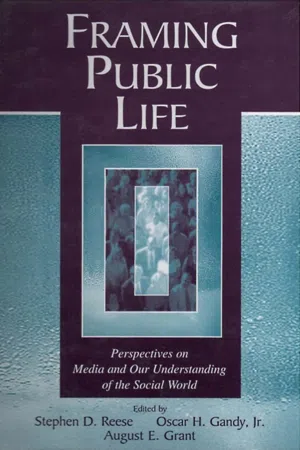
This distinctive volume offers a thorough examination of the ways in which meaning comes to be shaped. Editors Stephen Reese, Oscar Gandy, and August Grant employ an interdisciplinary approach to the study of conceptualizing and examining media. They illustrate how texts and those who provide them powerfully shape, or "frame," our social worlds and thus affect our public life. Embracing qualitative and quantitative, visual and verbal, and psychological and sociological perspectives, this book helps media consumers develop a multi-faceted understanding of media power, especially in the realm of news and public affairs.
eBook - ePub
Framing Public Life
Perspectives on Media and Our Understanding of the Social World
- 416 pages
- English
- ePUB (mobile friendly)
- Available on iOS & Android
eBook - ePub
Framing Public Life
Perspectives on Media and Our Understanding of the Social World
About this book
Information
PART I
THEORETICAL AND MEASUREMENT APPROACHES
CHAPTER 1
Framing as a Strategic Action in Public Deliberation
Zhongdang Pan
Gerald M.Kosicki
We are in the age of “talk.” With the proliferation of interactive electronic media including radio and television talk shows, Internet chat rooms, news groups and other new media forms, talk as a mode of communication, rooted in dialogue or conversation, is changing not only the political process but also how we communicate in society. These changes are visibly blurring the traditional boundaries between communicators and audiences, news and entertainment, information and opinion, journalists and talking heads, political and nonpolitical issues, interpersonal and mass communication, as well as political communication, mobilization, and participation (e.g., Gamson, 1992; Jamieson, Cappella, & Turow, 1998; Livingstone & Lunt, 1994; Munson, 1993; Owen, 1995; Verba, 1993).
With the increasing high volume and widespread nature of such “talk,” there emerges “an imaginary and discursive space where issues ‘sizzle’ and political ‘bashing’ can happen” (Munson, 1993, See Page). Such talk is said to provide a necessary venue for the public, under specific conditions, to overcome or correct the unrepresentative opinions of their “surrogate deliberators,” that is, political elites (Page & Tannenbaum, 1996). In essence, the normative idea of “deliberative democracy” (see Bohman, 1996; Bohman & Rehg, 1997; Calhoun, 1992; Elster, 1998) is slowly becoming a genuine empirical phenomenon with which to reckon (see Gamson, 1992; Katz, 1995; Kim, Wyatt, & Katz, 1999; Page, 1996; Verba, 1993).
Such talk also has structural underpinnings. The public arena that serves as the infrastructure for public deliberation is structurally arranged (Dahlgren, 1991; Hillgartner & Bosk, 1988). In addition, such structuring is also enforced discursively through political actors manipulating symbols to “spin” issues or events. In other words, political actors skew the flow of information and opinions in public deliberation toward their advantage by using discursive means (see Maltese, 1994; Zaller, 1992). News media, operating in terms of their professional ideology and established work ways (Price & Tewksbury, 1997), more often than not are found to be collaborating with the ruling elite in weaving this discursive order (e.g., Bennett, 1990; Gitlin, 1980; Page & Tannenbaum, 1996; Zaller & Chiu, 1996). Public deliberation, therefore, is not a harmonious process but an ideological contest and political struggle. Actors in the public arena struggle over the right to define and shape issues, as well as the discourse surrounding these issues. Sometimes, actors struggle mightily to keep important issues off the public agenda (Cobb & Ross, 1997).
Gamson (1996) described framing as a discursive process of strategic actors utilizing symbolic resources to participate in collective sense-making about public policy issues. Thus, we have argued that framing is an essential part of public deliberation (Pan & Kosicki, 1997). With this re-situation of the key problems of framing analysis, we advanced a perspective that helps connect various conceptions of framing (e.g., Cappella & Jamieson, 1997; Entman, 1993; Gamson, 1981; Ghanem, 1997; Iyengar, 1991; Price & Tewksbury, 1997). We argued that framing analysis connects the normative propositions of “deliberative democracy” and the empirical questions of collective decision making (see Baumgartner & Jones, 1993; Kingdon, 1984) and helps understand the operation of American democracy (Cobb & Elder, 1983). In this chapter, we extend this earlier conceptualization and discuss framing as “strategic actions” in public deliberation. We then explicate two key concepts that can be applied to analyze such strategic actions, “discursive communities,” and “web of subsidies,” and show their application with one illustrative case.1
TO PARTICIPATE IS TO FRAME
Although its exact nature and practical feasibility remain to be debated, public deliberation is generally understood as a process of collective and open reasoning, and discussion about the merits of public policy (Bohman & Rehg, 1997; Elster, 1998; Page, 1996). Two propositions make the idea fundamental for political communication research. One is that, as a normative ideal, public deliberation is the essence of democracy. Deliberation has a long intellectual as well as political tradition from which American democracy developed (Bohman 1996; Habermas, 1989; Page, 1996; Page & Shapiro, 1992).2 Second, political communication increasingly is being democratized. Opportunities for public participation in producing political discourse have proliferated not only in the media but also in deliberating institutions such as Congress (Cook, 1989; Frantzich & Sullivan, 1996; Livingstone & Lunt, 1994; Munson, 1993; Page & Tannenbaum, 1996; Verba, 1993).
Such participation is potentially transforming the public’s role from that of mere spectators of political sports (Edelman, 1988) or targets of elite manipulation (Zaller, 1992) into that of actors or citizens in the American political process. Meaningful participation opens up public deliberation and makes it more inclusive. Members of the public develop their own interpretations of media messages but also incorporate these meanings into their store of everyday common-sense knowledge (Neuman, Just, & Crigler, 1992). They talk about public policy issues by making use of the symbolic resources available to them, originating with media discourse, personal experiences, and popular wisdom (Gamson, 1992). Such discussion in the public arena constitutes not only the “public mood” or “public sentiment” that is closely monitored by public officials and media, but also the texture of policy discourse (Gamson & Modigliani, 1989; Page, 1996; Stimson, 1991; Verba, 1993).
Therefore, we argue that participating in public deliberation inevitably involves the discursive practices of framing an issue, which is not the exclusive province of political elites or media. However, this observation takes us only so far toward our goal of conducting framing analysis. At this point, we must consider two questions that lie at the heart of the framing process. First, how do people develop the terms, that is, the frames and signification devices of the frames that they use in the deliberation process? Second, how are different perspectives or points of view, that is frames, contested or struggled over in the public arena?
FRAMING IN PUBLIC DELIBERATION
In his widely cited book, Goffman (1974) defines frames as “schemata of interpretation” that enable individuals “to locate, perceive, identify, and label” occurrences or life experiences (See Page).3 He proceeds to show how our common sense knowledge performs its constructive role in our everyday life and how such schemata of interpretation are “acted out.” Following this tradition, framing analysis is concerned with how various social actors act and interact “to yield organized ways of understanding the world” (Reese, see prologue, this volume). Such understandings are developed via symbolic means, including language, which in Berger and Luckmann’s (1967) terms is capable of both objectifying and typifying our experiences. Frames are the “central organizing ideas” to achieve such understanding and to organize political reality (Gamson & Modigliani, 1989, See Page).4
Framing as a process has its cognitive underpinnings, which many scholars have made attempts to articulate. For example, Price and Tewksbury (1997) argued that the three major media effects hypotheses, agenda-setting, priming, and framing all address the issue of “knowledge activation and use” (p. 184). Thus they attempt to account for such effects by applying the associative network model of memory structure and related concepts, such as accessibility and spread of activation. According to them, framing effects result from the salient attributes of a media message changing the applicability of particular thoughts, resulting in their activation and use in evaluations. Their work represents a formal statement of the cognitive view of the framing effect and how it takes place (see also Higgins, 1996; Kahneman & Tversky, 1984).5 Incorporating both cognitive processes and discourse analysis of news text, Rhee (1997) showed that audiences frequently use the thoughts associated with the frame made salient in media coverage to talk about an election campaign (see also Kintsch, 1988; Pan & Kosicki, 1993; van Dijk, 1988). In sum, framing effects result from schema activation or modification and can be found in how information is processed and made sense of, how people talk about an issue, and how they form political evaluations.
Demonstrating the nature and process of framing effects is an important area of research (Cappella & Jamieson, 1997; Iyengar, 1991; Kinder & Sanders, 1990; Scheufele, 1999). However, the effects paradigm is limited for framing analysis. First, as Gamson (1992, 1996) demonstrated, people construct their understanding of issues (see also Crigler, 1996; Neuman et al., 1992). They do so by tapping into the symbolic resources that are available to them in their everyday lives, as conveyed through their experiential knowledge, popular wisdom, and media discourse. They combine such symbolic resources differently across varying situations. In other words, individuals strategically maneuver to “tame the information tide” (Graber, 1988) and to communicate with others. For example, lorio and Huxman (1996) showed that voters from Wichita, Kansas, employed linking, collapsing, and colorizing strategies in making use of various resources to talk about their concerns. The question raised by this line of reasoning, to paraphrase Katz (1959), is not what media discourse does to people but what people do with media discourse?
Second, talking about public issues is not limited to people’s leisure time. Very often, such talk takes place in public arenas for specific political objectives (Page, 1996; Verba, 1993). Such talk is, using Katz’s (1995, p. xxi) characterization, “the elementary building block” of political participation. A frame is an idea through which political debate unfolds, and political alignment and collective actions take place (see Snow & Benford, 1988; Snow, Rochford, Worden, & Benford, 1986; Zald, 1996). In public deliberations, the rise and fall in the prevalence of a frame, and consequently, a particular policy option, clearly involve debates among people who sponsor or align with different frames (Gamson & Modigliani, 1989; Snow & Benford, 1988). Which frame to sponsor, how to sponsor it, and how to expand its appeal are strategic issues to participants (Ryan, 1991). The infamous political campaign against Robert Bork’s nomination to the U.S. Supreme Court is an example (Pertschuk & Schaetzel, 1989). These should also be issues to address in framing analysis.
In sum, framing an issue is to participate in public deliberation strategically, both for one’s own sense making and for contesting the frames of others. Thus, limiting ourselves to the effects paradigm prevents us from analyzing the strategic contests in framing processes.
We need to say a little more about the linkage between framing and frame contestation. In “public deliberation,” a frame also functions as a key idea to animate and sustain individual participation in collective actions, a necessary part of the policy making process (Snow & Benford, 1992; Zald, 1996). It also offers an organizing schema for policy making or implementing an agency’s organizational mission (Moore, 1993).
Adopting a certain frame is manifested in paradigmatic choices from the existing cultural repertoire of symbolic resources (Gamson & Modigliani, 1987, 1989; Hartley, 1988; Pan & Kosicki, 1993). Such choices often are imparted by and resonate with some broader ideological perspective (Snow & Benford, 1988, 1992). Therefore, framing is an ideological contest over not only the scope of an issue, but also over matters such as who is responsible and who is affected, which ideological principles or enduring values are relevant, and where the issue should be addressed (Cobb & Elder, 1983; Hilgartner & Bosk, 1988).
In such a contest, participants maneuver strategically to achieve their political and communicative objectives. Each actor needs to take strategic steps to “get messages across” and win arguments. A step toward framing is strategic if it makes one’s message meet the epistemic standards of “good arguments” and achieve “cultural resonance” (Gamson & Modigliani, 1987; Snow & Benford, 1988). Such a step is also strategic if it leads to a desirable configuration of social and political forces. Frames may be differentiated in terms of the strengths of their political and cultural appeals (Snow & Benford, 1988, 1992). Similarly, framing actions differ in their potential for achieving the desired political and discursive goals. Framing an issue is therefore a strategic means to attract more supporters, to mobilize collective actions, to expand actors’ realm of influences, and to increase their chances of winning (Snow & Benford, 1988, 1992; Zald, 1996).
Framing is also part of constructing “political spectacle” (Edelman, 1988). First, framing involves elite manipulations and performances (Kinder & Herzog, 1993), although not necessarily to the exclusion of citizen participation. The venues of the public sphere can then be viewed as “stages” for performances by elites. Although such stages may have privileged access by elites, they may also be constructed and used by grassroots and/or dissenting groups (Benford & Hunt, 1992; Page, 1996; Ryan, 1991). Second, framing involves interpreting political activities and statements to construct the factuality of the political world. Their degrees of empirical credibility vary in their degrees of conformity to the prescribed conventions shared by the participants and their roles in the political world (Blumler & Gurevitch, 1980; Edelman, 1988, pp. 94–97). Consequently, framing involves political drama and theater (Benford & Hunt, 1992; Cobb & Elder, 1983; Esherick & Wasserstrom, 1990; Gamson, 1988; Gitlin, 1980; Ryan, 1991). It also involves personalities, characters, scripts, conflicts, dramas, emotions, symbols, and expressive activities consisting of both “real” and “pseudo-events” (Boorstin, 1971/1992).
The Persian Gulf conflict in 1990 and 1991 was a good case in point. Elite debate and the antiwar protests at the margin were conducted on a stage designed for and by the media, especially television. Remarkably, diplomatic exchanges between the hostile parties were carried through the same venue (see Kellner, 1992). Historical icons of Hitler and Vietnam were invoked. Metaphorical depictions such as American flags, yellow ribbons, “line in the sand,” and “surgical strike” became condensed expressions of a patriotic hype, justice, and determination. With these symbolic devices, the public discourse depicted a drama of confrontation between a determined leader of the “free world” and a villain from the authoritarian underworld, the spectacle of the U.S. high-tech weaponry crushing ruthless but powerless Iraqi “Republican Guards,” and a timid antiwar protest.6 Public deliberation thus includes political performances in all the venues of the “public arena.” Many examples of recent large-scale, well-developed public policy controversies—such as the “gays in the military” issue, the Lani Guinier nomination, health care reform, the various “-gates” involving Bill Clinton, and the bitter impeachment battle—all illustrate such attribute of the framing process.
FRAMING BOUNDARIES AND BUILDING DISCURSIVE COMMUNITIES
Frames provide labels to typify social conditions and policy concerns (Best, 1995) and thus allow us to choose from a “repertoire of interpretations” (Mooney & Hunt, 1996). But which sector of this repertoire of interpretation would we tap into? How is the choice of political vocabulary related...
Table of contents
- Cover
- Half Title
- Title
- Copyright
- Contents
- Foreword
- Preface
- Introduction
- Prologue—Framing Public Life: A Bridging Model for Media Research
- PART I THEORETICAL AND MEASUREMENT APPROACHES
- PART II: CASES—OBSERVATIONS FROM THE FIELD
- PART III THE NEW MEDIA LANDSCAPE
- Epilogue—Framing at the Horizon: A Retrospective Assessment
- Contributors
Trusted by 375,005 students
Access to over 1.5 million titles for a fair monthly price.
Study more efficiently using our study tools.
Frequently asked questions
Yes, you can cancel anytime from the Subscription tab in your account settings on the Perlego website. Your subscription will stay active until the end of your current billing period. Learn how to cancel your subscription
No, books cannot be downloaded as external files, such as PDFs, for use outside of Perlego. However, you can download books within the Perlego app for offline reading on mobile or tablet. Learn how to download books offline
Perlego offers two plans: Essential and Complete
- Essential is ideal for learners and professionals who enjoy exploring a wide range of subjects. Access the Essential Library with 800,000+ trusted titles and best-sellers across business, personal growth, and the humanities. Includes unlimited reading time and Standard Read Aloud voice.
- Complete: Perfect for advanced learners and researchers needing full, unrestricted access. Unlock 1.5M+ books across hundreds of subjects, including academic and specialized titles. The Complete Plan also includes advanced features like Premium Read Aloud and Research Assistant.
We are an online textbook subscription service, where you can get access to an entire online library for less than the price of a single book per month. With over 1.5 million books across 990+ topics, we’ve got you covered! Learn about our mission
Look out for the read-aloud symbol on your next book to see if you can listen to it. The read-aloud tool reads text aloud for you, highlighting the text as it is being read. You can pause it, speed it up and slow it down. Learn more about Read Aloud
Yes! You can use the Perlego app on both iOS and Android devices to read anytime, anywhere — even offline. Perfect for commutes or when you’re on the go.
Please note we cannot support devices running on iOS 13 and Android 7 or earlier. Learn more about using the app
Please note we cannot support devices running on iOS 13 and Android 7 or earlier. Learn more about using the app
Yes, you can access Framing Public Life by Stephen D. Reese, Oscar H. Gandy, Jr., August E. Grant, Stephen D. Reese,Oscar H. Gandy, Jr.,August E. Grant in PDF and/or ePUB format, as well as other popular books in Social Sciences & Communication Studies. We have over 1.5 million books available in our catalogue for you to explore.