Rock Music in American Popular Culture III
eBook - ePub

Rock Music in American Popular Culture III

More Rock 'n' Roll Resources

  1. 352 pages
  2. English
  3. ePUB (mobile friendly)
  4. Available on iOS & Android
eBook - ePub

Rock Music in American Popular Culture III

More Rock 'n' Roll Resources

About this book

Rock Music in American Popular Culture III: More Rock 'n'Roll Resources explores the fascinating world of rock music and examines how this medium functions as an expression of cultural and social identity. This nostalgic guide explores the meanings and messages behind some of the most popular rock 'n'roll songs that captured the American spirit, mirrored society, and reflected events in our history. Arranged by themes, Rock Music in American Popular Culture III examines a variety of social and cultural topics with related songs, such as:

  • sex and censorship--"Only the Good Die Young" by Billy Joel and "Night Moves" by Bob Seger and The Silver Bullet Band
  • holiday songs--"Rockin'Around the Christmas Tree" by Brenda Lee and "The Christmas Song" by Nat King Cole
  • death--"Leader of the Pack" by The Shangri-Las and "The Unknown Soldier" by The Doors
  • foolish behavior--"When a Man Loves a Woman" by Percy Sledge and "What Kind of Fool" by Barbra Streisand and Barry Gibb
  • jobs and the workplace--"Don't Stand So Close to Me" by The Police and "Dirty Laundry" by Don Henley
  • military involvements--"Boogie Woogie Bugle Boy" by the Andrews Sisters and "War" by Edwin Starr
  • novelty recordings--"The Purple People Eater" by Sheb Wooley and "Eat It" by Weird Al Yankovic
  • letters and postal images--"P. S. I Love You" by The Beatles and "Return to Sender" by Elvis PreselyIn addition, a discography and a bibliography after each section give further examples of the themes and resources being discussed, as do extensive lists of print references at the end of the text.

Frequently asked questions

Yes, you can cancel anytime from the Subscription tab in your account settings on the Perlego website. Your subscription will stay active until the end of your current billing period. Learn how to cancel your subscription.
No, books cannot be downloaded as external files, such as PDFs, for use outside of Perlego. However, you can download books within the Perlego app for offline reading on mobile or tablet. Learn more here.
Perlego offers two plans: Essential and Complete
  • Essential is ideal for learners and professionals who enjoy exploring a wide range of subjects. Access the Essential Library with 800,000+ trusted titles and best-sellers across business, personal growth, and the humanities. Includes unlimited reading time and Standard Read Aloud voice.
  • Complete: Perfect for advanced learners and researchers needing full, unrestricted access. Unlock 1.4M+ books across hundreds of subjects, including academic and specialized titles. The Complete Plan also includes advanced features like Premium Read Aloud and Research Assistant.
Both plans are available with monthly, semester, or annual billing cycles.
We are an online textbook subscription service, where you can get access to an entire online library for less than the price of a single book per month. With over 1 million books across 1000+ topics, we’ve got you covered! Learn more here.
Look out for the read-aloud symbol on your next book to see if you can listen to it. The read-aloud tool reads text aloud for you, highlighting the text as it is being read. You can pause it, speed it up and slow it down. Learn more here.
Yes! You can use the Perlego app on both iOS or Android devices to read anytime, anywhere — even offline. Perfect for commutes or when you’re on the go.
Please note we cannot support devices running on iOS 13 and Android 7 or earlier. Learn more about using the app.
Yes, you can access Rock Music in American Popular Culture III by Frank Hoffmann,B Lee Cooper,Wayne S Haney in PDF and/or ePUB format, as well as other popular books in Mezzi di comunicazione e arti performative & Musica. We have over one million books available in our catalogue for you to explore.

Chapter 1

Child Performers

Brenda Lee, a Georgia-bom country artist who began her professional singing career at age six, charted two Top 100 national hits before her thirteenth birthday. Her most noted holiday-related song—“Rockin’ Around the Christmas Tree”—was recorded for Decca records prior to her fourteenth birthday. Before Brenda Lee’s success, another thirteen-year-old youngster scored a No. 1 hit record with the Christmas novelty tune “I Saw Mommy Kissing Santa Claus.” Little Jimmy Boyd followed this hit-making 1952 debut with three Billboard-charted songs during the next six months: “Tell Me a Story,” “The Little Boy and the Old Man” (both duets with Frankie Laine), and “Dennis the Menace” (a duet with Rosemary Clooney). But even younger children have produced popular hit recordings. Seven-year-old Barry Gordon sang the 1955 holiday humor song “Nuttin’ for Christmas” and Jo Ann Morse, a youngster of the same age in 1962, produced a Kennedy-ribbing recording titled “My Daddy Is President.” Appearing with his father on the 1974 RCA recording “Daddy What If,” five-year-old Bobby Bare Jr. is undeniably one of the youngest hit makers ever. Finally, numerous recordings such as Pink Floyd’s “Another Brick in the Wall (Part II),” Buzz Clifford’s “Baby Sittin’ Boogie,” and Tom Glazer’s “On Top of Spaghetti” have featured children’s choruses of wide-ranging ages.
The previous paragraph illustrates the roles of several young people as popular music performers. What is even more fascinating, though, is the variety of songs addressing children’s interests, images, perspectives, and youthful culture that have achieved Billboard Top 100 ranking since 1945. It is almost as though America’s postwar baby boom helped launch a new genre of kiddie-oriented records that have become long-term cultural staples. If the early rock era (1954–1964) marked the emergence of teenage control of the radio airwaves, the decade before and the years since have featured many paeans to those carefree preteens.
What kind of music has attracted youthful attention? What type of recordings will parents gladly purchase for their youngsters? After a rigorous review of the 1945 to 1985 Billboard Top 100 charts, the answers are obvious. Over the past four decades parents and children have been especially attracted to popular recordings featuring: (a) familiar animated characters (Alley Oop, Cinderella, Sylvester the Cat and Tweety Bird, Snoopy, and Woody Woodpecker); (b) theme songs from Broadway shows, motion pictures, radio programs, and television series; (c) tunes with titles or lyrical content referring to toys, games, childhood chants, or slang terms; (d) references to major holidays, mythic characters, and comic situations (“Rudolph the Red-Nosed Reindeer,” “The Purple People Eater,” “The Little Drummer Boy,” and “Peter Cottontail”); (e) depictions of family life (“Color Him Father,” “1432 Franklin Pike Circle Hero,” “Giddyup Go,” “Hello Mudduh, Hello Fadduh (A Letter from Camp),” and “The Naughty Lady of Shady Lane”); (f) images from nursery rhymes, fairy tales, and other children’s literature (“The Children’s Marching Song,” “Pop Goes the Weasel,” “White Rabbit,” and “Little Red Riding Hood”); plus (g) a variety of general topics relating to education, food, and religion.
The following discography presents more than 120 Billboard-charted 45 rpm or 78 rpm records featuring children’s ...
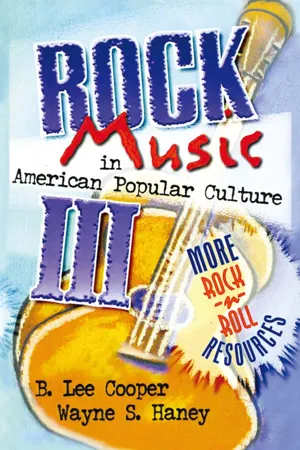
Table of contents

  1. Cover
  2. Half Title
  3. Title Page
  4. Copyright Page
  5. Dedication
  6. About the Authors
  7. Table of Contents
  8. Preface
  9. Acknowledgments
  10. Introduction
  11. Chapter 1. Child Performers
  12. Chapter 2. Christmas Songs
  13. Chapter 3. Death
  14. Chapter 4. Foolish Behavior
  15. Chapter 5. Honoring Excellence
  16. Chapter 6. Jobs and Workplaces
  17. Chapter 7. Novelty Recordings
  18. Chapter 8. Patriotism
  19. Chapter 9. Popular Music
  20. Chapter 10. Postal Images
  21. Chapter 11. Public Schools
  22. Chapter 12. Rock Songs
  23. Chapter 13. Scholarship
  24. Chapter 14. Social Commentary
  25. Chapter 15. Song Revivals
  26. Chapter 16. Tobacco
  27. Chapter 17. Western Images
  28. Bibliography
  29. Index