eBook - ePub
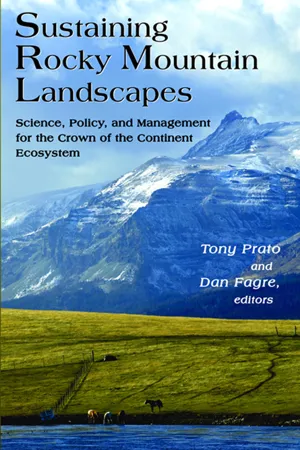
Sustaining Rocky Mountain Landscapes
Science, Policy, and Management for the Crown of the Continent Ecosystem
- 352 pages
- English
- ePUB (mobile friendly)
- Available on iOS & Android
eBook - ePub
Sustaining Rocky Mountain Landscapes
Science, Policy, and Management for the Crown of the Continent Ecosystem
About this book
Prato and Fagre offer the first systematic, multi-disciplinary assessment of the challenges involved in managing the Crown of the Continent Ecosystem (CCE), an area of the Rocky Mountains that includes northwestern Montana, southwestern Alberta, and southeastern British Columbia. The spectacular landscapes, extensive recreational options, and broad employment opportunities of the CCE have made it one of the fastest growing regions in the United States and Canada, and have lead to a shift in its economic base from extractive resources to service-oriented recreation and tourism industries. In the process, however, the amenities and attributes that draw people to this 'New West' are under threat. Pastoral scenes are disappearing as agricultural lands and other open spaces are converted to residential uses, biodiversity is endangered by the fragmentation of fish and wildlife habitats, and many areas are experiencing a decline in air and water quality. Sustaining Rocky Mountain Landscapes provides a scientific basis for communities to develop policies for managing the growth and economic transformation of the CCE without sacrificing the quality of life and environment for which the land is renowned. The book begins with a natural and economic history of the CCE. It follows with an assessment of current physical and biological conditions in the CCE. The contributors then explore how social, economic, demographic, and environmental forces are transforming ecosystem structure and function. They consider ecosystem change in response to changing patterns of land use, pollution, and drought; the increasing risk of wildfire to wildlife and to human life and property; and the implications of global climate change on the CCE. A final, policy-focused section of the book looks at transboundary issues in ecosystem management and evaluates the potential of community-based and adaptive approaches in ecosystem management.
Information
PART I
Introduction
1
The Crown of the Continent
Striving for Ecosystem Sustainability
Tony Prato and Dan Fagre
The Crown of the Continent is a place for two nations to protect, a place for all the world's people to cherish.
—Doug Cox
The Crown of the Continent Ecosystem (CCE) is a Rocky Mountain region that covers 43,700 km2 in northwestern Montana, southwestern Alberta, and southeastern British Columbia (see map on p. xviii). Approximately 60% of the CCE is in the United States and 40% is in Canada (Waldt 2004). The region, which extends from the Highwood River south of Banff National Park (in Alberta) in the north to the Blackfoot River (in Montana) in the south, features many spectacular natural areas, including the Waterton Glacier International Peace Park in Alberta and Montana, the Castle Rock Wilderness and Elk River Valley in British Columbia, and Glacier National Park in Montana. The CCE is also home to the Bob Marshall, Great Bear, Scapegoat, Rattlesnake, and Mission Mountains wilderness areas. Mountains and plains converge on the eastern side of the CCE to form the Rocky Mountain Front, one of the few outstanding native prairies remaining in the northern Great Plains (TNC 2004).
Regional Growth and Change Escalate
Spectacular natural landscapes, diverse employment and outdoor recreation opportunities, and an excellent quality of life make the CCE an attractive place to live, work, and play. These amenities are driving demographic and economic growth and transitions in the region. For example, the Rocky Mountain West (which is home to the CCE) is one of the fastest growing areas in the United States and Canada. Between 1990 and 2000, the population of Colorado, Idaho, and Utah increased 23%, and the population of Alberta, British Columbia,Montana, New Mexico, and Yukon Territory increased between 10 and 15% (Travis et al. 2002). During the 1990s, the population of the entire Rocky Mountain West grew more than 25% (Riebsame et al. 1997), and population growth in two-thirds of the region's counties exceeded the national average (Beyers and Nelson 2000). In the United States during the same period, 5 of the 10 fastest growing states and 9 of the 15 fastest growing counties were in the Rocky Mountain West (Fagre 2000).
Populations and economies in the Rocky Mountain West have grown vigorously, especially in counties near metropolitan areas, such as Calgary, Alberta, and Denver, Colorado. High-amenity communities located in protected areas (national parks and wilderness areas) and near resort towns, such as Aspen, Colorado; Banff, Alberta; and Kalispell, Montana have also seen brisk growth. For example, the population of the Greater Yellowstone ecosystem, which includes Yellowstone and Grand Teton national parks, portions of six national forests, and three national wildlife refuges, grew by 55% from 1970 to 1997 (Hansen et al. 1999). The recreational opportunities and environmental amenities afforded by public lands attract new people to the region and encourage long-term residents to stay.
Rocky Mountain landscapes are also being transformed by the shift from the traditional economic base of extractive resource industries of the Old West(i.e., mining, agriculture, and logging) to the service-oriented recreation and tourism industries of the New West (Riebsame et al. 1996; Power and Barrett 2001; Travis et al. 2002), which rely on environmental amenities.
Inflation-adjusted per capita income in the western United States has grown 60–75% faster in isolated rural counties that contain protected areas than in isolated rural counties that do not feature such areas (Rasker et al. 2004). The structure of regional economies has changed significantly over time, as evidenced by changes in the types of employment available and the sources of personal income. Service and professional jobs in technology development, communication, real estate, recreation, and tourism have become more numerous. Jobs in traditional resource-extraction industries (agriculture, logging, oil and gas development, and mining), however, have become more scarce. In non-metropolitan (rural) areas of the American West from 1970 to 2000,(1) nonlabor income (money received from investments, retirement benefits, health care and disability payments, Medicare, Medicaid, and welfare) was the fastest growing source of personal income; (2) nonlabor income accounted for one-half of net growth in total personal income; (3) service-related industries were the second fastest growing source of personal income; and (4) income earned in resource-extraction industries decreased 20% (U.S. Department of Commerce 2001).
Flathead County, Montana, located in the northern U.S. portion of the CCE, illustrates the economic and demographic transformations taking place in the region. From 1990 to 2000, the total population of Flathead County increased 25.8%, compared to 12.9% for the state of Montana and 13.1% for the nation (U.S. Census Bureau 2006). Since 1980, Flathead County's population has doubled, making it the second fastest growing county in Montana. From 1987 to 1997, total personal income grew 45% and total employment rose 53% (Davis 2000). Employment growth in the county is heavily concentrated in the retail trade and services sectors. Included in the services sector are health care, business services, engineering and management, and social services. Currently, employment in the services sector accounts for nearly $295 million in labor earnings in the county, which represents about 30% of all labor earnings by county residents. The services and retail trade sectors accounted for more than 60% of all job growth in Flathead County during the 1990s. Rapid employment growth is also occurring in the construction, manufacturing, finance, insurance, and real estate sectors, as well as in sectors that benefit from travel and tourism.
In contrast, labor earnings for longstanding industries, such as lumber and wood products manufacturing, primary metals manufacturing, railroads, and agriculture, declined or grew slowly from 1980 to 2000. Specifically, labor earnings for these industries—as a percentage of all total labor earnings in the county—fell from 11.4% in the mid-1970s and 10.95% in the early 1980s to 6.8% in 2000. During the same period, these industries’ share of total personal income fell from 9% to less than 5%. Such transformations are representative of the CCE's transition from the Old West to the New West (Flathead on the Move 2004).
Human Activities Have a Significant Impact
Because of rapid growth and development in many communities within the CCE, agricultural and forest lands have been converted to residential and commercial uses, with the following negative effects on the ecosystem: (1) loss or degradation in fish and wildlife habitats; (2) increased human–wildlife conflicts and associated increases in wildlife mortality; (3) proliferation of non-native invasive species; (4) loss of open spaces; (5) increased erosion and runoff;(6) higher temperatures in streams, lakes, and ponds; and (7) loss of environmental amenities. Many of these consequences can be seen in fertile river valleys and near forests where growth and development are concentrated.
Our discussion of sustainability is based on four premises related to human activity, described in the sections that follow.
- Natural landscapes are worth preserving because they supply valuable consumer and ecosystem goods and services. Natural landscapes embody natural capital in the form of forests, soil, water, air, and minerals. To produce ecosystem goods, such as timber, fossil fuels (coal, crude oil, and natural gas), and natural fiber (cotton and wool), natural capital must be combined with human capital (labor) and manufactured capital (machinery, buildings, and equipment). Ecosystem goods are used to produce intermediate goods (such as lumber, aluminum, and inorganic fertilizers) and consumer goods (such as homes, automobiles, and clothing). The values of ecosystem goods are derived from the market prices of the products made from those goods. For instance, the commercial value of a stand of timber is derived from the tree species in the stand and the prices of wood products manufactured from those species. Natural landscapes supply ecosystem services including air and water purification, flood and drought mitigation, waste detoxification and decomposition, soil generation and renewal, biodiversity preservation, partial climate stabilization, nutrient cycling and services, pollination, and many others (Daily 1997).Because market prices do not exist for system services, analysts estimate their value using nonmarket valuation methods. For example, the economic value of 17 ecosystem services yielded by 16 biomes has been estimated at $16 trillion to $54 trillion per year on a global basis, with an average value of $33 trillion per year (Costanza et al. 1997). The average value is three times that of global gross domestic product.
- Population, economic growth, and environmental threats are expected to increase. Experts anticipate that population expansion and economic growth in the CCE will continue. Increases in the demand for recreation and tourism will be fueled by increases in per capita disposable income, higher rates of retirement, and higher numbers of urban refugees (people who move to rural areas to escape the crime, social problems, and higher cost of living in urban centers). As a consequence, threats to the CCE's ecological integrity are expected to increase, reducing its capacity to supply ecosystem goods and services. Growth rates may slow, particularly if the adverse environmental effects of growth and development discourage people from visiting or moving to the ecosystem, and cause others to leave. Another factor that may alter future growth in the CCE is its attractiveness relative to other ecosystems. For example, if real estate prices and environmental degradation grow faster (slower) in the Greater Yellowstone ecosystem (GYE) than in the CCE, the CCE could grow more rapidly (slowly) than the GYE.
- Although past human activities have degraded natural landscapes, the ecosystem remains intact. Despite the negative environmental effects of growth and development, the CCE retains its standing as one of the most biologically intact ecosystems in the contiguous United States and western Canada. The U.S. portion of the CCE contains the only viable nontransplanted population of wolves, the largest native population of Rocky Mountain bighorn sheep, one of the largest elk herds, the largest mountain goat population, and the largest and densest population of grizzly bear in the American West (Waldt 2004). Other natural landscapes are less fortunate. The air pollution in the Great Smoky Mountains, Sequoia, Kings Canyon, and Shenandoah national parks, for example, is substantially worse than in Waterton Glacier International Peace Park (Mansfield 2002). Negative impacts of snowmobile use on air quality and wildlife are a major concern in Yellowstone National Park, but snowmobiles are prohibited in Glacier National Park. Even though water quality has deteriorated in certain areas of the CCE, aquatic ecosystems are in good shape.
- Sustainable landscape management is challenging because public lands dominate the region. As in other ecosystems in the Rocky Mountain West, the CCE is home to large areas of public land—approximately 83% of the CCE's land area is publicly owned and managed (Waldt 2004). Public land use and management presents more challenges than using and managing private land. For example, market prices for consumer goods and services influence the development and use of private land, but market prices either do not exist for ecosystem services from public land, or have limited effects on public land use and management. Most decisions about public land are based on statutory authority, regulations, public policy, and public opinion.
Classifying, Using, and Valuing CCE Landscapes
The CCE consists of a mosaic of natural, rural, built-up, and cultural landscapes. Natural landscapes are endowed with natural resources that are managed for a wide range of ecosystem goods and services. This type of management results in environmental amenities; supports economic growth and development; and sustains soil, air, fish, wildlife, and plants. National, state, and provincial parks and other protected natural landscapes in the CCE are managed primarily for public enjoyment and natural resource protection. Protected natural landscapes are generally off limits to residential and commercial development, and in some cases, resource extraction. National, state, and provincial forests are managed for multiple uses, such as recreation, water supply, logging, and fish and wildlife habitats. Most of the CCE's natural landscapes are publicly owned and managed.
Rural landscapes support consumptive and nonconsumptive land uses. Consumptive land uses include crop and livestock production, energy and mineral development, logging, fishing, and hunting. Nonconsumptive land uses encompass tourism, outdoor recreation, low-density residential housing, and commerce. Built-up landscapes, such as cities and towns, are devoted primarily to homes, businesses, government offices, roads, utilities, urban parks, and other land-intensive human activities. Cultural landscapes, such as community parks, scenic highways, battlefields, and historic structures, contain a mix of natural and cultural resources.
Biophysical attributes, land prices, and institutional arrangements strongly influence human and nonhuman landscape uses. Soil type, topography, climate, vegetation, water availability, and land ownership (public versus private) are biophysical attributes that have high spatial correlation. For example, mountainous areas are at higher elevations and contain headwater areas. Compared to valleys, the climate in these areas is more severe (snow and ice), the soil is less productive, and the slopes are steeper, which can lead to debilitating erosion and runoff. Compared to mountainous areas, valleys (in no...
Table of contents
- Front Cover
- Title Page
- Copyright
- About Resources for the Future and RFF Press
- Contents
- Figures and Tables
- Foreword
- Preface
- Acknowledgments
- Contributors
- PART I. Introduction
- PART II. Social Dimensions
- PART III. Biophysical Dimensions
- PART IV. Ecosystem Dynamics
- PART V. Management Issues and Challenges
- Index
Trusted by 375,005 students
Access to over 1.5 million titles for a fair monthly price.
Study more efficiently using our study tools.
Frequently asked questions
Yes, you can cancel anytime from the Subscription tab in your account settings on the Perlego website. Your subscription will stay active until the end of your current billing period. Learn how to cancel your subscription
No, books cannot be downloaded as external files, such as PDFs, for use outside of Perlego. However, you can download books within the Perlego app for offline reading on mobile or tablet. Learn how to download books offline
Perlego offers two plans: Essential and Complete
- Essential is ideal for learners and professionals who enjoy exploring a wide range of subjects. Access the Essential Library with 800,000+ trusted titles and best-sellers across business, personal growth, and the humanities. Includes unlimited reading time and Standard Read Aloud voice.
- Complete: Perfect for advanced learners and researchers needing full, unrestricted access. Unlock 1.5M+ books across hundreds of subjects, including academic and specialized titles. The Complete Plan also includes advanced features like Premium Read Aloud and Research Assistant.
We are an online textbook subscription service, where you can get access to an entire online library for less than the price of a single book per month. With over 1.5 million books across 990+ topics, we’ve got you covered! Learn about our mission
Look out for the read-aloud symbol on your next book to see if you can listen to it. The read-aloud tool reads text aloud for you, highlighting the text as it is being read. You can pause it, speed it up and slow it down. Learn more about Read Aloud
Yes! You can use the Perlego app on both iOS and Android devices to read anytime, anywhere — even offline. Perfect for commutes or when you’re on the go.
Please note we cannot support devices running on iOS 13 and Android 7 or earlier. Learn more about using the app
Please note we cannot support devices running on iOS 13 and Android 7 or earlier. Learn more about using the app
Yes, you can access Sustaining Rocky Mountain Landscapes by Tony Professor Prato, Dan Professor Fagre, Tony Prato,Dan Fagre,Tony Professor Prato,Dan Professor Fagre in PDF and/or ePUB format, as well as other popular books in Biological Sciences & Ecology. We have over 1.5 million books available in our catalogue for you to explore.