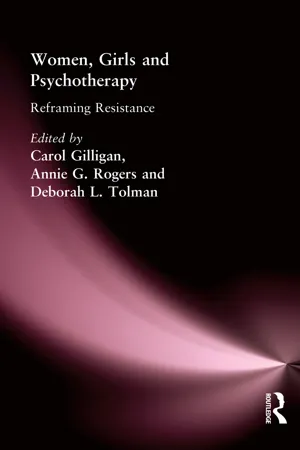
Adolescent girls'special needs in the teen-age years are thoroughly examined in Women, Girls & Psychotherapy, a compelling book focusing on the vitality of resistance in young girls. Drawing on studies of women's and girls'development, clinical work with girls and women, and their personal experiences, the voices of adolescent girls are used to reframe and greater understand their resistance against debilitating conventions of feminine behavior. As adolescent girls are often overlooked in feminist books in psychotherapy, this is an important volume as it looks positively at resistance, both as a political strategy and a health-sustaining process.The chapters cover such diverse topics as reconceptualizations of women's and girls'psychological development and the psychotherapy relationship; adolescent female sexuality; new approaches to psychological problems commonly seen in girls and women; female adolescent health; and diverse perspectives and experiences of growing up female. The voices of young women are increasingly important in the exploration of the field of psychotherapy and among the voices included are those from African-Americans, Asian-Americans, and lesbians. An enlightening look at resistance in females in the growing up years, this volume provides valuable insight on their experiences. The work of many researchers,therapists, and educators with diverse backgrounds, Women, Girls & Psychotherapy is an informative book on distinct psychological issues facing young females.
eBook - ePub
Women, Girls & Psychotherapy
Reframing Resistance
- 280 pages
- English
- ePUB (mobile friendly)
- Available on iOS & Android
eBook - ePub
Women, Girls & Psychotherapy
Reframing Resistance
About this book
Information
The Centrality of Relationships
Raising a Resister
Beverly Jean Smith
Throughout my reading of psychological literature and research on women, the printed word runs counter to my experiences. Ideas and concepts ring true to the larger knowledge I have of women in general and white, middle-class women in particular. This is understandable, since in my experience, individuals write out of and from what they know, feel, and live. Raised as a resister, I am able to question these paradigms. I see spaces that need filling, so that a more complete picture of women's development emerges.
This essay gives me a chance to enter a written discourse about women's experience. I speak only for myself within my family, community and school contexts, though I know that other African American women and women from different backgrounds share some of what I say. When I read the psychological literature about mother-daughter relationships, mostly what strikes me is daughters' pain, anger, hate, rejection, fear and struggle to find self. Perhaps these relationships drain some adolescent girls of the energy necessary to resist others' definitional norms. This way of speaking about the mother-daughter relationship runs counter to my experience. For the first ten years of my life, when my mother was alive, she and I related in what I experienced as healthy and healing ways.
She believed in me and recognized me as an individual. Two moments flash through my mind of her backing up my voice when teachers refused or just could not hear me. I remember a time when, in kindergarten, I kept telling my teacher I was not sleepy. She kept fussing at me, because I did not take naps. Eventually I told my mother. She came to my kindergarten class and asked the teacher if I got on the cot. "Yes." Did I disturb others? "No." Was I quiet? "Yes." Then she said that was all that could be asked of me. I could not be forced to nap. In fact, even at home I did not take naps, although my sister did. My mother lost a half a day's pay. She came to school again when I was in sixth grade, because a teacher kept calling me a liar. I had been questioned by this teacher several times about a fight that had occurred away from the school grounds. She was not my classroom teacher. I reported this questioning to my mother. She always told us to tell the truth and that anything could be dealt with. My sister and I owned up to all of our actions, good or bad, and faced the music. She assured the teacher that my version of the story was the truth as I knew it. Furthermore, she did not appreciate the teacher calling me a liar and to quit doing so, since I had explained to her several times that I had told the truth about the incident.
Connectedness and Independence
My first five years of living would have most social scientists today label me "poor" and "disadvantaged." Even then, I was probably living in poverty by white societal standards: living in two rooms, sharing a communal toilet and heating water to take baths in a tin tub. I was never fazed by these conditions, because I never felt poor, which is not so uncommon. Throughout my adult life, many acquaintances have echoed similar circumstances and sentiments.
In May of the same year that my mother came to school, she died in childbirth, after giving birth to a stillborn child. I was ten, and my sister Donna was twelve. My mother was one of ten children, and my sister and I were close to her people. These relationships provided a foundation that helped keep me centered. My sister Donna and I spent the summer of 1960 in California with my mother's family. They had moved in the summer of 1959. After a series of discussions involving my Aunties, my father, and my sister and me, the two of us ended up twenty miles from St. Louis, Missouri in St. Charles. The layout of the city was mostly unfamiliar, but the neighborhood we knew. After all, nearly every Sunday early in my life, my sister and I had visited my grandmother's house and spent several weeks there every summer among family. Here my sister and I lived with my first cousin Phyllis, who was twenty-one and married with a sixteen-month-old daughter. She and her family had moved from their tiny apartment in St. Louis into Grandma's house in St. Charles in 1959.
Soon after the death of my mother, my father and I sat in the main office of Benton Elementary School, my new school, waiting to see the counselor so that I could be registered. Even though I had completed half of the sixth grade before my mother died, the counselor said I would have to repeat the whole grade. My father asked my opinion. I said, "I should be allowed to go to the seventh grade. I was a good student and had good grades." Since I had just turned eleven, the counselor said I was too young for seventh grade. He stressed that I had already missed the first three weeks of the school year. I held my ground. I wanted to be in seventh grade. If I did not do well, then they could put me back in sixth. My father agreed. The counselor told me that someone would take me to the sixth grade classroom. I protested, but when my father told me to go, I left.
The whiteness struck me as I entered the room. My schools had been full of black people: the principal, teachers and classmates. My eyes locked with the only other black student; we smiled. I knew Linda Brown from visiting my relatives year after year. I remember nothing else about this room, the teacher, or the students, only the relief that rushed over me an hour later, when someone appeared at the door and led me back to the office. To support my claim that I was a good student who could handle the seventh grade, my father had driven to St. Louis and returned with all of my report cards. My father drove me to the junior high, so I could register again. The counselor there repeated my proposition to me: If I did not do well, I would be placed in sixth grade. Over the next three weeks he called me into his office weekly to inquire if I was having any difficulties with the schoolwork. Each week I echoed the same response: "I'm doing fine and the work isn't too hard." He assured me that I could be honest about any of these difficulties, since going back to sixth grade was not a bad thing. According to whom, I thought. I decided then and there that I would do well for my mother, my family, and the black people I had left at Marshall Elementary School in St. Louis. They sustained me in these predominantly white surroundings. Their collective voices would rise inside my head or be conjured up by me.
Of course, I had seen white people before. They owned or worked in a myriad of small businesses located on the street level of most buildings in my old neighborhood. They formed a backdrop. Children jumped, skipped and walked past their windows without them affecting our lives. Excluding Leonard and Barbara, the two youngest children of the white family who lived on the block, white people were outside of "my world." We did not talk or think about them one way or the other. In my new school, as situations arose or confronted me, the voices in my head, and I engaged in what black people know as "call and response.
Voice: The Interplay of Call and Response
As an African American, I grew up within a particular cultural context that values voice. African American culture demands that individual voices be connected to the whole and not just to go solo and fly off somewhere. In the neighborhoods where I was growing up, I would often see a group of young males clustered on a corner or somebody's steps. One starts a beat, the others chime in without explicitly being asked. They have responded to the indirect call of the male who began the beat. In 1990, "a rap" will probably emerge with one male giving his verse, then fading back into the beat as another voice surfaces. A group of my female friends and I meet. A conversation begins. Before we know it, all of us are speaking at the same time on the subject that has been raised by someone. Somehow, one voice gets the lead, while the rest of us become the background music. Eventually, another voice rises to displace the previous lead voice that joins us in the background. In New Orleans, Teish calls this act gumbayaya. Attend a B.B. King or Anita Baker or Public Enemy concert and notice that the audience talks to - the performer. But nowhere is call and response stronger than in the church. On any Sunday, a conversation goes on between the preacher and his congregation. He does not simply deliver the sermon but converses with "the church." He "calls" and God has "called him." A connectedness exists for African Americans between the individual and those around her or him, in all of these scenes. From birth, I feel I have understood the triadic concept of the individual, the family, the universe.
Tending Voice
This triad shaped my psyche. Although I was raised by my two parents until my mother's death, I felt always that I was of a larger collective community of aunts, uncles, grandmothers, cousins, and family friends. In contrast to the ways that relationships between women in families are portrayed, I saw relationships between the women in my mother's family as anything but pathological; my mother, aunts and grandmother had a "positive connection, interdependence and mutual exchange" (Herman and Lewis, 1986, p. 160). My mother visited her family every weekend after she left home. She would take the train from St. Louis, Missouri to Augusta and be picked up in town. After she got married, we visited my grandmother every weekend. Aunt Ruth lived next door to grandma, and Aunt Bertha lived one block away from them. When grandma decided to move to California, they went too - all but Aunt Hilda, who stayed in the country and tended gardens, flower and vegetable.
Ancestry: The Women’s Chorus
Do historical, cultural, and psychoanalytic assumptions about development and maturity correspond to our own experiences?
(Hirsch, 1989, p. 23)
I, girlchild in a working-class, African American family; I, the great granddaughter of Maude White who birthed one child, my grandmother, say no. Annie Hamm, my grandma, bore ten children, the first four were girls, and the last six were boys. Girl one birthed no children. Girl two birthed one child, a daughter. Girl three, my mother, birthed two daughters and died giving birth to her first son. Girl four birthed one daughter then one son. My maternal lineage illustrates that these women birthed women first. How did this pattern shape the experiences and mindset of women in my family?
My great-grandmother left my grandmother to be raised by her uncles. Her parting advice to her daughter was "don't have a lot of children." Clearly grandma did not listen. I suppose her mother meant it would tie grandma down. No such luck. With five children and no money, grandma packed them up and left grandpa when she thought he was messing around with another woman. Aunt Hilda told me that after they lived six months with grandma's twin uncles, John and Robert, grandpa came, professed his innocence and begged grandma to come back home. She did.
For my aunts and my mom, being the first four children born in a rural setting placed a lot of responsibility on them. They did gardening, housework and childrearing. They were strong-willed, independent and fiercely loyal to one another. Because they were black, they were denied the right to attend the town's white high school. The three oldest daughters graduated from elementary school together and had to move approximately fifteen miles from home to get a high school education. There they had access to the schoolbus that carried them another 35 miles (one way) to the nearest black high school located in St. Charles, Missouri. Their new male classmates acknowledged their beauty. They remarked, "mmmmm, look at those Ham girls, they look good enough to eat." To support their retort that their last name was not spelled like the meat, they changed the spelling of their last name, against my grandfather's protest, from H-a-m to H-a-m-m. All of these women before me defined their own existence against the odds. Born poor into a racist society, this larger society negated their existence, chipped away at their humanity. They were not framed within the picture that came to be scrutinized and redrawn within cultural, historical and psychoanalytic analysis. Neither was I. They and I lived in the borders.
The common understanding of women's psychological state as rooted in her powerless existence as homemaker and childrearer, or a pedestal queen, carries little weight within my family. Although the women in my family fall into the first two categories; except for my Aunt Hilda, they all worked outside of the home. In the black community I grew up in, being a mother held status, so whether women worked or did not work, if they were mothers, they were still valued. Women's work contributed to the well-being of the family unit. Their checks were not extras but necessities. In my family, all of the women handle the bills, even my Aunt Hilda who never worked outside of the home:
My thing to do was get the bills: get the bills figured out, read the meter so really it was my thing to keep the books whatever it was. A lot of women don't know what to do when her husband dies, like I did, cuz he don't tell her nothin and he don't want her to find out nothin!
Hope Chests and Prince Charming
Herman and Lewis's (1986) analysis of Cinderella, Snow White, and Sleeping Beauty made me slowly shake me head in disagreement when I thought about my community:
The resolution of the fairy tales, in which the daughter-heroine is lifted onto the prince's horse, represents not merely sexual fulfillment, but escape from the degraded female condition. Each girl is encouraged in the fantasy that an exception will be made for her; that as a princess, she will be chosen by a man to be elevated above the common drudgery of feminine existence, the drudgery to which she sees her mother consigned.
(p. 152)
Princess was not a term bestowed upon the young girls in my family. The women may have reigned but not as queens sitting on pedestals. Entitlement escaped them, even "lady." "Woman" was the term of the day. It was their acts that empowered Grandmothers and Aunts. These black women were the forerunners of what later white feminists wanted to become: independent, working, jugglers of self and family.
When I entered St. Charles High School, I was often searching "the white terrain" for some glimmer of my social reality, something that reflected my world even if in just a shard of light. For instance, several of my white girlfriends commented that on their upcoming birthdays, they would be receiving two gifts: one for them, and one for their "hope chests." I queried, "What's a hope chest?" Puzzled faces and voices responded. "You don't have a hope chest?" "No, what is it?" "Well," they chimed, "it's for when you get married." Married, I'm only thirteen. Even though I had a boyfriend who was three years my senior, I was hardly thinking about marriage. They educated me about the need to purchase china, crystal and linens, so as a new bride I would already have something. I laughed, because I found it strange. Why spend money hoping when people give newly weds gifts? "Besides," I said, "What if you don't get married?" At my last remark, they laughed and assured me they would. Perhaps embedded in their reply was their hope for a Prince Charming. The voices of my aunts spoke to me. As daughters and nieces, we, like most of my black female peers were told, "Be able to take care of yourself. Always have your own money."
No Prince Charmings would be coming on white horses. In America the concept of a "powerful black male" is an oxymoron. Not today, tomorrow or next week could we black daughters "rely on powerful men for [our] salvation" (Herman and Lewis, 1986, p. 152). Even as a fantasy, these tales were and are too farfetched against the realities of black life. Unlike the white male, the black male cannot elevate their women nor protect them. How can ...
Table of contents
- Cover Page
- Half Title page
- Title Page
- Copyright Page
- Contents
- List of Contributors
- Introduction
- Section I Reframing Resistance
- Section Ii Strategies of Resistance
- Section Iii The Centrality of Relationships
- Section Iv Notes from the Underground
- Index
Trusted by 375,005 students
Access to over 1.5 million titles for a fair monthly price.
Study more efficiently using our study tools.
Frequently asked questions
Yes, you can cancel anytime from the Subscription tab in your account settings on the Perlego website. Your subscription will stay active until the end of your current billing period. Learn how to cancel your subscription
No, books cannot be downloaded as external files, such as PDFs, for use outside of Perlego. However, you can download books within the Perlego app for offline reading on mobile or tablet. Learn how to download books offline
Perlego offers two plans: Essential and Complete
- Essential is ideal for learners and professionals who enjoy exploring a wide range of subjects. Access the Essential Library with 800,000+ trusted titles and best-sellers across business, personal growth, and the humanities. Includes unlimited reading time and Standard Read Aloud voice.
- Complete: Perfect for advanced learners and researchers needing full, unrestricted access. Unlock 1.5M+ books across hundreds of subjects, including academic and specialized titles. The Complete Plan also includes advanced features like Premium Read Aloud and Research Assistant.
We are an online textbook subscription service, where you can get access to an entire online library for less than the price of a single book per month. With over 1.5 million books across 990+ topics, we’ve got you covered! Learn about our mission
Look out for the read-aloud symbol on your next book to see if you can listen to it. The read-aloud tool reads text aloud for you, highlighting the text as it is being read. You can pause it, speed it up and slow it down. Learn more about Read Aloud
Yes! You can use the Perlego app on both iOS and Android devices to read anytime, anywhere — even offline. Perfect for commutes or when you’re on the go.
Please note we cannot support devices running on iOS 13 and Android 7 or earlier. Learn more about using the app
Please note we cannot support devices running on iOS 13 and Android 7 or earlier. Learn more about using the app
Yes, you can access Women, Girls & Psychotherapy by Carol Gilligan,Annie G Rogers,Deborah L Tolman, Carol Gilligan,Annie G Rogers in PDF and/or ePUB format, as well as other popular books in Psychology & Developmental Psychology. We have over 1.5 million books available in our catalogue for you to explore.