This volume boldly proposes that the core of the Arthurian and Holy Grail traditions derived not from Celtic mythology, but rather from the folklore of the peoples of ancient Scythia (what are now the South Russian and Ukrainian steppes). Also includes 19 maps.
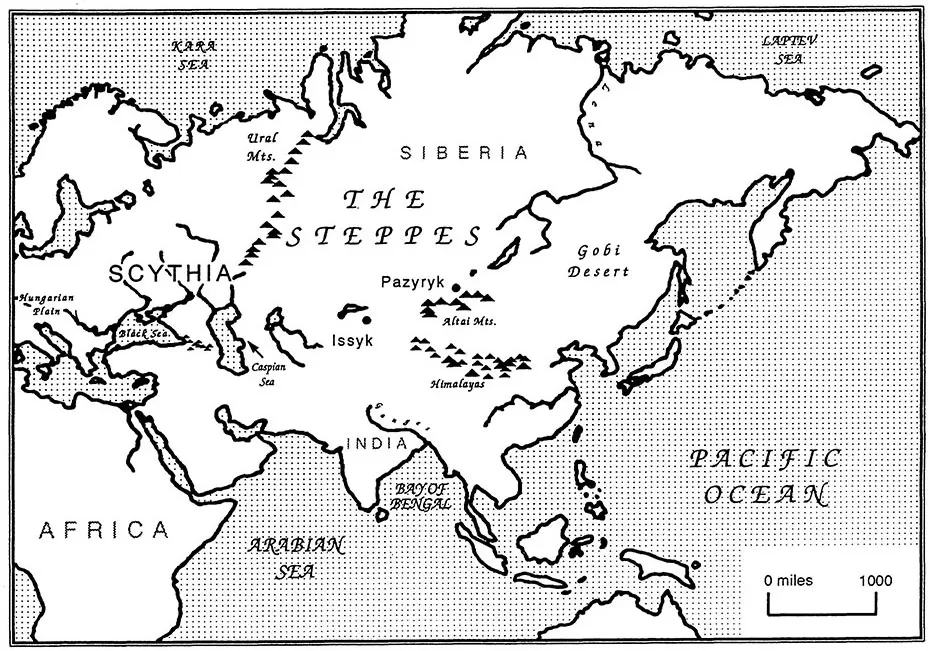
This book argues that the core of the Arthurian and Holy Grail legends derives originally from a region known in antiquity as Scythia, that is, the western portion of the great "sea of grass" that stretches from the Altai Mountains to the Hungarian Plain (see map 1). We must therefore take a closer look at several of the ethnic groups that originated in this vast steppe region. Almost all of them spoke languages belonging to what linguists call the Northeast Iranian branch of the Indo-Iranian substock of the Indo-European language family;1 most scholars now think that the linguistic differences among these several groups were minimal and that they not only shared a closely related set of dialects but also a common culture.2
Scythians
One of the earliest of these Northeast Iranian steppe peoples, or at least the earliest to have an impact on the ancient civilizations of the Mediterranean basin, was known to the Greeks as the
(i.e., Scythians). Here we encounter a major terminological paradox: "Scythian" can be used in two ways. In the narrow sense it is limited to the ancient Scythian tribes, as described by Herodotus and other Greco-Roman authorities. In the broad sense it applies to all of the groups we will survey in this chapter, including the modern Ossetians,3 who can perhaps be considered "epi-Scythians." The region's ancient name,
MAP 1.Ancient Scythia
Scythia, reflects this inclusive notion that anyone who called the "sea of grass" home was a "Scythian."
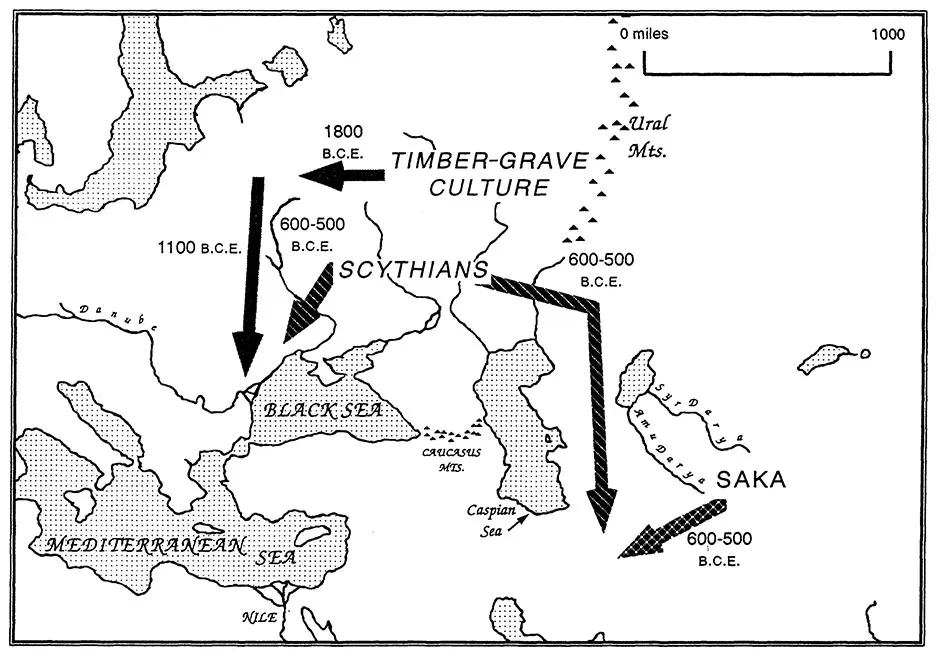
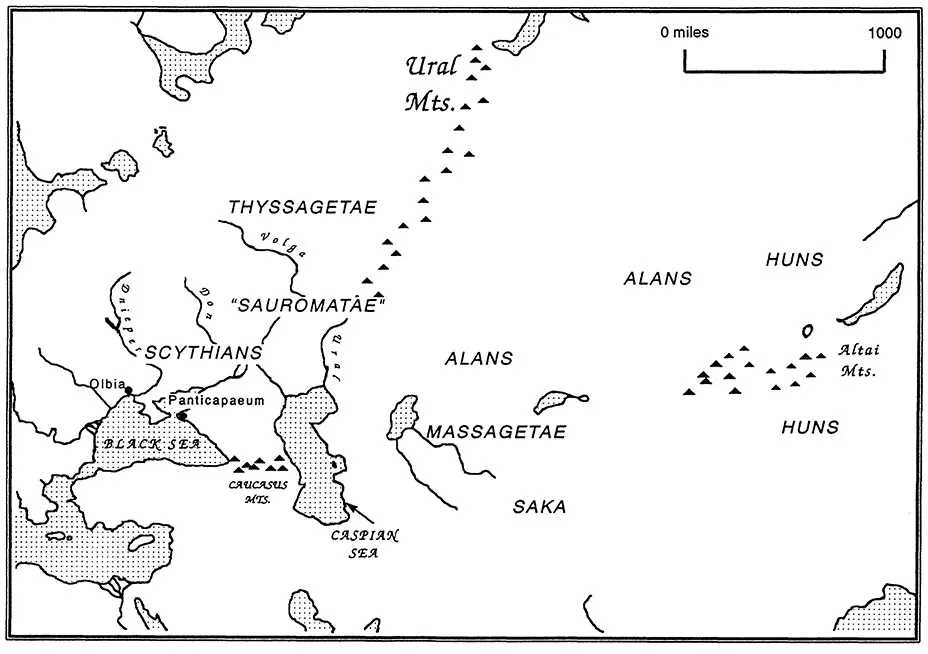
The Scythians expanded into the West in several major waves (see map 2). The first, which Gimbutas describes as "proto-Scythian," originated well east of the Urals.4 Known archaeologically as the Timber-Grave Culture, this wave began expanding westward as early as 1800 B.C.E..5 A second wave, this time of Scythian mounted nomads who buried their dead in timber-lined tumuli, swept across the more settled, agricultural communities of the north Pontic steppes and incorporated some of the indigenous cultivators, who became known as "Agricultural Scythians" (ca. 1100 B.C.E..).6 Then, ca. 600-550 B.C.E.., a third wave migrated westward out of southern Siberia.7 These latecomers, who eventually pushed west along the north coast of the Black Sea as far as Bulgaria and who invaded northeast Iran as well, bore several ethnic labels (see map 3). Among them were the Massagetae (southeast of the Aral Sea), the Saka (northeastern Iran, western Afghanistan), the Thyssagetae (the central Urals), and a people Herodotus calls the "Sauromatae,"8 who seem to have been the immediate ancestors (or earliest known example) of the Sarmatians.
Although all of these subtribes seem to have shared a similar way of life, the westernmost group, which roamed the Pontic steppes in the fifth century B.C.E.. (ca. 450 B.C.E..), provided most of our nonarchaeological information about Scythian culture.9 According to Herodotus10 there were three major social strata (or tribes): "Royal Scythians," pastoral nomads who formed the ruling elite; "Warrior Scythians," also nomads, who maintained and extended the power of the former group; and "Agricultural Scythians," most likely comprising conquered, "Scythianized," indigenous peoples.
The Scythian economy was a mixture of pastoralism and settled cultivation, although the former seems to have taken precedence, as it still does among the Kazakhs and other modern inhabitants of the eastern portion of this region.11 As among those Altaic peoples who came to the region in more recent times, the horse was the primary, or at least the most prestigious, animal herded. The Scythians were the first great cavalry nation. Unlike the ancient Celts, who still relied on horse-drawn chariots
MAP 2.Major Migrations of Steppe Cultures
MAP 3.Ancient Steppe Cultures
as late as the first century C.E., the Scythians were mounted warriors who fought with both lances and bows, as well as long, slashing swords.12 These steppe nomads also wore trousers, overlapping scale armor, and conical helmets. A millennium and a half later this warfare pattern, which was also characteristic of the Sarmatians and the Alans, was to have a fundamental impact on medieval European society; as Nickel points out, it was the basis upon which the concept of chivalry developed.13
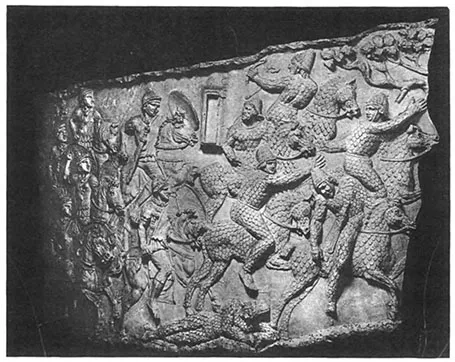
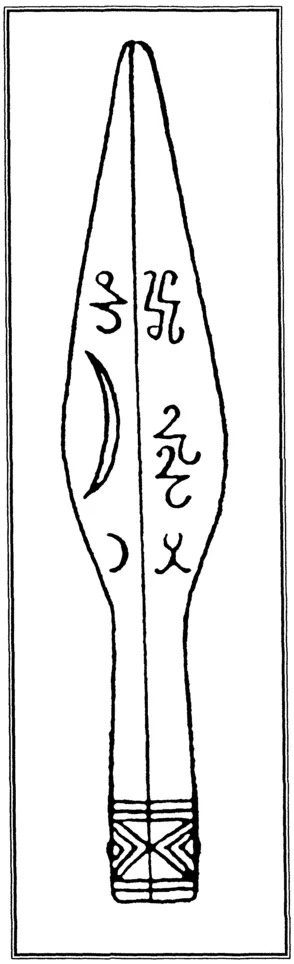
Unlike the Romans and, for the most part, the Celts, Arthur's people, as they are depicted in the medieval chivalric romances, seem to have preferred to fight from horseback and to have relied primarily upon a long slashing sword14 rather than upon a heavy thrusting spear and a javelin (or pilum) characteristic of the foot-slogging legionnaires. This, together with their relatively heavy body armor, which consisted of overlapping scales attached to a leather tunic, tallies well with what evidence we have of Sarmatian military technology, such as the images on Trajan's Column (see plate 1).15 Even the custom of designating warriors by means of an emblem, which eventually evolved into the medieval concept of the heraldic device, may have its roots in the Sarmatian and Alanic practice of identifying clans and other kinship units by means of tamgas ("sacred symbols") emblazoned on helmets, shields, and other pieces of equipment (see fig. 2), many examples of which have been found in south Russian sites associated with the cultures in question.16
As with the Alans draft animals and carts also played an important part in the Scythian economy, and we have evidence that while on the move they lived in wagons: indeed Herodotus said that they had no other homes.17 These carts were covered by felt tents that functioned like the yurts still to be found among the steppe nomads of central Asia.
The role of women in Scythian society, and in Northeast Iranian society as a whole, also needs to be noted, as it not only differed markedly from that played by women in the Greco-Roman world but also has implications for the role of women in the Arthurian tradition.18 The Greek legends about the Amazons are almost certainly derived from their observations of this culture. Scythian wives were expected to fight alongside their
PLATE 1.Sarmatians on Trajan's Column. ALINARI/ART RESOURCE,NY.
FRGURE 2. Tamgas
husbands when the occasion demanded, and Herodotus went so far as to assert that among their eastern cousins, the "Sauromatae,... [there is] a marriage law which forbids a girl to marry until she has killed an enemy in battle."19
According to Herodotus the Scythian religion centered on seven divinities, chief among them a goddess called Tabiti, whom he glosses as "Hestia."20 Another was a war-god whom he refers to as the "Scythian Ares," who was symbolized by a sword thrust into a pile of wood. Yet another major divinity seems to have been called Don Bettyr,21 who most likely was associated with the Don River (known to the Greeks as the Tanais) and who presided over plant and animal fertility.
The way the Scythians conceived of their own origins also has important implications for our thesis. According to Herodotus the primeval being, whose name he transliterates as "Targitaos," had three sons.22 When three burning golden objects fell from the sky—a cup, a battle-ax,23 and a yoked plow—each son in turn attempted to gather them. Only the youngest, whom Herodotus calls "Kolaxaïs," was successful. From him were descended the "Royal Scythians" (the Paralatai), who had sovereignty over all. From the second son, "Lipoxaïs," descended the "Warrior Scythians" (the Aukhatai), while from the eldest, " Arpoxaï's," sprang the "Agricultural Scythians" (the Katiaroi and the Traspies).24 While there is still some argument as to whether these were separate tribes or social classes within a single tribe, one aspect of this myth is extremely important for our purposes: the emphasis placed on cups (see chaps...
Table of contents
Cover
Title
Copyright
Dedication
Contents
Foreword
Acknowledgments
Preface
Introduction
Part I: The Cultural and Historical Background
Part II: Figures
Part III: Themes and Images
Part IV: The Holy Grail
Conclusions
Appendix 1. A Note on Sources
Appendix 2. Genealogies
Appendix 3. A Reinterpretation of Nennius's Battle List
References Cited
Index
Trusted by 375,005 students
Access to over 1.5 million titles for a fair monthly price.
Study more efficiently using our study tools.
Frequently asked questions
Yes, you can cancel anytime from the Subscription tab in your account settings on the Perlego website. Your subscription will stay active until the end of your current billing period. Learn how to cancel your subscription
No, books cannot be downloaded as external files, such as PDFs, for use outside of Perlego. However, you can download books within the Perlego app for offline reading on mobile or tablet. Learn how to download books offline
Perlego offers two plans: Essential and Complete
Essential is ideal for learners and professionals who enjoy exploring a wide range of subjects. Access the Essential Library with 800,000+ trusted titles and best-sellers across business, personal growth, and the humanities. Includes unlimited reading time and Standard Read Aloud voice.
Complete: Perfect for advanced learners and researchers needing full, unrestricted access. Unlock 1.5M+ books across hundreds of subjects, including academic and specialized titles. The Complete Plan also includes advanced features like Premium Read Aloud and Research Assistant.
Both plans are available with monthly, semester, or annual billing cycles.
We are an online textbook subscription service, where you can get access to an entire online library for less than the price of a single book per month. With over 1.5 million books across 990+ topics, we’ve got you covered! Learn about our mission
Look out for the read-aloud symbol on your next book to see if you can listen to it. The read-aloud tool reads text aloud for you, highlighting the text as it is being read. You can pause it, speed it up and slow it down. Learn more about Read Aloud
Yes! You can use the Perlego app on both iOS and Android devices to read anytime, anywhere — even offline. Perfect for commutes or when you’re on the go. Please note we cannot support devices running on iOS 13 and Android 7 or earlier. Learn more about using the app
Yes, you can access From Scythia to Camelot by C. Scott Littleton,Linda Malcor,Linda A. Malcor in PDF and/or ePUB format, as well as other popular books in Literature & Literary Criticism. We have over 1.5 million books available in our catalogue for you to explore.