- 246 pages
- English
- ePUB (mobile friendly)
- Available on iOS & Android
eBook - ePub
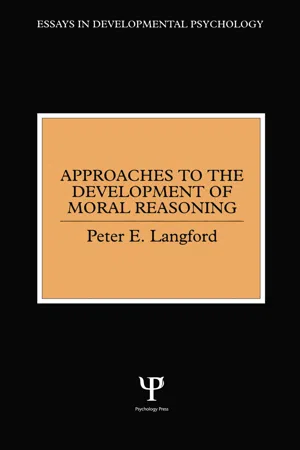
Approaches to the Development of Moral Reasoning
About this book
The first part of the book offers a survey of current approaches to the development of moral reasoning: those of Freud, ego psychology, Piaget and Kohlberg. The approach of Kohlberg has been popular because he was able to give an impressive account of findings from the key method of interviews, the other crucial method being naturalistic observation of moral discourse. The accounts of interview evidence given by ego psychology and Piaget were less comprehensive and less impressive. Naturalistic studies have either been impressionistic or less detailed in their methods of analysis.
The second part of the book argues that the impressive nature of Kohlberg's later evidence for his view that moral reasoning passes through a sequence of stages is in part illusory, because his theory predicts that specific types of reply will show specific developmental patterns. However, as data are always reported in terms of stages, which amalgamate very disparate types of reply, it is impossible to know whether the specific types of reply follow their predicted developmental courses or not. Reasons given for assigning given types of reply to a stage are also often doubtful. This leads to discussion of studies that have reported findings in terms of specific types of reply (weakly interpretive methods), as opposed to Kohlberg's stage-based and strongly interpretive methods. Findings from these disconfirm Kohlberg's theory at several crucial points.
The second and third parts of the book also examine findings from non-Kohlbergian interviews and other methods, again advocating that weakly interpretive and largely descriptive presentation of findings is preferable to strongly interpretive techniques. It is argued that a wide variety of mechanisms suggested by the theories outlined in the first part of the book, as well as others drawn from general theories of personality development, are able to explain existing descriptive developmental findings. The task for the future is to assess the relative importance of these mechanisms.
Information
Publisher
Psychology PressYear
2018Print ISBN
9781138882980
9780863773686
Edition
1eBook ISBN
9781317734956
CHAPTER ONE
Introduction
This introduction will begin by discussing definitions of moral reasoning and then provide a brief outline of the book.
Definitions of Moral Reasoning
Formal definitions of moral reasoning tend to rely heavily on the notions of moral rules and moral norms, so some preliminary consideration of these is needed. Amoral rule is usually taken to be any rule about human behaviour that is framed in moral language or has a moral intent. Such rules may be generally accepted rules, such as, in many societies, “You should not lie, cheat, steal, or murder.” These are known as moral norms. It is usually thought that a norm is such for a given society. Thus, the rule “You should not offer human sacrifices” is a norm in most modem Western societies, but it was not a norm to the Phoenicians or the Aztecs. There are in addition many moral rules that are advocated by some people in a society, but rejected by others. In Western societies the rules “You should not have sex before marriage” and “You should not take soft drugs” have this character. These are moral rules that are not norms for our society.
Both Piaget (1932) and Kohlberg (1958) thought that moral reasoning focused on generally accepted moral rules or norms, such as the rules against stealing, lying, and murder. This involves some difficulties, as rules equivalent to “We ought to help other people”, “We ought to promote the greatest happiness of the greatest number”, and other expressions of the idea that we should act to aid others, occupy an ambiguous role in definitions of this kind.
Such rules about helping others are evidently moral norms in Western societies and are agreed to be so whatever definitional tack we take, but they are not usually taken as key examples of moral norms by Piaget and Kohlberg; and they occupy a rather different role within systems of moral reasoning from rules like those against lying, stealing, and murder. This is because they are often given as reasons for adhering to rules like those against lying, stealing, and murder. If asked why we should not lie or steal or murder, one common reason given by both children and adults is that these rules enable everyone to be better off, or that flouting them makes everyone worse off (see Chapter 8). On the other hand, few people will give “You should not lie” as a reason for not stealing, or “You should not murder” as a reason for not lying. For this reason, it is convenient to distinguish first order moral norms, like those against lying, stealing, and murder, from second order moral norms, like rules suggesting we should help other people. First order norms are generally agreed moral rules that are not usually used to justify other norms, whereas second order norms are generally agreed moral rules that are quite often used to justify first order norms.
In considering formal definitions of moral reasoning, it is useful to look first at some general definitional tactics and then at some particular definitions that have been influential in the psychological literature. It is most usual to approach the problem of definition either through the set of rules for regulating conduct that are held to define the topic, or through some kind of metaethical theory that explains why this set of rules is to be included (see especially Gamer & Rosen, 1967; Hare, 1981; Mayo, 1986; McCloskey, 1969; Sanyal, 1970; Trainer, 1991). Philosophers usually distinguish between normative ethical theories and metaethical theories. Normative ethical theories tell us which kinds of things and actions are good. Thus, specification of a set of rules to define moral reasoning is closely related to one style of normative ethical theory.
Metaethics is concerned with the analysis of the meanings and logical functions of ethical expressions. Metaethical theories may involve a variety of tactics, including the purely descriptive analysis of the meaning of ordinary moral language. Here, arguments may be given that in such language the term “moral” has a certain extent (probably rather ill-defined) and that we should stick to the ordinary language usage of the term. Similar arguments may be applied to other moral words. Alternatively, a prescriptive metaethical theory may be put forward that aims to say why we ought to redefine the term in ways not sanctioned by ordinary language.
Some metaethical theories do not specify much about the content of normative ethics. Thus, the metaethical theory that what is good is that which is the will of God tells us nothing about what God actually wills. On the other hand, the metaethical theory that what is good is that which promotes the greatest happiness of the greatest number tells us a good deal about what is good. Metaethical theories, like the second one, that define what is good through a norm, tend to constrain what we should think about normative ethics to a greater extent than those that give more abstract definitions of what it is to be moral.
In considering the most influential psychological definitions of moral reasoning, it is convenient to begin with the way in which they use specification of a set of rules (the first kind of definitional tactic) to produce a definition. This is enough to specify what counts as moral reasoning and what does not. However, there is often also a prescriptive metaethical theory that at least in part motivates the selection of the chosen rules. We can understand more about the underlying reasons for adoption of the first kind of definition by an awareness of this theory.
Three definitions of moral reasoning will now be described, those of Kohlberg (1958), Piaget (1932) and that adopted by ego psychologists like Loevinger (1970,1983,1993) and Haan (1977, 1991). In considering the first two, a distinction needs to be drawn between the explicit and the implicit definition used by an author. Thus Kohlberg (1958) explicitly defines such reasoning as being about moral norms, but implicitly, as seen in the kinds of situation he chose to consider as involving moral reasoning, he nearly always restricts the norms considered to first order norms like those against lying, stealing, and murder.
Kohlberg’s (1958) explicit definition is that moral reasoning is about the reasons for upholding norms that are under challenge, usually because in a particular situation they conflict with another norm. His implicit definition tends to restrict this to first order norms.
Piaget’s (1932) definition, in its explicit version, is broader than that of Kohlberg and is that moral reasoning is about why we show respect for generally accepted moral rules. This is broader than Kohlberg’s definition in two ways. First, it does not stipulate that the norm must be brought into question, including reasoning about norms that are not in question. Second, Piaget interprets the term “moral rule” to include conventional rules that people think they ought to adhere to, like the rules of games, as well as moral rules in the more usual sense, which is that such rules should involve moral language, or have a moral intent, and bear on human interests. This excludes conventional rules, like the rules of games, that may be discussed in moral language, but do not bear on human interests. Turiel (1983) and Turiel, Hildebrandt, and Wainryb (1991) were able to present considerable evidence that the development of thinking about conventional rules differs substantially from that of thinking about moral rules in the narrower and more usual sense. Piaget not only includes conventional rules in his definition, but assumes the development of thinking about them is similar to that of thinking about moral rules in the narrower sense.
Piaget’s implicit definition of “moral rule” excludes second order norms, which he does not deal with in his studies.
The third and broadest definition of moral reasoning is that it is about what decisions we ought to make when these affect human interests. This definition is adopted in practice by Loevinger (1970, 1983, 1993) and Haan (1977,1991). The most usual version states that the reasoning must involve moral language and the issues considered must bear on human interests. Reasoning of this kind may involve only second order norms, such as those relating to aiding others, with no reference to first order norms. It will always involve second order norms about aiding others, as these are always relevant when thinking about what we ought to do where human interests are at stake. First order norms may or may not be involved.
The adoption of the first two definitions given here seems at least in part to have been motivated by the prescriptive metaethical theory of Kant (1788). In his Critique of practical reason, Kant argued that the definition of morality should be based on his categorical imperative, which states that we should act according to rules that can be established as universal laws applying to everyone. Piaget and Kohlberg assume that most people have recognised this binding character of universalisable rules of conduct, and thus universalisable moral norms will also be empirical moral norms.
However, they are on somewhat shaky ground in making this extension of Kant’s theory to ordinary people. For instance, Kant believed that the rule “You should not kill another human being” was a universalisable moral norm, although it is not an empirical norm of modem societies, which tend to adopt the rule “You should not murder another human being”, excluding at least killing the enemy in war and also often capital punishment as well. Thus, Kant includes some rules as moral norms that are arguably not recognised as such by most people in our society. For this reason, moral norms will be understood here as empirical norms, rather than as rules that some philosophers think can be universalised. The aim of doing this is to avoid the conceptual confusion that can arise from the joint use of the empirical and universalisability criteria for being a moral norm. It also avoids the uncertainty that philosophers have about which norms are really universalisable in the philosophical sense, and what is meant by the ambiguous term “universalisable” (on the latter see especially McCloskey, 1969; Mackie, 1977).
It is worth adding that Kohlberg also claimed to have been influenced by the universalisability arguments of Hare (1963). These are intended to provide a descriptive rather than a prescriptive metaethical theory, saying what ordinary moral language does mean rather than what it should mean. This theory has been subjected to considerable criticism on the grounds of its ambiguity and tendency to pass off a positive commitment to particular normative values as descriptive metaethics (e.g. Mackie, 1977; Nagel, 1988; Singer, 1988). As it is widely held that the theory is really, for the second of these reasons, prescriptive and not descriptive metaethics, reliance on it in defining moral reasoning has many of the same problems as reliance on that of Kant.
Although it is less easy to make a direct connection between the definition of moral reasoning adopted by the ego psychologists (who in this respect followed their mentor Freud) and their metaethical position, it is reasonable to see a link between the liberal humanism of Freud and many of his followers and their preferred definition of moral reasoning. Thus Bentham and John Stuart Mill, who played a key role in the establishment of the liberal humanist tradition, both thought that morality ought to be based on maximising human welfare. This leads to a definition of morality that emphasises this rather than other kinds of moral rule.
In his later work, Kohlberg tends to define moral reasoning as the study of reasoning about principles of justice (Kohlberg, 1971, 1981; Kohlberg, Levine, & Hewer, 1983). In the first two of these sources, justice reasoning is thought of as general styles of thinking that can be used to balance conflicting moral claims. In the third (Kohlberg et al., 1983, p.91), he also says “Our starting assumptions led to the design of a research instrument measuring reasoning about dilemmas of conflicting rights or of the distribution of scarce resources; that is, justice concerns.” However, the second part of this statement seems to represent something of an afterthought and is difficult to connect with the genesis or nature of the dilemmas that he regarded as so fundamental to the study of moral reasoning. There is no dilemma that deals with the distribution of scarce resources that does not at the same time involve the conflict of norms.
The notion of justice being invoked here, central to the later definitions, involves a kind of balancing of moral criteria that is only revealed by Kohlberg’s particular way of analysing interview replies. As such analysis is controversial, this appears an unwise definitional tactic.
An important use of definitions in this field is to determine whether particular questions are likely to elicit reasoning that is moral according to the adopted definition or not. This means that definitions should focus on the less controversial issue of how to categorise questions, not on the more controversial one of how to categorise replies. If introducing the notion of justice into the definition is merely intended to say that norms should be put under challenge in the interview, to encourage reasoning that involves balancing moral criteria, then this leads us straight back to the earlier definition. For these reasons, the 1958 definition will be assumed sufficient here. In any event, the shift from the earlier to the later definitional emphasis brought about no discernible change in the content of the dilemmas used to study moral reasoning.
Work inspired by all three of the major psychological definitions will be considered here. This is partly because they all help to delimit aspects of reasoning that we call “moral” in everyday language. It will also be argued that consideration of the wider range of issues, involved in the third definition, helps to reveal aspects of reasoning of the two narrower kinds, which remain obscure if we consider only those two narrower definitions.
These definitions are still quite restrictive in relation to what are called moral issues in everyday language and are considered as such by some philosophers. Thus, issues such as blasphemy and sacrilege are moral in these everyday and philosophical senses, but do not fall under any of the three definitions, as human interests are not usually directly involved. In deference to the psychological literature, which tends to exclude issues of this kind, I have not considered them.
It is worth clarifying one issue that arises in thinking about situations that involve first order moral norms. There are some moral rules, which nearly everyone will agree are desirable moral rules, that are applicable to an agreed range of situations, like the rules against lying and stealing. Disagreement may well arise as to whether certain mitigating factors would or would not allow us to countenance lying or stealing in a certain situation, but there is little disagreement as to when these rules are relevant. This contrasts with some other rules, which most people will agree are desirable rules in some situations, but will not agree on the range of situations to which they apply, regardless of the influence of mitigating factors. A good example here is the rule that a parent should have authority over their child, which Colby and Kohlberg (1987b) consider to be a moral norm. It is clearly not the case that everyone will agree on the range of situations to which this applies.
Colby and Kohlberg talk about the operation of this moral “norm” in situations where many people would not think it applied. This contrasts with the terminology used by Langford (1991a), that when applied to such situations a rule of this kind is not a norm. It is a norm in some situations, as most people think parents have authority over their children in some, for example life-threatening, situations. But, where the application of the rule is controversial, I will not consider that rule to be a norm for such situations.
On the surface, this is merely a terminological issue that should cause little concern to anyone. However, as Langford (1991a) and Turiel et al. (1991) found that moral reasoning in situations where the relevance of moral norms was doubtful to many interviewees was very different to reasoning about situations to which norms were generally agreed to be relevant, it is important to keep the two senses of “norm” apart. The usage adopted here is one convenient way to do this.
One or two further considerations about the scope of our topic arise from the expectations aroused by the terms “moral development” and “development of moral reasoning”. Moral development is obviously something wider than the development of moral reasoning, as it includes moral emotion and behaviour, moral character and personality, as well as moral reasoning.
Texts on moral development, such as Graham (1972) and Rich and DeVitis (1985), often include the Freudian approach. But when we come to discussions of the development of moral reasoning we are likely to hear about ego psychology and cognitive structuralism (i.e. Piaget and Kohlberg), but may not encounter Freud, on the grounds that he was more interested in the emotional or motivational aspects of moral development than in moral reasoning (e.g. Haan, 1977).
I shall include the orthodox Freudian view of development, as well as those of ego psychology and cognitive structuralism, as three broad strands within classical approaches to the development of moral reasoning. There are three main reasons for doing this. The first is that Freud and fairly orthodox Freudians like Erikson, as well as being interested in motivation and emotion, were also interested in ego development. The ego is the part of the personality responsible for rational thought. Their views thus offer a distinctive and interesting approach to the development of the rational aspects of moral reasoning. The second is that in considering “moral reasoning” there seems little reason to restrict ourselves arbitrarily to rational and conscious, as opposed to irrational and unconscious, reasoning processes. Once we begin to think about unconscious and irrational reasoning processes, we are led inevitably to consider Freud’s contribution to these topics.
A third reason for including Freud is that when Kohlberg (1958) reviewed work on the development of moral reasoning, as it existed prior to his own contribution to it, he included Freud as a major contributor. This is significant, as it shows that Kohlberg himself, the best known contemporary theorist of the development of moral reasoning, was swayed by the two reasons just given.
Structure of the Book
The overall structure of the book is as follows. It begins in Part 1 with a review of the three main theoretical traditions already mentioned. This throws up a major problem with the current state of the field. This is that the dominant approach, that of Kohlberg, involves commitment to theory-laden descriptions of development that comprise a blend of descriptive observations and theoretical interpretation. One of the first tests of a theory in developmental psychology should be that it provides an adequate account of descriptive aspects of development. It is, however, impossible to assess whether Kohlb...
Table of contents
- Cover
- Half Title
- Title Page
- Copyright Page
- Acknowledgements
- 1. Introduction
- Part One: Theoretical traditions
- Part Two: Interview findings in the light of weakly interpretive methods
- Part Three: Theoretical traditions
- Part Four: Conclusions
- Author Index
- Subject Index
Trusted by 375,005 students
Access to over 1.5 million titles for a fair monthly price.
Study more efficiently using our study tools.
Frequently asked questions
Yes, you can cancel anytime from the Subscription tab in your account settings on the Perlego website. Your subscription will stay active until the end of your current billing period. Learn how to cancel your subscription
No, books cannot be downloaded as external files, such as PDFs, for use outside of Perlego. However, you can download books within the Perlego app for offline reading on mobile or tablet. Learn how to download books offline
We are an online textbook subscription service, where you can get access to an entire online library for less than the price of a single book per month. With over 1.5 million books across 990+ topics, we’ve got you covered! Learn about our mission
Look out for the read-aloud symbol on your next book to see if you can listen to it. The read-aloud tool reads text aloud for you, highlighting the text as it is being read. You can pause it, speed it up and slow it down. Learn more about Read Aloud
Yes! You can use the Perlego app on both iOS and Android devices to read anytime, anywhere — even offline. Perfect for commutes or when you’re on the go.
Please note we cannot support devices running on iOS 13 and Android 7 or earlier. Learn more about using the app
Please note we cannot support devices running on iOS 13 and Android 7 or earlier. Learn more about using the app
Yes, you can access Approaches to the Development of Moral Reasoning by Peter E. Langford in PDF and/or ePUB format, as well as other popular books in Psychology & Developmental Psychology. We have over 1.5 million books available in our catalogue for you to explore.