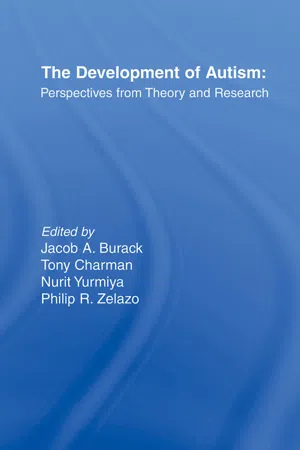
Dedicated to the memory and work of Lisa Capps, this volume is a forum for scholars and practitioners interested in the typical and atypical development of persons with autism. Each chapter is focused on theoretical considerations and the empirical evidence regarding a specific aspect of functioning, but common themes of development are considered throughout. Within this framework, the contributors provide a detailed and comprehensive account of the development of persons with autism.
The book is divided into four sections: (1) Developmental, Neurobiological, Genetic, and Family Considerations; (2) Attention and Perception; (3) Cognition, Theory of Mind, and Executive Functioning; and (4) Social and Adaptive Behaviors. With the consideration of this broad range of topics, this volume is both a state-of-the-art resource about autism and a unique contribution to the study of development. It will be of interest to researchers and care providers from several domains, including psychology, psychiatry, social work, developmental psychology, and education. This volume can be used as a text in graduate and advanced undergraduate courses, and as a resource in applied settings.
eBook - ePub
The Development of Autism
Perspectives From Theory and Research
- 392 pages
- English
- ePUB (mobile friendly)
- Available on iOS & Android
eBook - ePub
The Development of Autism
Perspectives From Theory and Research
About this book
Information
III
Cognition, Theory of Mind, and Executive Functioning
9
A Reexamination of the Theory of Mind Hypothesis of Autism
Helen Tager-Flusberg
University of Massachusetts and Eunice Kennedy Shriver Center, Waltham, Massachusetts
University of Massachusetts and Eunice Kennedy Shriver Center, Waltham, Massachusetts
The Theory of Mind Hypothesis of Autism
In 1985 a group of British researchers published a seminal paper titled Does the autistic child have a theory of mind? (Baron-Cohen, Leslie, & Frith, 1985), igniting a new era of research on autism. Baron-Cohen and his colleagues found that the majority of children with autism failed a classic theory-of-mind test, in contrast to normally developing preschoolers and children with Down syndrome. Follow-up studies provided further support for their hypothesis that children with autism do not have a theory of mind: They fail to understand stories that involve deception and do not use mental-state terms such as think and know in their retelling of these kinds of stories (Baron-Cohen, Leslie, & Frith, 1986). The significance of the theory of mind hypothesis of autism, as it came to be known in the literature (Baron-Cohen, Tager-Flusberg, & Cohen, 1993), was that it not only explained the failure of children with autism on tasks tapping theory-of-mind abilities, but also provided a unified explanation for the primary diagnostic impairments in pretend play, social functioning, and communication (Baron-Cohen, 1988; Frith, 1989; Leslie, 1987). Yet over the past decade much of the excitement originally generated by work on theory of mind in autism has been dispelled. Several researchers are now skeptical about its significance as a theory that explains the primary symptoms that define this complex neurodevelopmental disorder. In this chapter I review this history, critically examining the issues that led to the current status of the theory of mind hypothesis of autism.
Early studies on theory of mind in autism were guided by ongoing work in cognitive science. Following commentary by the philosopher Dennett (1978) and others on studies of theory of mind in chimpanzees (Premack & Woodruff, 1978), much of the focus of developmental research initially addressed when typically developing children first understand false-belief and related concepts of mind. Studies by Perner, Wellman, Flavell, and their colleagues (e.g., Flavell, Flavell, & Green, 1983; Perner, Leekam, & Wimmer, 1987; Wellman & Estes, 1986; Wellman & Bartsch, 1988; Wimmer & Perner, 1983) provided the major measures that became the standards in the field. Theories emphasized the child’s acquisition of a representational understanding of mind, especially knowledge that a person’s mind is opaque—its contents are not a direct reflection of reality and are not available to the minds of others. Research with falsebelief tasks demonstrated repeatedly that beginning around the age of 4, normally developing children exhibit this understanding. Although modifications in the procedural administration of such tasks may push the developmental timing down a few months (e.g., Mitchell & Lacohée, 1991; Moses & Flavell, 1990; Sullivan & Winner, 1993; Zaitchik, 1991), the dramatic change in performance on these kinds of tasks at about the age of 4 is one of the most robust findings in child development literature (Wellman, Cross, & Watson, 1999).
Research on theory of mind in children with autism reflected this emphasis on the acquisition of a representational understanding of mind by exploring their difficulties using a range of different tasks (Baron-Cohen, 2000a). Other studies were conducted within this conceptual framework that focused on language, communication, and pretend play (e.g., Baron-Cohen, 1987; Happé, 1993, 1994a; Tager-Flusberg, 1992, 1993). In these studies, the primary emphasis was on the child with autism’s failure to appreciate mental states in his or herself or others and the implications of this failure for everyday social and communicative functioning (Frith, Happé, & Siddons, 1994). Nevertheless, the primary emphasis in the literature on theory of mind in autism is on the cognitive developments associated with a representational understanding of mind (Baron-Cohen, 2000a).
Challenges to the Theory of Mind Hypothesis
After a brief honeymoon period, during which many researchers came to view the theory of mind hypothesis of autism as an important approach for understanding this enigmatic syndrome, criticisms began to surface. Questions were raised on a number of fronts:
- Are deficits on theory-of-mind tasks universal among individuals with autism?
- Are deficits on theory-of-mind tasks unique to individuals with autism?
- How can the theory of mind hypothesis explain the impairments that are evident in infants with autism, long before the emergence of a representational theory of mind?
- How can the theory of mind hypothesis explain some of the other features of autism, such as repetitive behaviors and interests or savant abilities?
- Can failure on theory-of-mind tasks be interpreted in terms of other constructs, such as executive functions or language?
Thus, despite its wide-ranging appeal, the theory of mind hypothesis came under attack in ways that could not easily be dismissed. From the earliest study (Baron-Cohen et al., 1985), it was clear that a minority of individuals with autism were able to pass classic theory-of-mind tasks. The number who passed varied from one study to the next, but even a small percentage must be accounted for in any theory. If autism involves a failure to develop a theory of mind, how could these well-defined research participants with autism pass the tasks? One straight-forward explanation was that theory-of-mind deficits are not universal among people with this disorder, thus calling into question the specificity of this hypothesis.
Studies also began to emerge questioning the selectivity or uniqueness of theoryof- mind impairments in autism. It is now clear that nonautistic children and adolescents with mental retardation fail standard theory-of-mind tasks at a higher rate than would be expected given their age and developmental level (Benson, Abbeduto, Short, Bibler- Nuccio, & Maas, 1993; Yirmiya, Erel, Shaked, & Solomonica-Levi, 1998; Zelazo, Burack, Benedetto, & Frye, 1996). The same is true for oral deaf children (de Villiers, 2000; Gale, de Villiers, de Villiers, & Pyers, 1996; Peterson & Siegal, 1995; 1998; Russell et al., 1998), blind children (Brown, Hobson, Lee, & Stevenson, 1997), children with specific language impairment (Cassidy & Ballaraman, 1997; Miller, 2000), and people with schizophrenia (Corcoran, 2000). If all these populations also have difficulty on theory-of-mind tasks, can theory-of-mind be interpreted as the unique deficit in autism?
Another concern with the theory of mind hypothesis of autism is the age at which autism symptoms are first identified. As noted earlier, much of the research on theory of mind in autism focuses on performance on tasks that normally developing children pass at around the age of 4. Yet, clearly, autism is apparent much earlier than this. Indeed, onset prior to the age of 3 is required in the current diagnostic criteria, according to DSM-IV (APA, 1994). Symptoms often are noted during infancy, which is long before the emergence of a representational theory of mind. Anecdotal evidence as well as empirical studies suggest that infants and toddlers with autism exhibit deficits in social responsiveness, empathy, play, joint attention, and imitation (e.g., Dawson & Adams, 1984; Gillberg et al., 1990; Mundy & Sigman, 1989; Ornitz, Guthrie, & Farley, 1977; Volkmar et. al., 1987). Clearly not all the early-appearing deficits in autism entail an appreciation of others’ minds. For example, social responsiveness and primary intersubjectivity depend simply on appreciating and responding contingently to another person’s presence or behavior (Klin & Volkmar, 1993), and their absence is not easily interpreted in terms of a deficit in a representational understanding of mind.
Not only do some symptoms of autism appear prior to the age at which children’s theory of mind may be expected to develop, but other symptoms of the disorder—some of which develop later—are not so clearly interpreted in terms of a primary impairment in theory of mind. Diagnostic criteria for autism include three distinct areas of impairment: social and communicative impairments—which have been interpreted within a theory-ofmind framework (cf. Baron-Cohen, 1988; Tager-Flusberg, 2000)—and repetitive behaviors and interests. It is not obvious how one might understand the relationship between a theory-of-mind deficit and this kind of limited behavioral repertoire, or obsessional interest in a narrow area such as train timetables or washing machines (for a different view, see Baron-Cohen, 1989). Furthermore, there are other features of autism that frequently are apparent, even though they are not part of the DSM-IV criteria. These include savant abilities (such as outstanding memory for facts, calendrical calculating ability, or artistic talent), deficits in emotional expression, inability to generalize, exceptionally good visual perceptual skills, and atypical sensory sensitivities. Impairments in theory of mind also do not explain these features of the disorder (Happé, 1999, chap. 12, this volume; Plaisted, chap. 8, this volume).
Finally, recent evidence suggests that theory-of-mind deficits may not be the primary underlying impairment in autism and may not provide an explanation for surface symptoms such as deficits in communication and social functioning (cf. Baron-Cohen, 1988; Happé, 1994b; Pennington, 1999; Tager-Flusberg, 1999). According to some researchers, failure on tasks that tap theory-of-mind abilities may be more directly interpreted in terms of more fundamental deficits in either executive functions or language. For example, Russell (1997) argued that theory-of-mind tasks entail executive functions, such as action monitoring or self-regulation, which may explain why children with autism fail on these tasks. As an alternative explanation for the syndrome, executive-function impairments—especially in set shifting and planning—may account for a range of both social and nonsocial problems, including the repetitive behaviors and interests as well as play deficits that define autism (Jarrold, 1997).
Other researchers (e.g., de Villiers, 2000; Tager-Flusberg, 2000) argue that deficits in language ability may be at the root of the problems that children with autism have in performing theory-of-mind tasks. Language ability, as measured on standardized tests of vocabulary or grammar, is closely related to theory-of-mind performance in children with autism (e.g., Dahlgren & Trillingsgaard, 1996; Happé, 1995; Sparrevohn & Howie, 1995; Tager-Flusberg & Sullivan, 1994). Some researchers suggest that this connection between language ability and theory-of-mind performance results from the nature of language needed to understand the tasks and test questions (e.g., Bruner & Feldman, 1993). Others claim that there is a deeper connection between language and theory of mind, especially a representational theory of mind. For example, de Villiers (2000; de Villiers & de Villiers, 2000; see also Tager-Flusberg, 1997) argues that the cognitive architecture required to represent propositional attitudes, in which the content of the proposition could be marked true or false, is isomorphic to the linguistic representations needed for sentential complement constructions, in which one clause is embedded in a matrix sentence (e.g., Bobby thought/forgot/knew/said/whispered that the cake was in the cupboard). Studies of children with autism find a close relationship between knowledge of the semantics and syntax of sentential complements and theory-of-mind performance (Tager-Flusberg, 1997; 2000). Perhaps deficits on theory-of-mind tasks are the result of limitations and impairments in the linguistic knowledge of children with autism.
Taken together, this set of arguments seems to provide a compelling case against the theory of mind hypothesis of autism. Is it really viable at this point to claim that autism involves primary impairments in theory of mind? In the remainder of this chapter, I argue that, despite these criticisms, the theory of mind hypothesis of autism provides a coherent view of many of the phenomenological features of autism that are not easily captured by alternative perspectives. Nevertheless, the challenges summarized here need to be taken seriously; in particular, they provide a guide for how we might conceptualize the place of theoryof-mind impairments in a more comprehensive account of the autistic syndrome.
A Developmental Perspective on Theory of Mind
As noted previously, much of the early work on theory of mind focused on the transition that takes place between the ages of 3 and 4 in normally developing children.1 The primary change at this stage is from a nonrepresentational understanding of mind to a representational understanding, for which false-belief tasks are an excellent measure. This narrow emphasis, however, failed to provide a developmental framework for theory of mind in the field of cognitive development, and this failure carried over to research on theory of mind in autism. The problem is compounded by the fact that false-belief and other related tasks are scored as either passing or failing. We are led to believe that theory of mind is something one does or does not have—it emerges spontaneously at a single point in time. Autism research was especially influenced by this narrowly defined approach to theory of mind (for a similar critique, see also Charman, 2000; Bowler, chap. 11, this volume). Thus, the literature on autism often equates performance on a falsebelief task to the presence or absence of a theory of mind, reducing what should be a rich, complex, unfolding mentalistic conception of people to a categorical capacity. This absence of a developmental perspective may be partially responsible for the criticisms of the theory of mind hypothesis discussed earlier. If so, we may be able to rescue this hypothesis by exploring the development of theory of mind and its impairment in autism.
The past few years witnessed a significant increase in studies on both early and later developments in theory of mind. False-belief understanding is now viewed as just one developmental milestone along a pathway that can be traced back to the emergence of infants’ interpretation of intentional action, continuing with the older child’s ability to integrate concepts of intention, knowledge, mind, and action to interpret morality, human personality, and nonliteral language (Flavell, 1999; Wellman & Lagattuta, 2000). For some current cognitive theorists, theory of mind begins at birth with the newborn’s ability to imitate facial expressions and orient to social stimuli including both faces and voices (e.g., Gopnik, Capps, & Meltzoff, 2000).2 These innate capacities are viewed as the groundwork on which theory of mind develops over the course of infancy. By the age of 5 or 6 months, infants demonstrate that they interpret human actions (e.g., a moving hand) as goal-directed (i.e., as reaching for an object) or intentional (Woodward, 1996). In the second year of life, older infants have a more sophisticated conceptual view of people as having subjective experiences. For example, Repacholi (1998) showed that 14- month-olds differentiate between objects based on the emotional expressions directed to them by someone else. Baldwin’s (1993) studies of early word learning also demonstrate that older infants use the direction of eye gaze to interpret referential intent. These early abilities to interpret other people’s behavior as intentional are complemented by the infant’s own intentional actions, including communicative pointing, early language, and social referencing. The foundation of an early theory of mind—the capacity to impute mental states to others and to interpret action within a mentalistic causal framework—is in place by the second year of life.
The later toddler years are referred to as the “dark ages” of theory-of-mind development (Meltzoff, Gopnik, & Repacholi, 1999) because little research is done on children at this stage. But the gaps are beginning to be filled in (see, for example, Gopnik et al., 2000; Lewis & Mitchell, 1994; Meltzoff et al., 1999; Wellman & Lagattuta, 2000) with studies showing that the ability to interpret desire, emotion, and perception emerge at around 2 to 3 years of age, before the understanding of belief or other epistemic states. Parallel changes occur in language and communicative competence as young children become increasingly good conversationalists and demonstrate sensitivity to their listener’s needs (e.g., Bloom, Rocissano, & Hood, 1976; Shatz & Gelman, 1977; Shatz & O’Reilly, 1990). This line of research highlights the growth in the toddler’s appreciation of other people with an expanding understanding of their mental worlds (Shatz, 1994).
This brief overview of early development serves to illustrate that the acquisition of a representational understanding of mind is simply one more step on a developmental pathway to a rich understanding of mind. It is also not the end point; children at age 4 who pass false-belief tests still have much to learn about the mind and the mental life of themselves and other people. Studies on later developments in theory of mind have explored a range of tasks tapping a more advanced understanding of mind within the broader context of social cognition and metacognitive ability (Perner, 1988).
During middle childhood, children come to a deeper appreciation of ambiguity (e.g., Gopnik & Rosati, 1997; Pillow, 1991) and a more mature understanding of the mind as an interpreter of knowledge (e.g., Flavell, Green, & Flavell, 1998). They develop a more sophisticated conception of the enduring nature of personality traits and how trait information may be important for interpreting the intentional nature of people’s actions (Heyman & Dweck, 1998; Yuill, 1993, 1997). The central place of intentionality in making moral judgments and attributions also develops during this period (Mant & Perner, 1989). In addition, higher order theory-of-mind abilities are important in explaining developmental changes in communication during middle childhood. For example, children’s understanding of various forms of nonliteral language such as irony or bluffing depends on this kin...
Table of contents
- Cover Page
- Title Page
- Copyright Page
- Dedication
- Preface
- I Introduction: Developmental, Neurobiological, Genetic, and Family Considerations
- II Attention and Perception
- III Cognition, Theory of Mind, and Executive Functioning
- IV Social and Adaptive Behaviors
Trusted by 375,005 students
Access to over 1.5 million titles for a fair monthly price.
Study more efficiently using our study tools.
Frequently asked questions
Yes, you can cancel anytime from the Subscription tab in your account settings on the Perlego website. Your subscription will stay active until the end of your current billing period. Learn how to cancel your subscription
No, books cannot be downloaded as external files, such as PDFs, for use outside of Perlego. However, you can download books within the Perlego app for offline reading on mobile or tablet. Learn how to download books offline
Perlego offers two plans: Essential and Complete
- Essential is ideal for learners and professionals who enjoy exploring a wide range of subjects. Access the Essential Library with 800,000+ trusted titles and best-sellers across business, personal growth, and the humanities. Includes unlimited reading time and Standard Read Aloud voice.
- Complete: Perfect for advanced learners and researchers needing full, unrestricted access. Unlock 1.5M+ books across hundreds of subjects, including academic and specialized titles. The Complete Plan also includes advanced features like Premium Read Aloud and Research Assistant.
We are an online textbook subscription service, where you can get access to an entire online library for less than the price of a single book per month. With over 1.5 million books across 990+ topics, we’ve got you covered! Learn about our mission
Look out for the read-aloud symbol on your next book to see if you can listen to it. The read-aloud tool reads text aloud for you, highlighting the text as it is being read. You can pause it, speed it up and slow it down. Learn more about Read Aloud
Yes! You can use the Perlego app on both iOS and Android devices to read anytime, anywhere — even offline. Perfect for commutes or when you’re on the go.
Please note we cannot support devices running on iOS 13 and Android 7 or earlier. Learn more about using the app
Please note we cannot support devices running on iOS 13 and Android 7 or earlier. Learn more about using the app
Yes, you can access The Development of Autism by Jacob A. Burack,Tony Charman,Nurit Yirmiya,Philip R. Zelazo in PDF and/or ePUB format, as well as other popular books in Education & Education General. We have over 1.5 million books available in our catalogue for you to explore.