- 128 pages
- English
- ePUB (mobile friendly)
- Available on iOS & Android
eBook - ePub
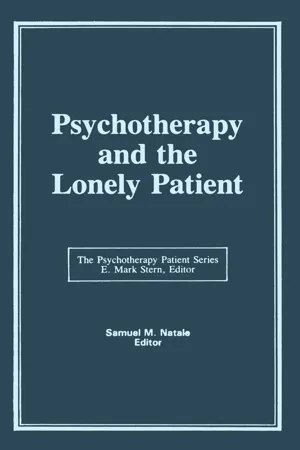
Psychotherapy and the Lonely Patient
About this book
Here is an important new book focusing on the contribution of the therapist's love and empathy to the therapeutic process. Technique without dedication, discipline, and understanding will rarely benefit patients nor help resolve their conflicts. Psychoanalytic Technique demonstrates how the therapist's countertransference feelings, anxieties, wishes, and superego admonitions shape his or her therapeutic interventions.
Information
Loneliness and the Aging Client: Psychotherapeutic Considerations
ABSTRACT. The article surveys the sociological and psychological themes and demographics that characterize the aging person. Loneliness as a manifestation of psychological and social development is examined. Individual and group modes of intervention to alleviate chronic loneliness among the aged are discussed and analyzed.
EXPERIENCE OF LONELINESS AND OLD AGE
Definition of Aging
Current literature supplies numerous definitions of aging. Since the process of aging may be conceived from various perspectives, the subsequent definition becomes a function of that particular view. The author favors a concept of aging consistent with the definition set forth by Birren and Renner (1977). They define aging as, “the regular behavior changes that occur in mature genetically representative organisms living under representative environmental conditions as they advance in chronological age” (p. 5).
We can further refine the definition by distinguishing between biological, psychological and social age (Birren & Renner, p. 5). Biological age is the individual's physical status in relation to his or her life expectancy. Psychological age refers to the adaptive behavioral capabilities of the individual in relation to other individuals. Social age deals with social roles the individual plays as well as social habits developed and must be judged in terms of societal expectations for the individual's age.
Changes in biological, psychological and social age are not necessarily parallel within the individuals nor are these patterns similar from individual to individual. Direction and rate of change may vary for each of the three components. Decline or growth in one area is not necessarily associated with a proportional decline or growth in another area. It is therefore possible to experience a decline in physical status while simultaneously experiencing positive growth in psychological adaptive capabilities.
Factors Which Contribute to Loneliness in Old Age
Biological Correlates of Aging
As a biological process, aging is characterized by a decline in functioning which ultimately terminates with death. It is a “progressive loss of functional capacity after an organism has reached maturity” (Busse & Blazer, 1980 p. 5). There is a deterioration in major organs and systems; heart, lungs, kidneys, liver, nervous and digestive systems lose their former capabilities. The immune system weakens and the individual no longer resists disease with his/her previous strength. This results in “declines in mobility, energy, strength, and stress tolerance” (Yurick, Robb, Spier, & Ebert, 1980, p. 5).
How prevalent are physical limitations in the elderly compared with the total population? In 1980, there were 31.4 million individuals with an activity limitation due to chronic physical disorders (selected chronic conditions included heart conditions, arthritis and rheumatism, hypertension, impairment of back/spine, and impairment of lower back extremities and hips) (Statistical Abstract of the United States, 1982–83, p. 85). Of this total, 10.2 million were under 45 years of age, 10.4 million were between the ages of 45 and 64, and 10.8 million were 65 years of age or older. Although persons age 65 and older accounted for approximately 11 % of the total population in 1980, they accounted for over one-third of all cases of activity limitation due to chronic illness.
Perhaps a more meaningful comparison is the percent of the population with no impairment. Of the total population, 85.6% are not limited by a physical condition while 54.8% of these 65 years and older enjoy this freedom. The contrast is heightened if we examine individuals 45 years and younger. In this case, a full 93.2% are free from the debilitating effects of physical impairment.
Although it is true that the majority of those 65 and over are in good health (if we define good health as the absence of an activity limitation), it is also true that the elderly experience substantially more restrictions based on poor health than the population in general. Logically, we can deduce that the increased isolation due to physical limitation contributes to the experience of loneliness in old age. Kivett (1978, 1979) provides support for this assumption in two separate studies. She classified 103 rural widows into three levels of loneliness: frequently lonely, sometimes lonely, and never lonely. She found that physical isolation as determined by self-perceived health and availability of transportation separated those who were frequently lonely from those who were never lonely. In the second study, Kivett classified 418 rural elderly into either high or low risks for loneliness. Poor vision and self-rated health were two of seven conditions which were associated with frequent loneliness. (The other conditions were widowhood, problems with transportation, frequent use of telephone, low participation in organized social activities, and being female.) Poor health has also been found to account for conditions related to loneliness. Mussen, Honzik, and Eichorn (1982) found that poor health was associated with a lack of life satisfaction in elderly men. Likewise, Markides and Martin (1979) and Beck (1982) found life satisfaction and happiness to be strongly associated with good health in the elderly.
Developmental Views of Aging
As early as 1933, Jung saw the later half of life as a process of turning inward toward the self. To deal with one's impending death one must, to some degree, remove oneself from the world. In introspection one develops a philosophical or religious view of life and death (p. 55).
Erikson views the life cycle as a series of stages which have specific goals (p. 87). In the last stage, the individual must attain ego integrity by turning inward, examining one's life, and accepting it as it has been lived. If the individual cannot develop a sense of integrity from past accomplishments, but instead focuses on past mistakes and missed opportunities, despair results. Perhaps the most extensive work on the theme of turning inward has been proposed by Cumming and Henry (1961). Based on their study of a health cross-section of the elderly in Kansas City, they introduced a concept which has been known as disengagement. Disengagement theory holds that the elderly person withdraws and detaches himself or herself, gradually reducing contacts and involvements with the larger society. This is seen as a natural, adaptive process that is necessary because of the elderly individual's impending death. Cumming and Henry viewed disengagement as a necessity for successful adaptation to old age.
Although subsequent research does not substantiate the disengagement process as a healthy adaptation to aging, it is difficult to point to a cause and effect relationship (Larson 1978, p. 109). In other words, did the elderly turn inward to an effort to examine their life and values or were they forced into passivity and isolation because of poor health? We might conclude that those who choose a contemplative life-style would be well adjusted while those who involuntarily withdrew would not. Unfortunately, most research to date has not separated the effects of these intervening variables.
Owens (1981) feels that turning inward can indeed be beneficial in old age (p. 113). She sees an absence of wholeness, expressed in the lack of integration of left and right hemispheres of the brain, as a cause of many difficulties experienced in old age. She proposes the use of meditation as a means by which attainment of wholeness is possible. Meditation allows the activation of previously buried virtues. It enables the individual to use these resources to deal with the problems of aging. By the process of meditative exploration, the “true self” is found. This true self paves the way for the “moment of becoming” when the individual experiences a oneness with the universe. Owens feels that meditators can find companionship in their awakened selves and in their experience of oneness with the universe. This companionship is a powerful aid in dealing with loneliness.
She states that meditation “… transforms the whole hierarchy of values from the seen to the unseen. The chief riches valued by followers of the Eternal Way are inner wealth: certitude, courage, creativity, honesty, love, desire to serve others, selflessness, purity and joy” (p. 113). We can conclude therefore, that turning inward can be beneficial in dealing with problems of old age if it is utilized as a development of psychological resources. Removing oneself for the purposes of solitary contemplation, be it expressed as meditation or as prayer, can be a positive experience in old age. If the individual uncovers previously obscured inner resources, withdrawal can be comforting and productive.
The Role of Sociocultural Factors
Despite an increased awareness and acceptance of the aging process in recent years, ageism continues to exist in American society and is one factor contributing to the experience of loneliness in old age (Butler, 1969, p. 243). Alex Comfort (1980) speaks of the cultural problem termed gerontophobia. He states that, “unique to our culture is its rejection of the old, their exclusion from work and their accustomed social space, their premature burial as ‘unpeople’, and a rich and erroneous folklore of mental decline, infirmity, asexuality, ineducability, and the normality of causeless mental disorders in the old” (p. 2).
Changes in chronological age are typically accompanied by changes in social roles. At earlier points in the life cycle, loss of one role is usually substituted by another. For example, a college student will, upon graduation, lose the role of “student.” However, it is likely that this role will be replaced with “employee.” A young couple may no longer consider themselves “newlyweds” after the birth of their first child. They have however, now acquired a new role: that of parents. The difference between this type of situation and that of the elderly revolves around the issue of replacement.
When an elderly person retires, the work role is frequently not replaced with another job. Loss of employment is often accompanied by a loss in economic security and social status. One can no longer define oneself as an employee of XYZ Company. Contributing to loneliness may be a loss of contact with co-workers and friends. Unlike the young person who has the opportunity to replace this job with another, the elderly individual's role loss is permanent.
Another frequent role change experienced by the elderly is that of marital status. With increasing age, the loss of spouse through death becomes more probable. The widowed individual loses much more than an identity; he or she loses a lifelong partner, a companion, and a primary source of psychological support. Because of lack of time and opportunity, remarriage (replacement) becomes less likely. This type of unreplaced role loss is not universal nor has it always been the case.
Gutmann (1980) feels that certain types of societies are more suited to supporting the mental health of the elderly than others. According to Gutmann, the small, face to face, traditional folk society comes closest to providing optimal support for the elderly. Hareven (1978) also supports this general view. She feels that the negative image of old age and consequent isolation of the elderly from the mainstream of society are a function of increasing segragation of different life stages in modern American society. She points out that, “The absence of dramatic transitions to adult life allowed a more intensive interaction among different age groups within the family and the community, thus providing a greater sense of community and interdependence among people at various stages in the life course” (p. 208).
Although both Gutmann and Hareven concur on the type of social structure most supportive of the elderly, Gutmann proposes a somewhat different perspective on causation. He states:
There appears to be an assured, organic linkage—a “deep structure”—that bond the older traditional persons and the sacred systems of their culture as these are represented in theology, in myth, and in ritual. This special bonding between the sacred and the geriatric leads to traditional gerontocracy, to special privilege and esteem for the aged, based on their special access to spiritual resources. (p. 433)
A loss of isolation causes a redistribution of power within the previously insulated society. The introduction of new ideas weakens the strength of the old. Economic power is now accessible from sources other than familial holdings. The power base shifts from within the culture to an outside source. Gutmann distinguishes between urbanization and modernization, Stating that the former is not necessarily a product of the latter. In modernization, a different culture is accepted as better than that of the present one. If however, both rural and urban areas are part of the same social evolution, harmony of process is achieved. Before their contact with the West, Oriental cities preserved traditional values, rituals, and practices. It is therefore theoretically possible to maintain a supportive social structure for the elderly in modern urban society.
Gutmann proposes a creative solution to a very difficult problem. He points out that certain secular professions—for example law, medicine, and academia—might create the essence of the earlier religious function of the elderly. Appointing older practitioners to represent the ethical standards of the profession would effectively recreate the sacred status of the aged.
These professions resemble folk society by sharing a strong distinction between the sacred and the secular. The younger members would address the routine norms of practice while the elderly would address the moral issues. The elder, no longer motivated by self-interest in building a career, can be a more objective spokesperson for the ethical position. The elder's function would therefore be of value to society, and also supportive of the social status and mental health of the aged in modern society.
Situational Factors and Loneliness in Old Age
Retirement and Income
Although one might expect retirement to be correlated with loneliness and an overall detrimental effect in old age, this is not always the case. There are several intermediate and interconnected conditions that determine whether or not retirement has an adverse effect on the elderly.
Income is a significant determinant of the evaluation of retirement. Beck (1982) found that lower income was one of the main determinants in a negative evaluation of retirement. In March of 1982 the median annual income for all persons in the United States was $19,074.17. For those aged 65 and over, the median annual income was only $9,903.18. Only 20% of the el...
Table of contents
- Cover
- Half Title
- Title Page
- Copyright Page
- Table of Contents
- Loneliness and the Fuller Vision: A Preface
- Interrelationships Between Religiousness and Loneliness
- Treating Loneliness in Children
- Loneliness and the Single, the Widowed, and the Divorced
- Cognitive Pastoral Psychotherapy With Religious Persons Experiencing Loneliness
- Will You Be My Friend? Group Psychotherapy With Lonely People
- Loneliness and the Aging Client: Psychotherapeutic Considerations
- Replication of the Phenomenology of Loneliness in the Therapeutic Dyad
- A Model for Working With Lonely Clients: Sadler Revisited
Trusted by 375,005 students
Access to over 1.5 million titles for a fair monthly price.
Study more efficiently using our study tools.
Frequently asked questions
Yes, you can cancel anytime from the Subscription tab in your account settings on the Perlego website. Your subscription will stay active until the end of your current billing period. Learn how to cancel your subscription
No, books cannot be downloaded as external files, such as PDFs, for use outside of Perlego. However, you can download books within the Perlego app for offline reading on mobile or tablet. Learn how to download books offline
Perlego offers two plans: Essential and Complete
- Essential is ideal for learners and professionals who enjoy exploring a wide range of subjects. Access the Essential Library with 800,000+ trusted titles and best-sellers across business, personal growth, and the humanities. Includes unlimited reading time and Standard Read Aloud voice.
- Complete: Perfect for advanced learners and researchers needing full, unrestricted access. Unlock 1.5M+ books across hundreds of subjects, including academic and specialized titles. The Complete Plan also includes advanced features like Premium Read Aloud and Research Assistant.
We are an online textbook subscription service, where you can get access to an entire online library for less than the price of a single book per month. With over 1.5 million books across 990+ topics, we’ve got you covered! Learn about our mission
Look out for the read-aloud symbol on your next book to see if you can listen to it. The read-aloud tool reads text aloud for you, highlighting the text as it is being read. You can pause it, speed it up and slow it down. Learn more about Read Aloud
Yes! You can use the Perlego app on both iOS and Android devices to read anytime, anywhere — even offline. Perfect for commutes or when you’re on the go.
Please note we cannot support devices running on iOS 13 and Android 7 or earlier. Learn more about using the app
Please note we cannot support devices running on iOS 13 and Android 7 or earlier. Learn more about using the app
Yes, you can access Psychotherapy and the Lonely Patient by Samuel M Natale,E Mark Stern in PDF and/or ePUB format, as well as other popular books in Psychology & History & Theory in Psychology. We have over 1.5 million books available in our catalogue for you to explore.