eBook - ePub
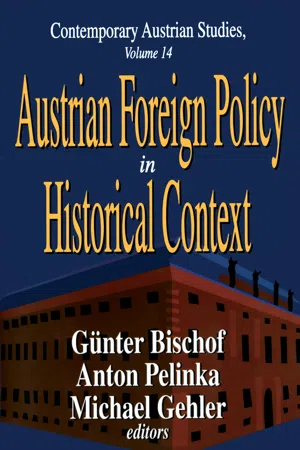
Austrian Foreign Policy in Historical Context
- 423 pages
- English
- ePUB (mobile friendly)
- Available on iOS & Android
eBook - ePub
Austrian Foreign Policy in Historical Context
About this book
In 2005, Austria celebrated the sixtieth anniversary of its liberation from the Nazi regime and the fiftieth anniversary of the State Treaty that ended the occupation and returned full sovereignty to the country. This volume of Contemporary Austrian Studies covers foreign policy in the twentieth century. It offers an up-to-date status report of Austria's foreign policy trajectories and diplomatic options. Eva Nowotny, the current Austrian ambassador to the United States, introduces the volume with an analysis of the art and practice of Austrian diplomacy in historical perspective. Ambassador Wolfgang Petritsch analyzes recent Balkans diplomacy as an EU emissary in the Bosnian and Kosovo crises. Historians G nther Kronenbitter, Alexander Lassner, G nter Bischof, Joanna Granville, and Martin Kofler provide historical case studies of pre-and post-World War I and World War II Austrian diplomacy, Austria's dealings with the Hungarian crisis of 1956, and its mediation between Kennedy and Khrushchev in the early 1960s. Political scientists Romain Kirt, Stefan Mayer, and Gunther Hauser analyze small states' foreign policymaking in a globalizing world, Austrian federal states' separate regional policy initiatives abroad and Austria's role vis-is current European security initiatives. Michael Gehler periodizes post-World War II Austrian foreign policy regimes and provides a valuable summary of both the available archival and printed diplomatic source collections. A "Historiography Roundtable" is dedicated to the Austrian Occupation decade. G nter Bischof reports on the state of occupation historiography; Oliver Rathkolb on the historical memory of the occupation; Michael Gehler on the context of the German question; and Wolfgang Mueller and Norman Naimark on Stalin's Cold War and Soviet policies towards Austria during those years. Review essays and book reviews on art theft, anti-Semitism, the Hungarian crisis of 1956, among other topics, complete the volume.
Information
Topical Essays
I. Introduction
Diplomats: Symbols of Sovereignty become Managers of Interdependence: The Transformation of the Austrian Diplomatic Service
Introduction
One hundred years ago, Sir Ernest Satow—the author of the much used guide to diplomatic practice—defined the task of diplomats as “the application of intelligence and tact to the conduct of official relations between the governments of independent states.” This definition seems rather quaint or even dysfunctional today. An informed public would hardly support and legitimize the arrogance inherent in the claim that only professional diplomats would be endowed with the “tact and intelligence” required for this task.
Nor can the claim be supported that diplomats should have a kind of monopoly of being active in this field. Indeed, it seems presumptuous to raise such a claim, given the fact that today politicians do not find it difficult to contact one another directly without the intercession of their respective ambassadors. In doing so, they could—it seems—avoid misunderstandings and ambiguities that would be bound to arise so easily from the interposition of a third and fourth person. Indeed, these direct contacts between rulers proliferate.
The insistence on “official relations” seems outmoded, too, for in today’s world, the distinction between “official” and “not official” has lost much of its meaning. Prime ministers lobby potent transnational firms for selecting their country as the site for their new investments. Criticism by non-governmental bodies like Amnesty International, Greenpeace, or Transparency International usually carries greater weight, consequence, and relevance than some critical remarks made by Ambassador A to Ambassador B at a cocktail reception of Ambassador C.
Additionally, funding this diplomatic apparatus is expensive. In the case of Austria, several hundred of diplomats have to be maintained abroad, with official residences, chauffeurs, cooks, and other support staff in a lifestyle that seems a leftover from feudal times and is not in accord with the egalitarian ethos of the democratic republic they represent.
So, if all of this is true, why, then, are diplomats still around a hundred years after their demise had been predicted? Why have they become even more numerous instead of quietly becoming extinct as a species no longer adapted to the new habitat of a modem, democratic, information-and knowledge-based society?
It is true, of course, that all bureaucracies tend to perpetuate themselves and that they tend to do so beyond the time of their functionality. This pertains, in particular, to the bureaucracies of the state. The diplomatic service should be no exception. Motivated by the narrow interest of preserving its privileges and shielded by a fog of nationalist myth about its unique symbolic value, the diplomatic corps of the world would, thus, have been able to survive even after having lost all practical usefulness.
But it seems doubtful that these are the true reasons for the survival and even expansion of the diplomatic services of the world. For one should doubt that over decades ministers of finance and critical members of parliaments would have been willing to budget for institutions which might be charming, but useless.
Using the Austrian diplomatic service as an example and drawing on my personal experience as a diplomat, political advisor, and historian, I will argue that the diplomatic service flourishes because, while preserving and honing some of its core skills, it has changed, adapting to the radically changed environment of a deeply interdependent world and developing new tools and modes of action to tackle the new tasks presented by this new environment.
Changes in the Terrain of Diplomacy
When I entered the Austrian Ministry for Foreign Affairs on 1 March 1973, my first boss installed me in an empty office and handed me a thick file which he advised me to study diligently and carefully. It was entitled “Runderlass über die Formen der schriftlichen Aktenerledigung” (“Circular Instruction ad omnia on the Appropriate Forms of Written Communications”). Having come to diplomacy with a doctorate in history and having gone through years of archival research in preparation for my dissertation on Klemens von Metternich, I discovered very quickly that there was nothing in this “Runderlass” which was in any way new or surprising. On the contrary, all the various elements contained therein, from the proper way of drafting the “Aktenvermerk”, giving the reader of a file a brief synopsis of the case at hand and explaining the reasoning of the author for a proposed course of action, to the political report, the political instruction or the correct filing, were deeply familiar to me. They were the same used by Metternich and his staff as he drafted and negotiated his European-wide diplomatic network. These first hours on my first day into a new career gave me insight into the astounding degree of continuity, which through all the vagaries of history has marked and still marks Austrian diplomacy—a degree of continuity and a sense of tradition combined, as it is, with openness for change and the capacity to adapt very quickly to changed circumstances.
When I entered the diplomatic service, faxes and xerox machines were not yet in use. Making a long distance call (even within Austria) required prior approval by the head of the department. Diplomats were still supposed to travel to new overseas assignments by boat. Hierarchies were steep and strict. The “Du” among colleagues, a leftover from the feudal era of the empire, was strictly reserved for the A-level officers. In matters relating to official business, communication other than via the official hierarchic channels was not only frowned upon, but it was also punished. Truly relevant were only the things that happened within the confines of this monastic entity. Other state bureaucracies were automatically assumed to be of a lesser kind and of negligible relevance. The role model was the elegant, slightly cynical ambassador writing, every two months or so, witty, highly readable, and quotable reports based on his periodic encounters with the political director of the Foreign Ministry of his receiving state.
It was at that time, too, that Austria—a young state in many respects—had just managed to gain a firmer sense of its own identity and place in the world. But this identity being young and that place still being uncertain, much unease persisted. It influenced some activities and claims that today may seem quixotic (such as the claim that Austria should politically use its weight as a “cultural super-power,” with the Vienna Philharmonic orchestra being equivalent to the armament of bigger states). But the same unease and uncertainty also fueled the desire to gain acceptance and respectability by being useful to others by:
- lowering the risks inherent in the East-West confrontation,
- broadening contacts with its neighbors in Central and Eastern Europe in the hope of preserving their European identity,
- strengthening European fora of cooperation like the Council of Europe, and
- promoting on a global level the rule of law and widening and deepening the reach of cooperation in and through international organizations.
The new Austrian Federal Chancellor Bruno Kreisky was about to broaden this agenda further by claiming for Austria a role in the viciously explosive conflict between Israelis and Palestinians, and— more generally—in efforts to narrow the gap between the rich and the poor nations of the world.
Thus, in terms of the tasks set for Austrian diplomats, this was a time of transition and significant change. The prior, obvious, and somehow externally imposed tasks had been completed. Independence and sovereignty were secured. Austria had adhered to stipulations by the United Nations and the Council of Europe. With neutrality, a viable security policy had been defined. To the extent possible, the rights of the Austrian population living in South Tyrol had been safeguarded. With Germany, claims and counter claims arising from the Second World War had been settled. Last but not least, Austria had managed to participate in the economic integration of Western Europe through its membership in the European Free Trade Association (EFTA).
These immediate tasks completed, Austria now sought its place and function in a wider regional and global setting. The concept of a “national interest” was broadened and was subsumed under the notion of “Aktive Neutralitätspolitik,” a policy of pro-active neutrality. Austrian diplomats, their mode of work and the tools they used, had to adapt. But this need to adapt did not just reflect the new priorities in Austria’s own foreign and security policy; it also reflected the changes in the wider world.
There is a tendency to regard the period between 1950 and 1990 as a period of great stability, in which all the main parameters of the global order remained unchanged, with the two structural cleavages being the one between the Communist “East” and the democratic “West” and the one between a poor, post-colonial “South” and the wealthy “North.” This era of tranquility would have come to an end just at the end of the last century with the downfall of the Communist empire and with terrorists smashing the twin towers of New York’s World Trade Center ten years later.
But this image of an uneventful forty years is misleading. Actually, the time between 1950 and 1990 was one of massive transformation in the very structure of the global system. The relative power of the United States became somewhat lesser, and the power of its Soviet counterpart had been in irreversible decline since the early 1960s. Japan and Germany regained their former economic status, yet renounced their historic geo-political ambitions. The number of states doubled, and next to these numerous new states, other actors became active as players on the global scene: transnational corporations and transnational groups pursuing a political agenda became both more numerous and relevant. So did the official international organizations whose number also doubled in that period.
But that was not all, and this increase in the numbers of international actors and the shifts in their relative power were not changes of a truly revolutionary kind. What had truly transformed the global order was the growing interconnectedness of all of these players. As the world’s population doubled and as the world’s wealth grew even faster, each one came to depend on the other in a very direct way, with lower transportation costs and the general lowering of the “transaction costs” merging the world into a single economic space and making increasingly porous the international borders that once had so clearly divided the realm of one sovereign from the territory of another.
Many profited. Quite a number of persons and states did not. While the world as such became wealthy as it has never been before, the chasm that divides wealth and poverty also became deeper than it had ever been before.
Complex systems such as a highly interconnected and interdependent world are accident-prone and vulnerable. They are in need of steerage and protection, and this is what the actors in the international system have to provide. A good part of that task falls to the agents of states, who remain, after all, the dominant players on the global scene. In fulfilling these tasks, states may, of course, use different agents. Heads of governments themselves have become more directly involved in this task. They congregate at the ever more frequent summit meetings of various sorts. In between, they have adopted the habit of calling one another on the phone, or as in the European Union, they have at their disposal a special e-mail system for instant communication. Within the public administration, many different branches of government have installed special offices to administer their international agenda. Indeed, there are only few not touched by global interdependence and, thus, not obliged to interact with their counterparts in other countries of the world. Even provinces and towns have an international agenda and their own strategies and instruments for achieving it. Nevertheless, diplomats remain active, and looking at Austria, I would maintain that their assignments have multiplied. Far from receding into the irrelevance that had been predicted for them, they are multi-tasking professionals and now till fields they had not touched before. Certainly, this could not be the case had the Austrian diplomatic service remained as it was at the time when I was initiated into its ranks. Had it remained unchanged, it would have been reduced to a reliquary of merely symbolic value, surviving in reduced scope, out of bureaucratic inertia and not because of services rendered to the public. Instead, it has been transformed. An old ambassador who retired in 1970 would feel lost after passing through the gates of Ballhausplatz 2. He would no longer recognize as his the ministry now in place.
Three forces are behind this wholesale makeover:
- the need to adapt to changes in the international environment and in the global order;
- the unprecedented ease of communication both within and outside of the country, together with the ease of providing and accessing information on a global scale; and
- finally, socio-cultural changes, which affected mos...
Table of contents
- Cover
- Title Page
- Copyright
- Table of Contents
- INTRODUCTION
- TOPICAL ESSAYS
- NON-TOPICAL ESSAY
- ROUNDTABLE
- REVIEW ESSAYS
- BOOK REVIEWS
- ANNUAL REVIEW
- LIST OF AUTHORS
Trusted by 375,005 students
Access to over 1.5 million titles for a fair monthly price.
Study more efficiently using our study tools.
Frequently asked questions
Yes, you can cancel anytime from the Subscription tab in your account settings on the Perlego website. Your subscription will stay active until the end of your current billing period. Learn how to cancel your subscription
No, books cannot be downloaded as external files, such as PDFs, for use outside of Perlego. However, you can download books within the Perlego app for offline reading on mobile or tablet. Learn how to download books offline
Perlego offers two plans: Essential and Complete
- Essential is ideal for learners and professionals who enjoy exploring a wide range of subjects. Access the Essential Library with 800,000+ trusted titles and best-sellers across business, personal growth, and the humanities. Includes unlimited reading time and Standard Read Aloud voice.
- Complete: Perfect for advanced learners and researchers needing full, unrestricted access. Unlock 1.5M+ books across hundreds of subjects, including academic and specialized titles. The Complete Plan also includes advanced features like Premium Read Aloud and Research Assistant.
We are an online textbook subscription service, where you can get access to an entire online library for less than the price of a single book per month. With over 1.5 million books across 990+ topics, we’ve got you covered! Learn about our mission
Look out for the read-aloud symbol on your next book to see if you can listen to it. The read-aloud tool reads text aloud for you, highlighting the text as it is being read. You can pause it, speed it up and slow it down. Learn more about Read Aloud
Yes! You can use the Perlego app on both iOS and Android devices to read anytime, anywhere — even offline. Perfect for commutes or when you’re on the go.
Please note we cannot support devices running on iOS 13 and Android 7 or earlier. Learn more about using the app
Please note we cannot support devices running on iOS 13 and Android 7 or earlier. Learn more about using the app
Yes, you can access Austrian Foreign Policy in Historical Context by Anton Pelinka,Gunter Bischof,Michael Gehler in PDF and/or ePUB format, as well as other popular books in Politik & Internationale Beziehungen & Geschichte des 20. Jahrhunderts. We have over 1.5 million books available in our catalogue for you to explore.