- 560 pages
- English
- ePUB (mobile friendly)
- Available on iOS & Android
eBook - ePub
About this book
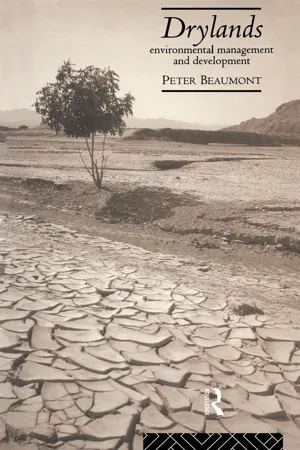
Drylands, which cover over half the world's area, have witnessed rapid development, exploitation and change with the discovery of mineral reserves, urbanization and population growth. Environmental management is critical to the conservation and sustainable use of resources.
This comprehensive text offers a systematic study of the physical nature of drylands and the history of human response to and uses of these harsh landscapes. Detailed case studies, including urban as well as pastoral drylands from California to Soviet Central Asia, the Middle East, the Sahara and Australia, contrast different management approaches and problems.
Information
Part One
Systematic Study of Drylands
1
Nature of the Dryland Environment
1.1 Definitions of Drylands
The term drylands is one which is easy to understand in a general sense, but is difficult to define in precise terms. The same is also true for concepts such as aridity and drought. With all of these terms it is water shortage which is the critical variable, though other factors are also important. In this study the term ‘drylands’ will be used to distinguish all those areas which experience regular water shortage on a seasonal or longer-term basis. This obviously includes all the arid lands of the world, defined by their extremely low precipitation totals, but will also encompass regions which may record significant rainfall for at least part of the year. In this context, the term ‘drylands’ involves a much broader interpretation than is the case with the more commonly used term, ‘arid lands’.
Many workers have attempted to define precisely the term ‘aridity’ so that areas could be cartographically delimited for planning purposes. Any definition must, therefore, be quantifiable and at the same time produce a result which ideally has some physical meaning on the ground, either in terms of vegetation patterns or soil formation processes. Water is, of course, the key to understanding aridity, but absolute amounts, in isolation from other factors, tell us little of the dynamic processes which are operating in any particular region. Precipitation is the main input of water into any drainage basin and the two major outputs are evapotranspiration and streamflow. Of these two, evapotranspiration is the independent variable and streamflow the dependent one. Hence, in any consideration of aridity, the focus of any study must be on the relationships between precipitation and evapotranspiration.
Precipitation is an environmental attribute which is relatively easy to measure, and records, often over many years, are available from many dryland regions. In contrast, data on actual evapotranspiration — that is, the water loss from plant and soil surfaces — are extremely scarce for almost all parts of the world, even at the present day. This has meant that workers in the arid zone have therefore tended to overestimate the significance of absolute precipitation amounts, and been forced to utilise what are often crude measures of temperature or energy input as surrogates for evapotranspiration data. Not surprisingly the formulae which have been produced have lacked the degree of precision which is necessary for accurate planning purposes.
Over the years, many definitions of aridity in the meteorological/climatological sense have been put forward. In a review paper, Wallen (1967) identifies three bases for definition, which he defines as the classical, index and water balance approaches. The classical approach focuses on climatic elements and their relationships to vegetation belts and agricultural zones. Initially, simple assessments of precipitation amounts were used, though these were later amplified by studies of variability and intensity. The effects of temperature were originally confined to mean or extreme values, but later, more sophisticated methods were employed, making use of heat sums, limiting temperatures and annual fluctuations.
The index approach seeks to delimit regions with differing degrees of aridity by the application of standard formula. The best known example of this approach is the climatic classification of Koppen (1931), which defined the boundaries of the arid zone in terms of annual precipitation and temperature indices. Koppen identified two arid climates, deserts (Bw climates) and steppes and semi-deserts (Bs climates), which together accounted for slightly more than 26 per cent of the Earth’s land surface. A similar index of aridity developed by Martonne (1926) has also been widely used.
To provide a more scientific approach to the subject and in particular to explore the relationships between precipitation and evapotranspiration, the water balance concept was developed. Initially, the two main workers in the field were Thornthwaite and Penman, who both developed the concept of potential evapotranspiration independently in 1948 (Penman, 1948; Thornthwaite, 1948). Of the two, Penman devised the more sophisticated formula by making use of both the turbulent transfer and energy balance approaches, whereas Thornthwaite’s work relied upon the energy balance approach alone. In experimental work, Penman’s formula has been shown to produce results which are closely comparable with direct measurements obtained from evaporating pans and lysimeters. As a result it has been widely adopted throughout the world for the estimation of potential evapotranspiration. Many other workers have developed formulae for specific needs. Perhaps the best known is that of Blaney and Criddle (1950), which has been widely employed to calculate irrigation water requirements in the USA and elsewhere.
It is, however, the work of Meigs during the 1950s which today forms the basis of most definitions of arid conditions (Meigs, 1953). He aimed to produce a world map, which would reflect plant-growing conditions and, therefore, be valuable for agricultural planning purposes. Meigs employed Thornthwaite’s method to calculate potential transpiration to produce a moisture index which illustrated the relationships between precipitation and evapotranspiration. This was then used to produce a threefold division of the arid zone into extremely arid, arid, and semi-arid (Table 1.1). The map so produced also provided information on the season of precipitation by the use of three categories — no distinct season, summer precipitation, and winter precipitation. Temperature information was included on the mean monthly temperatures of the coldest and warmest months respectively in 10°C groupings.
Table 1.1: Arid homoclimates by Peveril Meigs

Source: Meigs, 1953.
The most recent definitive map of the arid zones of the world has been prepared by the Man and Biosphere (MAB) programme of UNESCO and was published in 1979 (UNESCO, 1979). It represents an updating of the well-known Meigs map of 1952, which was also produced for UNESCO. As yet the new map has not become widely known and many workers still continue to use the Meigs map. The main divisions of the UNESCO map, representing differing degrees of bioclimatic aridity, are delimited using values of the ratio P/ETP (Figure 1.1). P is the mean annual precipitation and ETP is the mean potential evapotranspiration calculated using the Penman formula. Four categories are recognised: the hyper-arid has a P/ETP ratio of less than 0·03; the arid from 0·03 to 0·20; the semi-arid from 0·20 to 0·50; and the sub- humid from 0·50 to 0·75. The sub-humid classification is a new one not used in the earlier Meigs map.

Figure 1.1 The arid regions of the world
Source: Redrawn from the Map of the World Distribution of Arid Regions. © Unesco 1977. Reproduced by permission of Unesco.
The hyper-arid zone consists of true desert climates where precipitation is extremely low and irregular in occurrence. Perennial vegetation is almost totally absent and neither pastoral nor arable farming is possible using naturally occurring rainfall. The arid zone receives annual precipitation totals of between 80 and 350 millimetres (mm), with inter-annual rainfall variability of between 50 and 100 per cent. Some scattered vegetation permits low-intensity grazing, but no rain-fed agriculture can be maintained on a continuing basis. The semi-arid zone is characterised by precipitation totals of between 200 and 700 mm. Grassland and scrub vegetation predominate, providing high-quality grazing. Rain-fed agriculture can easily be maintained in this zone, but yields show marked variations from year to year as inter-annual variability is between 25 and 50 per cent. The sub-humid zone contains a variety of vegetation types, from savannahs to broken woodlands. Inter-annual rainfall variability is less than 25 per cent and productive arable farming is the primary human land use.
Each of these categories is further sub-divided on the basis of temperature. The temperature of the coldest month in degrees centigrade is used to define four classes. These are:
(a) warm winters with coldest-month temperatures between 20 and 30°C;
(b) mild winters with coldest months from 10 to 20°C;
(c) cool winters with coldest months from 0 to 10°C; and
(d) cold winters where the temperature of the coldest month is less than 0°C.
In turn these temperature classes are further sub-divided in terms of the mean temperature of the hottest month of the year using values of 10, 20 and 30°C as the boundaries between the categories. Finally, the map also shows the lengths of periods of drought in relation to the seasons and precipitation regimes.
Although the UNESCO (1979) map is currently the definitive work on the arid zone, it has to be realised that the data on which the map is based are still very restricted for many parts of the world. This means that the lines drawn on the map often have a spurious accuracy, particularly in the more isolated parts of the arid zone. Having defined the arid lands it is important next to consider their distribution over the surface of the Earth. In examining the UNESCO map (Figure 1.1) the first point which strikes one is the concentration of the world’s drylands in a belt stretching across north Africa and into south-west and central Asia. Indeed, so important is this zone that it accounts for about two-thirds of all arid lands. Elsewhere, a much less continuous pattern is found. Australia is undoubtedly the driest continent, but only accounts for 13 per cent of the arid zone. In the New World, pockets of aridity are found, which are locally important, though nowhere do they match the intensity and scale of Africa, Asia or Australia. In total these New World drylands account for 14 per cent of the arid zone.
1.2 Climatic Characteristics
1.2.1 Precipitation
Of all the climatic parameters it is precipitation which plays the dominant role in drylands. By definition all arid lands receive low annual precipitation totals, with stations like Aswan in Upper Egypt often experiencing many years with no rainfall whatsoever. An equally important characteristic of drylands is their high rainfall variability. Indeed, as precipitation totals decrease, annual rainfall variability increases. This means that the reliability of precipitation at any station will decrease as precipitation totals decline. Variability, though, can provide either much more or much less water than mean annual totals would suggest. Indeed, to talk of mean annual precipitation within the arid zone conveys a false impression of what conditions are actually like. In many cases a truer reflection is conveyed by the inter-quartile range (which brackets 50 per cent of available observations) or the 10 percentile to 90 percentile range (which brackets 80 per cent of available observations) (Figure 1.2).

Figure 1.2 Annual rainfall of Australia showing the 10 percentile and 90 percentile distribution
Source: Redrawn from a map from the Rainfall volume of the Climatic Atlas of Australia supplied by courtesy of the Bureau of Meteorology, Australia.
The form of precipitation in the arid zone depends largely on temperature conditions. Throughout many of the drylands, snowfall is not unknown, and in some highlands it is the chief form of precip...
Table of contents
- Cover Page
- Half Title page
- Routledge Natural Environment: Problems and Management Series
- Title Page
- Copyright Page
- Dedication
- Contents
- List of Figures
- List of Tables
- List of Plates
- Preface
- Part One Systematic Study of Drylands
- Part Two Regional Resource Management — Case Studies
- Part Three Prospect
- Bibliography
- Index
Trusted by 375,005 students
Access to over 1.5 million titles for a fair monthly price.
Study more efficiently using our study tools.
Frequently asked questions
Yes, you can cancel anytime from the Subscription tab in your account settings on the Perlego website. Your subscription will stay active until the end of your current billing period. Learn how to cancel your subscription
No, books cannot be downloaded as external files, such as PDFs, for use outside of Perlego. However, you can download books within the Perlego app for offline reading on mobile or tablet. Learn how to download books offline
Perlego offers two plans: Essential and Complete
- Essential is ideal for learners and professionals who enjoy exploring a wide range of subjects. Access the Essential Library with 800,000+ trusted titles and best-sellers across business, personal growth, and the humanities. Includes unlimited reading time and Standard Read Aloud voice.
- Complete: Perfect for advanced learners and researchers needing full, unrestricted access. Unlock 1.5M+ books across hundreds of subjects, including academic and specialized titles. The Complete Plan also includes advanced features like Premium Read Aloud and Research Assistant.
We are an online textbook subscription service, where you can get access to an entire online library for less than the price of a single book per month. With over 1.5 million books across 990+ topics, we’ve got you covered! Learn about our mission
Look out for the read-aloud symbol on your next book to see if you can listen to it. The read-aloud tool reads text aloud for you, highlighting the text as it is being read. You can pause it, speed it up and slow it down. Learn more about Read Aloud
Yes! You can use the Perlego app on both iOS and Android devices to read anytime, anywhere — even offline. Perfect for commutes or when you’re on the go.
Please note we cannot support devices running on iOS 13 and Android 7 or earlier. Learn more about using the app
Please note we cannot support devices running on iOS 13 and Android 7 or earlier. Learn more about using the app
Yes, you can access Drylands by Peter Beaumont in PDF and/or ePUB format, as well as other popular books in Biological Sciences & Ecology. We have over 1.5 million books available in our catalogue for you to explore.