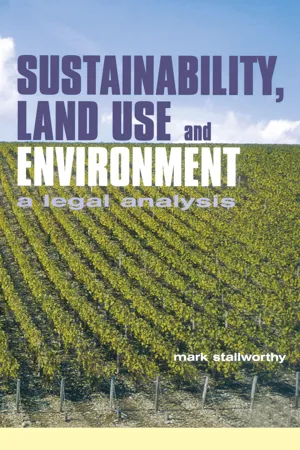
This book focuses on land use, a topic at the heart of attempts to find sustainable solutions. It will be invaluable to practitioners and students of environmental law.
- 412 pages
- English
- ePUB (mobile friendly)
- Available on iOS & Android
eBook - ePub
Sustainability Land Use and the Environment
About this book
Information
Publisher
Routledge-CavendishYear
2013Print ISBN
9781859416471
9781138153523
Edition
1eBook ISBN
9781135339371
Chapter 1

The Nature of Sustainable Development
The next case was that of a youth barely arrived at man’s estate, who was charged with having been swindled out of large property by his guardian, who was also one of his nearest relations. ... The lad, who was undefended, pleaded that he was young, inexperienced, greatly in awe of his guardian, and without independent professional advice. ‘Young man,’ said the judge sternly, ‘do not talk nonsense. People have no right to be young, inexperienced, greatly in awe of their guardians, and without independent professional advice. If by such indiscretions they outrage the moral sense of their friends, they must expect to suffer accordingly.’1
1 Problems of Definition
Sustainability should be distinguished from sustainable development. Sustainability is about respecting the processes at work in our ecosystem so as to ensure, or at least prolong, our survival as a species, and concerns our level of connectedness with future generations. Sustainability from this perspective bears close similarity with a ‘principle of integrity’,2 which has been described as starting ‘with the fundamental need for ecological and biological integrity and raises questions about what it would mean to institutionalize this primacy’.3 Both ideas are necessarily tied to the precautionary principle, which is discussed in the next chapter.4 By contrast sustainable development is about pragmatics, or ways in which we can organise ourselves politically, whether upon local, regional, national or global levels, so as to engage in habits of living which respect sustainability. The distinction has recently been most eloquently put by Porritt. The former he sees as neither elusive nor soft, but ‘just about as hard-edged, uncompromising, quantifiable and scientifically rigorous a concept as exists in the indeterminate world of contemporary policy making’. In contrast, sustainable development is ‘a process, not a scientifically definable capacity; it describes the journey we must undertake to arrive at the destination, which is of course sustainability itself; it is essentially driven by political and economic processes, not by science and empirical data; and it can be defined in such a way as to mean almost anything that anybody wants it to mean, which sustainability cannot’.5
To a marked degree, therefore, sustainable development is politically the less discomfiting notion. For its essence lies not in any non-tradability, but in those compensatory mechanisms that serve to support our social and economic systems. It is the purpose of this opening section to explore ways in which such accommodations can be reached and the priorities that should be applied within those processes.
1.1 ‘Sustainable Development’ as a Framework for Debate
It can at least be said that sustainable development is likely to inform law making across a vast range of human activities in our new century. In seeking to understand the notion, a justifiable starting point is the Brundtland Report in 1987.6 The report established the imperative of sustainable development, which it proceeded to define as follows: ‘development that meets the needs of the present generation without compromising the abilities of future generations to meet their own needs.’7 Yet, as relatively new concepts go, ‘sustainable development’ has probably been defined to death. Macnaghten and Urry offer a fair approximation, in that such definitions ‘share the underlying belief that economic and social change is only sustainable and thereby beneficial in the long term when it safeguards the natural resources on which all development depends’.8 Such a view reflects a multipurpose application, for all shades of green argument, countering root causes of non-sustainability, which O’Riordan has identified as ‘profoundly powerful systems of exploitation and degradation that are fostered by ignorance, greed, injustice and oppression’.9
The nature of the term is that it is uncertain. A universal definition is perhaps impossible, given the contradictions and variations in localised responses, for, after all, human activity reflects culture and history, as well as the geography of territory and institutions.10 Its essential vagueness is indeed problematic. The Brundtland definition referred to above has been described by Heal as ‘eloquent’ though ‘very thin on operational content’.11 Cullingworth and Nadin, in a land use planning context, see it as so overworked ‘that it has ceased to have any communicable meaning’, though they appear at least to divine ‘a broad political commitment to the idea of sustainability, even if there is no general agreement on what it means’.12
The evident level of broad acceptability suggests a tendency for implicit endorsement of a ‘business as usual’ approach.13 O’Riordan, elaborating upon an earlier argument to the effect that it could be seen as ‘a mediating term to bridge the widening gulf between “developers” and “environmentalists” ... deliberately vague and inherently self-contradictory’, detects in the concept a staying power at once ‘understandable, if not forgivable’.14 There is little doubt that its potential for mixing cliché and blandness is attractive to politicians and administrators.15 Pallemaerts refers to an ‘artful vagueness’ afforded by the concept to their responsibilities, illustrated by a tendency to regress to what he terms sustainable growth.16 UK land use planning policy guidance offers a flavour of this in the following explanation: ‘Sustainable development seeks to deliver the objective of achieving, now and in the future, economic development to secure higher living standards while protecting and enhancing the environment.’17 The term’s very fungibility can therefore support self-justificatory assertions on the part of development interests. In an analysis concerned with native peoples and their sustainable resource systems, Gedicks states that ‘the cutting edge of this concept has been dulled as practically every major institution in the world economy – from multinational mining and logging companies to the World Bank – has embraced the concept. Even the International Atomic Agency claimed that “the supply of energy for economic growth in a sustainable and environmentally acceptable manner is the central activity of the Agency’s programme’”.18
However, a search for a precise meaning is perhaps unnecessary. Jacobs has, for instance, argued that the attempt is misguided, as ‘resting on a mistaken view of the nature and function of political concepts’.19 The idea underlying such argument is that sustainable development can operate adequately as a normative though contestable concept. Thus in the circumstances of doubt as to its impact upon an ontological level, or in accordance with rights-based approaches, its value can be said to lie in encouraging argument at least broadly within its boundaries: ‘resolution by reconciliation’.20 There remains an assumption that accepted core ideas are otherwise open to dispute, and that such ‘contestation constitutes the political struggle over the direction of social and economic development’.21 Macnaghten and Urry urge a similar benefit, in that sustainability has become the new discourse, which frames the formal environmental agenda, creating in the process a common language as between environmentalists, administrators and business. On this basis it might be considered an advantage that environmental rhetoric is no longer solely the preserve of environmental groups, as corporations ‘routinely advocate sustainable development, as do aid agencies, government departments, the European Union and even insurance firms’.22 In this way sustainable development is said to be concerned with how economic growth is secured, and removing the linkage of ‘materials/energy throughput’ not only from pollution but also from growth.23 It has even been argued that despite the contribution of markets to environmental damage, ‘this poor record is not intrinsic on its merits’ and that ‘markets can be reoriented in a positive direction’.24 Indeed, solutions increasingly look to self-regulation, or at least regulation supported by market-based systems, such as fiscal mechanisms or emissions trading.25
On this basis, the introduction of a level of environmental consciousness has arguably changed the terms of debate. It is necessary to bring arguments within a sustainability framework in inclusive ways that appear to have been beyond the capacities of traditional regulatory mechanisms.26 A dialectic has emerged, so that ‘most of the emphasis is on reconceptualizing, on devising new ways of thinking (although largely from established disciplinary bases) and the details of new practice are often left to be worked out in more precise contexts, such as pollution control. The sustainable development discourse remains first and foremost a new concept aimed at altering ways of thinking’.27 An optimistic view of more radical arguments is that they can offer ‘a comprehensive set of values and objectives, an analysis of the operation of the political economy, and a strategy for political change’.28 A perhaps more realistic view of sustainable development is that for all its apparent staying power, ‘no-one can properly put it into operation, let alone define what a sustainable society would look like in terms of political democracy, social structure, norms, economic activity, settlement geography, transport, agriculture, energy use and international relations’29
Calls to counter a charge of calculated vagueness, and to add substance to what is meant by sustainable development, therefore include ‘better articulation of the terms, concepts, analytical methods and policy-making principles’.30 This poses a considerable task for policy makers, admin...
Table of contents
- Cover
- Half Title
- Title Page
- Copyright
- Dedication
- Contents
- Preface
- Table of Cases
- Table of Statutes
- Table of Statutory Instruments
- Table of International Legislation
- Introduction
- 1 The Nature of Sustainable Development
- 2 Sustainability and Legal Principle
- 3 Regulation and Private Property
- 4 The Remit of English Land Use Planning Law
- 5 Environmental Impact Assessment
- 6 Seeking a Sustainable Framework for Land Use Planning
- 7 The Relationship Between Separate Regulatory Regimes
- 8 Environmental Protection and Scientific Uncertainty
- 9 Human Rights and the Environment
- 10 Sustainability, Law and Democratic Politics
- 11 Afterword
- Bibliography
- Index
Trusted by 375,005 students
Access to over 1.5 million titles for a fair monthly price.
Study more efficiently using our study tools.
Frequently asked questions
Yes, you can cancel anytime from the Subscription tab in your account settings on the Perlego website. Your subscription will stay active until the end of your current billing period. Learn how to cancel your subscription
No, books cannot be downloaded as external files, such as PDFs, for use outside of Perlego. However, you can download books within the Perlego app for offline reading on mobile or tablet. Learn how to download books offline
Perlego offers two plans: Essential and Complete
- Essential is ideal for learners and professionals who enjoy exploring a wide range of subjects. Access the Essential Library with 800,000+ trusted titles and best-sellers across business, personal growth, and the humanities. Includes unlimited reading time and Standard Read Aloud voice.
- Complete: Perfect for advanced learners and researchers needing full, unrestricted access. Unlock 1.5M+ books across hundreds of subjects, including academic and specialized titles. The Complete Plan also includes advanced features like Premium Read Aloud and Research Assistant.
We are an online textbook subscription service, where you can get access to an entire online library for less than the price of a single book per month. With over 1.5 million books across 990+ topics, we’ve got you covered! Learn about our mission
Look out for the read-aloud symbol on your next book to see if you can listen to it. The read-aloud tool reads text aloud for you, highlighting the text as it is being read. You can pause it, speed it up and slow it down. Learn more about Read Aloud
Yes! You can use the Perlego app on both iOS and Android devices to read anytime, anywhere — even offline. Perfect for commutes or when you’re on the go.
Please note we cannot support devices running on iOS 13 and Android 7 or earlier. Learn more about using the app
Please note we cannot support devices running on iOS 13 and Android 7 or earlier. Learn more about using the app
Yes, you can access Sustainability Land Use and the Environment by Mark Stallworthy in PDF and/or ePUB format, as well as other popular books in Law & Environmental Law. We have over 1.5 million books available in our catalogue for you to explore.